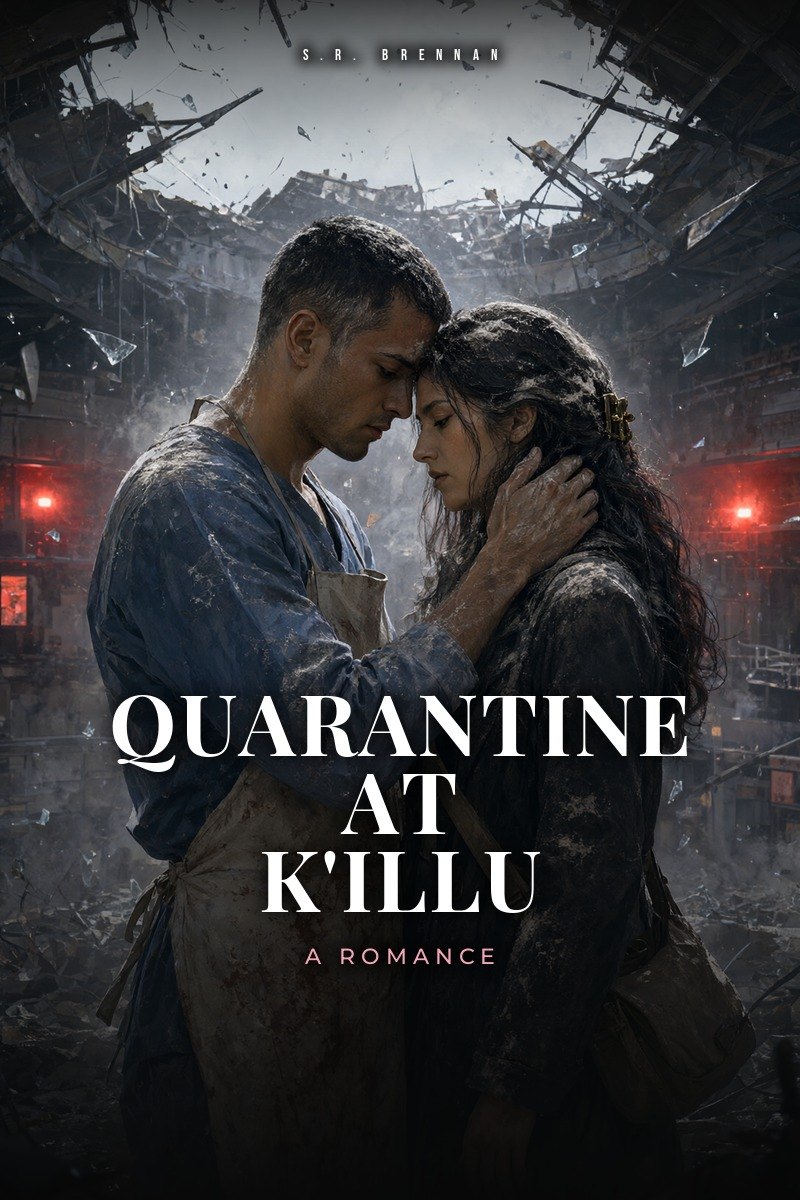
Chapter 8
"Step away from the console, Sisaqa," Ch'aska said.
Her tone had the manicured chill of a board memo.
The pneumatic rifle rested against her silk lapel. The heavy polymer stock was braced against her ribs, the muzzle fixed on Sisaqa's collarbone.
Behind her, the red LED matrix on the atmospheric terminal pulsed in the dim executive suite.
00:43.
I wanted that rifle pointed at my sternum instead of hers. I shifted half an inch to the left. The rubber lug of my boot dragged across the plush executive wool carpet. The wool felt absurdly soft after six flights of greasy hoistway cables and pulverized drywall.
"You don't want to fire that dart, Administrator," I said.
"Try me, Doctor."
Her knuckles were bloodless against the textured grip. Forty-two seconds. Forty-two seconds before the Qhari sub-level compressors drained the remaining ambient oxygen to keep Ch'aska's executive air scrubbers pressurized.
Sisaqa stood two paces to my right.
She did not flinch. She kept her chin high, but her left thumb twitched against the outer seam of her trousers. That was her tell. She did that when she was calculating collateral damage and running out of arithmetic.
"The municipal rotor is not landing on your roof," Sisaqa said.
Her voice stayed level, cutting through the low whine of the ceiling blowers.
"The seismic shear cracked the landing pad struts twenty minutes ago," she continued. "You are hoarding nitrogen for an evacuation flight that is never coming."
"Rumiq," Ch'aska barked without taking her eyes off us. "Disarm them."
Rumiq remained motionless on the threshold behind us.
The security chief had a thick streak of graphite soot across his jaw and three broken door welds at his back. He looked at Ch'aska's immaculate cream scarf. Then he looked down at my blistered, blackened hands.
He stayed where he stood.
"Rumiq is doing the math," I said.
I kept my pitch flat. It was the tone I used in Trauma One when a junior resident froze during an arterial blowout.
"He knows what happens to an executive redoubt when the lower wards figure out who shut off their vents," I added.
00:36.
Ch'aska's chin jerked upward. "You think you can bully me with hospital charter bylaws? You are a disgraced surgeon and an expelled advocate. You possess zero authority in this sector."
"We do not need authority," I said. "We have the schematic."
I swung my trauma kit off my right shoulder.
I let the heavy nylon pack hit the tempered glass conference table. The impact produced a sharp, echoing crack across the soundproofed walls. The sound made Ch'aska's shoulder flinch.
Her barrel swung four inches to the right. Directly onto my chest.
Good.
"Keep your hands visible, Pomaq," she snapped.
"Standard procedure," I said.
I unzipped the main flap with my left hand.
My palms burned like raw meat from the hoistway descent. The rope friction had peeled through the epidermis across both palms, leaving weeping crimson patches. Pain had a function. Pain kept my resting pulse under seventy-five.
Inside the pack sat two liters of normal saline, three sterile ten-gauge trocars, and the portable biphasic defibrillator unit I had taken from the third-floor cardiac annex.
00:29.
"Step back from that table," Ch'aska ordered.
"I am complying," I said. "Reaching for my badge."
I did not reach for plastic.
My fingers found the two adhesive defibrillator electrode pads in the mesh side pocket. I hooked the heavy lead wires with my pinky. With my thumb, I toggled the unit's manual override switch on the lower casing.
The internal capacitor began to whine.
It was a thin, rising hum. The thrum of the ceiling intake louvers masked the sound.
Sisaqa heard it.
She did not glance at my hands. Her gaze flicked instantly to the master console's optical interface housing mounted beneath the mahogany desk lip. She understood within half a second.
Three years apart, and she still read my hands before I finished moving them.
My chest tightened. It was the familiar, dangerous ache I had spent thirty-six months burying under hospital grievance paperwork.
"Administrator," Sisaqa said, taking a deliberate step forward.
"Stay where you are!" Ch'aska shouted. The rifle barrel wavered between us.
"The dual-biometric lockout requires two active attending credentials," Sisaqa said, speaking fast and clean. "You have your clearance. Pomaq still holds his senior surgical clearance in the central database. Let him scan."
"He was stripped of his administrative token three years ago," Ch'aska sneered.
00:21.
"The local hardware registry has not updated since the primary server collapsed," Sisaqa pressed. "Scan his thumb, Ch'aska. Abort the purge, and we walk out."
Ch'aska let out a harsh laugh. "You think I survived twenty years in municipal administration by trusting a union saboteur?"
"I am not asking you to trust him," Sisaqa said. "Look at the timer."
00:15.
Ch'aska's glance flicked toward the red digits.
Just for a fraction of a second.
That was the opening.
I seized the saline bag with my teeth. I ripped the delivery port open and dumped three hundred milliliters of conductive salt solution across the glass table, flooding straight into the open diagnostics hatch beneath the primary screen.
"Pomaq!" Ch'aska screamed.
She pulled the trigger.
The pneumatic valve hissed. A carbon-fiber dart struck the nylon strap of my trauma pack, tearing through webbing and grazing the muscle above my left clavicle. The paralytic agent burned like hot lye. The thick shoulder strap took the blunt force of the projectile.
I did not pause.
I slammed both defibrillator paddles into the flooded diagnostic housing. With my right hand, I drove a ten-gauge stainless steel trocar straight through the optical relay bus bar, bridging the master circuit directly into the auxiliary high-voltage rail.
"Clear!" I roared.
Sisaqa did not hesitate. She lunged across the desk, grabbing the red manual abort lever with both hands.
I pressed the orange discharge buttons with both thumbs.
Three hundred and sixty joules of direct electrical current tore through the saline puddle.
A blinding blue arc exploded across the glass table. The smell of scorched ozone and vaporized copper filled the room. The master terminal screen turned brilliant white, then fractured into jagged static lines as the surge blew the biometric gate fuses into hardware fail-safe mode.
00:04.
00:03.
The digital console emitted an unbroken alarm tone. The glass screen flickered violently, resetting its logic gate as the blown relay defaulted to municipal emergency fire protocol.
PURGE OVERRIDE: MANUAL FAIL-SAFE ENGAGED.
00:00.
A deep hydraulic shudder vibrated through the floor plates.
High above in the ceiling plenum, the massive steel intake louvers slammed open with a metallic crash.
A wave of cold, unpressurized basement air hissed through the ventilation grates.
On the secondary telemetry screen, the red warning bar over the Qhari Intensive Care Ward blinked once, twice, and stabilized into solid green.
O2 SATURATION RESTORED: SECTOR 2 SUB-LEVELS.
The pressure in my ears equalized.
Sisaqa remained bent over the console. Her fingers were white where they gripped the metal lever. Her dark hair clung in damp strands to her forehead, streaked with graphite grease from our climb up the shaft.
She stared at the green readout.
"She has air," Sisaqa whispered.
The words barely cleared her lips.
"She has air," I said.
My voice came out raspy. The paralytic burn in my shoulder was throbbing, sending a dull numbness spreading along my neck, but the needle had missed the jugular. I reached up, gripped the plastic shaft of the dart, and wrenched it free from my shoulder strap. I dropped it onto the wet carpet.
Across the shattered desk, Ch'aska stood motionless.
The rifle dangled from her right hand. The diagnostic terminal before her was a smoking crater of melted resin and charred wiring.
"Do you comprehend what you have done?" Ch'aska asked.
Her crisp composure was gone. Her voice shook with cold rage.
"The fail-safe did not merely open the Qhari vents," she said. "It disengaged the master electromagnetic locks across every sector in this facility."
I wiped a streak of copper soot from my forehead with my sleeve. "Good."
"You arrogant fool," she spat. "Level Four is open. The containment wards are open. Every desperate person trapped between the sub-basement and Level Nine is moving toward the central shafts."
"Then they have a route to survive," Sisaqa said.
She released the lever.
When she straightened up, the exhaustion in her frame seemed to vanish. The guarded hunch she had carried since Ward B was gone. Her shoulders were square, her jaw locked with that terrifying, stubborn focus that had drawn me to her five years ago in the residency clinic.
She turned toward me.
Her dark eyes scanned my shredded scrub shirt, the raw burns on my palms, and the dark spot of blood soaking through the fabric near my collarbone.
"You took a hit," she said.
"A scratch," I lied.
"Sit down, Pomaq."
"I am fine, Sisaqa."
"Sit down before the paralytic hits your vagus nerve and I have to carry two hundred pounds of stubborn surgeon down six flights of stairs."
I did not argue.
My left knee buckled half an inch, warning me that the neurotoxin was circulating. I dragged one of Ch'aska's ergonomic leather armchairs backward and dropped into it. The executive leather felt ridiculous against my grease-caked spine.
Sisaqa dropped to her knees beside my chair.
She pulled my trauma kit closer, unzipping the sterile supply compartment. She extracted a vial of atropine, a sterile syringe, and a roll of heavy cotton gauze.
Her fingers worked with rapid, familiar efficiency.
Up close, she smelled like industrial lubricant, crushed sheetrock, and the carbolic soap from the Ward B washbasins. It was the only clean scent in this entire gilded office.
"You shorted a high-voltage terminal with a trocar," she murmured, swabbing the puncture near my clavicle with antiseptic.
"The trocar was sterile," I said.
She made a sound that was half a cough and half a laugh. "You are completely reckless."
"You gave the prompt."
"I told you to scan your thumb."
"My thumb had no administrative rights," I said, watching the steady dip of her lashes as she drew the atropine into the barrel. "Your negotiation had an incurable flaw. I corrected it."
"I despise your corrections."
"I know."
She inserted the needle into the deltoid muscle with a quick, practiced flick. She pushed the plunger smoothly. The cold sting of the antidote chased the burning numbness out of my neck.
"Hold the gauze," she commanded.
I pressed my thumb against the pad.
Her fingers lingered against my skin for a fraction of a second before she pulled back. Her hands were ice cold, trembling from the adrenaline drop.
I reached out and caught her wrist.
She froze.
Her pulse thumped hard against my calloused fingertips. Fast and steady.
"Misk'illa is alive," I said quietly. "We bought her time."
Sisaqa looked down at where my fingers circled her wrist. She did not pull away.
For three years, every interaction between us had been a catalog of grievances, broken promises, and professional ruin. We had built a barricade of silence and formal memos between us, thick as the hospital fire doors.
Sitting in this wrecked office, surrounded by smoke and ozone, that barricade was gone.
"We are still on the twelfth floor," she said, her voice dropping lower.
"We have the stairs."
"There are six unlocked wards full of panic between here and Qhari," she whispered. "Ch'aska was not wrong about the chaos. The stairwells will be impossible."
"We will clear them," I said.
Behind us, the heavy mahogany double doors swung inward.
Security Chief Rumiq stepped into the office. His sidearm was secure in its holster, his hands resting loose at his sides. He glanced at Ch'aska, who stood silent against the credenza, then turned his gaze to us.
"The central hoistway is jammed," Rumiq said. "Survivors from Level Seven breached the service ladder two minutes ago. If you try to climb down the main shaft, you will be crushed by the crowd."
He reached into his chest rig and withdrew a heavy brass key ring holding two oversized tubular keys. He tossed them onto the table beside the melted console.
"South service hoist," Rumiq said. "Independent freight car. Manual brake control on the utility landing. It drops straight into the sub-basement laundry corridor without touching the ward corridors."
Sisaqa looked up from my chair. "Why give this to us?"
Rumiq rubbed his thumb over the soot on his chin. "My younger sister is an orderly in the neonatal wing on Level Three. You opened the ventilation louvers. She can breathe."
He turned on his heel and walked out, his heavy boots sounding down the marble corridor.
Sisaqa picked up the brass keys. The metal jingled softly in her grip.
She looked down at me and held out her hand.
I gripped her palm. She braced her feet and hauled me upward out of the deep leather chair. The atropine had blunted the paralytic edge, leaving my limbs steady and responsive.
"Ready, Doctor?" she asked.
I hitched the trauma kit over my uninjured shoulder.
"Lead the way, Advocate."

Comments
Loading comments…