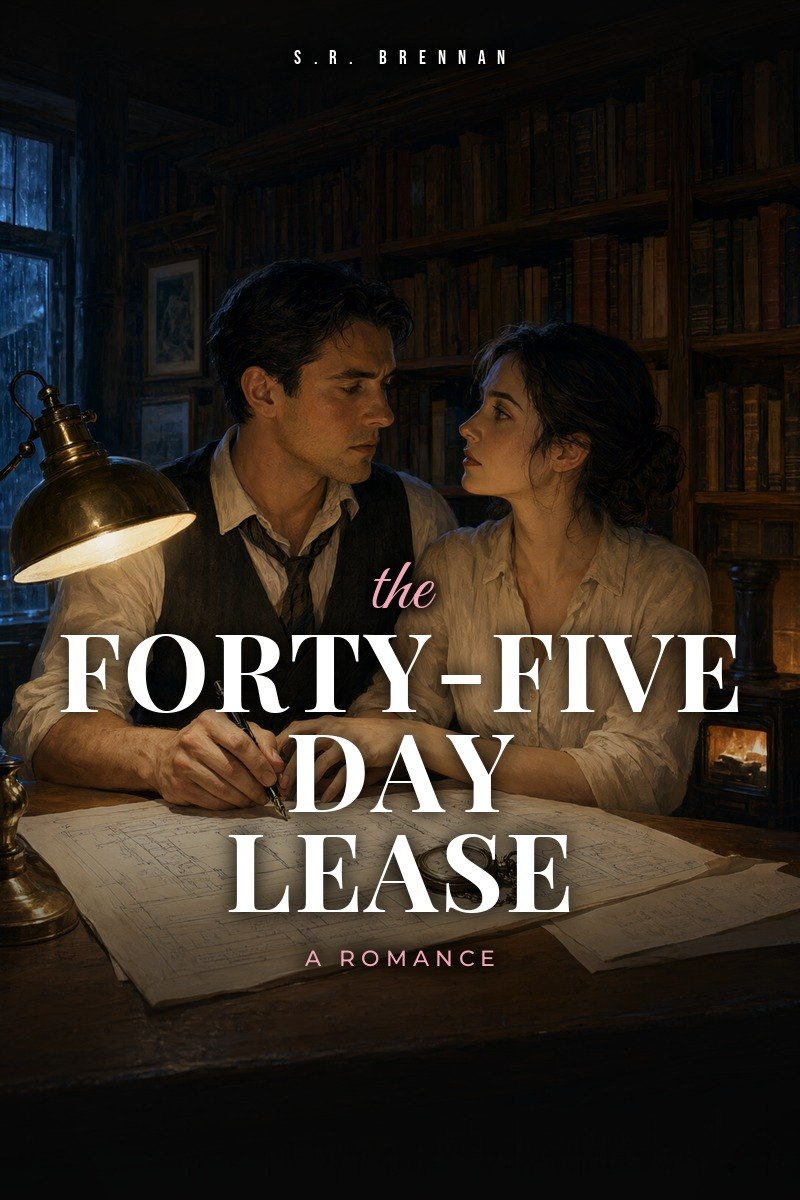
Chapter 7
"Clause nineteen is a trap," Isla said.
She didn't look up from the oak counter. Her left index finger pinned the corner of the vellum sheet, right over my third revision of the St. Jude deed. A red grease pencil sat between her knuckles.
I checked my watch.
Two seventeen in the morning. Twenty-four days left on the Frankfurt mezzanine loan. Six hours and forty-three minutes until Treasa Conroy walked into my Merrion Square office with a default order.
"Clause nineteen is standard commercial indemnity," I said. My voice sounded like gravel scraped across iron. "It protects the developer against third-party utility claims."
"It protects MacAoidh Urban Holdings," she corrected. Her pencil slashed a neat crimson line through four lines of my legal counsel's finest Latinate syntax. "If Moira Creggan takes your equity in receivership, this clause lets her assign the maintenance costs of the glass roof back to the ground tenant. That's me."
She finally raised her chin.
Her gray eyes were completely clear. Since I brought the initial drawings through her door on Monday night, we had spent forty-eight hours dismantling municipal codes, and she had spent the last six hours tonight auditing every line of this final execution draft under a single gooseneck lamp. Her posture hadn't slipped an inch. A streak of black bookbinding ink stained the crook of her left thumb.
My chest tightened.
"I drafted that clause at four this afternoon," I said. "Eoghan didn't even catch the assignment loophole."
"Eoghan thinks in court orders and brute force," she said, leaning back against the cedar shelving. "He doesn't read subclauses like a translator."
"And how does a translator read them?"
"Like threats disguised as manners."
She wasn't wrong.
I took the grease pencil from her hand. Her skin was warm, cool-edged from the draft coming off the front door. The brief contact sent a hard, sharp jolt straight down my collarbone. I pulled back before my fingers could linger.
"Give me the drafting pad," I said.
She slid the heavy yellow ledger toward me.
My right hand felt stiff. The deep ache in the muscle between my thumb and forefinger had started around midnight, a dull, pulsing heat that meant the nerve conduction was fraying under exhaustion. I gripped the pen harder, forcing the nib against the paper.
"We replace Clause nineteen with a reciprocal covenant under Section 47 of the Heritage Act," I said, writing as the equations formed in my head. "MacAoidh Urban Holdings warrants structural maintenance in perpetuity. If the developer defaults, the roof maintenance obligation transfers to the municipal heritage trust, not the leaseholder. Zero assignment. Zero liability on Plot 4."
She watched the tip of my pen. "Can you bind your mezzanine lenders to a municipal trust covenant without their sign-off?"
"Under Section 47, heritage covenants attach to the freehold title, not the corporate entity," I said. I didn't stop writing. "Moira can foreclose on my holding company, but she cannot strip an executed planning covenant registered with the High Court. If she touches this building, she violates statutory planning law."
Isla tilted her head. She looked at the fresh lines of ink, then at my face.
"You're stripping the profit out of your own development," she said softly.
"I'm keeping the site alive."
"You're giving me an absolute veto over the atrium envelope."
"I am."
"Why?"
The word hung between us in the cold, quiet shop. Outside on Pearse Street, a night bus rumbled past, rattling the leaded glass above the entrance.
"Because you have Schedule G in that cardboard folder," I said, nodding toward the red archive file resting beside her elbow. "And because Revision H only works if Clannad Books stays where it was built."
She didn't buy it. I could hear it in the way she drew breath—slow, measured, weighing every syllable I hadn't said. Isla Ní hAonghais didn't just listen to words; she dismantled them.
"You're a terrible liar, Lorcán."
"I'm an executive," I said, capping the pen. "We call it risk management."
"No," she said. She reached across the blueprints, tapped the structural load calculations I had scribbled along the margin of the elevation sheet. "A developer managing risk gives me a five-year lease and a cash settlement, then waits for me to die of old age. You stayed up three nights running to calculate inverted steel cantilevers for a nineteenth-century timber frame."
Her finger traced the load diagram.
"Three cantilevers," she murmured. "Twelve metric tons of structural steel anchored to the rear bedrock, taking the dead weight off my basement arches. You memorized the shear modulus of Baltic pine."
"I read Cormac's blueprints."
"Cormac's blueprints are eighty pages of hand-drawn Victorian notation." She looked up, her gaze pinning mine. "You didn't just read them. You recalculated the bending moment for every joist under the main room."
My throat went dry.
Having her look at me like that was dangerous. It was like standing in front of a building inspector who knew exactly which brick was hollow.
"If the cantilevers fail," I said, keeping my tone flat, "the glass canopy cracks. If the canopy cracks, my mezzanine interest jumps to eighteen percent. I like my numbers clean."
"Your numbers are insane," she countered. "And you're running out of time."
She reached for the countdown calendar pinned behind the cash register. With a black marker, she drew a single, heavy diagonal stroke through Wednesday.
Day 28.
The bold red numeral stared back at us.
Twenty-four days until Frankfurt pulled the loan. Twenty-four days until my father's remaining shares vanished into insolvency.
And five hours until Conroy demanded proof of site control.
"We have to execute the lease rider before six," I said. "The courier needs the stamped deeds at City Hall by eight sharp."
"Then show me the load transfer on the party wall," she said, pulling a fresh technical schedule from the stack. "The chimney flue for Bríd's bakery. If the new venting creates back-pressure, the city will revoke her health permit anyway."
I reached for the grease pencil to sketch the secondary baffle layout.
My right hand didn't move.
The muscle locked. A violent, rhythmic spasm seized my forearm, jerking my wrist inward. The pen slipped from my grip, clattering across the oak boards and rolling off the edge of the counter.
I grabbed my right wrist with my left hand, shoving it down against my thigh.
Not now.
Not in front of her.
The tremor rippled through the tendon, stubborn and ugly, shaking my entire shoulder. Pain flared behind my collarbone, hot and sharp. I pressed my knuckles into the wood, leaning my weight over the desk to pin the arm still.
Isla didn't scream. She didn't gasp.
She stood up from her stool.
The silence in the bookshop became absolute. The only sound was my own ragged breathing and the ticking of the antique clock behind the history stacks.
She walked around the counter. Her boots made no sound on the floorboards.
She picked up the fountain pen from the floor. Then she set it on the ledger, right next to the brass lamp. She reached into her wool cardigan pocket, pulled out a small glass of water from the back counter, and set it within my reach.
She didn't touch me. She didn't look away either.
"How long?" she asked.
The question was quiet. No pity. No triumph. Just the razor-edged directness that had terrorized Eoghan all week.
"It's muscle fatigue," I lied, my jaw aching from the strain of holding my arm against the timber. "I've been on a drafting table for seventy hours."
"Lorcán."
Her voice dropped an octave. It was the same tone she used when she caught a false clause in a property contract.
"I saw the tremor on Friday morning," she said. "I saw the silver box in your pocket. And I saw you check your watch every twelve seconds while you were threatening to tear down my wall."
I closed my eyes.
The shame of it hit me like a blow to the ribs. I had spent six years building a reputation across Dublin as the man who never flinched, the developer who could stare down municipal boards and German mezzanine syndicates without blinking.
And here I was, pinned against a counter in a dusty bookstore by a woman who could hear the cracks in my ribs before I even spoke.
"Motor neuropathy," I said. The words tasted like ash. "Degenerative. Conduction velocity in the ulnar nerve is down forty percent."
She stayed motionless. "How long do you have?"
"Before I lose the hand entirely?" I let out a short, rough breath. "Six months. Maybe eight, if the therapy holds. After that, fine motor control is gone. I won't be able to sign a deed, let alone draft a structural calculation."
Isla looked at my right hand, still trembling slightly against the dark wool of my trousers.
"That's why the lease had to be forty-five days," she said. Her voice wasn't an accusation anymore. It was a realization. "That's why you couldn't grant an extension. You weren't rushing to beat the bank. You were rushing to beat yourself."
"Both," I said, finally lifting my head. "The Frankfurt mezzanine facility carries a personal guarantee. If St. Jude fails, my father's creditors take the family trust. My sister loses her medical care. My mother loses the house in Dalkey. And I spend the rest of my functional life in bankruptcy court."
I looked straight into her eyes.
"So yes, Isla. I needed your shop. I needed the land, I needed the permits, and I needed them before my hand stopped working. You wanted leverage? There it is. Take it to Moira Creggan. She'll buy you out by noon just to watch me bleed."
The words tore out of me, stripped of polish, stripped of every corporate defense I had ever practiced.
I waited for the blow.
I waited for her to pick up the red folder and walk out into the cold Dublin rain. She had every right to. I had marched into her sanctuary with an eviction notice and a wrecking crew. I had tried to squeeze her out of the only home she had left.
Instead, Isla reached out.
Her fingers were cool and steady as they closed over my right wrist.
She didn't squeeze. She just held it, pressing her thumb firmly against the inner tendon near the joint, right where the nerve cluster pulsed.
The warmth of her skin cut through the burning ache in my arm. My breath hitched in my chest.
"I'm not going to Moira," she said.
My heart thudded against my ribs, hard and uneven. "Why?"
"Because Moira Creggan would tear this place down and put up a parking garage," Isla said, her eyes locked on mine. "And because she doesn't know the difference between Baltic pine and plywood."
She paused. Her thumb moved slightly, easing the knot in my wrist.
"And because you built three cantilevers to save my roof," she added.
Her touch was undoing me faster than the fatigue. I could smell the cedar wood on her, the bitter tea, the faint citrus scent of the bookbinding paste on her sweater. She was standing inches from me, close enough that I could see the golden flecks in the gray of her irises.
I wanted to pull her closer.
The thought came out of nowhere, fierce and irrational. I wanted to drag her against my chest and forget about Frankfurt, forget about the mezzanine loan, forget about the six months ticking away in my marrow.
I didn't move.
Restraint was the only currency I had left. If I crossed that line, I became the man taking advantage of her mercy.
"Isla," I murmured.
"Sit down, Lorcán," she said softly.
She didn't let go of my wrist until I pulled the wooden drafting stool out and sat.
She picked up the silver pillbox from where I had set it beside my coat. She opened the latch, popped two of the small white tablets into her palm, and held them out to me with the water glass.
I took them. I swallowed them without a word.
She pulled the legal parchment toward herself, uncapped her red grease pencil, and set it down. In its place, she picked up my heavy black fountain pen.
"Read me the execution clauses," she said.
"Isla—"
"Read them," she repeated, her voice brisk, snapping back into that razor-sharp professional cadence that made my chest ache with admiration. "We have four hours before the couriers wake up. If we're going to tie Moira Creggan's hands in the High Court, this contract needs to be bulletproof."
I looked at her sitting across the desk.
She had the certified fraud evidence in her folder—the document that could have sent me to prison for false tenancy warranties. She had the upper hand in every legal, financial, and moral dimension of this war.
And she was sitting under a brass lamp at three in the morning, drafting my salvation.
"Section four," I said, leaning forward. "The lease term."
"Ninety-nine years," she said, her handwriting clean, elegant, and perfectly upright on the heavy paper. "Nominal rent of one euro per annum, payable on the feast of St. Jude."
"Clause five," I continued, watching her fingers guide the nib. "Permitted use. Retail antiquarian book trade, literary translation archive, and community cultural facility. No commercial conversion without unanimous consent of the leaseholder."
"Clause six," she said, glancing up. "The bakery flue."
"Dedicated ventilation shaft running through the central atrium core," I recited from memory. "Fully insulated, acoustic baffling rated to municipal standard 14-B. Construction and maintenance fully indemnified by MacAoidh Urban Holdings."
She wrote every word without hesitation. Her penmanship was steady, unyielding, carving our new reality into the grain of the parchment.
By three forty-five, the document was complete.
Four pages of dense, unassailable legal covenants, backed by Revision H's architectural drawings. A permanent shield around Clannad Books, built out of my company's steel and her uncompromising terms.
She turned the last page around so it faced me.
At the bottom of the sheet were two signature blocks.
Isla Ní hAonghais, Leaseholder.
Lorcán MacAoidh, Managing Director, MacAoidh Urban Holdings DAC.
Isla took the pen, pressed the nib to the line above her name, and signed with a single, sweeping flourish. The black ink shone wet under the lamp.
She offered the pen to me.
I looked down at my right hand.
The medication had kicked in, dulling the violent tremor into a faint, intermittent twitch, but the fine control was still shaky. My fingers felt numb, distant, like trying to manipulate steel wire through heavy leather gloves.
I reached out and took the pen.
I positioned the nib over the managing director's line.
My hand jerked. A tiny blot of ink splashed onto the margin.
A cold sweat broke across the back of my neck. My throat tightened. The humiliation surged back, bitter and suffocating. I couldn't even sign my own surrender.
Then Isla's hand came down over mine.
Her palm was warm, firm, and completely steady. She wrapped her fingers around my knuckles, closing the gap, pressing my shaking grip securely against the barrel of the pen.
She didn't say a word.
She didn't make an excuse.
She simply leaned in, her shoulder pressing lightly against mine, her breath brushing the side of my neck as she guided my hand down to the parchment.
Together, with her strength bracing my trembling fingers, we drew the first stroke.
L-o-r-c-á-n.
The ink flowed smooth and dark across the fiber.
M-a-c-A-o-i-d-h.
The final line ended with a sharp, decisive dot.
We stayed like that for several seconds.
Our hands joined over the wet signature. Her breathing was warm against my skin. I could feel the steady, rhythmic beat of her pulse through the palm resting over my knuckles.
I didn't pull away.
For the first time in six years, the relentless ticking in my head went quiet. The deadlines, the bank covenants, the cold fear of my failing body—all of it faded into the quiet warmth of her hand over mine.
I turned my head slightly.
Her face was inches from mine. Her eyes searched my features, dark and luminous in the amber lamplight. There was no pity in them. There was only something fierce, protective, and unmistakably real.
"We have a deal, Lorcán," she whispered.
"We have a deal," I said.
She slowly withdrew her hand. The sudden loss of her warmth left my skin feeling cold, but the ink on the paper was already drying.
She picked up the red cardboard folder containing Schedule G.
Without a word, she walked over to the cast-iron stove in the corner of the office. She opened the heavy door, revealing the glowing peat embers from yesterday's fire.
She held the certified copies above the heat.
"Isla," I called out, my voice tight. "That's your leverage. If you burn that, you have nothing to hold over me."
She looked back over her shoulder. The firelight carved the sharp, beautiful angles of her face against the darkness of the room.
"I don't need leverage over a partner," she said.
She dropped the folder into the embers.
The dry paper caught instantly. Blue and orange flames curled around the certified archive stamps, turning the fraudulent warranties and my darkest secret into curling gray ash in less than ten seconds.
She closed the iron door with a solid click.
The clock in the hall chimed four times.
Four in the morning.
Five hours until Treasa Conroy and Moira Creggan walked into my office expecting an easy execution.
I stood up from the stool. My legs felt grounded for the first time in weeks. The tremor in my right hand was still there, but my spine was straight.
"Get some sleep, Isla," I said, buttoning my coat with my left hand. "I'll pick you up at eight thirty."
She leaned against the counter, crossing her arms, a faint, wry glimmer touching the corners of her mouth.
"I don't sleep before a fight, MacAoidh."
"Neither do I."
I took the signed execution copies, zipped them into my leather folio, and walked to the front door.
As I turned the brass latch, I looked back at her standing under the warm circle of lamplight, surrounded by her ten thousand books.
"See you at dawn," I said.
She lifted her chin. "Don't be late."

Comments
Loading comments…