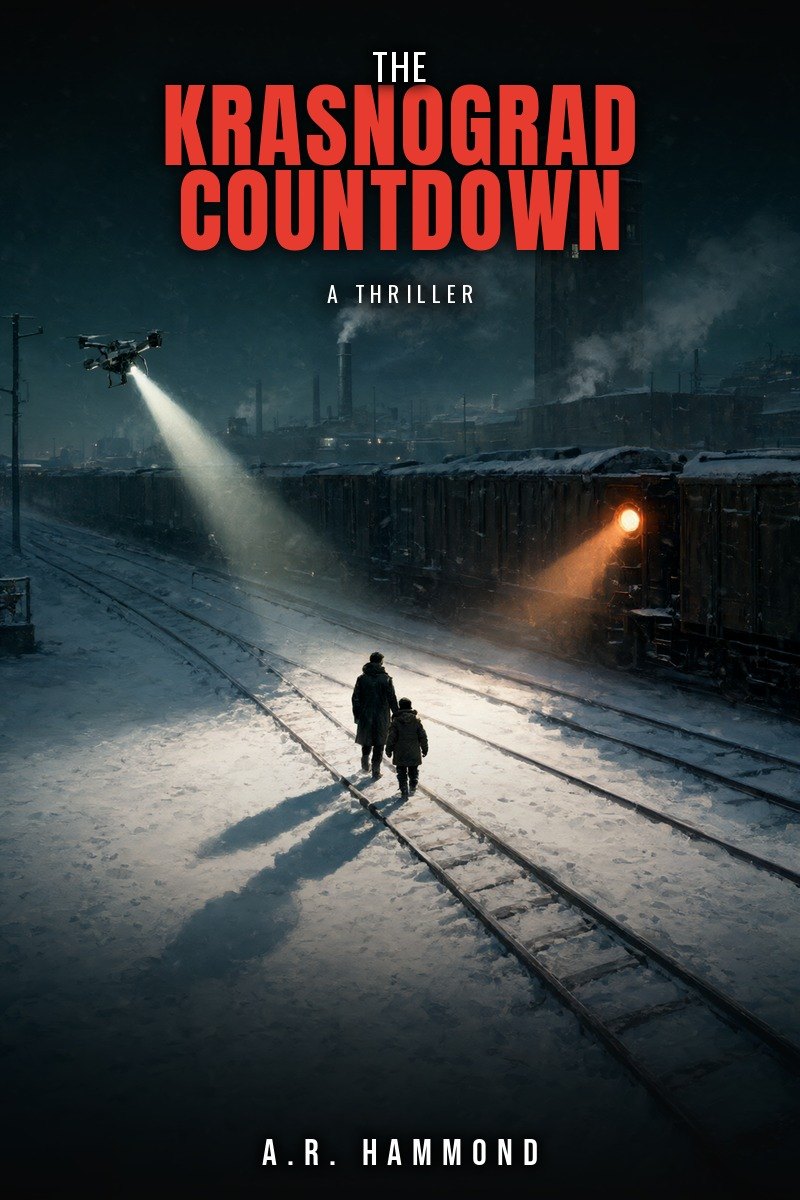
Chapter 8
T-Minus 65:30:00 | Krasnograd Central Rail Buffer
The iron rungs of the vertical maintenance shaft were coated in a quarter-inch glaze of black frost that peeled away in brittle, razor-edged scales under Viktor Volkov’s leather palms.
Twenty feet below them, the high-voltage bypass conduit was silent at last. Five tons of sheared steel gantry, shattered concrete masonry, and severed feeder cables held back the drowned bodies of Major Rostova’s lead acoustic sweep team, sealing the flooded culvert from floor to ceiling. Above, through the narrow slots of the cast-iron storm grate, Krasnograd’s surface blizzard screamed like an industrial turbine.
Volkov paused on the sixteenth rung, wedging his right boot heel firmly against a corroded anchor bolt to take the dead weight off his stitched quadriceps. The shrapnel wound from Junction 12 throbbed with a dull, rhythmic pulse through the field suture tape and compression bandage, but the muscle held.
He did not shove the iron storm grate open immediately. He pressed his ear against the frozen metal rim, closing his eyes to filter the howling gale into distinct acoustic frequencies.
The wind was blowing out of the northeast at thirty-five knots, driving dry, needle-fine snow across the open switching tracks. Above the hollow drumming of the gale against stationary freight cars and the shrill whistle of severed catenary wires, Volkov isolated another sound: the high-pitched, harmonic whine of shrouded carbon-fiber rotors.
"Viktor," Yevgeni whispered from four rungs down. His voice rattled violently against his jaw, the syllables hitching on every breath. The accountant’s lower wool trousers were soaked to the hips in freezing canal water, the fabric already hardening into rigid, frozen boards as sub-zero surface air drifted down the shaft. "My legs. I can't feel my heels against the iron. I'm slipping."
"Keep your weight on the balls of your feet," Volkov said, his voice flat, steady, and devoid of false comfort. "If your grip fails, you fall into the rubble pile and break an ankle. If you break an ankle, I leave you in the shaft."
"You wouldn't."
"Try it and find out." Volkov drew his tactical utility knife from its scabbard, working the hardened steel tip into the dense ring of packed ice sealing the perimeter of the grate. "We have three hundred yards of open railyard between this exit and the north ventilation well of Data-Hub 7. The surface air temperature is twenty-four below zero, before wind chill. In saturated wool, your body loses heat twenty-five times faster than in dry air. Your peripheral capillaries will shut down in four minutes. Your core temperature will hit lethal delirium in fourteen. You move when I move. You stop when I stop. If you freeze in place, you die in place."
Volkov cut the last ice bridge, seated the blade back in its sheath, and braced his shoulders against the underside of the heavy iron grating. He drove his legs upward in a single, controlled thrust.
The grate broke free with a muffled crunch of ice. The blizzard struck them immediately, driving a blinding vortex of frozen grit and powdered snow down into the shaft.
Volkov hauled himself over the concrete collar into a three-foot snowdrift, rolling instantly onto his chest behind the rusted steel bolster of a derailed freight flatcar. He reached down with one arm, seized the collar of Yevgeni's oversized down parka, and dragged the shivering accountant bodily up onto the frozen ballast. With his right boot, Volkov kicked the iron grate back into its recessed frame, letting the howling wind bury the seam under fresh drifts within seconds.
Krasnograd’s Central Rail Buffer stretched before them: a vast, desolate expanse of dead spur tracks, abandoned switch shanties, and frost-fractured concrete cable conduits. During peacetime, the buffer had served as the classification neck for the county's coal and grain freights. Now, under the seventy-two-hour quarantine lockdown, it was a fortified dead zone separating the civilian worker slums from the administrative core of the Directorate.
To the south, the crimson perimeter beacons of the industrial sector were entirely blotted out by the swirling whiteout. To the north, three hundred yards through the curtain of driven snow, the monolithic concrete silhouette of Data-Hub 7 rose like a fortress against the black horizon.
The facility had been erected forty years earlier as a municipal civil defense and emergency telecommunications bunker before the Directorate privatized the county's infrastructure and retrofitted its sub-levels into a high-security cryptographic repository. It had no exterior windows on its lower four stories. Its raw, blast-cured reinforced concrete walls rose fifty feet into the storm, crowned by high-gain microwave relay dishes, armored perimeter searchlight towers, and heavy lightning arrestor masts.
Two hundred feet above the snow-swept tracks, a mechanical shape cut horizontally through the whiteout.
It was a Directorate P-14 aerial survey platform. Twin ducted rotors hummed with a flat, insectile drone as its onboard flight stabilization gyroscopes fought the shifting wind shears. Suspended beneath its aerodynamic composite nose, an armored sensor pod swept back and forth across the rail buffer, casting a faint, pale beam of infrared illumination into the gale.
"Down," Volkov said, his hand clamping onto the nape of Yevgeni's neck, forcing him flat into the cinder trough between the flatcar's steel wheels.
Yevgeni shivered violently, pressing his face into the frozen cinders. Ice was already forming across his eyebrows and the wool scarf wrapped around his lower jaw. "Can that thing see us?"
"The optical lens is blind in this storm," Volkov said, keeping his eyes locked on the drone's flight path through the snow. "The sensor pod carries a cryo-cooled indium-antimonide thermal imager operating in the three-to-five micrometer mid-wave band. At twenty-four below, our exposed faces and body heat radiate against the frozen snow like burning road flares."
"Then we're trapped here," Yevgeni muttered, his teeth chattering so hard the words were barely coherent. "If we move across the open tracks, that imager will pick us up instantly."
"Only if our contrast is distinct from the ambient background," Volkov replied.
He pulled a spare 9x18mm cartridge from his tactical pocket, rolling the cold brass cylinder across his knuckles as he evaluated the thermal geography of the yard.
The Directorate’s automated surveillance protocols were rigid and predictable. The P-14 followed a programmed racetrack patrol between the central rail switching tower and the hub's exterior transformer sub-station, sweeping a forty-yard lane every thirty-six seconds. At each turnaround, the drone banked thirty degrees into the headwind, tilting its nose pod upward and blinding its downward-looking sensor for a four-second transition window.
More importantly, the frozen railyard was not a uniform thermal plane.
Fifty yards ahead of their flatcar, a row of vertical cast-iron relief chimneys vented excess low-pressure steam from the municipal district heating lines buried beneath the tracks. Thick, churning plumes of boiling vapor billowed out of the snowdrifts, whipping horizontally across the rails in the thirty-five-knot gale. The venting created a turbulent, five-hundred-foot wall of boiling thermal refraction across the central switching corridor.
"Look at the relief chimneys," Volkov said, pointing low beneath the freight car’s axle.
"The steam vents?" Yevgeni squinted through the frost on his lashes.
"Low-pressure municipal exhaust. Two hundred and ten degrees Fahrenheit at the pipe lip," Volkov said. "To a cryo-cooled thermal sensor, that plume is an opaque barrier of pure infrared saturation. It creates a thermal blind spot forty yards wide and thirty feet high. If we advance directly behind the downwind vapor wash, the sensor cannot isolate a human heat signature against the background bloom."
"And when we have to leave the steam?" Yevgeni asked, his voice shaking.
"We use the wind-shear drifts where the powder is banked five feet deep against the retaining wall. Cold, dry snow is an exceptional insulator. If you keep low and maintain a flat profile, the ambient surface temperature masks your torso."
Volkov checked the stolen R-392 transceiver strapped securely beneath his heavy winter coat. The analog frequency display at 148.225 MHz remained dark and silent; Valentin Skripov had not transmitted a panic alert, confirming that Major Rostova’s surviving garrison had not yet discovered their subterranean escape route.
Above the yard, the P-14 drone reached the southern apex of its patrol oval over the switching tower. The craft banked sharply into the gale, its twin rotor cowlings tilting forty-five degrees as the ventral camera pod swept harmlessly toward the eastern tree line.
"Move," Volkov said.
He launched himself out from under the flatcar, dropping into a low, aggressive crouch. His heavy combat boots bit into the crusted snow, propelling him forward in a rapid, rhythmic sprint. Despite the sharp pull in his right thigh where the shrapnel had torn the muscle, his center of gravity never wavered.
Yevgeni scrambled after him, his frozen trouser legs rasping together with the sharp, stiff clatter of pressed cardboard.
They sprinted across two sets of snow-choked tracks, vaulted a frost-fractured concrete signal trough, and dove shoulder-first into the churning vapor plume downwind of the first relief chimney.
The air inside the steam cloud was suffocatingly hot, thick with the sharp stench of sulfur, scalded mineral scale, and wet rust. Moisture instantly flash-condensed across Volkov’s exposed skin, his eyelashes, and the cold metal receiver of his suppressed Kedr submachine gun. Volkov immediately ran his gloved thumb along the bolt carrier and ejection port, wiping away the condensation before the sub-zero exterior air could flash-freeze the mechanism into a solid block of ice.
Beside him, Yevgeni collapsed against the brick foundation of the chimney, his chest heaving in ragged, desperate gasps. The sudden transition from twenty-four below zero to two hundred degrees of steam heat hit his circulatory system like a physical hammer blow, turning his pale cheeks an angry, blotched crimson.
"My coat," Yevgeni gasped, looking down at his torso. The outer shell of his oversized tactical parka had frozen into a rigid, icy breastplate where the stagnant canal water had splashed over the fabric. "It feels like wearing sheet iron. I can barely bend my elbows."
"Good," Volkov remarked in a dry, even tone. "If the perimeter sentries open fire with buckshot, the ice might deflect a ricochet. It is the only ballistic armor you possess."
Yevgeni stared at him through steam-fogged eyes, letting out a short, wheezing sound that fell somewhere between a cough and a laugh before the wind swallowed it. "You have an appalling bedside manner, Viktor."
"It was an engineering assessment, not comfort."
Volkov leaned his shoulder against the chimney's brick corner, exposing only half of his face as he surveyed the remaining terrain.
Between their steam plume and Data-Hub 7's outer perimeter fence lay a two-hundred-yard gravel buffer, scoured bare of deep snow by the unrelenting gale. The perimeter was secured by an eight-foot galvanized chain-link fence topped with triple-strand concertina razor wire. However, thirty yards to the northwest, a heavy municipal snowplow had derailed weeks ago during the first blizzard, crushing two sections of mesh against a reinforced concrete retaining wall and leaving an open, thirty-inch crawl space beneath the sheared wire.
Beyond that breach lay the facility's northern facade: a deeply recessed concrete maintenance alcove housing the intake louvers of the bunker's primary air-filtration well.
Volkov retrieved his waterproof magnetic compass, confirming the heading against the facility's architectural profile. Valentin Skripov’s radio intelligence was exact down to the yard: the north intake well sat in a fifty-yard dead zone between the two corner searchlight towers, positioned specifically to draw freezing exterior air into the sub-basement cooling circuits to keep the massive cryogenic server banks from overheating.
"The entry ciphers," Volkov said, turning his head back toward Yevgeni. "Recite them."
Volkov watched the accountant’s breathing slow. Whenever it came to numbers, ledgers, and systematic sequences, Yevgeni’s panic seemed to give way to procedural focus.
"Mechanical lockbox code is seven-seven-three-Delta," Yevgeni stated clearly. "Secondary mechanical dial sequence is forty-two right, eighteen left past zero, then zero-nine right to seat the internal shear pin."
"And the airflow cycle?"
"Ninety seconds of maximum intake suction at four thousand cubic feet per minute," Yevgeni recited without hesitation. "Followed by a sixty-second diagnostic maintenance purge where the internal fans idle and the exterior steel louvers swing open forty-five degrees to vent accumulated frost."
"If we breach the louvers during the intake cycle, the suction pressure will pin us against the primary pre-filter blades," Volkov said. "We breach during the sixty-second purge window. You match my pace. If you trip in the gravel, do not try to stand up on your own—reach for my belt."
Volkov checked the luminous second hand on his military wrist compass.
Above the open yard, the P-14 drone completed its northern sweep along the high-voltage transformer lines, banking its nose east toward the primary substation. The ventral thermal pod rotated away from the railyard buffer, leaving the central tracks in its blind sector for the next thirty-two seconds.
"Now," Volkov said.
They broke from the safety of the steam plume into the biting wind.
The gale struck them with the force of a solid wall. Volkov lowered his head, shoulders hunched, using the slight natural undulations of frozen gravel and low snowdrifts to break their silhouettes against the white horizon. His boots pounded across the hard-packed ballast, kicking up fine plumes of snow that were instantly pulverized and scattered by the wind, erasing their boot prints almost as fast as they were made.
Eighty yards out, Yevgeni’s right foot struck a concealed steel tie-plate buried beneath the snow. The accountant pitched forward, his hands flailing as his boots lost traction on the frozen gravel.
Volkov did not break stride. In a single, seamless movement, his left arm shot out, catching Yevgeni by the collar of his stiffened parka. With a sharp wrench of his core and shoulders, Volkov hauled the lighter man back onto his feet, absorbing the momentum and driving him forward before Yevgeni could hit the ground.
"Keep your eyes on the retaining wall," Volkov commanded against the roar of the storm. "Don't watch the ground."
They reached the perimeter fence. Volkov gripped the bottom of the buckled chain link, holding the jagged wire clear with his gloved forearm as Yevgeni scrambled through the gap on his hands and knees. An instant later, Volkov slid through behind him, rolling smoothly across the frozen asphalt of Data-Hub 7's outer security apron.
They were inside the facility's perimeter.
The blast-cured concrete facade of Data-Hub 7 towered fifty feet above them, completely shielding them from the worst of the northeast blizzard. The air in the courtyard was eerily still compared to the screaming railyard, filled only with the low, continuous industrial hum of high-voltage transformers and subterranean cooling compressors.
Ten paces ahead, recessed deep into the reinforced foundation wall, sat the north intake housing.
A massive cast-steel intake frame, eight feet high and twelve feet wide, projected six feet from the masonry. Its heavy steel louver panels were currently sealed flush, vibrating with a high-pitched, roaring resonance as the intake fans behind them pulled freezing air through the subterranean ducts with terrifying force.
Mounted flush into the concrete beside the steel frame was a heavy, armored inspection lockbox, sealed against moisture with a thick coating of white frost.
Volkov stepped to the lockbox, stripping off his outer leather glove to expose the thin wool shooting liner underneath. He gripped the brass bezel of the mechanical dial.
"Hold the flashlight low," Volkov instructed.
Yevgeni produced a small penlight from his pocket, cupping the lens with his fingers so that only a faint, narrow slit of amber light illuminated the frosted numbers.
Volkov turned the outer dial to 7-7-3, clicking the lateral brass toggle to D. He paused, feeling the internal spring tension through his fingertips, then began the mechanical dial sequence: forty-two degrees clockwise, counter-clockwise past zero to eighteen, then a sharp, deliberate quarter-turn clockwise to zero-nine.
Clack.
Deep within the lockbox casing, a heavy tempered-steel tumbler dropped into place. The pneumatic release lever on the underside fell two inches with a sharp hiss of escaping pressure.
Above their heads, the screaming roar of the air intake abruptly died.
The high-velocity whine of the subterranean turbine blades decelerated into a low, idling hum. With a heavy, metallic groan of frozen pivot pins, the giant steel louver panels swung outward forty-five degrees, locking in place for the sixty-second diagnostic purge.
A sudden wave of warm, bone-dry air surged out of the intake duct, thick with the scent of electrical ozone, warm copper windings, and fluorocarbon refrigerant. It washed over their frostbitten faces like a furnace draft.
"The maintenance purge has started," Volkov said, stepping onto the concrete ledge and testing the load-bearing frame of the open louver.
"We did it," Yevgeni whispered, his voice trembling with exhausted relief as he leaned his back against the concrete wall. "We're in the blind spot. We're actually inside."
"We are at the threshold," Volkov replied coldly, his eyes sweeping the darkened asphalt of the service apron. "Never celebrate at the threshold."
Before Volkov could reach down to hoist Yevgeni into the six-foot ventilation shaft, the ambient darkness of the northern courtyard was violently shattered.
Through the swirling snow at the far western gate, two pairs of high-intensity quartz-halogen headlamps pierced the whiteout, casting brilliant, stark white beams across the frozen asphalt.
Volkov reacted instantly. He clamped his hand over Yevgeni's shoulder, dragging the accountant deep into the black shadow behind the intake housing’s steel frame. He dropped onto one knee, drawing his suppressed Kedr submachine gun and resting the barrel across his forearm, his thumb flicking the safety selector to semi-automatic.
Sixty yards away, the motorized steel gates of Data-Hub 7's primary sally port rumbled open along heavy track rollers.
A three-vehicle motorcade rolled into the courtyard, tires grinding over the packed ice with a heavy, crunching crunch.
The lead and trailing vehicles were heavy, four-wheel-drive Directorate security trucks, their matte-gray hulls reinforced with welded steel grating over the windshields and roof-mounted 12.7mm machine gun turrets manned by gunners in thermal gear.
Sandwiched between the two gun trucks was a long, heavy, matte-black ZIL executive transport limousine, its armored windows tinted opaque and its chassis bearing the embossed silver crest of the Directorate Central Executive Committee.
The convoy swept across the apron and ground to a halt directly in front of the bunker's primary personnel airlock.
The doors of both security trucks slammed open simultaneously. Eight Treasury Guard suppressors in full tactical winter armor, armed with compact bullpup carbines and heavy ballistic shields, deployed into a rigid, overlapping security perimeter around the black limousine.
The rear passenger door of the ZIL clicked open.
A tall, broad-shouldered man in a tailored, charcoal-gray cashmere overcoat with a dark sable collar stepped out into the freezing storm. He pulled a thick silk-and-wool scarf over his lower face against the biting wind, but the sharp, patrician features, high cheekbones, and immaculately groomed silver-streaked hair were unmistakable.
It was Director Igor Morozov.
As Morozov raised his left hand to adjust his coat collar against the gale, the high-intensity halogen headlamps caught the metal on his third finger.
Mounted on the director's black leather glove, a heavy platinum signet ring gleamed under the lights—its central bezel housing an oval, encrypted biometric transponder.
It was Key B.
Beside Volkov in the dark alcove, Yevgeni stared through the shadows, his pupils dilated with sudden, paralyzing shock.
"He came here himself," Yevgeni whispered, his voice barely louder than the idling hum of the ventilation fans. "He didn't just order the hunt from his office. Morozov came to Data-Hub 7 to purge the cryogenic ledgers himself."
Volkov looked from the open ventilation louvers above them to the reinforced personnel airlock where Director Morozov was already being escorted inside under the protection of eight heavy suppressors.
Volkov reached into his interior coat pocket, his fingers closing around the encrypted titanium cylinder of Key A—the biometric fob he had stripped from the dead Treasury Guard squad leader in the flooded culvert.
The puzzle was no longer missing its half. The target had walked directly onto the board.
"He brought the key to our door," Volkov said quietly. "Up into the shaft. Now."

Comments
Loading comments…