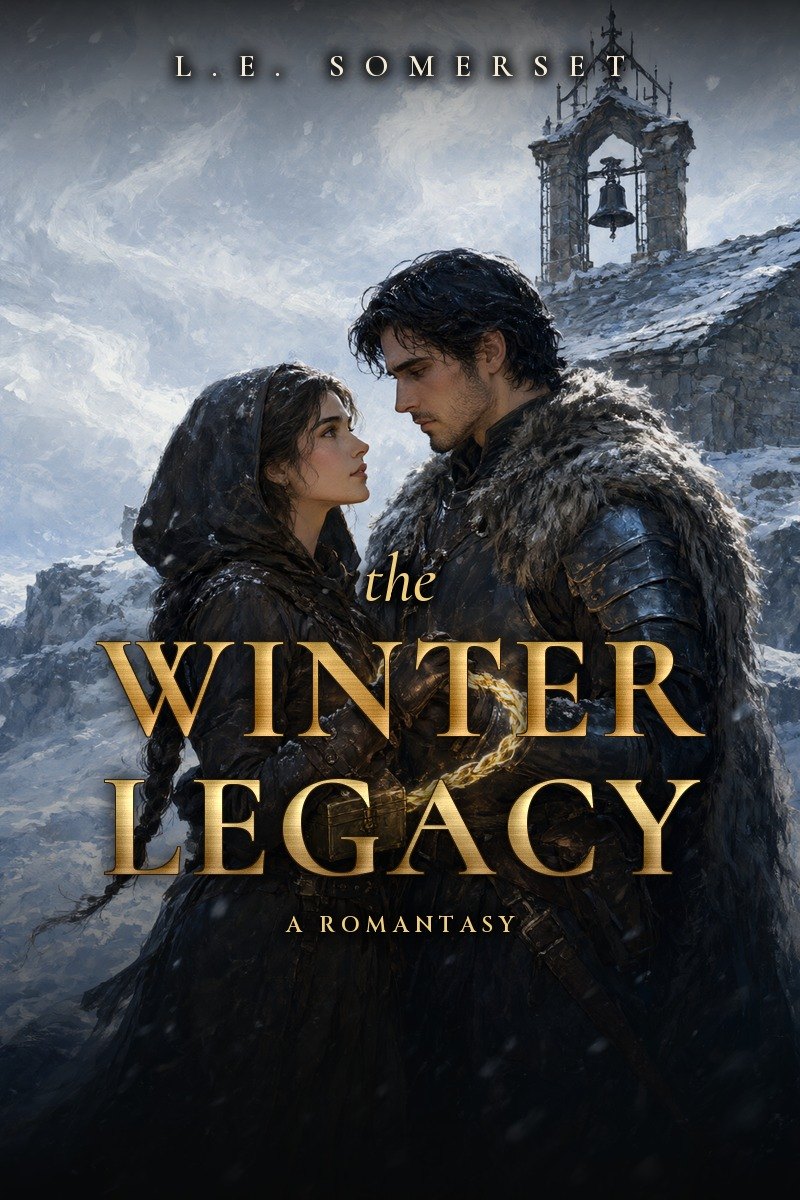
Chapter 6
How long did two bleeding survivors have before the mountain cold turned open flesh into gangrene?
I calculated the margin at twenty minutes as the freezing draft sliced through the vestibule. The four scavengers lay sprawled across the flagstones, their blood already thickening to black slush against the frost, but the shattered outer portal offered no barrier against the rising gale. If we did not seat the iron-reinforced cedar bar across the inner archway before the blizzard packed the foyer with five feet of drift, the reciprocal hearth in the great refectory would die of sheer exhaustion.
"Take the left bracket," Tirso said, his voice scraped raw from smoke and exertion.
He gripped the heavy timber bar with his uninjured left arm, his boots finding purchase on the slick stone. I stepped in close beside him, our movements constrained by the seven paces of golden cord that bound our wrists. My torn right shoulder screamed as I hooked my good hand under the frosted cedar, but I locked my knees and shoved upward on the count of three.
The iron fittings groaned against the stone sockets. Together, we drove the massive beam home, dropping the iron drop-pins into their masonry channels.
The heavy thud of the bar falling into place severed the howl of the storm.
Inside the refectory, the sudden quiet hit with the weight of dropped lead. Only the low crackle of the basalt hearth remained, throwing long, amber shadows across the vaulted timber ceiling and the soot-darkened benches.
Tirso leaned back against the barred timber, his head resting against the rough cedar. His right vambrace was smeared with dark crimson where the scavenger's falchion had glanced off the steel and torn open the previous day's laceration. Snow melted in the dark bristles of his jaw, dripping steadily onto the fur lining of his collar.
"Sit," I said, pointing toward the stone hearth bench. "Before you bleed over the only dry pine needles in the sanctuary."
He pushed himself off the door without a word, crossing the refectory with the steady, measured gait of an enforcer who refused to acknowledge shock. He dropped onto the bench near the fire, stripping the buckled leather straps of his right gauntlet with his teeth. When he peeled back the soaked linen bandage, the gash along his forearm pulled apart, weeping dark arterial red into the hearthlight.
I unslung my travel pouch and set the scavenged iron falchions beside the hearth alongside the Amanecer Covenant brass coffer, Estevan's brass-framed slate, and Chancellor Osvaldo's death warrant. With my left hand and teeth, I hauled the slack out of the linen binding my own strained right shoulder, resetting the knot against the bruised collarbone with a sharp, practiced jerk. From my inner pocket, I produced a horn vial of pine-pitch antiseptic, a spool of waxed sinew thread, and the fine curved brass needle I usually used to reseat the internal spring-cams of vault mechanisms.
"You use locksmith brass to mend muscle?" Tirso asked, watching my hands work.
"Locksmith brass does not rust when boiled in snowmelt," I told him, kneeling on the flagstones beside his knee. I set a small iron kettle over the coals. "And unlike your Chancery surgeons, I do not believe in leaving half a pound of butcher's iron under a man's skin."
"The Chancery prefers cautery," he murmured. "It leaves less to complain about."
"Because dead men have quiet tongues." I lifted his wrist, resting his forearm across my knee. His pulse beat hard and rapid against the skin of my fingers, hot against the chill of my own weathered knuckles.
I uncorked the pine-pitch salve. "This will sting."
"Do it."
I poured the resin directly into the furrow.
Tirso did not shout. His knuckles tightened until the white bone showed through the skin of his left fist, and a sharp intake of air hissed through his teeth. He held his arm completely motionless while the resin sizzled against the raw flesh, refusing to give me the satisfaction of a tremor.
"You handle pain like a man who expects to be punished," I said, threading the waxed sinew through the eye of the curved needle.
"Pain is a metric," he replied, staring straight into the flames. "It tells you what remains operational."
"That sounds like something written in an arbiter's manual." I set the needle against the edge of the torn flesh and pushed through.
His muscle jumped under my thumb, but he held his position. I drew the sinew through, tying the first knot with the quick, two-finger hitch Estevan had taught me ten winters ago in the backroom of the harbor ironworks.
Every stitch pulled my thoughts backward down the mountain pass, down five hundred leagues of frozen granite to the salt-slick cobbles of the Barrio de los Calafates.
· · ·
Five years ago, the fire on the harbor docks had smelled of burning pitch, scorched cedar, and boiling brine.
I had been nineteen, my leather coat still clean of grease, kneeling beside the secret floor cavity beneath Estevan's workbench while the roof beams overhead crackled with Chancery arson. In my hands, I held the true registry slate—the brass-framed ledger containing the real land patents and craft debts of five hundred harbor families. Outside the iron-shod workshop shutters, the bells of San Telmo were clanging the alarm, drowned out by the thundering boots of the Iron Arbiters cordoning off the quarter.
"Take the ledger to the municipal archive vault," Estevan had wheezed, his chest crushed beneath a collapsed oak gantry beam that neither my levers nor my desperate strength could budge. His gray hair was singed with soot, his eyes wide and feverish in the firelight. "Do not come back for me, Belisia. Slip the master slate into the central lockbox before Osvaldo's clerks replace it with their forged rolls. If that registry is lost, the entire harbor belongs to the Chancery."
"I am not leaving you to burn," I had screamed over the roar of the flames, throwing my entire weight against the iron pry-bar beneath the beam.
"The ledger is the life of this ward!" he yelled back, coughing blood against the stone floor. "A locksmith serves the balance, girl! Put the key back where it belongs!"
I had refused to listen.
I dropped the registry slate on the workbench, picked up a heavier iron wedge, and hammered at the collapsed timber for six agonizing minutes while the smoke thickened into blinding black poison. When the roof finally gave way with a thunderous roar of sparks and iron, the burning rafters crushed the bench, swallowed the ledger, and buried Estevan beneath five tons of flaming slate and timber.
I survived by throwing myself through the sea-drain into the black, freezing water of the bay.
When I dragged myself out onto the mud flats three hours later, the entire Caulkers' Quarter was a smoldering ash-field. Chancellor Osvaldo had already posted his falsified debt-scrolls on the cathedral gates, declaring every shop, boatyard, and tenement forfeited to the Chancery. Five hundred families were marched into indentured dock labor because I had prioritized one life over the restoration of the ledger.
That was the night I stopped stealing for coin. That was the night my collarbone began to ache whenever a stolen relic sat out of place, an unpayable ghost-debt burning in my blood until every item I ever took was returned to its true shelf.
· · ·
I pulled the sixth stitch tight and knotted the sinew with a sharp tug.
"You went somewhere else," Tirso said quietly.
I blinked, clearing the phantom stench of burning pitch from my nostrils. The great refectory of Alto de las Campanas returned to focus: the basalt hearth, the glowing embers, the smell of pine resin and boiled snow.
My hands were steady, but the golden tether connecting our wrists was humming with a faint, uneasy vibration that matched the knot in my stomach.
"I was thinking about the night your father burned the Caulkers' Quarter," I said, setting the needle down on the stone bench and reaching for the clean linen roll.
Tirso did not pull his arm away as I wrapped the cloth snugly over the stitched wound. His gray eyes fixed on the flames, the hard line of his jaw tightening.
"My father was an executor of orders," Tirso said, his voice flat and low. "He was not an architect."
"He carried the torches," I countered, securing the linen with a brass pin. "He brought three squads of arbiters to seal the alley exits so no one could carry the craft deeds out to the city judges."
"He brought two squads," Tirso corrected. "I was commanding the third."
My fingers froze against his wrist.
The silence between us sharpened into a blade. I looked up into his face, searching the harsh contours of his cheekbones and the grim line of his mouth. He did not look away. He offered no apology, no softening of the fact, presenting his complicity with the brutal clarity of an enforcer reading a charge.
"You were there," I whispered.
"I was nineteen," he said. "I stood at the north canal bridge with twelve pikemen, under direct written orders from Chancellor Osvaldo to seize any ledger, deed, or slate leaving the quarter and deliver it to the Chancery braziers."
"And you obeyed."
"I was an arbiter," he said. "The law of the Chancery was the only structure I knew. But when Estevan's apprentices ran toward my line carrying bread sacks and tool rolls, I did not search them. I ordered my pikemen to face the canal and let twenty families cross into the upper city."
I stared at him, the memory of that chaotic night colliding with his words. "Osvaldo would have had you broken on the wheel for letting them pass."
"He would have," Tirso said. "Which is why, when my father brought Estevan's registry slate back to the command tent that midnight, I stole it from his campaign chest."
He reached out with his uninjured left hand, picking up the heavy brass-framed slate from the stone bench. He ran his thumb over the defaced combination notches we had filed down earlier.
"My father thought it was consumed in the warehouse collapse," Tirso continued, his voice dropping into a register that barely carried over the crackle of the wood. "I knew what Osvaldo planned to do with the forged land patents. I could not stop the Chancery from taking the docks—not without fifty blades at my back. But I took the only piece of absolute evidence that proved the debt was a fabrication. I locked it in my father's strongbox, beneath five layers of clearance seals, waiting for the day Osvaldo's grip slipped."
"You kept it for five years," I said, the realization settling into my chest with the slow weight of sinking iron. "You were not guarding it for the guild. You were hiding it from them."
"The guild is a machine made of men who trade in leverage," Tirso said, turning the slate in his hands. "If you hand a corrupt chancellor evidence of his own treason, he does not repent. He executes you and burns the evidence. I needed the Amanecer Covenant to balance the leverage."
"And instead," I said, looking down at our bound wrists, "I broke into your carriage and triggered the curse."
"You broke into my carriage to return a stolen signet ring," he said, setting the slate back down between us. "A ring that my father stole from Estevan twenty years ago to seal the original contract."
He looked directly at me then, his gaze stripping away the armor and the enforcer's mask until only the raw, exhausted truth remained.
"We did not trigger this Covenant by accident, Belisia," he said quietly. "The magic didn't bind us because we were enemies. It bound us because we have been circling the same unpaid debt since the night the harbor burned."
The words hung in the warm air between us.
For five years, I had believed I was the only person carrying the ghost of Estevan's burning workshop—the only one paying penance for a ledger that never reached its shelf. I had viewed the Iron Arbiters as faceless butchers, iron automatons who crushed the weak under Osvaldo's seal. Yet here sat the sharpest blade of the Chancery, carrying the same stolen slate, bleeding from the same fight, bound to me by the very guilt I had carried alone through the winter dark.
A profound, hollow ache shifted beneath my ribs, releasing a tension I had held since the carriage crashed in the Paso de las Ánimas.
"I let him die," I admitted, the confession tearing out of my throat before my pride could choke it down. "Estevan told me to run with the slate. He ordered me to save the quarter. But I tried to lift the beam instead. I wasted the six minutes that would have saved five hundred families, and I couldn't even pull his body from the fire."
Tirso did not offer hollow comfort. He did not tell me it was not my fault, or that any apprentice would have done the same. He looked like a man who knew the cost of failure too intimately to insult me with platitudes.
Instead, he reached across the narrow space between us and laid his calloused, unbandaged left palm flat against my wrist, right above the golden band of the Covenant.
His grip was firm, grounding, and steady.
"A bad pry-bar does not make a thief a murderer," he said quietly. "Osvaldo lit the fire, Belisia. Not you."
As his skin touched mine, the golden cord binding our wrists flared.
I braced for the familiar, agonizing bite of the debt-curse—the icy, needle-sharp burning that punished every movement outside the ten-pace boundary.
The pain never came.
Instead, the light softened from a harsh, cutting glare into a deep, radiant amber. I tracked the magical vibration through the bone of my wrist, clocking the subtle shift in its harmonic oscillation—the rapid, jagged frequency of a contested debt was smoothing into the long, synchronized cadence of a balanced ledger. The Amanecer Covenant was not dissolving; it was retuning itself to the frequency of mutual confession, rewarding honesty under the sanctuary's ancient laws of reciprocity. The golden threads connecting our wrists expanded, pulsing with a slow, steady warmth that flowed directly into our skin. The magical heat washed through the torn muscles of my right shoulder, soothing the jagged ache, and traveled down Tirso's stitched forearm, sealing the fresh resin with a gentle, humming resonance.
The sanctuary itself seemed to respond to the shift. Above us, the great basalt hearth flared higher, sending a wave of cedar-scented heat rolling across the refectory floor, banishing the last lingering chill of the storm.
The Covenant had not loosened its grip. The boundary remained, tethering my life to his across every pace of the mountain. But the hostility in the magic was gone, replaced by an iron-solid current of shared purpose.
Tirso looked down at the glowing amber cord resting against our hands, then slowly lifted his eyes to mine.
Neither of us moved away.
Outside, the blizzard battered uselessly against the barred oak portal, but inside the circle of the hearth, the silence was no longer cold. We had laid our debts upon the stone, and the mountain had accepted the payment.
I picked up the execution warrant bearing Chancellor Osvaldo's crimson seal, smoothed the crumpled parchment against my knee, and met Tirso's gaze across the fire.
Tomorrow, the storm would clear. And when we walked down this mountain, we would not be running from our ghosts.
We would be hunting the man who made them.

Comments
Loading comments…