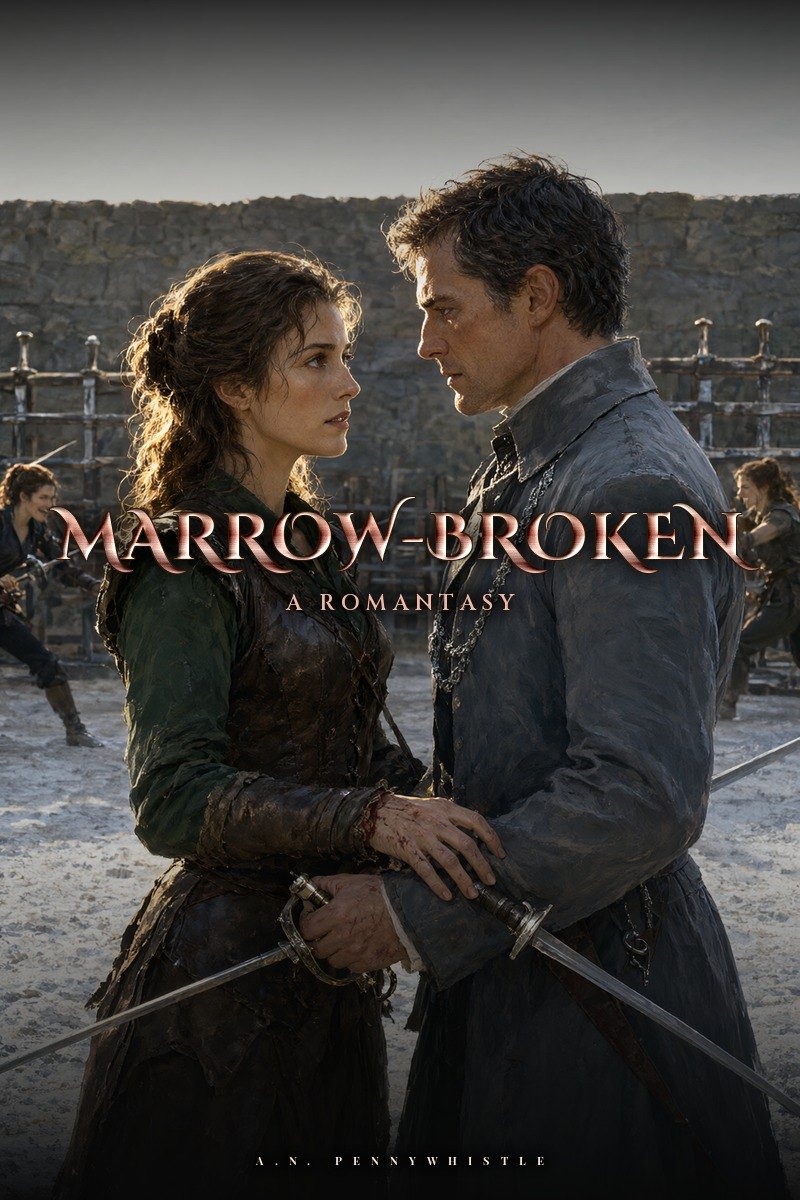
Chapter 5
The cut ran four inches along Sorlagh's forearm, shallow enough that it had already stopped bleeding by the time I got her to the recovery bench, and she would not stop talking about it.
"Four rounds," she said, holding her arm out like a prize while I turned it under the light. "No, wait, it wasn't even four rounds, it was during the bind, so it barely even counts, so really I finished undefeated."
"You finished with a hole in your arm."
"A small hole. An honorable hole." She hissed when I pressed two fingers either side of the cut, testing how deep it ran, and then grinned through the hiss like the pain was just more proof of something. "Tell me you saw the footwork on that last exchange. Tell me you saw it."
"I saw it." I had. Ceallagh had overcommitted on the reset, dropped her weight a half-beat too early, and Sorlagh had read it and punished it clean, the kind of read I'd spent six weeks trying to teach her and that she'd finally, infuriatingly, done on instinct instead of on command. It should have felt like a victory. Mostly it did. Under it, in a place I didn't examine too closely, it also felt like watching a door I'd kept shut for twelve years swing open another inch, because footwork that clean gets noticed, and the people it gets noticed by don't stop at the footwork.
I reached for the needle case at my belt and my hand shook.
Not badly. A fine tremor, the kind that lived in my right hand on any day I pushed it past what it wanted to give me, and today I'd pushed it across a competition rail, through a charter citation delivered from memory, and now into threading a suture needle in front of witnesses. The needle skittered against the case's edge. I closed my hand around it, waited two breaths, and made myself set it down rather than fumble it a second time in front of my student.
Sorlagh, still riding the bout, hadn't noticed. That was its own small mercy.
"Left hand," I said, and switched the needle to it. "This one's cleaner than it looks. No nerve involvement, no deep tissue — you'll have a scar and a story, in that order of usefulness."
"I already have a story. I'm working on the scar."
"Hold still for the scar, then." My left hand had never been trained to fine work, and threading a needle with it took twice as long as it should have, each pass deliberate, my eyes on the thread instead of on Sorlagh's face, which was probably why she chose that moment to say, far too casually for it to be casual:
"You crossed the rail."
"I did."
"You haven't done that. Not once. Not for me, not for anyone, in two years I've watched you stand at that line like it was drawn in something worse than chalk." She wasn't looking at her arm anymore. She was looking at me with the particular focus she usually saved for reading an opponent's guard. "What was that?"
"That was Article Fourteen." I drew the first stitch through, slow, even, my voice as flat and procedural as I could make it. "A grounding clause. Any line judge's ring-break call is subject to physical review if a party formally contests before the next bout begins. I contested. I was right. That's the whole of it."
"That's not the whole of it and you know it."
"It's the whole of what matters." I tied off the stitch and reached for the next length of thread, grateful for an excuse not to meet her eyes for a moment. "You won. That's what matters today. Don't spend your first real win wondering why your coach can read a charter."
She opened her mouth, ready to push, because pushing was what Sorlagh did with anything that looked even slightly like a locked door, and then her gaze went past my shoulder and whatever she'd been about to say died on the way out.
"Warrant," she said instead, and straightened up on the bench like the word itself had corrected her posture.
I didn't need to turn to know who'd have that effect on her. I finished the stitch anyway, because finishing the stitch was something my hands could do while I decided what my face was going to look like when I lifted it.
"Don't get up on my account," Ainrath Dunvagh said, arriving at the end of the bench with the unhurried economy of a man who'd watched the whole bout from the rail and had nowhere else he needed to be now that it was over. He had his slate under one arm, closed. That was new. Since the briefing I'd watched him carry it open, half a question always poised on it. "I only came to see whether the arm needed a physician sent for, or whether the Circle's Hand had it handled."
"Handled," I said, and set the second stitch.
"So I see." His eyes went to my hands — both of them, the working left and the closed right, resting against my knee where I'd put it the moment I'd set the needle down. I made myself not move it. Moving it would have been the tell. Stillness, if I held it right, could pass for a woman simply resting a hand she wasn't using. "You've changed which one you favor. This morning it was the right doing the demonstrating."
"The right's tired." True enough, as far as it went. Everything about me was tired, in ways that had nothing to do with a single bout. "Most people's dominant hand gets tired before the other one learns to keep up. It's not a mystery, Warrant, it's an afternoon."
"I didn't say it was a mystery." His voice held the same even, unhurried register it always did, the one that made every sentence sound like it had already been drafted somewhere and merely delivered here. But his eyes hadn't moved off my right hand, and I understood, with the specific cold clarity of watching a trap you'd half-built yourself, that he'd clocked the tremor before I'd finished hiding it. Not guessed at it. Seen it. "I only notice what's in front of me. It's rather the job."
"Rather," Sorlagh said, delighted, before I could find anything useful to say myself. "Doreagh, he's doing the thing where he sounds like he's agreeing with you and it's somehow worse than if he argued."
"I've noticed," I said.
"It's the job," Ainrath said again, mildly, and this time there was the ghost of something almost like humor in it, gone as soon as it arrived. He crouched at the end of the bench, bringing himself level with Sorlagh's arm rather than my face, which I understood, correctly I thought, as a deliberate courtesy, a way of giving me a beat to compose whatever I needed composing. "That was a clean win. The footwork on the last exchange in particular."
"I told her," Sorlagh said. "Nobody believes me when I say it myself."
"I believe you. I watched it happen." He glanced at me, and the humor was gone now, replaced by something more careful. "Your coach's citation of Article Fourteen this morning was equally clean. I've read that clause exactly twice in three years of Circle work, and both times I needed the book open in front of me."
"I read a great deal," I said. "Trainers have long winters and not much else to do with them."
"So it seems." He straightened, giving Sorlagh's shoulder a brief, approving pat that looked strange on him, like a gesture he'd learned by observation rather than habit, and then he did not leave, which I had been hoping for and had known, somewhere honest, not to expect. Instead he looked at me directly, and the careful thing in his face sharpened into something closer to a question actually being asked instead of orbited.
"Second Mhoran. Might I have a moment. Alone, if your student can spare you — I think she's earned the right to boast to an audience that isn't her coach."
"I have earned that right," Sorlagh agreed instantly, already twisting to find Cuinn's stall across the yard, her arm forgotten. "I'll come back for the last of it. I want to go be insufferable at someone who hasn't already seen me do it."
"Left hand only when you rewrap it," I called after her. "Don't let Cuinn talk you into anything with a hook in it."
She was already gone, moving the way she moved when a bout had gone well, too fast, too loud, taking up more space than the yard strictly allowed her, and I watched her go for exactly as long as it took to put off looking at the man still standing at the end of the bench.
"You're careful with her," Ainrath said, once she was out of easy earshot.
"She's worth being careful with."
"I meant it as an observation, not a question."
"Most of your observations turn into questions eventually." I said it before I'd decided to, and regretted the shape of it — too sharp, too close to an accusation of my own — the moment it left me. He didn't flinch from it. If anything, something in his face eased, the way a man's does when a conversation stops being polite and starts being real.
"Fair," he said. "All right. Here's one, plainly, since you'd rather I not dress it up. You cited a charter clause most sitting proctors would need to look up. You crossed a competition rail on a first-round bout that had no title riding on it, which every senior trainer I've spoken with says you have never once done in eleven years of running that yard. And just now, under my eye, your sword hand shook badly enough that you finished a suture with the wrong one." He paused, not for effect, I thought, but because even he needed a breath before the rest of it. "I'm not asking you to explain any one of those things. Taken alone, they're nothing. I'd like to know why, taken together, they feel like something."
The yard noise went on around us — Sorlagh's laugh somewhere off to the left, the grind of a whetstone, a proctor calling the next bracket to the sand — and none of it reached me the way his stillness did.
"Because you're the Crown's Warrant," I said, keeping my voice as level as I could make it, "and it's your job to make three unrelated facts feel like something. That's not evidence, Warrant. That's a habit of mind."
"It's also usually right." He said it without heat, a simple correction, the kind a man makes when he's confident enough in the fact not to need to defend it. "I'll tell you what I'm actually here for, since you've earned the plain version more than most people I've questioned this week. I'm not chasing bent charter calls, or unorthodox trainers, or a lowborn girl with fast hands, however much those things keep landing in my slate. I was sent to the Circle to run down a rumor. A specific one." His eyes hadn't left mine. "That somewhere, in the last dozen years, someone broke a completed Snaomh bond. And survived it."
The yard didn't go quiet. Nothing in the world was polite enough to go quiet for me. But something in my chest did, a stillness with teeth in it, the particular silence of standing very close to a cliff edge you've spent twelve years walking well back from.
"That's not possible," I said. My voice came out steady. I have had a great deal of practice making my voice come out steady over things that were not.
"That's what I'd have told you a month ago." He watched me while he said it, and I made myself hold his eyes rather than give him the tell of looking away. "Bond-shock doesn't fail. Everyone who studies the Snaomh will tell you that, with the same certainty they'd use to tell you fire burns. But certainty isn't the same thing as proof, Second Mhoran, and I've spent three years learning to be suspicious of the difference. Someone, somewhere, is the exception the certainty doesn't account for. I intend to find them before someone worse than the Crown does."
"Worse than the Crown," I repeated, because it was easier than answering the rest of it, and because I wanted, badly, to know what he meant by it.
"House Ontragh's entire fortune rests on the premise that a Snaomh, once sworn, is permanent. If that premise is false — if it can be survived, walked away from, lived past — every marriage their house has ever brokered becomes a debt someone might simply refuse to pay." His mouth moved, not quite a smile. "They would very much like to find your exception first. And they would not be gentle about what they did with her afterward."
Her. He hadn't meant anything by it — the rumor would have arrived to him shapeless, no more gendered than a rumor about weather — but the word landed in me anyway, precise as a blade finding a gap in a guard, and I had exactly the length of one held breath to decide whether my face had done anything with it before I made it do nothing at all.
"I'll keep my slate open for that, then," I said. "If I hear anything. Trainers do talk, when the wine's poured."
"I'd imagine they do." He studied me a moment longer — not unkindly, which was somehow worse than if he had been unkind, because unkindness I knew how to stand against and this, whatever this was, I didn't have twelve years of practice refusing. Then he inclined his head, the small formal motion he used to close every conversation I'd had with him so far, as if even his courtesies came filed under charter. "Congratulations to your contender. Round two fights tomorrow. I expect I'll see you at the rail again, one way or another."
"One way or another," I agreed, and watched him walk back toward the officials' stand, unhurried, his slate still closed under his arm, and did not let out the breath I'd been holding until he was well out of any distance a trained ear could use against me.
I sat alone on the recovery bench with a suture kit still open beside me and a right hand that had finally stopped shaking now that there was no one left to hide it from, and made myself think it through in order, the way I'd have broken down an opponent's opening after a bout, because that at least was work I still knew how to do.
He wasn't asking about a rumor of a rumor anymore. He had the shape of the thing exactly right — a completed bond, broken, survived — which meant someone, somewhere, had gotten close enough to the truth to hand him the outline of it, if not the name. That was new information, and new information was the first thing I'd had in twelve years that wasn't simply another thing to hide from. He didn't know it was me. He didn't even know whether to look for a woman or a man, and he knew House Ontragh wanted them found first, and he had just, without meaning to, told me both of those things instead of the other way around.
I could work with that. I had spent half a lifetime working with less.
The draw for round two hadn't gone up yet, but Ealtain would be proctoring it regardless of who Sorlagh drew, and Ainrath would be watching every motion I made from the rail the way he'd just watched this one. I would not cross that rail again unless the charter gave me no other choice, and if it gave me no other choice, I would do it clean and dull and unremarkable, the way a tired yard trainer does anything, and I would keep both hands where he could see them and neither of them doing anything worth writing on a slate.
I closed the suture kit, left-handed, and set it back on my belt, ready for when Sorlagh remembered she still owed it a last pass.
I would decide the rest of it walking home.

Comments
Loading comments…