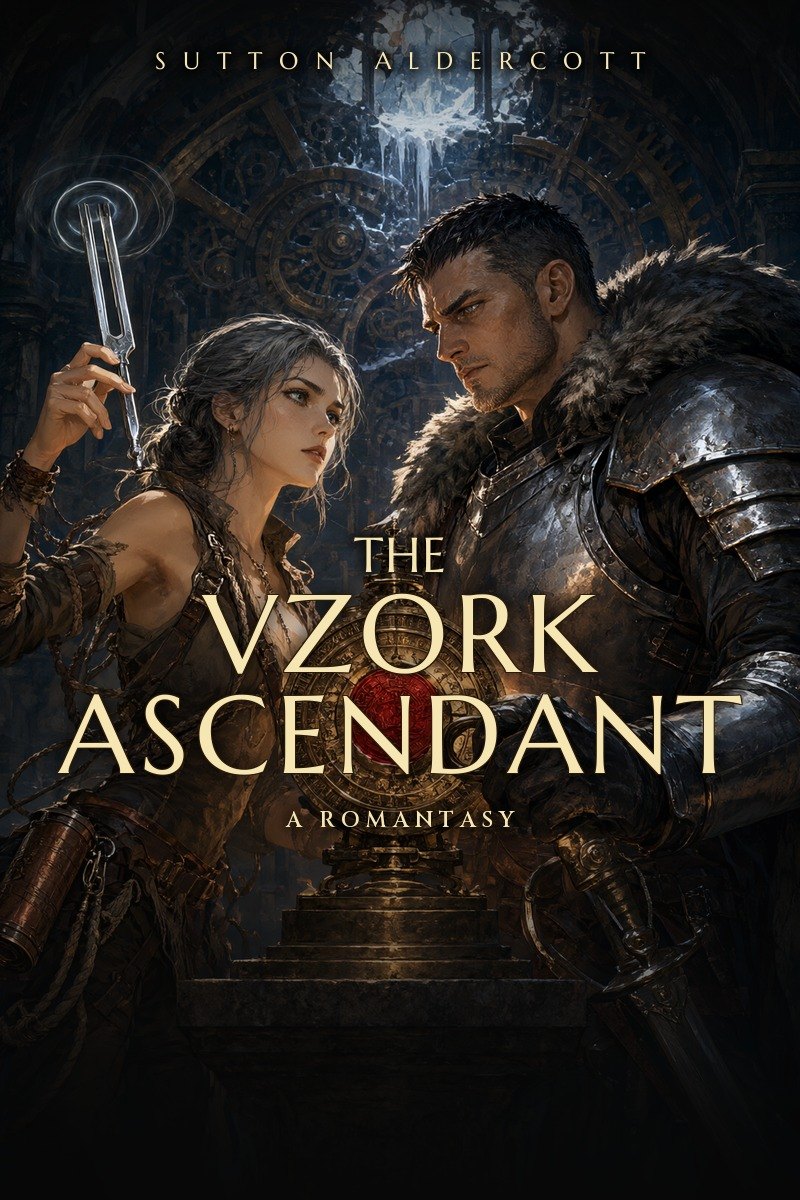
Chapter 2
The soot in the vertical flue tasted of dried pine resin and forty winters of dead charcoal. It clung to my eyelashes, the coarse wool of my collar, and the cracked skin of my knuckles as I hauled myself up the narrow chimney shaft, inch by friction-locked inch.
I needed the sanctuary's architectural layout before Dragimir’s soldiers dismantled the lower halls stone by stone. Without a structural floor plan, I was navigating five tiers of frozen mountain granite by pure guesswork, and guessing inside Svetakovar was a swift way to lose a foot to a counterweighted deadfall or end up pinned to a wall by a spring-loaded iron spit. My ribs throbbed from the climb. The buckskin tool roll was tied securely across my ribs, its steel forks and tension wrenches clinking faintly against my leather jerkin, while the heavy pouch slung beneath my shoulder held eight pounds of salt-cured mutton and nine stolen tallow candles—a heavy, unyielding ballast that ground against my sternum with every upward heave of my knees.
Ten paces above the lower intake junction, the flue narrowed to a chimney squeeze barely wide enough for my shoulders. I wedged my boot heels against the rough ashlar blocks, drove a notched copper shim into an open mortar joint to bear my hip weight, and paused to let the burning in my thighs settle into a dull, manageable ache.
Below me, muffled through sixty feet of vertical stone, came the rhythmic clatter of iron on granite.
I worked a loose iron exhaust louver free with the flat blade of my tension wrench, turned my head sideways against the soot-crusted stone, and peered down into the torchlit expanse of the Great Vestibule.
Dragimir was still at the center of the hall. Even from sixty feet above, his silhouette dominated the cavernous space with the grim economy of an executioner's block. He had stripped off his heavy wolfskin mantle, leaving only his blackened tactical cuirass, scarred by old saber notches and reinforced with overlapping steel ribs across the shoulders and clavicles. He was not shouting. Men of his rank rarely had to raise their voices to be obeyed. When he pointed a gloved finger at the western archway, two heavily armored infantrymen leaped immediately to drag heavy oak supply crates across the opening, their iron-cleated boots scraping frantically against the frost-sheared flagstones.
"Boryska," Dragimir’s voice traveled up the chimney shaft, low, dry, and flat as a honed razor. "Set two sentries on the intake cistern. Check the iron grates for grease marks, wire scuffs, or displaced rime. If the operative went high, she will look for a dry flue to wait out the first drop in temperature."
"She’s a gutter rat with a roll of lock-wire, Commander," Boryska spat, nursing a bandaged forearm near the roaring central brazier. "Let her freeze in the high rafters. The blizzard will drop the upper levels to ten below zero before midnight. By dawn, she’ll be a block of tallow."
"She carries eight pounds of our cured meat and enough tallow to burn three lamps for a month," Dragimir said. He did not turn around to look at his lieutenant. He drew a straight-edged iron compass from his belt and laid it across an open tactical sketch pinned to a wooden sledge. "She is not an amateur. She bypassed a triple-pin acoustic deadfall in under twenty heartbeats while hanging from a frozen climbing rope on an ice-glazed cliff. When she moves, she moves with purpose. Secure the lower gallery. Post two men at every stairwell and check the floor seams for tripwires before you step."
"And if she attempts to slip past the barricade?" Boryska asked, his hand dropping to the heavy wire-wrapped grip of his broadsword.
"Kill her if she draws steel," Dragimir said, his voice level and entirely devoid of heat. "Bring me her tool roll if she dies."
He turned on his heel and walked toward the western corridor, his heavy stride measured, economical, and soundless on the flagstones. He moved like a hunter who knew the quarry was penned in the same stall, completely indifferent to how long the stalking took so long as the exits remained barred.
I held my breath until his broad shoulders disappeared beneath the shadow of the lower archway, then carefully eased the iron louver back into its frame.
Dragimir was right about one thing: the upper tiers were already bleeding heat into the stone. Even with the outer blast portcullis sealed shut, the mountain had become a subterranean ice vault, cold and dead and breathless. The stone walls of the flue were coated in a stagnant, crystalline rime that numbed my fingertips through the wool liners of my climbing gloves. If I stayed in the chimney shafts, the dead freeze would lock my joints stiff before the second watch. My only path forward lay through the old monastic quarters on the fourth tier—the High Archive where the sanctuary’s first scribes had drafted the original master schematics of the mountain's subterranean vaults.
I braced my back against the rear wall of the shaft, found purchase with the iron spikes of my climbing boots, and resumed the climb.
Ten minutes of grueling upward wedging brought me to the fourth-tier exhaust vent.
The exit grate was forged from thick cast iron, pitted with centuries of rust and secured by an internal sliding toggle. I slipped a flat iron pry-bar between the second and third bars, levered the frozen toggle upward with a muffled thunk, and pushed the heavy grate outward.
I rolled through the opening, hit the flagstones in a low crouch, and pulled the iron grate shut behind me.
The silence of the High Archive had teeth.
Unlike the vestibule below, where the usurper's vanguard burned pitch pine and seasoned birch, no fire had warmed these halls in over a hundred years. Frost coated the vaulted ribs of the ceiling in thick, feathered needles that glittered like shattered glass in the faint amber beam of my tallow candle. The air was dry, brittle, and so cold it seared the lining of my throat with every inhalation. My boots made a faint, papery crunch against a carpet of desiccated moth husks and centuries of undisturbed dust.
I pulled my wool muffler higher over my nose, keeping my breaths shallow to avoid clouding my field of view with steam.
The gallery stretched seventy paces to the north, flanked by monumental arches carved in the heavy, unadorned masonry of the early dukes. Timber book-presses lined both walls, but their shelves had long since buckled under the weight of frozen rot, spilling mounds of moldering vellum into drifts of yellow ice along the baseboards.
I took three cautious steps down the center aisle, then froze mid-stride.
The floor slabs beneath my feet were rectangular blocks of dark gray granite. But twelve paces ahead, near the third arched alcove, the mortar line between two slabs showed a clean, razor-thin shadow where no frost had settled.
A mechanical deadfall.
In a fortress like Svetakovar, undisturbed dust was not just a sign of age; it was a warning. The ancient builders had counterweighted half the floor plates to prevent unauthorized scavengers from reaching the inner scriptorium.
I knelt on one knee, reaching into the buckskin tool roll tied across my ribs. I drew a six-inch steel tuning fork stamped with a clean G# on the flat shank. Leaning forward, I struck the fork lightly against the iron shank of my climbing boot.
The steel fork hummed with a pure, piercing resonance that vibrated through my fingers and into the cold air.
I lowered the vibrating tines to within a fraction of an inch of the suspect stone seam, sliding the tool slowly across the granite face. For the first two feet, the pitch remained a steady, crystalline drone. But as the tines passed over the hairline mortar gap, the frequency dropped sharply into a harsh, hollow buzzing.
A counterweighted drop-plate. The acoustic wave was echoing off a subterranean cavity directly beneath the slab.
I laid the flat of my palm against the adjacent wall-strut, feeling for the mechanical linkage. High above my head, hidden behind the decorative plaster cornice, hung a bank of iron-weighted deadfall beams held on a hair-trigger trip cam. If a person stepped on that center slab, sixty stone of granite and lead would plunge from the ceiling like an anvil.
"Vicious old monks," I muttered under my breath.
I took an ox-bone shim from the pocket of my jerkin and selected a flat iron tension wrench. Working with deliberate, feather-light pressure, I slipped the bone shim into the trip-lever aperture along the baseboard, easing it beneath the catch-pin until the tension wrench met the resistance of the internal spring.
I held my breath, slowly twisting the wrench half a turn.
A faint, metallic click resonated through the stone. The bone shim wedged securely beneath the release bar, locking the counterweight cam in its cradle.
The trap was neutralized, at least until the frost rotted the bone or an earthquake shook it loose.
I stepped carefully over the deadfall plate, planting my boots only on the reinforced wall-struts where the floor joists were mortised directly into the living granite of the mountain.
At the northern terminus of the gallery stood a pair of double oak doors bound in blackened iron strapwork. A heavy bronze plate was pinned above the lintel, bearing the archaic provincial seal and an inscription etched in angular, pre-dynastic lettering: Scriptorium of the First Keeper.
The door was locked with a four-tumbler box-ward mechanism. Over the decades, the tallow grease inside the keyway had frozen into a solid block of lard as hard as horn.
I held the flame of my tallow candle beneath the keyhole, letting the direct heat soften the congealed fat. Within two minutes, dark, amber grease began to weep from the bottom slit. I drew two hardened steel rakes from my buckskin roll, inserted them into the ward chamber, and felt for the tumbler gates.
The first pin lifted with a dry scrape.
The second pin caught, resisted, and slid home.
Click. Clack. Thunk.
The massive iron deadbolt retracted into the jamb.
I leaned my shoulder against the oak planking and pushed. The door shuddered, grinding through a century of rust on its pivot hinges, before swinging inward with a low, mournful groan that sent a shiver through the still air.
I slipped inside and pulled the heavy door almost shut, leaving only a hairline crack for ventilation.
The scriptorium was a vast rotunda, its high vaulted ceiling supported by eight fluted pillars of black granite. Narrow lancet embrasures pierced the exterior wall, but every opening was sealed by thick, translucent plugs of blue glacier ice, through which the howling blizzard outside cast an eerie, phosphorescent gloom. The room smelled of petrified sheepskin, dried iron gall ink, and the dry, sweet dust of ancient embalming herbs.
At the center of the rotunda sat a massive circular drafting table of petrified oak, flanked by high slate lecterns that radiated outward like the spokes of an iron wheel.
And seated behind the central desk was the scholar himself.
He was perfectly preserved by the dry, merciless cold of Mount Svetak. His skin was the color of yellowed vellum, stretched taut over high cheekbones, a sharp hawkish nose, and hollow eye sockets. He wore the thick wool robes of the monastic order, a heavy fur-lined mantle draped over his withered shoulders. His torso was pitched forward over the drafting table, his head tilted at an unnatural angle as if he had fallen asleep mid-sentence sixty winters ago.
His right hand was locked in a rigid, post-mortem grip around a ribbed copper cylinder resting on the drafting table.
I approached the desk with silent, measured steps, my boots leaving dark smudges in the delicate mantle of frost on the flagstones.
"Pardon the intrusion, brother," I murmured into the gloom. "I’m only taking what was stolen from the realm."
I reached out with my left hand and touched the copper cylinder. The metal was so fiercely chilled that the cold bit straight through the thick leather and wool lining of my glove, stinging my skin like boiling lye.
I tried to ease the tube from his grasp, but the scholar’s fingers were frozen solid, locked into the metal ridges by decades of ice and tendon contraction. If I applied brute force, the brittle bone of his fingers would snap like dry cedar kindling. In a resonant stone chamber, the sound of snapping bone and rattling metal would carry down through the ventilation flues like a trumpet blast.
I drew my skinning knife from my boot sheath, held the flat of the iron blade over my candle flame until the metal grew scorchingly hot, and pressed the warmed blade gently against the crook of the dead man's thumb joint.
A tiny wisp of steam hissed into the air, carrying the faint, sharp smell of singed wool.
Slowly, the frozen tendons softened under the heat. The rigid frost bond broke with a faint, crystalline crunch. The scholar's stiff fingers relaxed by a fraction of an inch, and the copper cylinder slid smoothly into my grasp.
It was heavy—easily five pounds of solid cast copper—roughly fifteen inches long and three inches thick, ribbed with gripping bands and capped on both ends with heavy brass threaded plugs. The top plug was stamped with the deep, unbroken wax seal of the Grand Duke: a three-tiered fortress crown above a split anvil.
I set my candle on the slate lectern, braced the cylinder against my thigh, and twisted the threaded brass cap with both hands.
The ancient wax sheared away with a dry, brittle crack. The brass cap turned on its greased threads, releasing a faint puff of trapped air that smelled of cedar oil and fresh parchment.
I reached inside the cylinder and drew out a tight, heavy scroll of calfskin vellum, wrapped in multiple layers of oiled green silk to protect it against moisture.
My heart hammered a steady, demanding rhythm against my ribs as I unrolled the silk and smoothed the heavy vellum flat across the drafting table. I weighted the four corners with my iron tension wrenches and the brass cylinder cap.
I lowered the tallow candle until the warm flame washed across the parchment.
The ink was pristine, executed in fine, geometric strokes of carbon black and brilliant cinnabar.
It was the complete structural schematic of Svetakovar’s subterranean vault network.
My eyes devoured the drafting lines, cross-referencing the architectural drawings with the structural layout I had observed during my climb. The Great Vestibule where Dragimir had entrenched his vanguard was only the uppermost tier of an immense, hollow mountain complex. Beneath the main hall lay four additional subterranean tiers: the old aqueduct cisterns, the pneumatic counterweight flues, the grain vaults, and at the deepest point of the mountain's bedrock, the Crypt of the First Keeper.
According to the cinnabar annotations, the blood-sealed astrolabe was stored within the central reliquary of the Crypt, sealed behind an acoustic counter-lock and a dual-lineage blood gate.
"The main stairwell is a death trap," I whispered to myself, tracing the cinnabar lines that marked Dragimir's current defensive perimeter. "Dragimir has barred the lower vestibule stairs with timber crates and posted guards on the landing. If I go down the grand staircase, I walk straight into twenty crossbows."
I shifted my candle to the eastern flank of the schematic.
There, etched in fine dotted black ink, was an auxiliary drainage sluice that bypassed the lower vestibule entirely. It was an ancient overflow channel designed to dump spring snowmelt from the upper mountain crags directly into the deep cisterns beneath the third tier.
The sluice dropped through a vertical bypass shaft located behind the northern chimney flue, emerging into a neglected maintenance corridor just fifty paces from the entrance to the Crypt.
"The sluice," I breathed, a fierce, razor-sharp surge of triumph cutting through the exhaustion in my limbs. "The sluice bypasses his sentries completely. I can drop straight to the sub-vault level without triggering a single barricade."
This was the gain I had climbed through the blizzard to find: a clear, verified blueprint of the sanctuary's hidden arteries. With this parchment, I was no longer an operative stumbling blindly through frozen dark; I had the key to the mountain.
I rolled the heavy vellum back into its oiled silk sleeve, slid it carefully into the copper cylinder, and screwed the brass cap down until the lead gasket sealed tight. I tucked the cylinder into the reinforced leather cross-strap of my climbing harness, buckling it firmly against my left hip.
I took my skinning knife and tension wrenches from the desk, slid them into their respective pockets, and blew out the candle to preserve the tallow.
Darkness rushed back into the rotunda, thick, cold, and heavy.
I turned toward the oak door, adjusting the strap of the heavy meat pouch beneath my shoulder.
I took one step forward.
My left boot came down on the slate flagstone directly beneath the scholar’s central drafting table.
Under my heel, the stone sank half an inch with a muffled, metallic thunk.
A counterweighted trip-plate.
The old archivist had not died defenseless; he had rigged the floor around his lectern with a dual-lever deadfall trigger, armed to release the moment his cylinder was lifted and the perimeter plate was stepped upon. Deep inside the sub-floor masonry, an iron catch-dog snapped free from its ratchet.
A deafening groan of shifting counterweights echoed through the chamber, followed instantly by the violent recoil of iron cables snapping under hundreds of stone of released tension.
The slate flagstones beneath my feet dropped with a terrifying, grinding screech.
"No," I gasped, throwing my weight backward toward the doorframe.
My fingers scrabbled for purchase against the edge of a slate lectern, but the entire central radius of the rotunda floor buckled inward, the counterbalanced support arch collapsing into the void below.
A thunderous roar of shearing iron straps and tumbling granite blocks erupted beneath me. The floor sheared away completely, dissolving into a vortex of falling masonry and choking stone dust.
The darkness opened its jaws, and I plunged through three stories of empty air into the freezing void below.

Comments
Loading comments…