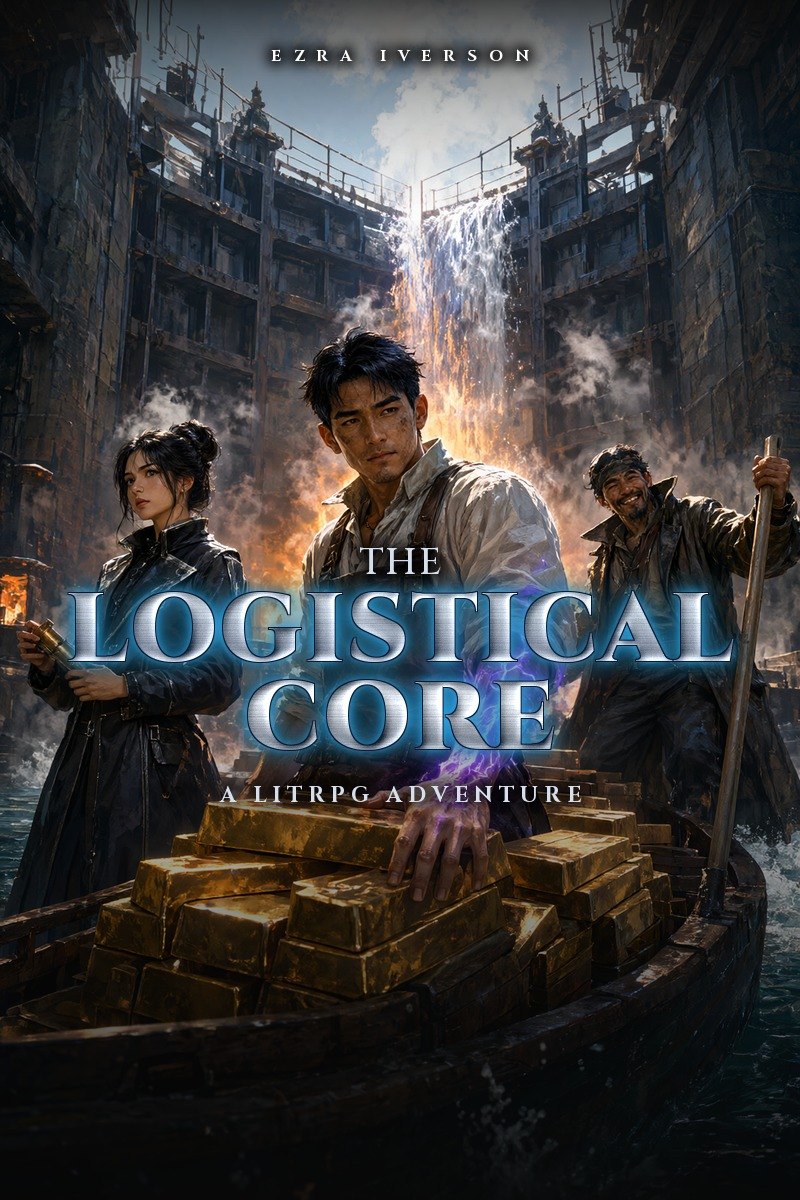
Chapter 7
How many foot-pounds of thermal backlash could a man’s forearm absorb before the bone shattered like overheated slag?
Kusiqa leaned over the iron leveling bar clamped across Amaru’s bilge bench, his left hand pressed against a slab of unlinked grey-iron scrap. The timber hull beneath his boots groaned as the cargo barge Huayra-Two drifted past the heavy iron sluice gates of Berth Fourteen. Thirty-eight hours remained before Collector Tupaq expected four standard forty-percent bronze ingots on the dross scales of Yanaruro. If Kusiqa could not forge a functional Class-Two buffer array before dawn, tapping the condemned sluice node would light up the Central Terrace assayer crystals like an arsonist’s pitch-pot.
"You are applying torque to the cold face while the core is still in crystalline transition," Willka said from the crate opposite him. She held a slate tablet in one hand and a lead stylus in the other, her spectacles reflecting the dull orange glow of the charcoal brazier. "The Imperial Standard for structural dampeners requires an isotropic lattice with less than zero-point-two percent carbon variance. What you have in that clamp is sewer-grate cast off from a foundry drain."
"The Academy’s isotropic ingots cost eight silver bits a pound," Kusiqa said, his voice flat as he wiped soot from his knuckles with a rag. "Sewer scrap costs what Amaru can fish out of the intake screens before the night watch clears the grates."
Amaru stood on the ladder leading to the deck hatch, one hand hooked over the comb coaming and an iron pry-bar tucked under his belt. "And if you crack my bilge timbers with that charcoal pot, the cost will be forty silver to re-caulk the hull. Keep the bellows down, Kusiqa. The night patrol’s patrol-skiff just crossed the main flume fifty yards off our port quarter."
"The bellows are cold," Kusiqa murmured.
He closed his eyes and let his awareness sink through his palm.
The Chuyma-Knot beneath his skin stirred, waking in a web of dry heat that traced from the junction of his thumb down into the deep fascia of his wrist. Where an ordinary artisan used an external resonance wand and a printed table of harmonic ratios to coax metal into shape, Kusiqa’s bloodline bypassed the standard liturgical equations. His pulse met the dead weight of the grey iron directly.
To his fingers, the metal was not solid. It was a chaotic aggregate of hard iron crystals floating in brittle flakes of graphite, laced with pocketed sulfur and raw slag. The Academy manuals called such scrap unviable clinker. They decreed that without a six-stage calcining furnace, grey iron could never hold an energy trace.
Kusiqa tightened his fingers. He did not need a six-stage furnace; he needed the iron’s inner boundaries to rotate sixty degrees along the secondary shear axis.
He pushed his intent through the knot. The violet veins along his forearm flared beneath the dirt, humming against his tendons.
Inside the clamped bar, the graphite flakes began to dissolve under localized pressure. The iron matrix yielded, sliding along micro-fractures as Kusiqa forced the outer grain to compress while pulling the core into an inverted diamond weave. It was the Class-Two lattice Master Wayra had sketched in the margins of his banned journals—a geometry designed to catch resonant vibration and turn it back on itself until the energy canceled out.
A sudden, sharp shudder rattled through the clamp.
The metal resisted. The uneven carbon pockets did not have the elasticity to absorb the geometric shift. Heat surged back through the contact point, screaming up Kusiqa’s palm like boiling grease.
He ripped his hand away, stumbling back against the bulkhead. The smell of scorched flesh filled the narrow hold.
In the clamp, the iron bar turned dull cherry-red, split down the center with a sound like a pistol shot, and shed a shower of jagged, smoking fragments onto the damp oak deck.
[System Notice: Structural Synthesis Failed]
[Material: Unlinked Grey-Iron Scrap (Purity: 58.4%)]
[Thermal Inversion Variance: +31.2%]
[Lattice Instability: Critical Threshold Exceeded]
[Chuyma Channel Strain: Moderate]
Amaru immediately dumped half a bucket of bilge water over the smoking iron. Steam hissed violently into the cramped air, smelling of burnt oil and stagnant canal mud.
"That," Amaru muttered, shaking his head, "sounded remarkably like two weeks in the salt mines if an auditor had been standing on the dock."
"An auditor is standing on the dock," Willka said without looking up from her slate. "Or rather, in the hold. And under Section Twelve of the Imperial Resource Act, that particular structural failure constitutes three distinct infractions: unauthorized lattice deformation, illicit kinetic discharge in a commercial hull, and gross negligence in the handling of unbonded ferrous waste."
Kusiqa gripped his left forearm with his right hand, his teeth set as the throbbing burn cooled into a dull ache. The violet channels under his skin pulsed erratically, slowly sinking back beneath his calluses. "Your textbook formulas assume pure iron, Willka. In the real world, scrap has sulfur pockets. When the sulfur hits two hundred degrees under pressure, the whole lattice shears."
"Then do not use the inverse-lattice geometry," Willka replied calmly. She drew a clean line across her slate, dividing a column of figures. "The standard Imperial dissipation array uses a thirty-degree hexagonal truss. It requires forty percent more mass, but the shear load distributes evenly regardless of carbon impurities."
"And it bleeds six percent of its energy into the surrounding stone," Kusiqa said, stepping back to the bench and kicking aside the shattered halves of the iron bar. "Berth Fourteen’s node is embedded in a wet masonry siphon wall fifty feet beneath the Central Terrace garrison. If six percent of the crafting pulse bleeds into the canal water, their resonance detectors will register the spike before the bronze finishes cooling."
Willka adjusted her spectacles, her eyes narrowing as she studied the numbers on her slate. "The inverse lattice only achieves complete cancellation if the opposing wave vectors match the exact frequency of the material’s internal resistance. You cannot guess that frequency by touch, Kusiqa. You are treating metallurgy as an argument between your hands and the metal, but metal is simply applied arithmetic."
"Arithmetic that was written for people who buy their ingots from the High Guild," Kusiqa retorted. He reached into his coat and pulled out the decrypted phosphor-bronze logbook, laying it flat on the bench beside the charcoal pot. "Look at Wayra’s notes on page fourteen. He didn’t use isotropic iron either. When he built his prototype in the lower canals, he compensated for the carbon inclusions by staggering the dampening nodes."
Willka leaned in, her gaze dropping to the bronze leaves covered in fine, etched cursive. For a moment, her rigid posture softened as her fingers hovered over the metal plates without touching them. "Master Wayra was an Academician of the Fifth Seat. If he staggered the nodes, he did so according to a variable differential equation, not blind instinct."
"Then calculate the equation," Kusiqa said.
He picked up a fresh bar of salvage iron from Amaru’s scrap crate. This one was thicker, roughly six inches long and two inches wide, pitted with deep corrosion along one edge where it had once served as a flange-bolt on a canal lock. He dropped it into the clamp and tightened the screw with the iron leveling bar.
Willka set her slate on the bench beside the logbook. Her stylus began to move, scratching swift, precise characters into the dark stone.
"If the sulfur content is between three and five percent," she murmured, "the critical resonance frequency shifts downward by twelve cycles per second for every half-inch of thickness. To prevent thermal rebound, the outer lattice must not invert simultaneously. It must fold in five sequential intervals, each offsetting the previous harmonic."
"Show me where," Kusiqa said.
She tapped the stylus against the surface of the corroded iron bar, leaving small white chalk marks at precise intervals. "First node at fifteen millimeters from the cold shoulder. Second at thirty-two. Third at forty-eight. The fourth and fifth must cross at the center point at an angle of fifty-four degrees."
Kusiqa placed his left thumb on the first white mark.
He did not immediately push his power into the metal. Instead, he closed his eyes and listened with his skin.
Through the contact point, the chaotic grain structure of the iron revealed itself again. He found the first dense pocket of graphite flakes precisely where Willka had placed the second mark. The textbook math was wrong about the exact distance—real cast iron was never uniform—but the relationship between the points held true.
"The sulfur pocket isn't at thirty-two," Kusiqa said softly. "It’s at twenty-nine. Shift your secondary interval."
Willka paused, her stylus hovering. She glanced at the metal, then at his face. "If it is at twenty-nine, the harmonic ratio drops from one-point-six to one-point-four-four. That changes the dampening angle at the core."
"Then recalculate the core angle," Kusiqa said. "What is it?"
"Fifty-one degrees," she answered after three rapid scratches of her stylus. "Not fifty-four. If you exceed fifty-two, the lateral strain will blow the base plate."
"Fifty-one degrees," Kusiqa repeated.
He pulled the lead-lined case from Willka’s satchel and uncapped the quartz vial of Tier-3 Imperial Reserve Alkali-Distillate. With careful, measured movements, he drew a single drop of the pungent, amber solvent onto the tip of his leveling bar and touched it to the central mark on the iron bar.
The distillate sizzled against the cold metal, biting through the grease and rust with an acrid tang that cut through the smell of the bilge. The solvent did not merely clean the surface; it softened the outer crystalline boundaries, creating a temporary slip-plane where the lattice could slide without generating friction-heat.
"Now," Kusiqa whispered.
He closed both hands over the bar.
The Chuyma-Knot flared. This time, instead of forcing a single, sweeping inversion through the entire mass, Kusiqa followed Willka’s staggered sequence.
He pushed his resonance into the first mark at fifteen millimeters. The outer grain folded inward, dense and tight, creating a rigid barrier against thermal backflow.
Click.
The metal beneath his left thumb settled with a sound like a latch catching in a well-oiled lock.
[System Notice: Lattice Inversion Phase 1 Complete]
[Harmonic Offset: -18.2 dB]
[Thermal Dissipation: Stable]
"First node locked," Kusiqa grunted, sweat beading along his forehead and dripping onto the bench. "Give me the second interval."
"Twenty-nine millimeters," Willka said, her voice taut and devoid of its usual bureaucratic dryness. "Do not push past forty percent load until the core angle aligns."
Kusiqa moved his fingers to the second mark. The graphite flakes here were brittle and jagged, threatening to tear the surrounding iron apart as the internal forces mounted. Instead of crushing them, he used the tactile flow of the Chuyma-Knot to guide them into parallel layers, sandwiching the carbon between compressed sheets of ferrite.
His forearms burned, the violet vessels glowing brightly enough to cast sharp shadows across the barge’s hull ribs. Pain spiked through his wrists, but the searing rebound that had shattered the previous bar did not come. The staggering sequence was working; each pocket of stress was being captured and redirected into the adjacent node before it could reach critical mass.
"Third node," Kusiqa breathed. "The crossover point."
"Fifty-one degrees," Willka instructed, her eyes fixed on the glowing lines under his skin. "Hold the frequency steady. If the flux deviates by more than two cycles, the solvent will evaporate before the molecular bond completes."
"Amaru," Kusiqa called out through gritted teeth. "Hold the clamp."
The smuggler jumped down from the ladder, grabbing the base of the heavy iron clamp with both gloved hands to steady it against the violent, micro-vibrations humming through the bench. "Holding! Whatever you're doing, Kusiqa, the water outside the hull is starting to glow like a swamp-lantern."
"It's not glowing," Willka snapped, though her own knuckles were white around her stylus. "It is localized cavitation caused by rapid acoustic damping."
"It looks like glowing to the patrol," Amaru hissed back.
Kusiqa blocked out their voices.
All of his focus narrowed to the intersection of the two internal vectors. At fifty-one degrees, the opposing waves of force met at the center of the bar. The iron groaned, its dark, pitted surface smoothing out as the micro-grain reorganized into a dense, interlocking pattern that resembled woven chainmail beneath the skin of the metal.
He applied the final drop of alkali solvent directly into the apex.
A deep, resonant chime echoed through the hold—pure, clear, and utterly distinct from the clanking noise of raw iron.
The violet light in Kusiqa's arms faded back into his skin, leaving his muscles trembling and his fingers stiff with exhaustion. The heat drained from the metal in a sudden, icy rush as the inverted lattice achieved equilibrium.
In the clamp lay an intricate, charcoal-grey bracket, six inches in length, its surface marked by five spiraling geometric facets that drank in the lantern light rather than reflecting it.
[System Notice: Structural Synthesis Successful]
[Crafted Item: Class-Two Inverse-Lattice Buffer Array (Modified)]
[Material Quality: Tier-2 Salvage Grey-Iron / Alkali Flux]
[Resonance Suppression Rating: 84.6%]
[Harmonic Efficiency: High]
[Ledger Status: Unregistered / Non-Standard Geometry]
Kusiqa slumped against the bench, drawing a ragged breath. His hands were blackened with soot and solvent residue, but the skin was intact.
Willka stepped forward, leaning down until her spectacles were inches from the finished bracket. She reached out with a brass caliper, measuring the angles between the five facets with methodical precision.
"Eighty-four-point-six percent," she said, her voice barely above a whisper. "The standard Imperial Class-Two dampener, manufactured in the High Capital with certified phosphor-bronze and three consecrated runes, achieves eighty-one percent."
"And this one was made from a sewer grate," Amaru said, letting out a low whistle as he tapped the bracket with his knuckle. The metal produced no ring, no vibration—it absorbed the impact like dead lead. "I suppose this means we aren't blowing up my barge tonight."
"Not from structural failure, at least," Willka said, though she could not hide the slight twitch of satisfaction at the corner of her mouth as she recorded the final dimensions in her pigskin ledger. "However, the unauthorized synthesis of a Class-Two dampening array remains a capital offense under Section Four of the Imperial Foundry Codes."
"Add it to my tab," Kusiqa said, releasing the clamp and lifting the heavy, cool bracket in his hands.
The weight was perfect. The balance was dense and dead, completely devoid of the ambient mana bleed that plagued ordinary scrap work. With this array fitted to the sluice node, they could draw enough high-pressure crafting energy to refine the four quota ingots without triggering the local assayer monitors.
"We have arrived," Amaru said quietly, gesturing toward the forward bulkhead.
Through the timber seams, the sound of rushing water grew louder. The barge slowed, its bow bumping gently against a row of slime-slicked wooden pilings.
Kusiqa climbed the short companionway ladder, peering through the cracked deck hatch.
They had drifted into the shadow of the Berth Fourteen sluice basin. Above them, the colossal stone retaining wall of the Central Terrace rose into the night sky, its sheer granite faces wet with mist from the upper aqueducts. Directly ahead, half-submerged beneath the churning overflow of a drainage arch, sat the condemned crafting node.
It looked like a massive, calcified bronze turbine embedded in the masonry, choked with river-weed and heavy iron security chains stamped with the crossed-gavel seal of the Imperial Bureau of Audit. A thick layer of green verdigris covered its intake flanges, but beneath the corrosion, the deep crystalline conduits still held a faint, dormant pulse of power from the city’s main logistical core.
"The seal chains are rusted through at the lower link," Amaru observed, tying off the bow line to an iron ring in the wall. "A good pry-bar will snap them in ten seconds. But the intake socket is completely fouled."
"The socket isn't fouled," Kusiqa said, stepping onto the damp gunwale with the iron leveling bar in one hand and the buffer array under his arm. "It was jammed with slag when they decommissioned the berth twenty years ago."
He leaped across the two-foot gap of churning black water, landing squarely on the narrow stone ledge flanking the node. Willka followed, carrying her lead-lined case and a small brass lantern hooded to emit only a thin slit of amber light.
Kusiqa knelt before the node's intake housing.
Using the flattened end of the leveling bar, he chipped away the brittle encrustation of dried slag and calcified lime around the primary junction box. Beneath the debris, a hexagonal aperture emerged, lined with corroded copper contacts.
"This is a Wayra-pattern intake," Kusiqa said, tracing the inner sleeve. "The same coupling he used on the siphon pumps at Berth Seventeen."
"Which means it expects an Imperial standard frequency," Willka warned, holding the lantern steady over his shoulder. "If the buffer's modified angle creates a phase discrepancy during initial power intake, the circuit will trip the emergency relief valve."
"The angle is fifty-one degrees," Kusiqa said. "Your math was solid."
"My math is always solid," she replied. "It is your hands that introduce statistical variance."
Kusiqa aligned the five geometric facets of the grey-iron buffer array with the copper contacts inside the node housing. The fit was tight; the rough cast iron scraped against the oxidized bronze, biting into the seating grooves.
He took the leveling bar, placed the butt against the array's outer shoulder, and struck it once with the heel of his hand.
The buffer seated home with a dull, heavy thud.
For two seconds, nothing happened. The black water swirled beneath the ledge, and the faint rumble of the midnight sluice gates echoed down the canal.
Then, the dead bronze turbine shuddered.
Deep within the masonry wall, a heavy mechanical relay tripped. A low, subterranean hum vibrated through the stone under Kusiqa's boots, rising in pitch until the verdigris on the node's outer casing began to flake away in fine green powder.
Inside the intake socket, the five facets of the scrap-iron buffer lit up—not with the standard golden glow of an Imperial crafting station, but with a deep, suppressed indigo that swallowed the surrounding shadows. The crystalline conduits running along the masonry flashed to life, siphoning raw, unmonitored energy from the deep Central Terrace mainlines directly into the node's working crucible.
[System Notice: Unmonitored Crafting Node 14-B Synchronized]
[Power Intake: 420 Siphon-Units / sec]
[Harmonic Resonance Bleed: 0.04% (Suppression Active)]
[Node Status: Operational]
Kusiqa let out a long breath, a fierce grin breaking through the soot on his face. "We have power. Bring the bronze scrap from the hold. We can start the melt in ten minutes."
"Wait," Willka said.
Her voice was suddenly devoid of breath. She was staring past him, her eyes wide behind her spectacles, fixed on the node’s primary indicator glyph embedded above the intake arch.
The glyph was not glowing green for local artisan use.
It was pulsing in a rapid, rhythmic sequence of bright crimson flashes, three short bursts followed by one long, piercing flare that cast harsh red light across the wet stone walls and the dark surface of the canal.
[CRITICAL SYSTEM EVENT: Harmonic Signature Mismatch]
[Lattice Geometry Identified: High-Priority Imperial Extraction Protocol]
[Beacon Broadcast: Class-A Emergency Requisition Signal]
[Target Transmitted: Central Terrace Regional Assayer Grid]
[Status: Active Alert Dispatched]
"What did you do to the dampening sequence?" Kusiqa demanded, his hand gripping the cold bronze casing of the humming node.
"I did not do anything," Willka whispered, her face pale in the flashing red light. "The fifty-one-degree crossover angle... it didn't just suppress the local resonance. It mimicked the private encryption frequency of the High Assayer's personal vault line."
Above them, across the dark waters of the canal basin, a distant iron siren began to wail from the high battlements of the Central Terrace.

Comments
Loading comments…