Chapter 2
Why did an abandoned copper foundry smell of fresh marrow instead of dead ash? Bramund crouched in the dark mouth of the Sixth Sluice, pressing his swollen right hand against his wool coat to stop his split knuckles and branded wrist from throbbing against the iron doorway. He had less than two hours before the first bell rang across the Lower Tiers, and if he could not force his lungs to hold the ambient poison of the city before sunrise, the apprentice writ in his vest would be nothing more than a formal receipt for his own execution.
The Sixth Sluice sat three levels below the salt wharves, buried where the city’s drainage runoff met the heat of the lower kilns. Even in the dead of night, the air hung thick with powdered slag and sulfuric vapor. Every breath tasted like sucking on a tarnished copper penny. Above him, somewhere through three hundred feet of limestone arches and iron brackets, the colossal balance-gears of Vengskyr groaned in their decennial countdown. Thirty-eight days. If he did not have martial weight behind his words before those gears completed their rotation, Eirund would be mortared into the foundation blocks of the new tier.
Bramund pushed through the warped sheet-iron door.
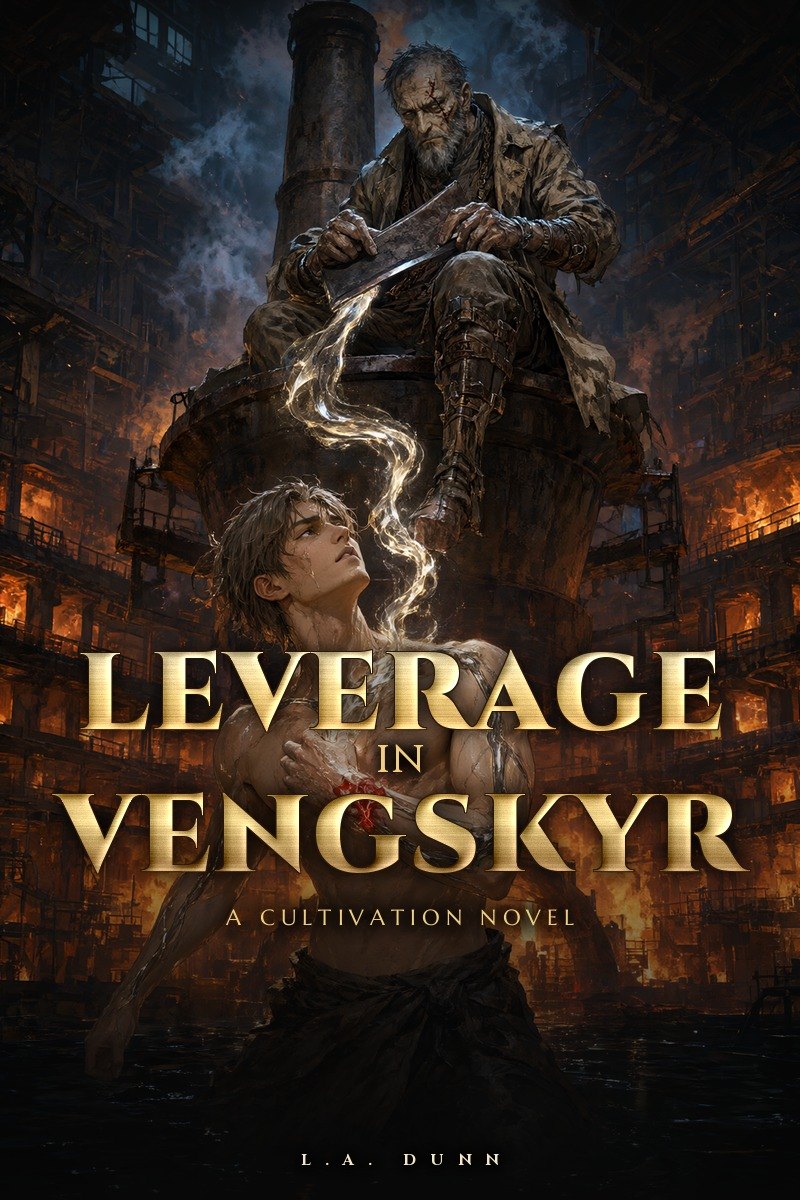
The Old Foundry opened into a cavernous vault of rusted catwalks and shattered crucibles. High above, narrow grates leaked streaks of gray fog, illuminating patches of black stone coated in centuries of soot. In the center of the hall, perched atop the cold lip of an iron-casting vat, sat Varnsk.
The master had his bad leg stretched out straight along the rim, his scarred boot dangling over the pit. In the gloom, the dark lines branded into his neck pulsed with a dull, leaden sheen. He was shaving dried salt-pork with a short skinning blade, flicking thin slivers into his mouth without glancing down.
"You're seven minutes late," Varnsk said, the blade clicking against his thumb nail. "A minute for each rib I should crack to teach you the value of an appointment."
"The bailiffs set a checkpoint at the Third Canal," Bramund replied, stepping onto the floor. The sole of his boot crunched on vitreous slag. "I had to take the overflow pipes under the tannery."
"I don't care if you swam through a slaughterhouse drain." Varnsk swallowed the pork, wiped the blade on his greasy trousers, and slid it into his boot cuff. "A corpse has no excuses, boy. It simply rots where it falls. Strip your coat."
Bramund did not hesitate. He unbuckled his brass ledger case, set it gently behind a heap of firebricks, and shrugged out of his damp wool coat. The cold bit into his linen shirt instantly. Beneath the cloth, the deep purple contusions from Borgund’s enforcers burned against his ribs. His right knuckles, split and scabbed where he had forced his blood into the iron covenant ink hours earlier, throbbed in time with his racing pulse.
Varnsk hopped down from the crucible. His landing on his good left leg was silent, while his right heel struck the slag with the heavy, dull thud of dead timber. He limped forward until he stood less than two paces away. The man smelled of bitter weed, stale tallow, and something sharp and ionizing, like the smell in the air right before lightning splits a mast.
"You think you bought a master with a bundle of old warrants," Varnsk murmured, his one good eye fixing on Bramund with cold disdain. "You think because your name is scribbled on municipal parchment, you are on the path to the high rings. Tell me, scrivener. What is an Ond-strand?"
"The condensed metallic essence of the city's bedrock," Bramund said, reciting the standard definition from the tournament registry treatises he had cataloged for years. "Drawn through controlled respiration, refined through the lungs, and anchored into bone marrow to multiply tensile strength and kinetic force."
Varnsk barked a dry, hacking laugh that echoed off the high rafters. "Book-rot. Academic slop written by fat clerks who never swallowed a lungful of raw ore in their lives."
The master stepped closer, his heavy calloused hand suddenly clamping around Bramund’s throat.
Bramund stiffened, fighting the instinct to pull back. Varnsk’s fingers were like iron calipers, pinching the carotid artery until blood pounded behind Bramund's eyes.
"Ond is not essence," Varnsk hissed into his face. "Ond is the refuse of the city's engine. It is pulverized iron, vaporized brimstone, and the kinetic resonance of three million tons of moving masonry, ground fine enough to float on the mist. It does not want to be your armor. It wants to tear your trachea into ribbons, turn your alveoli into rusted iron sponge, and drown you in your own froth."
Varnsk shoved him back. Bramund stumbled, catching his balance against the rough edge of a slag trough, coughing as air rushed back into his bruised throat.
"The weak cannot bind it because their flesh rejects the poison," Varnsk continued, pacing with his uneven, rhythmic limp. "They breathe it in, their chest seizes, and the back-pressure shatters their sternum like dry porcelain. To bind a strand, you do not invite it. You seize it. You drag it through your bloodline by force of will, pack it into the core of your marrow, and nail it down before it can burn its way out."
Varnsk stopped, tapping his own right collarbone. Under his grimy tunic, a dense, braided ridge bulged beneath the skin, looking less like bone and more like a twisted cable of cold-forged steel.
"I will teach you the intake once," Varnsk said flatly. "Five counts to draw the vapor deep into the lower diaphragm. Five counts to hold and compress the iron particulate against the inner lung lining. Five counts to drive the residue through the arterial root into the right clavicle. Then vent the slag-gas on the purge."
Bramund watched the master’s chest. When Varnsk inhaled, there was no gentle expansion of the ribs. His torso locked like an iron coffer, a low, metallic hiss whistling through his clenched teeth. The surrounding air seemed to warp, cold currents pulling tiny flakes of rust off the foundry floor and swirling toward his nostrils. For five long beats, the master remained motionless. Then, with a sudden, violent twitch of his neck, his skin grayed, and a jet of black, acrid smoke vented from his lips, sizzling as it hit the cold stone.
"Your turn," Varnsk said, folding his arms across his broad chest. "If you choke, do it quietly. I have no desire to carry a corpse up the sluice stairs."
Bramund closed his eyes for a single beat, centering his thoughts. He knew his body was at its limit. His ribs were cracked from Skeld's brass knuckles, his hands were battered, and his stamina was that of an office clerk who spent fourteen hours a day over ledgers. If he died here in an abandoned furnace, he thought with grim irony, it would at least spare Eirund the municipal cremation fee.
He squared his stance on the soot-stained flags, opened his mouth, and drew his first deliberate breath of the raw foundry air.
Pain hit him like a hammer striking an anvil.
It was not air entering his lungs; it felt like a shovel full of hot sand and iron filings dumped directly into his windpipe. The caustic vapor tore through his mucous membranes, searing the lining of his throat with immediate, blinding agony. His diaphragm spasmed violently, his chest locking in a desperate, primal reflex to cough and purge the intrusion.
"Hold it!" Varnsk’s voice cracked like a whip through the dark. "Compress! If you purge now, the back-draft will tear your windpipe open!"
Bramund clenched his jaw until his teeth groaned. Tears of pure reflex spilled down his cheeks, cutting clean tracks through the soot on his skin. Inside his chest, the pressure built with terrifying speed. The five-count compression felt like an eternity. He could feel the dense, microscopic shards of metallic Ond swirling in his lower lobes, heavy as mercury, scraping against delicate tissue.
One. Two. Three.
A sickening crack resonated inside his chest. One of his bruised ribs, strained by the unnatural pressure of the compressed gas, gave way with a sharp, sickening spike of agony. Blood rushed up his throat, filling his mouth with a hot, coppery froth.
Four. Five.
"Drive it!" Varnsk barked, leaning in, his gaze predatory and merciless. "To the bone, boy! Force it into the marrow!"
Bramund tried. He clamped his mental focus around the boiling mass in his chest, attempting to channel the burning weight toward his right collarbone, exactly as Varnsk had commanded.
Nothing moved.
The metallic vapor did not flow. Instead, the sudden constriction caused a violent hydraulic surge inside his chest cavity. The pressure rebounded against his bronchial walls like a closed floodgate in a drainage canal. His vision swam with spots of black and red. His throat was closing, paralyzed by the caustic burn. If the pressure built for two more seconds, his lungs would rupture from the inside.
It’s wrong, the thought flashed through Bramund’s panic with absolute, crystalline clarity. The ratio is wrong.
Bramund had spent seven years auditing the municipal waterworks and the pressure-release systems of the Lower Sluices. He understood fluid dynamics, back-draft thresholds, and mechanical resistance better than any street fighter in Vengskyr. Varnsk’s five-count compression technique was designed for a body that already possessed hardened meridians and conditioned flesh—a vessel capable of withstanding massive internal recoil.
For an unconditioned novice with fractured ribs, forcing a full five-count compression on raw atmospheric Ond was not training. It was an over-pressurized chamber with no bypass valve.
He was about to blow his own chest apart.
Bramund did not attempt to force the five counts. Nor did he panic and exhale all at once, which would draw the caustic fire back through his torn windpipe.
Instead, he altered the cadence.
He split the internal pressure. Using his tongue as a baffle against his palate, he created a micro-vent, releasing a tiny stream of scalding slag-vapor through his front teeth in a sharp, measured hiss. That relieved the lethal back-pressure in his upper bronchi.
Simultaneously, rather than trying to ram the entire unrefined mass of Ond into his bone in one clumsy surge, he treated the intake like a three-stage siphon.
Pulse one: filter the heavy grit. He let the coarse soot settle into his lower stomach lining to be coughed up later.
Pulse two: isolate the kinetic resonance. He drew the fine, ionizing charge of the metallic vapor upward, following the natural blood flow through the subclavian artery.
Pulse three: the anchor. He did not aim for the broad center of his clavicle where the bone was thick and unyielding. He directed the charging thread directly toward the base of his neck, where the Blood-Iron covenant had already burned a gateway into his flesh hours before.
The brand on his right wrist flared with cold, sympathetic resonance.
Now.
Bramund clamped his jaw and forced the refined filament of Ond down into the periosteum of his right collarbone.
A sound like an iron nail being driven into an oak beam echoed inside his skull.
The agony was instantaneous and profound, so sharp it turned his vision entirely white. The cold filament latched onto the bone, burrowing into the marrow cavity. It did not burn like fire; it froze. It felt as if liquid frostbite were being injected directly into the core of his skeleton, locking the fibers of his bone into a rigid, crystalline lattice.
His right shoulder violently seized, the muscle knotting so hard it threatened to rip from the joint.
With a ragged, shuddering gasp, Bramund expelled the remaining poisonous exhaust. A dense plume of black, sulfur-heavy smoke blasted from his mouth, spraying flecks of bloody phlegm across the foundry stones.
He dropped to his knees, his hands slapping into the cold slag.
His chest heaved, every breath rattling with fluid, but the catastrophic internal pressure was gone. The air he took in now, though cold and filthy, actually reached his blood.
Silence descended over the cavernous foundry, broken only by Bramund’s ragged, wheezing gasps and the distant, eternal hum of the city's gears.
Varnsk stood completely still. His scarred face, usually set in an expression of bored contempt, had hardened into a sharp, scrutinizing stare. His one good eye tracked from Bramund’s bloody lips up to his right shoulder.
There, resting just beneath the pale skin of Bramund’s collarbone, a single dark, metallic thread gleamed through the flesh. It looked like a thin vein of polished iron, perfectly anchored, taut as a bowstring, humming with a faint, almost imperceptible vibration.
"You modified the cadence," Varnsk said. His voice was low, devoid of its earlier mocking tone, replaced by something far more dangerous: curiosity.
Bramund spat a mouthful of dark, coppery phlegm onto the floor. He wiped his chin with the back of his bruised hand, his whole body trembling from the shock of the binding.
"Your five-count... is built for a forge that's already reinforced," Bramund rasped, his voice raw and scraped down to gravel. "An unconditioned chamber... needs a secondary release valve. Otherwise the back-draft ruptures the intake."
Varnsk slowly walked around Bramund, his wooden-heeled limp echoing against the iron walls. He stopped behind him, reached down, and dug his thumb with brutal force directly into the newly anchored strand on Bramund’s collarbone.
Bramund gritted his teeth, refusing to scream, though stars exploded in his eyes.
The strand did not snap. It did not disperse. Under Varnsk’s immense pressure, the iron-bound bone held fast, resisting the master's weight with the stubborn density of solid metal.
"A three-stage pulse," Varnsk muttered, more to himself than to Bramund. He lifted his thumb. "And you used the covenant resonance at the arterial branch to guide the root. You didn't just survive it. You anchored a true First Strand on your first breath."
"Did you... expect me to die?" Bramund asked, slowly pushing himself up from the floor, though his knees shook violently under the strain.
Varnsk did not smile, but a cold glint flickered in his eye. "Most clerks die on the third count. Their lungs drown in blood, and I drag them out to the tide-sluice before sunrise. It saves me the trouble of teaching someone who lacks the stomach for iron."
The master turned and walked back toward his perch on the casting crucible. "Do not celebrate, boy. One strand is not power. It is merely the anchor that keeps your skeleton from collapsing when real force strikes it. Against an enforcer with three bronze grafts, your single strand will snap your collarbone in half if you try to block a direct blow."
"I don't plan on blocking," Bramund said, testing the movement of his right arm.
The difference was startling. The right side of his upper torso felt strangely grounded, heavier, as if an invisible iron bar had been threaded through his muscle and bone. When he clenched his right fist, his split knuckles felt firmer, the loose rattle of exhaustion tightened into a sharp, coiled tension. It was only one strand, but for the first time in his life, Bramund possessed a fraction of martial leverage that did not rely on paper or bluffs.
"You won't have a choice in the ring," Varnsk said, picking up his whetstone and a dull iron scraper. "Borgund’s men do not fight with ledgers. They fight to break meat."
"I know how they fight," Bramund replied coldly. "They fight like men who have never had to calculate the cost of their mistakes."
Before Varnsk could answer, a sharp, metallic clatter echoed from the far end of the foundry.
The heavy iron chain securing the exterior sluice gate rattled violently.
Bramund froze. His newly bound strand hummed against his collarbone, the metallic vibration transmitting the kinetic tremor through the floor directly into his skeleton.
Two distinct sets of footsteps crunched on the gravel outside the drainage hatch. Low, guttural voices drifted through the iron grates.
"He went down the Sixth Sluice," a harsh voice muttered from beyond the door. "The soot on the ladder is fresh. Skeld said if the clerk isn't at his desk by dawn, we bring back his fingers."
Bramund looked down at his trembling legs. His lungs burned with every shallow breath, his rib throbbed with a fresh fracture, and his body was completely spent from the agony of the first binding. He could barely lift his brass ledger case, let alone run up the sluice stairs.
Varnsk sat atop the crucible, calmly sliding his whetstone along the iron scraper, his eyes cold and unmoving.
"Your guests, scrivener," the master said softly, not making the slightest move to rise. "Let’s see what your new strand is worth when the bill comes due."

Comments
Loading comments…