Chapter 5
Could a man with two days of martial cultivation survive sixty seconds against a three-meridian bronze adept without a ceiling to drop on him?
Bramund asked himself that question with every step he took down the slick granite stairs into the drowned sector. The stamped brass entry token felt like a lead weight in his vest pocket, tapping against his bruised ribs with the rhythm of a clock running down. He had forty-eight hours before the arena gates of District Six swung shut behind him. In an open sand pit, surrounded by five thousand screaming laborers and syndicate bookmakers, there would be no rotted shear-pins to snap and no overloaded scaffolding to bring down. If he stepped onto that sand with only a single Ond-strand anchored to his right collarbone, Borgund would cave in his chest before Bramund could even draw breath to negotiate.
Water dripped from the ceiling of the drainage vault, hitting the iron plates of the floor with dull, rhythmic clinks. The stench of stagnant canal grease, scorched slag, and bitter copper salt hung thick in the cold air.
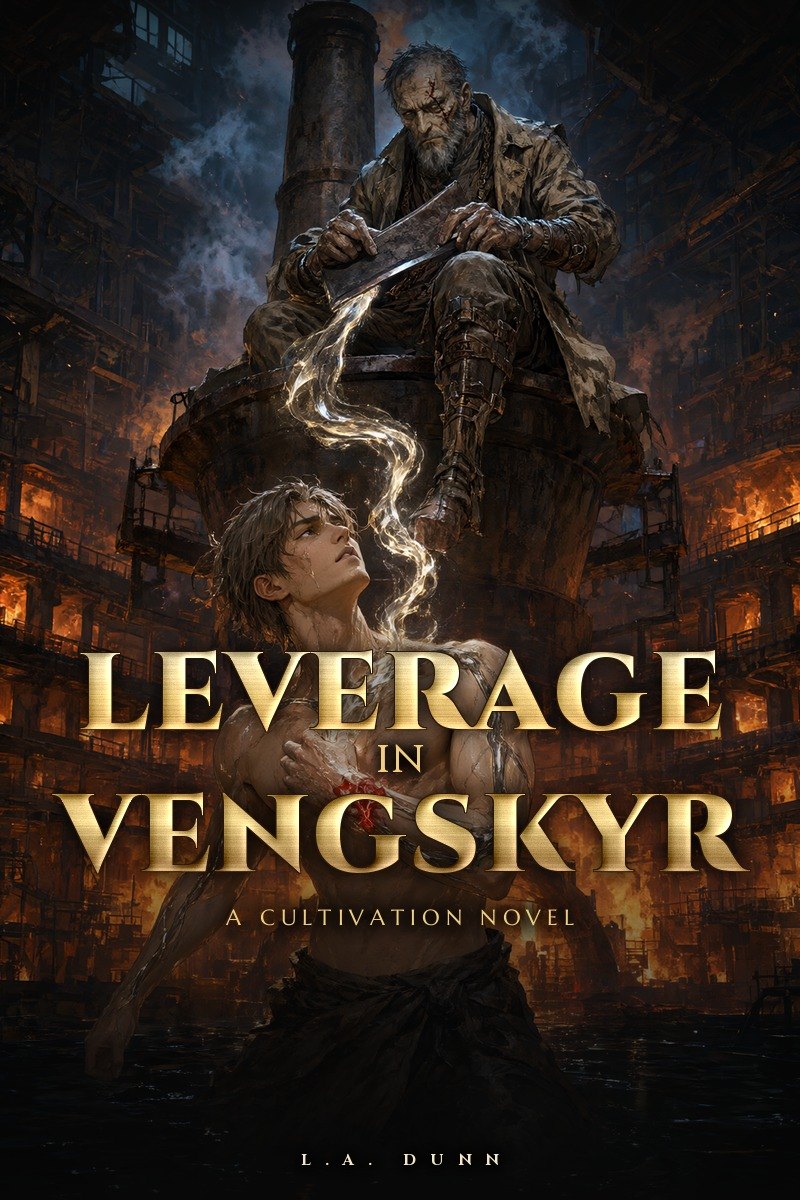
Varnsk was sitting atop a rusted crane housing near the dead smelting hearth, scraping dark grime from beneath his fingernails with the point of a curved skinning knife. His withered left leg hung limp over the edge of the steel beam, wrapped in oilcloth bandages stained with gray soot. He didn't look up when Bramund’s boots splashed through the shallow scum on the floor.
"You smell like wet parchment and dead bailiffs," Varnsk said, his rasp carrying easily over the hiss of leaking steam. "Halvask didn't hang you from the bridge?"
"Halvask took twelve iron marks and stamped the parchment," Bramund said. He reached into his coat, pulled out the brass token, and tossed it upward.
The token turned twice in the air. Varnsk’s right hand moved with blur-fast precision, snatching the metal disk out of the dark before Bramund could blink. The exiled master brought the token to his crooked nose, sniffed the greasy stamp of the registrar's seal, and let out a dry, rattling cough that passed for a laugh.
"District Six preliminary roll. Stamped under the Iron Talon lineage." Varnsk turned the token between two calloused fingers. "You gave an extortionist your name, boy. Borgund owns three junior magistrates and twenty canal dredgers in that district. He will have seen the roll before the ink was dry."
"He already saw it," Bramund said. He stopped five paces from the crane, his hands resting lightly on the brass frame of his ledger case. "He didn't just see it. He paid sixty gold marks to the Grand Registrar to buy out the draw. My opening match is against Borgund himself."
Varnsk paused. The knife point stopped halfway along his thumbnail. He looked down at Bramund, his pale, scarred eyes narrowing until they looked like slits in a block of cracked tallow.
"Sixty gold," Varnsk murmured. "The fat slug actually spent coin on you. He must want your tongue cut out in public very badly."
"He wants the ledger, and he wants to make sure nobody in the Lower Sluice thinks an audit clerk can push him off a wharf," Bramund replied evenly. "I have forty-eight hours to prepare. One strand along my clavicle gives me enough kinetic bite to shatter an unreinforced pin, but it leaves my left side open and drains my marrow after three strikes. I need the second strand."
Varnsk stared at him for three slow breaths. Then his scarred face split into a grin that had nothing to do with humor and everything to do with cruelty.
"The second strand," Varnsk mocked softly, dropping from the crane beam. He landed on his sound right leg with a dull clang of boot heel on steel, his crippled left foot trailing behind like dead weight as he leaned on a notched iron rod. "Listen to the clerk. He took half an hour to draw a single thimble of metallic dust into his collarbone without vomiting his spleen, and now he wants to weave a second line before the first has even calcified into the bone matrix."
"I don't have the luxury of six months of breathing exercises," Bramund said. "You have the forge, you have the flue controls, and the writ says you teach me."
"The writ says I teach you to survive the trial," Varnsk snapped, his voice dropping into a harsh gravel rasp. "It doesn't say I have to keep your skeleton from blowing apart like an over-pressurized boiler because you're in a hurry to die in an arena. When you force a second strand into an unconditioned marrow, the two currents fight for balance. The first strand pulls from the center out to the right; the second strand has to sit in an opposing limb to create a counter-lever. If the resonance spikes before the anchoring takes, the bone doesn't just crack. It turns to gravel inside the meat."
"Then show me how to balance the lever," Bramund said. He took off his hide coat, folded it carefully, and set it on a dry corner of a rusted workbench alongside his ledger case. Beneath his linen undershirt, the bruise over his fractured rib showed as a dark, mottled purple, calmed only slightly by the copper-salt salve he had smeared across the skin that morning. "Where does the second strand go?"
Varnsk stepped close. The scent of burnt tallow, iron filings, and old blood rolled off the master in waves. Varnsk raised his notched rod and struck Bramund’s left forearm—a sharp, stinging tap against the ulna that sent a bolt of pain down into Bramund's wrist.
"Here," Varnsk growled. "The left radius and ulna. A twin-track anchor. If you lock the Ond into the forearm, you can form a two-point shear with your right shoulder. It gives you a bracing line across your chest. When you strike with the right, the left arm absorbs the recoil into the ground. If you miss with the right, the left can lock a joint or snap an edge."
"And if the intake overloads?" Bramund asked, rubbing his aching forearm.
"Then the bones of your left arm burst through the skin like split kindling," Varnsk said cheerfully. "You drop your ledger, you bleed out into the bilge water, and I take your boots and sell your brass case to a pawn-broker on the wharf for six copper bits. A tidy morning's business."
"You won't get six coppers for the case," Bramund muttered. "The hinges are worn. Let's start."
Varnsk’s pale eyes gleamed with malicious anticipation. He turned toward the massive, soot-blackened smelting hearth at the back of the vault. The hearth was connected to the central municipal steam conduit through three massive bronze flues, each sealed with a heavy butterfly valve locked by rusted iron turn-wheels.
"Climb onto the dressing slab," Varnsk ordered, pointing his rod toward a thick granite bench positioned directly beneath the central flue exhaust. "Strip the wraps from your wrist. When I open the second valve, the flue won't just bleed ambient dust like it did in the outer foundry. This is raw intake from the deep ore-reduction crucibles beneath District Four. The air will feel like breathing ground glass. If you lose the three-stage rhythm for even two counts, the Ond will flood your lungs and roast your windpipe from the inside."
Bramund climbed onto the cold stone slab. The granite was pitted and stained with the grease of a hundred failed apprentices from decades past. He sat cross-legged, peeled back the damp linen sleeve of his left arm, and checked his wrist.
The Blood-Iron brand—the jagged sigil of the Iron Talon writ—glowed with a faint, sour crimson heat beneath his skin, still sensitive from when he had sealed the contract with his own torn knuckles. Along his right collarbone, the single Ond-strand he had bound yesterday hummed like a plucked wire, reacting immediately to the faint metallic charge leaking through the floorboards.
"Remember the count," Bramund told himself quietly, settling his breathing. "Three counts of shallow draw through the nasal bridge to filter the soot. Hold for one count at the clavicle nexus to temper the heat. Exhale the ash through the teeth. Then force the pure metallic charge down the left brachial path."
"Talking to yourself won't cool the slag, boy," Varnsk called from the control station.
The master gripped the heavy iron turn-wheel of the second flue and shoved his weight against it.
With a shriek of ungreased metal, the bronze valve rotated.
A deep, subterranean roar vibrated through the foundation of the foundry. From the mouth of the central exhaust duct overhead, a thick plume of shimmering, iridescent gray vapor billowed out. It was not smoke; it was vaporized heavy ore, charged with the dense, raw Ond of the city’s tectonic rebuilding engines. The temperature in the vault spiked instantly, the damp chill evaporating into a dry, scorching heat that smelled of molten brass and sulfur.
"Draw!" Varnsk barked, his voice cutting through the roar of the flues. "Don't stare at it, you fool! Pull it in before the slag settles!"
Bramund closed his eyes and inhaled.
The first breath felt like swallowing a handful of hot iron filings. The searing vapor hit the back of his throat, stripping away moisture in a fraction of a second. His lungs spasmed violently, wanting to reject the toxic mineral cloud, but Bramund clamped his jaw shut, forcing the intake through the three-stage filter he had deduced during his first trial.
Count one: Draw the vapor into the upper nasal passages, allowing the coarse carbon soot to catch on the mucous membranes while the energized metallic ions passed deeper.
Count two: Compress the charge at the base of his throat, where his right clavicle strand acted as an intake valve.
The moment the raw Ond touched his right collarbone, the anchored strand went wild.
A piercing shriek echoed in Bramund’s inner ear. The single strand of invisible iron along his clavicle vibrated at violent speed, heating until the skin above it blistered. The existing strand didn't welcome the new intake; it fought it like a territorial beast, rejecting the turbulent influx of raw ore. A wave of concussive pressure backed up into Bramund’s chest, threatening to tear the healing fracture in his rib wide open.
Blood welled up in Bramund’s mouth, thick and salty with the taste of copper.
"Control the branch!" Varnsk’s rasp came from somewhere through the shimmering heat haze. "The right strand is an anchor, not a sponge! If you let it gorge on the intake, it will crack your sternum! Shunt the load down the left shoulder! Now!"
Bramund didn't panic. Panic was a luxury for people with margins in their ledgers. In municipal audits, when a primary conduit suffered hydraulic hammer from an over-pressurized reservoir, you didn't try to clamp the main pipe; you opened a secondary bypass to bleed the kinetic head before the joint ruptured.
He visualized the conduit network inside his own flesh.
His right collarbone was already reinforced, rigid as a steel bar. Instead of letting the new intake pile up against it, Bramund actively contracted the muscles of his neck and chest, forming a biological wedge. He redirected the surging torrent of raw metallic Ond across the sternum, driving it into the unconditioned flesh of his left shoulder.
The pain was instantaneous and sickening.
It felt as though someone had driven an iron chisel into his shoulder socket and struck it with a ten-pound sledge. The raw Ond scraped through the muscle tissue, tearing micro-channels through the fascia as it poured down his upper arm toward the elbow.
His left arm jerked uncontrollably, fingers clawing at the rough surface of the granite bench.
Count three: Guide the charge through the elbow hinge and split the stream into two tracks along the forearm—one into the radius, one into the ulna.
The metallic vapor inside his bones began to condense. The temperature in his arm climbed to an agonizing pitch. The mineral essence was attempting to crystallize, but the bone marrow was too hot, the natural moisture of his body turning to steam and creating pockets of explosive pressure along the bone sheath.
Cracking sounds—faint, wet, and terrifying—echoed along the length of his left forearm.
"It's rejecting the marrow," Bramund realized through the haze of agony. The unconditioned bone was too dry, its internal porosity too dense to absorb the heavy metallic fibers without shattering.
With his right hand, Bramund fumbled at his belt. He didn't reach for water or medicine; he grabbed the small ceramic jar of grade-three marrow-salve he had taken from Kolsk's corpse. With a flick of his thumb, he knocked the clay lid off and jammed two fingers into the greasy, greenish-gray paste.
He didn't swallow it. Swallowing it would take twenty minutes to diffuse through the digestive tract into the bloodstream—time he didn't have.
Bramund slammed the cold, copper-salt salve directly onto the bare, blistering skin of his left forearm, smearing the thick grease from his elbow to his wrist with rough, desperate strokes.
The chemical reaction was immediate. The cooling salts in the salve penetrated the overheated dermis, creating a steep temperature drop across the outer surface of the arm. The sudden thermal contrast forced the expanding steam pockets inside his bone sheath to collapse inward rather than blowing outward through the periosteum.
"Clever rat," Varnsk muttered from the flue station, watching through the smoke with sharp, appraising eyes. "Using the salve as a quench. But the charge is still backing up at the wrist. Vent it or lose the hand!"
The hydraulic pressure was reaching its peak. The twin streams of condensing iron-Ond had reached his left wrist, but with no exit path and no anchor point, the kinetic energy was pooling in the small carpal bones, threatening to crush his hand from the inside out.
Bramund gritted his teeth so hard his gums bled.
He didn't have an anchor at the wrist—except for one thing.
The Blood-Iron brand.
The covenant sigil carved into the skin of his inner left wrist was made of alchemically treated iron ink that resonated with the city's legal wards. It had its own metallic frequency.
Focusing every shred of his will, Bramund drove the twin streams of raw Ond straight into the lines of the brand.
The brand flared brilliant, blinding red.
The jagged lines of the Iron Talon contract burned like white-hot wire against his flesh. Excess kinetic charge roared through the sigil, venting out into the ambient air of the vault in a crackling shower of crimson sparks. The sudden release of back-pressure stabilized the flow, allowing the cooling, condensed metallic fibers inside his forearm to settle into the vacated channels of his bone marrow.
One second. Two seconds. Three seconds.
Bramund drew one final, ragged breath through his teeth, pulling the last trailing vapor from the air into his chest, and locked his diaphragm.
Along the radius and ulna of his left forearm, the two streams cooled, hardened, and snapped into alignment.
A deep, metallic chime resonated through Bramund’s skeleton—a harmonic ring that vibrated from his left knuckles all the way across his chest to the anchored strand on his right collarbone. The two poles connected. A circuit of invisible iron was forged across his upper torso, humming with cold, steady, lethal tension.
The second strand was bound.
Bramund slumped forward onto the granite bench, his forehead striking the cold stone with a dull thud.
The flue valve overhead slammed shut with a concussive boom as Varnsk released the lever. The roar of escaping steam subsided into a thin, dying hiss. The thick metallic smoke began to drift out through the high ventilation grates, leaving the vault in heavy, suffocating silence.
Bramund lay on the slab, his body trembling violently. Every muscle in his chest and arms felt as though it had been beaten with lead pipes. His left arm was completely numb from the elbow down, covered in a mixture of melted salve, soot, and sweat. The skin along his forearm was discolored—a pale, slate-gray hue that showed the presence of the twin metallic lines running deep within the bone.
He tried to push himself up, but his right shoulder refused to bear weight. He coughed, spitting a thick gob of dark, iron-tasting phlegm onto the granite. At standard municipal rates, three counts of lethal instruction without hazard pay carried a forty-mark fraud penalty; he made a silent note to deduct it from whatever debt he might someday owe the old monster.
"Still breathing," a harsh voice said.
Varnsk hobbled over to the bench, leaning heavily on his iron rod. The master looked down at Bramund’s slate-gray left forearm, then reached out with his leather-wrapped hand and pressed a thumb hard against the ulna.
A sharp jolt of electric pain shot through Bramund’s nerves, but the bone held firm. It didn't flex. It didn't crack. It resonated with the solid, dead thrum of cast iron.
"The twin tracks anchored," Varnsk said, his tone flat and devoid of praise, though his pale eyes betrayed a cold, calculating interest. "You used the brand as a bleed-valve. Most apprentices try to swallow the whole surge and end up with their wrist bones protruding through their palms like broken teeth."
"I told you," Bramund croaked, his voice raw and scraped bare from the mineral heat. "I understand pressure. You open a bypass... you save the pipe."
"You saved the bone," Varnsk said, pulling his thumb back. "For now."
Bramund slowly dragged himself into an upright position, his back resting against the cold masonry of the flue support. His left hand was pale and stiff; when he curled his fingers into a fist, he could feel the terrifying, heavy density running through his radius and ulna. It felt as though two solid iron rods had been hammered into his flesh. If he channeled his focus, the balance between his right collarbone and left forearm created a rigid kinetic axis across his chest. He was no longer just an audit clerk with a single fragile strike; he had an opposing brace.
"How long until the marrow stabilizes?" Bramund asked, massaging his aching shoulder.
"It doesn't," Varnsk replied coldly.
Bramund looked up, his eyes narrowing. "What do you mean it doesn't?"
Varnsk rested his weight on the iron rod and leaned down until his scarred face was inches from Bramund’s.
"You forced a high-grade ore surge into unconditioned bone in less than four minutes," Varnsk said, tapping the slate-gray skin of Bramund’s arm with the tip of his knife. "The strand is anchored to the outer bone sheath, but the marrow inside is running at white heat. The copper salve cooled the dermis, but it didn't quench the deep core. In twelve hours, the marrow will begin to blister. In twenty-four, the bone tissue will undergo calcified necrosis. By the time you step into the arena to face Borgund in two days, your left arm will be as brittle as dried clay. One punch from his bronze-grafted fist, and the entire limb will shatter into powder."
Bramund’s heart gave a cold, hard lurch. He stared at his gray forearm, feeling the deep, unnatural throbbing heat radiating beneath the numbness.
"You knew this would happen before you opened the flue," Bramund said, his voice dropping into the quiet, dangerous cadence he used when discovering altered numbers in a merchant's books.
"Of course I knew," Varnsk chuckled, straightening up. "I'm an exiled master of the Iron Talon lineage, boy, not a charitable doctor from the upper wards. Training without proper medicine is suicide. Everyone in Vengskyr knows that."
"What medicine?" Bramund demanded.
Varnsk reached into the folds of his grease-stained coat and withdrew a small, heavy glass flask. Inside, a dense, shimmering liquid of deep cobalt blue swirled sluggishly, glowing with a faint, crystalline phosphorescence.
"Kobal-vein distillate," Varnsk said, holding the flask between two scarred fingers. "Mined from the deepest sluices beneath the Third Ring. It’s an alchemical coagulant. Drink this within six hours, and it quenches the internal heat of the marrow, cementing the new Ond-strand permanently into your skeletal matrix. Your bone density will double, and your left arm will be arena-ready by tomorrow night."
Bramund reached out his right hand for the flask.
Varnsk pulled it back, a cruel, mocking smile spreading across his thin lips.
"Nothing in Vengskyr is free, clerk," Varnsk said. "Especially not life-saving medicine."
"The writ," Bramund said, his eyes hard. "You agreed to train me in exchange for the debt ledger on the Western Wharves."
"I trained you," Varnsk countered smoothly, tapping his iron rod on the floor. "I showed you the stance, I operated the flue, and I watched you bind the second strand. The writ says nothing about supplying rare alchemical distillates from my personal stores. You want the Kobal distillate? Then we write an addendum to our contract."
Bramund leaned forward, ignoring the throbbing pain in his rib and arm. "What terms?"
Varnsk set the heavy glass flask down on the edge of the granite bench, precisely three inches beyond Bramund’s reach.
"Twenty-five percent of all tournament purses from every match you fight in the preliminary and secondary brackets," Varnsk said, his rasp deliberate and sharp. "Plus exclusive salvage rights to all martial gear, tokens, and cultivation materials recovered from the corpses of your opponents. If you survive Borgund and advance to the Second Tier, that twenty-five percent applies to every purse until the decennial reconstruction begins."
Bramund stared at the cobalt vial, calculating the brutal economics of the demand.
Twenty-five percent was extortionate. Combined with the standard municipal arena tax of fifteen percent and the district filing levies, Varnsk was asking him to hand over nearly half of every mark he would earn by bleeding in the sand. But without the distillate, his left arm would rot from the inside out within thirty-six hours, leaving him a one-armed cripple against Borgund’s crushing bronze meridians.
Varnsk had played the negotiation perfectly—withholding the true cost of the second strand until the physical damage was already done and irreversible.
"You drive a hard bargain for a man hiding in a flooded sewer," Bramund said softly.
"I am an exiled master," Varnsk said, his smile cold and razor-sharp. "And you are an apprentice who needs to kill an enforcer in forty-eight hours. Do we write the addendum in blood, or do I watch your arm turn to chalk?"
Bramund looked down at the Blood-Iron brand on his wrist, then back at the glowing blue flask on the stone. He reached over to his workbench, unlatched the brass clasp of his ledger case, and pulled out a fresh sheet of contract parchment.
"Get the iron ink," Bramund said. "We have an agreement to draft."

Comments
Loading comments…