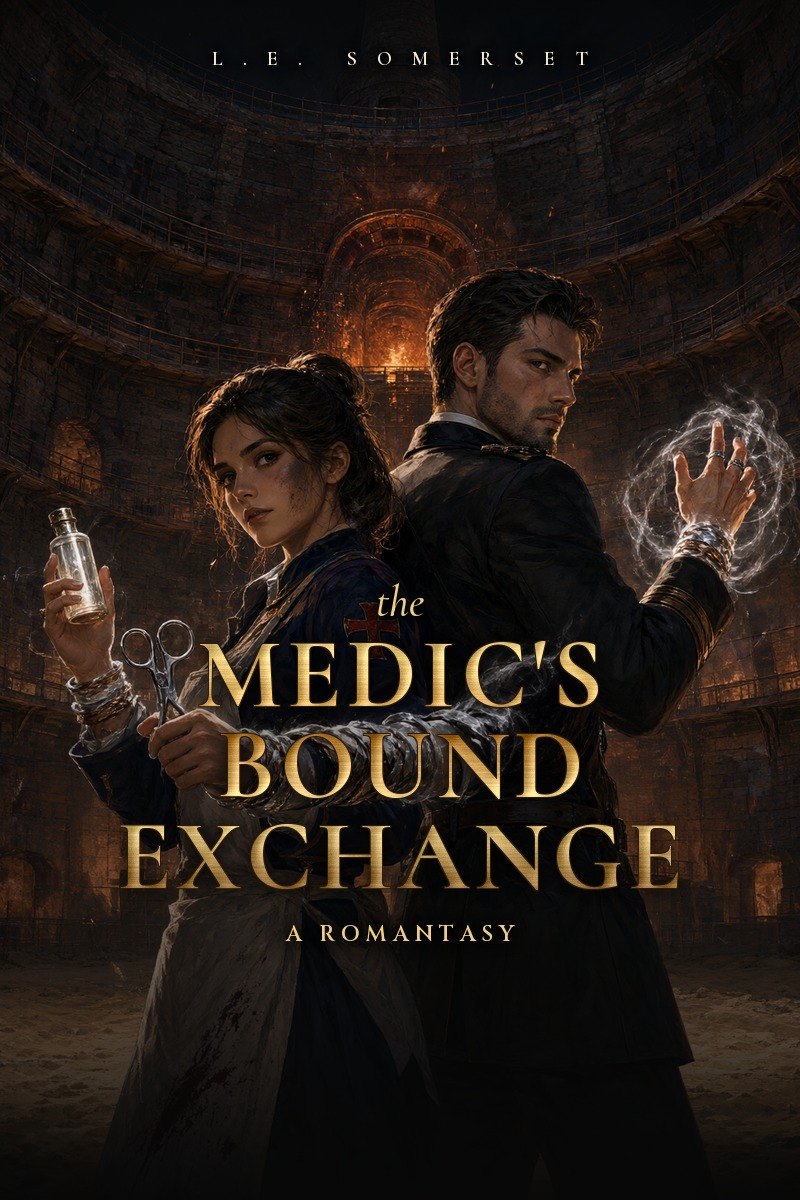
Chapter 5
The lock on the subterranean archive had three deadbolts, but only one took a key. The other two drank blood, and I had no intention of offering mine to an Instituto ward before I knew what was written on the other side.
I crouched on the wet slate of the lower cloisters, my fingers cold inside my leather gloves. Two stories above our heads, the bells of the central courtyard chimed the second hour of the morning. Five hours remained before morning muster. Five hours before Professor Aranda called the exchange roll and noticed that his newest bonded pair was missing from their quarters.
"Get back," Matias said.
His voice was a low rasp against the dripping silence of the vault passage. He stood two paces behind me, his back pressed to the damp limestone wall, his left hand resting on the hilt of his short combat rod. His right hand remained bound in the clean linen I had wound around his fractured metacarpal an hour ago. Under the sleeve of my own coat, the silver band of the Enforcement Pact pulsed with a faint, rhythmic heat that matched the cadence of his pulse.
"If you hit this plate with kinetic force," I whispered without looking up, "the vapor trap inside the tumblers will dissolve our lungs into brown foam before we reach the bottom of the stairs."
"I am aware of how our traps work, Flores."
"Then stop hovering over my shoulder like an executioner waiting for a signal."
"I am not hovering."
"You are casting a shadow across my lockpick."
Matias shifted his weight. The leather of his harness creaked, dry and taut. He did not step away, but the shadow tilted, letting a slant of lantern light fall across the greenish corrosion on the bronze faceplate.
I leaned closer, inhaling through my nose. The air in the passage smelled of wet rock, sulfur, and the sharp, almond stench of raw arsenic. The Instituto did not keep its records under ordinary iron. For seventy years, every treaty, disciplinary warrant, and supply allotment between our schools had been filed in these damp cellars, guarded by wards designed to kill thieves and rot unwarded skin.
"The plate is primed with an arsenic-vitriol seal," I said, setting my field kit flat on the stone floor. "If the tumblers drop without the neutralizing agent, the glass capsule behind the shear pin shatters. It vents through the keyhole."
"Can you clear it?" he asked.
"Do you want the honest answer or the one that keeps you from pacing?"
"The fast one."
"I need three minutes and your focus ring."
Matias looked down at his left hand. A plain band of blackened iron sat on his index finger, dull and unadorned. It was the standard vanguard conductor, designed to channel kinetic shock without melting under high friction. He pulled it from his knuckle with a sharp twist and dropped it into my open palm. The metal was still warm from his skin.
I unrolled my canvas kit, selecting a narrow steel bodkin, a glass phial of powdered sulfur, and a small tin of refined bone charcoal.
"Hold the lantern," I said.
He took the handle of the oil lamp in his good left hand, lowering the beam until the bronze plate gleamed with oily moisture. His face was carved from hard lines and shadows in the yellow light, his jaw set in that rigid, unyielding angle he used whenever he was forced to rely on someone else.
I poured a pinch of sulfur into the hollow rim of his iron ring, added two drops of neutralized spirit from my field dropper, and stirred the slurry with the tip of the steel bodkin. The mixture hissed, turning a dark, curdled grey.
"What is that?" he asked.
"Precipitating wash," I said, leaning toward the lock. "Sulfur binds the arsenic vapors before they expand. Charcoal absorbs the acid carrier. If I coat the tumblers before the shear pin trips, the gas neutralizes into inert sludge instead of eating our faces."
"A field medic's trick."
"An apothecary's survival tactic. At Ouro, we learn how to handle poison before we learn how to suture a severed artery."
I guided the coated needle into the keyhole. The bronze tumblers resisted, stiff with age and damp grease. My fingers were steady, though a dull ache throbbed in my right palm—a sympathetic echo from the sutured cut on Matias's hand. Every time his muscles tightened against the lantern handle, the tension flared along my own tendons.
"Careful," he murmured.
"I am being careful."
"You are forcing the second tumbler."
"The second tumbler has thirty years of verdigris on it. If you want to take the needle with your broken knuckles, be my guest."
Matias did not reply. He merely lowered the lamp another inch, keeping the light pinned exactly where my bodkin met the keyway. The heat of his body pressed close against the chill of the subterranean vault, a solid, immovable weight at my back.
The first pin gave with a wet, muted click. A thin thread of yellowish vapor leaked from the brass bezel, hit the sulfur paste, and died instantly into a crust of harmless black salt.
I drew a slow breath through my teeth. "One."
"Two pins left," he said.
"I can count, Valdivia."
I worked the bodkin deeper, feeling for the secondary shear pin. The mechanism was archaic but lethal, forged during the first border skirmishes when the two academies fought over the northern copper veins. To my left, the iron grating of the outer cloisters rattled under a distant gust of wind from the upper courtyards. Somewhere up above, the watch wardens were making their rounds, their boots ringing on the granite flags.
If they caught us here, Aranda would not need an excuse. An unsanctioned duel in the sub-vaults was a disciplinary breach; breaking into the central administrative archives was treason against the exchange mandate. He would strip our insignias, seal our magic, and dump us into the salt quarries before the sun cleared the eastern peaks.
"Between your broken hand and my total lack of offensive magic," I said, twisting the bodkin a quarter turn, "we make the most heavily monitored suicide pact in the history of both schools."
"You talk too much when you work," Matias said.
"It keeps me from thinking about what happens if my hand slips."
"Your hand will not slip."
The second pin snapped into place. A faint shudder ran through the iron frame of the door. The third tumbler followed a second later with a heavy, hollow thud that echoed down the stone corridor.
The heavy oak door swung inward by two inches, releasing a blast of dry, frigid air that smelled of ancient paper, cedar shavings, and dried ink.
I let out the breath I had been holding, retrieved Matias's ring from the stone, wiped the black paste from the iron with the hem of my coat, and handed it back to him.
"You're welcome," I said.
Matias slid the iron band back onto his finger. His dark eyes held mine for a fraction of a second in the amber lantern light, sharp and assessing.
"Let's move," he said.
We slipped through the narrow gap into the archive, pulling the heavy door almost shut behind us to block the lantern's glow from the hallway.
The room was vast, cold, and buried deep beneath the foundations of the central tower. Rows of towering iron bookcases stretched into the gloom, their shelves crammed with bound leather folios, lead-sealed cylinders, and crumbling stacks of parchment. High above our heads, the vaulted ceiling was ribbed with black iron conduits that hummed with a low, vibrating resonance—the magical arteries that fed the Instituto's upper defensive wards.
"Where is the disciplinary registry?" I whispered, lifting the lantern.
"North alcove," Matias said, moving ahead of me with silent, predatory steps. Even with one hand injured, he moved like a soldier clearing an ambush zone, his eyes scanning every shadow, every shelf, every corner of the stone floor. "The third tier holds the exchange treaties. The lower cabinets hold the disciplinary warrants."
"We need the original charter for the Enforcement Pact," I said, hurrying after him. "Aranda used a standard five-to-one transference formula when he cast the seal. There has to be a recorded counter-clause. Every binding spell registered under the dual-academy accords requires a mutual release mechanism."
"There is no release mechanism," Matias said, not breaking stride.
"Everything has an exit clause, Valdivia. Even military treaties."
"Not this one."
He stopped before a massive iron cabinet set directly into the stone wall of the northern alcove. The doors were secured with a heavy iron latch stamped with the double-headed hawk of the Instituto's administrative council. A layer of grey dust coated the brass fittings, undisturbed for months.
Matias set his left boot against the base of the cabinet, hooked his fingers under the iron latch, and pulled. With a sharp, metallic screech that set my teeth on edge, the corroded rivets sheared away from the stone.
"Subtle," I muttered.
"Speed over elegance," he said.
I stepped in front of him, setting the lantern on a dusty reading lectern. The cabinet was packed with thick, calfskin-bound ledgers, their spines stamped with gilded dates and imperial seals. I scanned the titles, my fingers trailing over the cracked leather.
Accords of the Third Partition.
Disciplinary Protocols: Class of 482.
Somatic Bindings and Vanguard Sanctions.
"Here," I said, pulling down the heaviest volume. The leather was stiff, smelling of vinegar and lye.
I flipped the parchment leaves until I reached the section marked with Aranda's personal wax stamp—a stylized serpent coiled around an iron balance.
The entry was dated three years prior: Protocol of Mutual Somatic Coercion (Enforcement Pact).
I traced the Latinate script with my gloved thumb, reading the dense legal boilerplate as fast as my eyes could track.
"The pact requires the physical blood of both subjects and the signet seal of a presiding adjudicator," I read under my breath. "Trauma is distributed inversely to magical capacity. The dominant vanguard channeler absorbs five shares of somatic disruption; the secondary vessel absorbs one share."
"I told you," Matias said, his shoulder brushing against mine as he leaned over the lectern to read. "Five to one. It is designed to keep the vanguard from killing their handler."
"Listen to this," I whispered, tapping the bottom of the folio. "'The binding may be dissolved only under three explicit conditions: first, by the unanimous decree of the joint academic tribunal; second, by the formal application of the caster's personal signet key; third, upon the cessation of biological function in either subject.'"
Silence settled over the alcove, heavy and suffocating.
"No counter-ritual," Matias said. His voice was completely flat, drained of all inflection. "No administrative loophole."
"He knew that when he cast it," I said, a cold knot tightening in the pit of my stomach. "Aranda knew there was no way for us to sever it on our own. He didn't lock us together to discipline us. He locked us together because as long as I am attached to you, you can't fight at full capacity without risking my life—and I can't leave your side without collapsing from the tether."
"It's worse than that," Matias said quietly.
He reached past me, his fingers turning the heavy pages backward toward the requisition indices at the front of the volume.
"Look at the disbursement logs," he said.
I stared down at the lines of neat, cramped handwriting.
Under the heading for the current term, third week, there was a series of requisition entries stamped with Aranda's serpent seal.
Item 14: Two crates of high-grade surgical vitriol, uncertified Ouro origin. Confiscated under Health Ordinance 4. Logged as condemned surplus.
Disposition: Transferred to Sub-Vault Repository B-7.
"He didn't destroy our supplies," I said, my voice shaking with sudden, cold fury. "He told the assembly he burned them at the gate because they were contaminated. He stole them."
"Keep reading," Matias said.
My eyes dropped to the very next line.
Item 15: Refined cinnabar flux, three ounces. Released from central stores to Adjudicator Aranda for tactical conditioning.
Recipient: Third-Year Vanguard Santino.
The date on the requisition was yesterday afternoon. Four hours before Santino stepped onto the sand of the blast furnace pit and tried to tear Matias apart with unhinged kinetic strikes.
"Santino didn't buy the flux on the black market," I whispered, the realization hitting me like a physical blow. "Aranda gave it to him. Aranda poisoned his own student with an unstable combat stimulant, pushed him into an illegal duel, and waited for you to kill him."
"If I had killed Santino," Matias said, his jaw tightening until the muscle stood out like corded wire, "the exchange council would have executed me for murder under the treaty laws. The Instituto's vanguard line would have fallen under Aranda's direct command."
"And when I kept Santino alive," I said, looking up at him, "I ruined the entire setup. You didn't become a murderer, Santino survived to talk, and Aranda was left holding an unsanctioned duel with no dead body to justify an expulsion."
"So he bound us," Matias finished. "To silence you, cripple me, and buy time until he can stage another incident."
I reached into my inner pocket, pulled out my small surgical shears, and carefully aligned the blade against the gutter of the ledger. With two swift, silent cuts, I sliced the requisition pages free from the binding.
"What are you doing?" Matias demanded, grabbing my wrist.
His grip was fierce, his fingers digging into my coat sleeve. The silver band flared with sudden heat, sending a sharp prickle of alarm straight up my forearm.
"I am taking our leverage," I said, pulling against his grip without flinching. "If we walk out of here with nothing, we are two lambs waiting for Aranda's next training accident. If I have these pages, we have proof of treason against the exchange accords."
"If they find those leaves on you, it is an automatic death sentence."
"They have to catch me first."
I folded the parchment into a tight square and shoved it deep into the waterproof lining of my medical satchel, right next to the three silvered vitriol vials I had won from Tadeo.
Matias stared at me. For three long seconds, neither of us moved. The tension between us was sharp enough to draw blood, but under the anger in his eyes, something else flickered—a dark, reluctant recognition.
He let go of my wrist.
"You are reckless, Flores."
"I am pragmatic, Valdivia. There is a difference."
Before he could answer, the floor beneath our feet gave a sudden, sickening shudder.
High above the iron shelves, the black conduits began to hum—not with their usual low vibration, but with a rising, piercing shriek.
Three clicks echoed from the threshold.
The air in the room grew instantly heavy.
A brass bell began to toll.
The floor tiles beneath the reading lectern lit up with a brilliant, blinding crimson lattice. An acoustic resonance ward, hidden beneath the slate flags, had snapped awake, triggered by the missing weight of the excised parchment.
"Move!" Matias snapped.
He lunged forward, his left arm hooking around my waist as he dragged me backward just as the stone flag where I had been standing shattered into a shower of pulverized gravel.
Across the cavernous archive, the heavy oak door we had entered through slammed shut with a deafening crash, followed by the grinding screech of an iron portcullis dropping into the stone threshold.
From the ventilation shafts above, the warning bells of the central tower began to scream into the night.
Matias kicked the nearest reading table across the charging ward line, pulling his rod.
"Into the flue," he said, shoving me into the dark.

Comments
Loading comments…