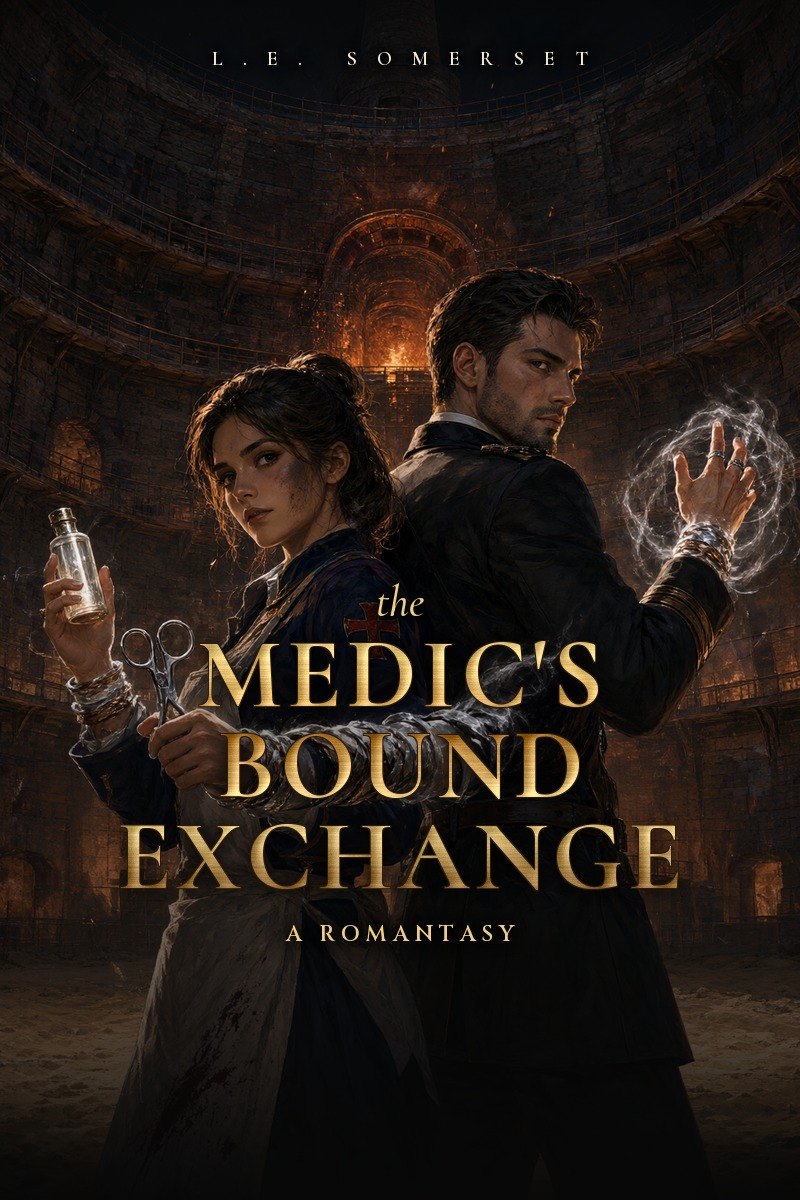
Chapter 7
The apothecary workbench smelled of dried pennyroyal, rancid walnut oil, and decades of undisturbed lime dust.
Matias lay motionless on the cold flagstones where he had collapsed against the cupboard, his boots leaving twin scuffs in the grime. The somatic tether pulled at the center of my ribs like a frozen wire, each erratic flutter of his heart sending a nauseating tremor through my own breastbone.
"Get up," I muttered under my breath, wiping a smear of coal soot from my forehead with the back of my wrist. "Don't you dare stop breathing in my annex."
He gave a low, dry rasp in his throat, but his eyelids stayed shut.
I locked both hands beneath his shoulders, set my stance, and hauled his dead weight upward with my legs. He landed on the heavy oak workbench with a dull thud that rattled three empty glass bell jars on the shelf above. His head rolled to the side, dark hair matted with chimney soot and sweat.
Behind us, the thick iron door of the western bulkhead was already sealed tight, deadbolted against the drainage conduits. Nobody had dried belladonna or pressed castor seeds in this room since the border treaty of the fifty-ninth year, but the walls were two feet of solid granite and the only entrance was the reinforced iron bulkhead door and an iron-slatted soot flue six feet above the cold hearth.
I pulled my satchel onto the table and dumped its contents beside his hip.
Steel shears. Two bone-handled scalpels. A jar of carbolic paste. Half a tin of dried marsh-mallow root. Three rolls of bleached linen, slightly grayed at the margins from chimney dust. And beside them, the two remaining vials of pure silvered vitriol, their silver sovereign seals catching the dim light of the tallow stub I struck and set in an iron dish.
I slipped the excised ledger leaves and Warden Vives's heavy brass pass-key from my tunic and laid them beneath a stack of empty distillation parchment on the high shelf. They were safe for now. Neither of those prizes would buy our lives if the boy on the table suffered ventricular collapse before sunrise.
I picked up the shears and cut his soot-ruined wool tunic straight down the center seam.
The fabric tore with a clean rip. I peeled back the stiffened wool and the linen undershirt beneath it, tossing the blackened rags to the floor.
The bruising across his chest made my breath catch in my throat.
Warden Vives's kinetic pulse had landed squarely over his sternum. The impact had ruptured the dermal capillaries across a six-inch circle, leaving the skin the color of crushed plums and dark ink. Worse than the surface discoloration was the unnatural depression along the second costochondral junction. The bone had held, but the cartilage had buckled inward, pressing directly against the pericardial cushion.
Every three seconds, his thoracic wall hitched, a violent spasm interrupting his shallow breathing. Through our link, my own sternum throbbed with a cold, hollow ache that made my fingers stiffen.
"Traumatic kinetic shock," I whispered to the empty room, laying my palm flat against his bare skin.
His skin was clammy, chilled by the rapid drop in peripheral vascular tone. Beneath my fingers, his pulse was rapid and thready, running at nearly one hundred and forty beats a minute, stumbling over every fourth stroke as the bruised cardiac plexus fought to maintain rhythm.
"Matias," I said, leaning over him until my cheek was inches from his mouth. "Listen to the sound of my voice. If you slip into fibrillation, you take us both down."
He didn't answer. His lips were parted, pale against the dark stubble on his jaw.
I didn't have refined tincture of foxglove, and I didn't have an acoustic stabilizer. All I had was two hands, six years of Ouro trauma drills, and the somatic feedback loop currently tying our nervous systems together.
I dipped two fingers into the carbolic paste, smearing the thick, pine-scented salve across the hematoma to cool the burning surface tissues. Then I pressed the heels of both hands firmly into the intercostal spaces on either side of his sternum.
"Hold still," I murmured, even though he was unconscious.
I pushed down with controlled, rhythmic weight, engaging my own breathing to set the cadence. Medical magic was not an offensive flare; it was a matter of metabolic alignment. I forced my own heart to slow, drawing deep, measured breaths through my nose, and pushed my somatic intent through the contact points into the bruised autonomic cluster beneath his ribcage.
The resistance hit me instantly.
A sharp, needle-like spike of concussive backfire surged back along the tether, stabbing into my collarbone. My teeth clicked together. The pain was sharp enough to water my eyes, but I did not lift my hands. I leaned harder into the table, pinning his shoulders against the oak slab with my forearms while my fingers maintained pressure along the vagal pathways.
Slow down, I commanded the erratic beat beneath my palms. Match me.
For ten agonizing seconds, nothing changed. His ribs convulsed beneath my weight. The tremor in his chest sent sympathetic nausea crawling into the back of my throat. I gritted my teeth, digging my thumbs deeper into the muscular junctions between the second and third ribs.
Then, under my right palm, the rhythm shifted.
The frantic, fluttering stutter smoothed out. His heart dropped from a panicked gallop into a steady, heavy thud. A long, shuddering gasp tore out of his chest, expanding his lungs until his bare skin pressed hard against my hands.
His dark eyes snapped open.
Before I could move, his left hand shot up from the table. His long fingers clamped around my left wrist with sudden, desperate force, pinning my hand to his sternum while keeping his bandaged right hand tucked safely against his side.
His grip was hot, trembling with residual tension, the strength of his uninjured arm unmistakable against my skin. His eyes were wide, dilated by adrenaline, searching the low ceiling before they locked onto my face.
"Don't pull away," I said, keeping my voice low and flat. "Your costal cartilage is separated. If you jerk your torso, you'll puncture the pleura."
His chest rose and fell beneath my palm. The wildness in his gaze slowly receded, replaced by the guarded, lethal clarity that never completely left him.
"You took Vives down," he rasped. His voice was rough, like two stones grinding together in gravel.
"I gave him a chemical blowout and a carotid squeeze," I said, looking down at his hand where it still encircled my wrist. "And then I had to haul one hundred and eighty pounds of vanguard through a sewer hatch. You owe me three yards of linen."
He didn't let go of my wrist immediately. His thumb rested against the inside of my pulse point, feeling the rapid beat of my own blood answering his.
"The vitriol," he said.
"Expended one vial," I replied. "Two left. Plus his master pass-key and the ledger pages. We have Aranda's signature on the cinnabar requisition."
Matias let his head fall back against the wooden table with a quiet exhale. His grip on my wrist finally loosened, his fingers sliding down to rest against the edge of the slab.
"He won't stop at Vives," Matias said quietly, his eyes tracking the dusty cobwebs hanging from the rafters. "Once the archive alarm is logged, Aranda will realize the leak didn't come from an Ouro infiltration. It came from inside."
"Then let him look," I said, reaching for the roll of linen on the bench. "We have the documentation. If we deliver those leaves to the joint oversight council during the equinox review, Aranda goes to the gallows for treason."
Matias let out a short, dry sound that was half a laugh and half a cough. The motion pulled at his bruised ribs, and his jaw tightened against the pain.
"You think the council doesn't know?" he asked.
I froze with the linen roll in my hands, looking down at him. "What are you talking about?"
"The exchange," he said, turning his head slightly to face me. "You think twelve students from Ouro were sent here because our chancellors wanted peace? You think del Cobre accepted twenty vanguards into these halls to build bridges?"
The cold air in the annex suddenly felt heavier.
"The border garrisons have been mobilized along the Rio Seco since midwinter," Matias said, his voice dropping into a steady, stripped cadence. "Both academies knew the treaty was dead six months ago. The exchange wasn't a peace gesture, Catalina. It was a staging ground."
I stood beside the table, the linen roll resting between my fingers. "A staging ground for what?"
"A clean provocation," he said. "If an Ouro vanguard kills a Cobre student in an unsanctioned duel, Cobre marches across the border with full legal sanction. If a Cobre student butchers an Ouro medic, your chancellors claim an atrocity and seize the southern vitriol springs. We were never meant to finish the academic year. We were sent here to provide the corpse."
The words hung in the quiet of the room, plain, brutal, and entirely coherent with every piece of rot I had witnessed since stepping through the front gates.
"Santino," I whispered.
"Santino was supposed to kill your friend Bernardo on the threshold," Matias said, looking straight into my eyes. "When you patched Bernardo up in the hallway, Aranda lost his first pretext. When Santino challenged me in the sub-vaults, Aranda dosed him with cinnabar flux so I would be forced to execute him. If I killed a classmate under the influence of illegal combat stimulants, Aranda could purge me from the vanguard command and take total control of the garrison."
"And instead," I said slowly, "I kept Santino alive on the flagstones."
"You ruined his second trap," Matias said. "So he bound us together. Two liabilities in a single knot. If I die, you die. If you bleed out, my combat focus shatters. One stray blade in a training yard, and Aranda gets two birds with one stone."
I looked down at his bare torso, at the jagged purple hematoma spreading across his chest, at the steady rise and fall of his ribs beneath the thin layer of carbolic paste.
He was the premier weapon of the Instituto del Cobre. He had spent his entire life being trained to break bones and shatter shields with kinetic precision. Yet lying on this dusty oak table, stripped of his heavy armor and his uniform, he was just another pawn the high officers were eager to feed into the fire.
"I don't die on other people's schedules," I said.
A faint, wry edge touched his lips. "Clearly."
"Sit up slightly," I told him, stepping closer and looping the linen roll behind his back. "I need to bind the costal arch before the inflammation sets."
He braced his elbows against the wood and pushed upward an inch. A sharp intake of breath hissed through his teeth, but he didn't complain.
I leaned over him, wrapping the clean linen tightly around his torso. The scent of pine resin and clean skin rose between us, mingled with the faint, metallic tang of residual kinetic charge. My hands moved with practiced precision, pulling the bandage snug across his shoulder blades, smoothing the fabric over his ribs, and securing the tension over the sternal junction.
With every pass of the cloth, our bodies drew closer. His chest rose against my knuckles with each breath, steady and warm. When I reached around to tuck the final fold beneath his left armpit, his gaze caught mine and held it.
There was no mockery in his eyes, no icy vanguard detachment. There was only the raw, unvarnished weight of two people who had stood in the dark and looked at the same gallows.
"You're very good at this," he said quietly.
"I'm a field medic," I said, tying the linen off with a clean surgical knot. "Keeping stubborn idiots from bleeding out is my primary qualification."
"I am rarely an idiot."
"You let an enforcer hit you with a kinetic gauntlet at point-blank range," I pointed out, smoothing the linen flat against his chest. "That qualifies."
"He was aiming for your neck," Matias said plainly.
My fingers stilled against the bandage.
The silence in the annex stretched between us, thick and unbroken. His gaze remained locked on mine, steady, unyielding, and completely devoid of excuse. The somatic link between us felt warm, a faint, hum of shared sensation that no longer felt like an intrusion.
Before I could find a reply, a sharp, metallic scrape echoed from the ceiling.
Matias's hand was at his boot before the sound finished echoing, his fingers closing around the hilt of his hidden skinning blade. I grabbed a scalpel from the tray, stepping between the table and the cold hearth.
The iron grate of the soot flue rattled once, twice, and then popped free with a shower of loose mortar.
A pair of wool-clad legs swung down into the hearth, followed by a muffled curse, a cloud of gray ash, and a thoroughly soot-stained Inma Suarez.
She landed on her feet in the firebox, coughed violently into her sleeve, and dusted off her knees with vigorous swathes of her skirts.
"If either of you stab me," Inma wheezed, shaking soot from her dark curls, "I am charging fifty copper sovereigns for laundering this dress."
I lowered the scalpel, letting out a long breath. "Inma. How did you find this flue?"
"I sell tallow candles to the scullery boys who clean the bakery chimneys," Inma said, stepping out of the hearth and wiping a black smudge from the tip of her nose. "I know every grease conduit in the western wing."
She stopped, her dark eyes darting from my blood-spattered apron to the oak workbench, where Matias sat bare-chested and bound in fresh linen, his dagger half-drawn from his boot.
Inma raised one cynical eyebrow.
"Well," she said, folding her arms across her soot-streaked apron. "I see you've had a productive night. Here I was, running through maintenance shafts like a terrified sewer rat, while you two were busy staging a private clinic."
"He had a blunt thoracic contusion," I said, putting the scalpel back on the tray.
"Naturally," Inma said, her voice dripping with dry amusement. "It always requires three yards of linen and removing his shirt. You never do things by halves, Flores."
"Inma," I said warningly. "Why are you here?"
The humor vanished from Inma's face in an instant, replaced by the sharp, calculating coldness of a woman who knew when the ledger was turning red.
"Aranda found Vives," she said, stepping closer to the table.
Matias's grip tightened on his knife. "Where?"
"On the central cistern catwalk," Inma replied, keeping her voice to a low, rapid whisper. "The enforcers carried him into the infirmary ten minutes ago. His gauntlet was melted into slag and he was babbling about a vitriol blowout. Aranda didn't waste time looking for phantom infiltrators. He declared a general dormitory lockdown."
My stomach dropped. "A lockdown?"
"A room-by-room muster," Inma said, looking between the two of us. "The disciplinary wardens are sweeping the east and west apprentice wings right now. They're checking bunks, inspecting uniforms for soot, and logging every empty bed. If you aren't in your quarters when Aranda unlocks the exchange doors, you won't need a tribunal. You'll be executed on the spot for attacking an officer of the institution."
I glanced at the small tallow candle on the shelf. The wax had burned down by half.
"How much time do we have?" I asked.
"Twenty minutes," Inma said flatly. "Maybe twenty-five if Rafael stalls the wardens at the Ouro threshold with administrative nonsense. But Matias has to cross three courtyards to reach the Cobre barracks, and you have to get past the western sentry post without leaving a trail of ash."
Matias swung his legs over the edge of the oak table. The movement cost him—his breath caught and his face went pale—but his boots hit the stone floor with solid, unhesitating weight.
He stood up, resting one hand against the edge of the workbench to steady his balance, his eyes fixed on me.
"We move now," he said.
I picked up the master brass pass-key from the high shelf and tucked the stolen ledger leaves securely against my ribs beneath my coat. The sanctuary was over. The game was back in the open halls, and the clock was already ticking down to zero.
I met his gaze and nodded. "Let's go."

Comments
Loading comments…