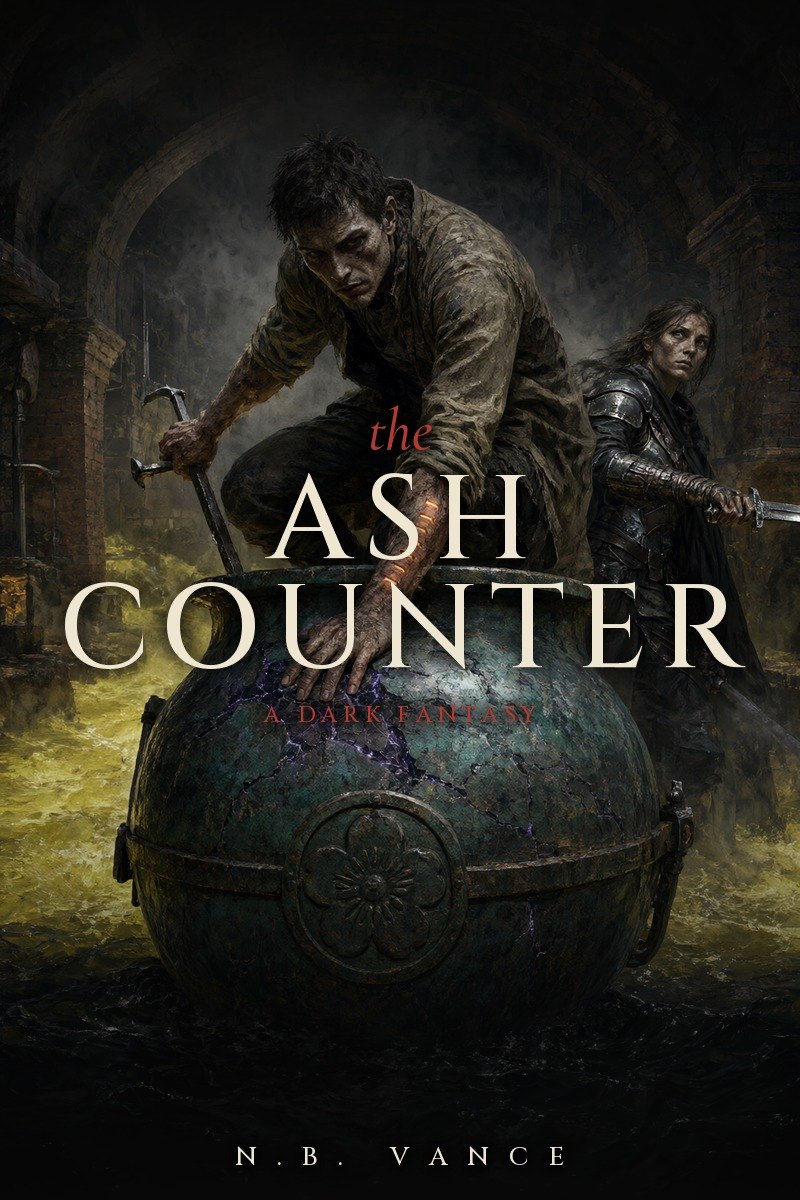
Chapter 8
The subterranean overflow conduit smelled of rotting riverweed, rancid lard, and boiling asphalt.
Gao Lin hauled himself out of the foaming canal discharge, his boots slipping on the thick algae that coated the granite sill beneath the Fourth Sluice spillway. His knuckles were raw, scraped down to the pink dermis where he had dragged his weight against the rusted iron intake grates. He rested against the curved masonry wall, coughing violently and spitting a mouthful of black, oily froth into the surging current.
He reached beneath his coat, his fingers checking every seam of his quilted wool vest.
Under his ribs, the cold pulse of the Withering remained quiet, pinned down by the drop of Grade-3 concentrate he had swallowed two hours earlier beneath the Fourth Foundry. Thirty-nine days and twenty hours remained on the invisible ledger etched into his marrow. The numbers were exact, a rigid schedule of biological decay that cared nothing for floodwaters or collapsing tunnels.
Beside his ribs, the three remaining glass ampoules of Grade-3 concentrate rested unbroken in their leather loops. The two vials of Grade-4 tincture rattled softly against his pry-bar. And bound tightly across his chest in double layers of oilcloth and lead wire, the House Bai logistics registry remained dry, its stiff vellum corners biting into his collarbone with every breath.
A deep, low-frequency shudder vibrated through the bedrock beneath his boots.
Lin pressed his right palm flat against the damp stone of the drainage arch. Through the masonry, his perception reached into the mountain of granite above. He could feel the familiar mechanical cycling of the heavy hydraulic release valves three hundred paces to the north. But layered beneath that hydraulic rhythm was a new, violent disturbance—a thick, churning surge of heavy crude oil rushing through the feeder flues, followed by the muffled, subterranean thump of ignition in the upper foundry conduits.
The air inside the spillway shifted in an instant.
The damp, chilly draft from the canal vanished, swallowed by a wave of dry, blistering heat that smelled of yellow sulfur, burned tallow, and unrefined subterranean pitch.
House Bai was not waiting for the scheduled noon purge to open the siphons. Their engineers were already bleeding fire into the lower municipal drains hours ahead of schedule to clear the streets before the district knew it was burning.
Lin did not waste breath cursing. He adjusted the iron pry-bar in his belt, tightened the cord of his copper wire spool, and hauled himself up the rusted iron service rungs set into the vertical overflow wall. He struck the latch of the timber trapdoor with the heel of his palm, heaving the warped oak plank upward, and climbed out into the cellar alley behind the Lower Canal basin.
The district above had already dissolved into chaos.
Thick, greasy smoke rolled through the narrow alley in suffocating yellow banks, hugging the wet cobblestones like toxic fog. Two streets to the north, a four-story timber tenement leaned drunkenly against the third arch of the Great Aqueduct, its cedar roof shingles popping and cracking in a sheet of roaring orange flame as burning pitch poured in fiery ribbons from the municipal gutter spouts.
Dozens of canal laborers, grease-haulers, and dye-workers stumbled through the blinding haze, their faces blackened with soot. Men pushed overloaded handcarts piled high with wet wool bedding, rusted iron kettles, and sacks of dry barley; women carried crying children wrapped in grease-stained smocks, their eyes wide with terror as flaming cinders rained out of the sky. Near the corner of the charcoal yard, four dockworkers were battering the iron padlock of a municipal water cistern with heavy sledgehammers, desperate for water that had been diverted to the Upper Terraces three days ago.
Nobody looked at Lin. In the Low Sinks, when the sky began raining burning pitch, every man carried only the weight of his own skin.
Lin pulled his wool cap low over his brow to shield his eyes from the drifting embers and broke into a fast, economical trot. He bypassed the main thoroughfare, cutting through the narrow lanes between the tallow warehouses where he had shattered Chen Meilin's ash-iron pike less than an hour ago.
The shattered municipal ward-anchor still hung dead against the corner brickwork, its cracked cast-iron housing charred black where the three years of stored agony had detonated through the circuit. The air around the junction still tasted faintly of scorched copper and ionized blood, but the enforcer cohort had cleared their casualties and retreated to the upper works.
Beyond the tallow sheds, the alley sloped sharply downward into the sunken depression known as the Copper Gut.
Wu Jianyu’s brokerage shop sat jammed beneath the dripping granite footings of the second aqueduct arch.
The heavy front door hung drunkenly from a single warped iron hinge, its thick oak frame splintered down the center by an enforcer's breaching ram. The paper lanterns that had hung outside the lintel were crushed into the gray mud. Inside the front parlor, Jianyu’s carved camphorwood desk lay overturned on the pine floorboards, its velvet-lined compartments ripped open and stripped of assay slips. Shattered porcelain tea bowls, torn linen bills of sale, and scorched scraps of account ledgers littered the room.
Jianyu had not waited for Lin’s return or Meilin’s pikemen. The moment Lin had cleared the Iron Kettle teahouse, the broker had collected his portable bullion, dumped his daily manifests into the iron heating stove, and fled toward the upper lift stations.
Lin stepped over the overturned desk, glass and charred vellum crunching beneath his heavy boots. He moved past the abandoned front counter and walked directly into the small rear storeroom where Jianyu kept his assaying furnaces and lead-shielded scales.
The floor here was paved with four-inch slabs of gray river slate, sealed along every joint with dense tar pitch to prevent live agony resonance from leaking into the canal silt and alerting municipal inspectors.
Lin knelt in the middle of the floor, pulling off his leather work gloves and placing his bare palms flat against the cold slate.
He closed his eyes, breathing slowly through his nose, and let his structural perception sink through the surface stone.
The memory of the floor came alive against his nerve endings: the dragging friction of heavy iron-bound chests; the repeated strike of a concealed release lever set into the rear foundation; and, two feet beneath the central seam, a rectangular void encased in three-hundred-pound slabs of cold-rolled lead.
Lin opened his eyes, reached to his hip, and drew his scarred iron pry-bar.
He drove the beveled edge of the pry-bar into the mortar channel between the third and fourth slate slabs. Feeling for the internal pivot point where the retaining catch met the balance counterweight, Lin drove his heel down onto the iron shaft with the full momentum of his body.
The slate slab released with a dull, sucking gasp of displaced air, swinging upward on a counterweighted bronze armature.
Beneath the floor lay Jianyu’s private reserve vault.
The chamber was four feet deep, lined on all six sides with seamless sheets of dull gray lead to insulate whatever lay inside against external resonance probes. Inside the pit sat an empty iron strongbox with its lid thrown back, two discarded hauler packs made of heavy oiled hemp, and, resting in a thick cradle of grease-soaked wool, the thirty-five-pound bronze sorrow-crucible.
The ancient relic sat dark, brooding, and massive in the dim cellar light.
Its flared rim was etched with the suppressed five-petal plum blossom and iron ring of House Bai, hammered flat by ancient censors centuries ago but still vividly legible to fingers trained to trace cold metal fatigue. Even through the lead shielding of the vault, the dense, suffocating weight of refined ancestral suffering hummed against Lin’s skin, setting up a dry, electric resonance that vibrated in the roots of his molars.
"Still where you belong," Lin muttered.
He reached into the pit, wrapped his calloused fingers around the heavy cast-bronze handles, and hauled the vessel upward. His shoulder muscles bunched and burned under the sudden strain—thirty-five pounds of solid, unyielding alloy packed to the brim with centuries of compressed agony.
He picked up one of the heavy hemp hauler harnesses from the bottom of the pit. He unbuckled the iron clasps, laid the harness flat on the slate floor, and seated the sorrow-crucible firmly into the reinforced timber back-frame. He wrapped the entire bronze vessel in two layers of thick, oil-soaked burlap to disguise the flared rim and ancient handles, securing the bundle with tight coils of copper wire until it resembled a common surveyor’s core-sample case.
Lin hoisted the harness onto his back, slipping his arms through the padded shoulder straps and buckling the wide leather girth belt across his lower ribs.
The weight drove down hard against his spine, forcing his boots half an inch into the grit on the floorboards. But the harness was well-balanced, distributing the burden across his hips and leaving his hands completely unencumbered.
Above him, the heavy ceiling timbers of the brokerage groaned.
A sudden, blinding wash of orange light flooded the front parlor. A river of boiling sulfur pitch had crested the street drainage curb, pouring through the shattered front entrance in a bubbling, smoking deluge that ignited the overturned furniture in a wall of greasy blue flame. The air inside the shop grew instantly searing, thick with toxic white smoke that smelled of burning hair and caustic lime.
The pine rafters overhead began to crack and splinter.
Lin did not attempt to fight through the front parlor. He turned toward the rear wash alcove, raised his boot, and kicked the slop-drain grating out of its mortar seat with three heavy blows. He dropped onto his stomach, dragged the thirty-five-pound crucible pack through the narrow stone flue, and spilled out into the rear drainage alley behind the Great Aqueduct piers.
The air in the alley was so dense with black soot that visibility dropped to less than fifteen paces. Cinders the size of thumb-joints swirled through the draft, burning tiny pinprick holes in his wool smock.
Lin turned west, setting his boots toward the grand granite silhouette of the Iron Spire barrier gate four hundred paces up the slope.
He had not covered thirty yards when three silhouettes lunged out of the smoke near the entrance of the charcoal kilns.
They were scavengers from the lower canal crews, dressed in charred leather coats with wet linen rags wrapped around their mouths and noses. The man in the center carried a heavy iron-headed coal pick; the two flanking him gripped six-foot boiler scraper poles fitted with recurved iron gaff hooks.
The leader planted his boots in the center of the lane, his bloodshot eyes fixing instantly on the bulky, burlap-wrapped pack strapped to Lin’s shoulders.
"Hold up, runner," the man rasped, his voice raw and gravelly from breathing sulfur fumes. "That ain't grain on your back, and that ain't bedding. You're carrying vault stock."
The two men on the wings spread out, leveling their scraper poles to pin Lin against the burning brick wall of the kiln.
"Unbuckle the harness, boy," the leader snarled, resting the heavy head of the coal pick on the palm of his hand. "The gatekeepers at the Spire are charging ten ounces of silver per head to let anyone through the wickets before the emergency lockdown. You drop that crate of iron right here, and maybe we let you drag behind our cart."
Lin halted. He did not drop his hands to plead, nor did he look back over his shoulder. His eyes flicked upward, past the three men, reading the blackened brickwork and rusted iron rigging suspended above the narrow alleyway.
Directly over the center of the lane hung a corroded iron crane bracket, used by the kiln tenders to haul hundred-pound coal buckets to the upper drying lofts. The three-ton timber gantry supporting the iron block was already smoldering, its seasoned pine beams charred by a steady tongue of burning pitch leaking from the roof gutter above.
Lin’s structural perception locked onto the central pivot assembly. The sudden blast of heat had caused the rusted iron mounting bolt to expand faster than the stone sleeve around it; the threads were sheared through, held in place by nothing more than three millimeters of corroded slag.
Lin did not draw his pry-bar to engage three men armed with six-foot hooks. He stepped sideways, planting his heels firmly against the granite foundation of the aqueduct pier.
"You want the pack?" Lin asked, his voice calm, flat, and steady beneath the crackle of the burning timbers.
"The pack and the coat, boy," the lead scavenger barked, stepping forward with the coal pick raised above his right ear. "Now!"
Lin did not parry. He drew his iron pry-bar from his belt in a single, fluid motion, stepped into his throw, and hurled the heavy iron bar straight upward into the smoke.
The flat head of the pry-bar struck the glowing, thermal-stressed head of the crane's mounting bolt with a sharp, metallic crack.
The sheared bolt snapped instantly.
The three-ton pine gantry tore loose from the smoldering masonry with a screech of ripping iron. The entire wooden boom, laden with sixty feet of heavy iron chain and burning timber, dropped straight into the alleyway between Lin and the three scavengers.
A massive shower of blinding sparks, shattered wood, and flying iron links crashed into the cobblestones with the force of an avalanche. The lead scavenger shrieked, throwing himself backward into the dirt as a burning twelve-foot beam slammed down inches from his boots. The other two men dropped their scraper poles and scrambled in terror into the smoke, coughing and yelling as the blazing wreckage formed an impassable wall of fire across the lane.
Lin moved without pausing. He stepped across the smoking edge of the shattered gantry, bent down to retrieve his scarred pry-bar from the debris, and broke into a hard, measured sprint up the rising avenue.
Ahead, cutting through the swirling yellow smoke like an immense mountain of black iron, loomed the Iron Spire barrier gate.
The barrier was a colossal curtain wall of dressed basalt, ninety feet high and twelve feet thick, anchoring the lower rim of the mountain rock and dividing the toxic misery of the Low Sinks from the clean, pressurized tiers of the Fourth Ward. Three massive arched tunnels pierced the base of the wall, but the two outer portals were already shut, their six-inch-thick portcullises of banded iron dropped into deep stone sill-sockets, chained and padlocked.
Only the central inspection gate remained open, flanked by two dozen municipal gatekeepers in heavy, overlapping iron plates, holding six-foot containment pikes at the ready.
A desperate, frantic crowd of over two hundred merchants, couriers, grease-factors, and canal laborers surged against the timber barricades outside the gate arch. They waved stamped parchment slips, shook bags of brass coin, and screamed hoarse pleas at the indifferent guards. On the stone ramparts thirty feet above the archway, crossbowmen stood with cocked weapons, their iron bolts aimed directly into the press of the mob.
At the head of the narrow, iron-railed inspection channel sat the barrier checkpoint: a heavy oak desk bound in polished brass, sheltered beneath a reinforced iron awning.
Behind the desk sat Gate Sergeant Tan.
The sergeant was a broad-shouldered, thick-necked veteran in his fifties, his graying mustache stained with pork grease and coal soot, wearing a heavy iron breastplate over a stained wool tunic. He held an inked iron seal in his right hand, stamping transit manifests with rhythmic, bored indifference while two junior guards shoved rejected petitioners back into the smoke with the flat of their short-swords.
Lin forced his way through the fringe of the howling crowd. He used the hard, heavy wooden frame of the crucible harness on his back to wedge between shouting merchants and weeping weavers. He did not yell, he did not run, and he did not look at the armed guards on the wall. He kept his spine straight, his chin level, and his breathing deep and even, walking with the crisp, professional assurance of an appraiser on an urgent guild errand.
He stepped past the iron railing into the clear inspection lane, stopping two paces before the brass-bound desk.
Sergeant Tan did not look up immediately. He stamped a bill of lading, tossed the parchment into a wicker basket, and reached with greasy fingers for a small ceramic bowl of pickled radishes resting on the corner of the table.
"Next," Tan barked, chewing with an open mouth. "Name, guild tier, and cargo. Make it quick before the watch bells toll and I drop the main tooth on every neck in this gutter."
Lin reached smoothly inside his breast pocket with his left hand.
He drew out the stiff linen transit manifest signed by Wu Jianyu, followed by the heavy iron medallion stamped with the three-tower crest of the Yan Transit Authority. He laid the parchment flat on the oak desk, placing the cold iron token precisely over the wax wafer.
"Gao Lin," Lin said, his voice crisp, clear, and utterly barren of fear. "Appraiser's Journeyman to the House of Wu. Cargo: sealed mineral assays and certified ore samples for the Fourth Ward Trade Consistory."
Tan stopped chewing. His small, sharp eyes shifted from the radishes to the iron medallion on the desk.
The sergeant picked up the token, turning the heavy metal in his calloused palm. He ran his thumb across the stamped ridges, testing the depth and sharpness of the three towers. Then he picked up the folded manifest, squinting as his ink-stained finger traced the crisp calligraphy and the raised seal of the iron balance scale.
"Wu Jianyu," Tan muttered, his thick brow furrowing. "The pain broker down in the Gut."
"The same," Lin answered evenly. "Master Wu dispatched me at the fourth bell to deliver the quarterly assay cores before the municipal inventory lockdown. The Consistory expects the samples at the desk before the morning watch change."
Tan looked up from the parchment, his eyes sweeping across Lin’s soot-streaked forehead, his steady gaze, and the heavy, burlap-wrapped harness strapped across his broad shoulders.
From the burning district three hundred paces behind them, a colossal roar shook the foundations of the basalt wall. A primary crude-oil reservoir inside the Fourth Foundry had ruptured, sending a towering pillar of greasy black smoke and orange fire three hundred feet into the morning sky. The crowd at the barriers shrieked in terror, surging wildly against the leveled pikes of the gate guards.
Tan looked at the rising firestorm, then looked back at Lin. The sergeant rubbed the gray stubble on his chin with the back of an ink-stained thumb.
"Smells like Wu Jianyu's shop is currently converting into airborne soot," Tan remarked dryly, tapping the edge of the manifest against the desk. "Which means your master isn't going to be paying his municipal tax assessment next quarter."
"Which is why these core samples need to be in the Consistory vaults today," Lin replied without blinking. "Unless the Sergeant wishes to explain to the High Guild Assayer why forty thousand ounces of certified mineral records burned at the barrier gate."
Tan let out a short, wet snort through his nose. He picked up his ink brush, dipped the coarse bristles into the black cinnabar paste, and hovered the tip over the official entry log.
"The manifest is in order," Tan said, his tone shifting into smooth, well-practiced transaction. "The iron stamp rings true. But there is the matter of the emergency clearance fee."
"Jianyu said two silver for the ink surcharge," Lin said plainly.
"That was at dawn, boy," Tan replied with an indifferent shrug, pointing the tip of his brush toward the boiling sulfur clouds rolling across the tenement roofs. "At dawn, the air was free. Right now, this gatehouse is filtering two tons of burning pitch out of the municipal draft so my men don't choke on their own lungs. That's an extra two silver for the air purification assessment. Four pieces of clean silver, or you can take your ore samples back to the canal and assay them in the gutter."
Lin did not dispute the fee. Time was the only currency that mattered.
He reached into his small leather coin purse, pulled out four worn silver pieces, and set them down in a neat row beside the iron medallion.
Tan swept the coins into his palm in a single, practiced swipe. He brought one coin to his teeth, bit down hard on the rim to test the metal, and dropped the silver into his leather belt pouch. He picked up the heavy brass gate seal, smashed it into the wet cinnabar paste, and brought it down on the bottom corner of Lin’s transit manifest with a heavy, satisfying thump.
"Gao Lin," Tan recited in a monotone chant, handing back the stamped parchment and the iron token. "Accredited journeyman. Cleared for Fourth Ward transit. Proceed through the wicket."
Lin took the documents and the iron medallion, sliding them deep into his inner coat pocket where the House Bai registry rested secure against his ribs.
He turned toward the open iron wicket.
At that exact moment, the rapid, rhythmic clatter of iron-shod greaves echoed down the stone spiral staircase that linked the barrier gatehouse to the upper battlements.
Lin did not break his stride, but his eyes tracked the movement with cold precision.
Descending the stone steps came Enforcer Captain Chen Meilin, followed closely by Sergeant Bao Cheng and four fresh pikemen in burnished steel cuirasses.
Meilin had replaced her broken ash-iron pike with a standard six-foot iron-tipped halberd. Her face was pale as chalk, drawn tight with physical exhaustion, and the collar of her tunic was torn open where the siphon needle had been driven into the nerve cluster behind her shoulder. Across her left forearm, visible where her leather vambrace had been hurriedly laced, twenty-four fresh, angry notches of gray ash burned into her skin—the brutal physical mark of ninety stolen days.
Her dark eyes swept across the screaming mob outside the barricades, sharp, vigilant, and desperate, searching for a face in the sea of smoke.
Lin kept his head straight and his pace steady. He did not run. He stepped between the massive iron teeth of the central gate arch, his boots crossing the deep bronze threshold channel that marked the official boundary line of the Low Sinks.
Behind him, the great bronze bells in the upper spires began to toll.
One. Two. Three. Four. Five. Six.
The sixth bell of the morning watch.
"Seal the gates!" a commander’s voice roared from the upper parapet. "Drop the main tooth! Clear the threshold!"
A chorus of iron ratchets shrieked inside the overhead stone housings. The massive, four-ton iron portcullis broke free from its magnetic latches and plunged downward in a roaring vertical blur.
The mob behind the timber barricades erupted in a frantic, horrifying scream as dozens of desperate people surged forward, trying to dive beneath the falling iron. The gate guards slammed their shields together, leveling their heavy pikes with brutal efficiency and thrusting the crowd back into the blinding smoke and boiling pitch.
Lin took two long, measured strides forward, clearing the iron track just as the massive iron portcullis slammed into the granite sill behind him with a deafening, bone-jarring crash that sent a shockwave through the soles of his boots.
The heavy iron teeth seated deep into the bronze floor sockets, locking into place with a series of automatic deadbolts that sealed the gate shut with an air-tight hiss.
The frantic screams and the roar of the burning district were cut off in an instant, reduced to a faint, muffled rumble behind twelve feet of solid basalt.
Lin stood on the wide, clean flagstones of the Fourth Ward.
The air here was cold and sweet, smelling of crushed granite, wet cedar, and the crisp, clean tang of winter rain. Ahead of him, wide stone avenues rose in majestic terraces toward the towering spires of the merchant quarter, lit by glowing resonance lamps that cast no soot. Well-dressed guild factors in wool cloaks and linen-clad scribes with leather folios under their arms walked along the raised walkways, glancing with mild disdain at the soot-smeared hauler carrying the heavy burlap pack on his back.
Lin reached up, adjusting the wide leather straps of the hauler harness. The thirty-five pounds of House Bai’s ancestral sorrow pressed solid and real against his spine. Beneath his coat, the logistics registry that could shake the entire kingdom to its foundations rested safe against his ribs.
Thirty-nine days and nineteen hours remained on his countdown.
He wiped the last trace of the Low Sinks' sulfur ash from his cheek, took a deep breath of the cold mountain air, and walked up the avenue into the mid-tiers.

Comments
Loading comments…