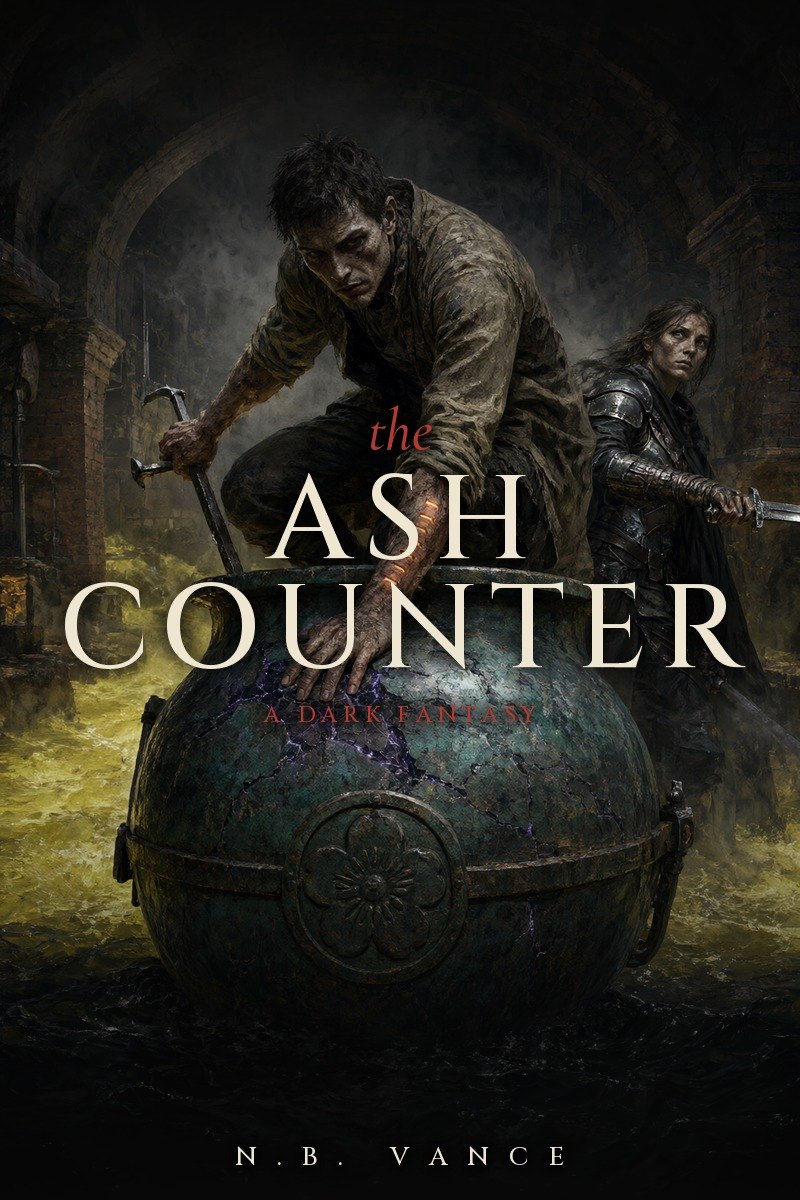
Chapter 9
The Fourth Ward smelled of crushed coke, cold river stone, and baking millet. Down in the Low Sinks, the air tasted of sulfur and burning tallow, but up here on the lower terraces of the middle tier, chimney draft-fans pulled the soot upward into the mountain vents. Clean basalt flagstones lined the avenue, scrubbed every dawn by municipal sweepers before the merchant carts rolled out.
Gao Lin kept his head level, his hauler pack riding square on his shoulders. The wide leather straps bit through his wool jacket, bearing thirty-five pounds of solid bronze and dead men’s agony. Scribes in clean linen tunics and factors with polished horn abacuses skirted past him, giving his soot-streaked coat and rough boots a wide berth. In the middle tier, a porter with a heavy load was invisible as long as he stayed near the curb and out of the carriage ruts.
His left forearm pulsed with a dull, iron ache under his sleeve. Thirty-nine days and nineteen hours. The stasis drop he had swallowed beneath the Fourth Foundry held the Withering in check, but every hour spent carrying House Bai’s stolen relic shaved minutes from his borrowed life. He needed a warded hearth, a cold-water basin, and four walls thick enough to swallow an agony flare.
He turned off the broad merchant avenue into Foundry Row, where the hum of belt-driven bellows vibrated through the pavement. The shops here catered to independent assayers, bullion melters, and tool-smiths who served the middle guilds. Iron shingles hung over heavy stone doorways, painted with guild seals and scales. Most of them were flanked by private ward-guards wearing the green sashes of the municipal tax office.
Lin walked past three open forge-yards until the street narrowed into Smelter’s Lane, a damp cul-de-sac wedged against the district retaining wall. At the end of the lane hung a corroded brass sign shaped like an assay crucible, stamped with three notches: Shen Qie, Independent Refining and Volatile Assays.
The door was reinforced with banded iron plates and set with a double-bolted viewing hatch. Lin knocked three times with the butt of his iron pry-bar.
The hatch slid open an inch. A pair of small, bloodshot eyes peered through the bronze grating, taking in Lin’s hauler harness, the heavy burlap pack, and the forged transit medallion pinned to his lapel.
"Closed until noon bell," a raspy voice snapped from within. "Guild inspection day. Go dump your scrap in the common pits."
Lin did not step back. He slipped two silver coins from his pocket, holding them flat against the iron plate beneath the slit. "I do not need scrap melted. I need two hours in an isolated smelting vault with a sealed flue and an iron door."
The eyes narrowed on the silver pieces. The hatch slid shut, followed by the clatter of two drop-bars lifting inside. The heavy door swung inward on greased bronze hinges.
A short, spare man stood in the entryway, wiping gray powder from his fingers with a soot-stained rag. Shen Qie wore a thick leather apron stiffened with dried borax, his graying hair pulled back into a tight bun secured with a copper bodkin. Behind him, the shop opened into a long gallery of stone bins, balances, and glass distillation tubes resting in straw cradles.
"Two hours," Shen Qie said, his gaze dropping instantly to the shape of the pack strapped to Lin's back. The assayer's nose twitched, catching the faint, coppery tang of compressed stasis that clung to the burlap. "Vault rental is three silver an hour for common ore. If what you carry has a thermal pulse or an agony resonance, the rate quadruples. Municipal air-scrubbing tax, chimney maintenance surcharge, and silence."
"Three silver total," Lin said, setting the two coins on the counter and adding a third. "And you stay behind the front desk."
Shen Qie scooped the silver into his palm, testing the edge of one coin against his front teeth with a practiced click. "Vault Three. Sub-level, through the rear arch. The walls are two feet of river granite lined with boiler plate. Charcoal bin is full, bellows foot-pedal works, and the quench tank has fresh well water. If you melt through the refractory brick, you pay for the masonry."
"I am not melting iron," Lin said.
Shen Qie tucked the silver into his apron pocket, his lips thinning into a dry, humorless smirk. "Nobody who brings a thirty-pound lump down Smelter's Lane in a hauler harness is melting iron, boy. Just make sure whatever you crack doesn't foul my intake pipes. The district warden charges twenty silver for an unbaffled soot burst."
Lin took the iron key the assayer tossed across the counter and walked past the display cases into the rear passage. A narrow spiral staircase cut directly through the living rock led down into the damp foundation vaults.
Vault Three sat at the far end of the subterranean corridor. The door was a slab of cast pig iron hung on reinforced box-hinges, sealed with a dual-lever deadbolt. Lin stepped inside, hauled the door shut, and drove the heavy internal throw-bolt home.
The chamber measured ten paces across, lit by a single resonance lamp suspended from an iron chain. A wide brick hearth dominated the rear wall, connected to a heavy cast-iron chimney baffle with a manual draw-lever. Beside the hearth stood a stone quench basin filled with murky well water, a heavy oak workbench scarred by acid burns, and a rack of standard assayer tongs and cold chisels.
Lin shrugged off his hauler pack and unbuckled the harness. He lowered the burlap bundle onto the workbench. The heavy timber creaked under the thirty-five-pound mass.
He unlaced the burlap and peeled back the coarse sacking.
The House Bai sorrow-crucible sat on the oak planks, its dark, verdigris-crusted bronze shell gleaming under the pale white glow of the resonance lamp. The ancient plum-blossom crest, hammered flat centuries ago, caught the light in faint, uneven ripples. Around the rim, seven recessed hex-pins held the pressurized lid flush against the vessel’s neck, sealed with a ribbon of lead and oxidized copper wire.
Lin laid out his gear on the table: his forged iron pry-bar, four lengths of stiff copper wire, a small flat cold chisel, his water bladder, and his brass tallow lamp. He did not light the lamp; the cool resonance light was enough.
He rolled up his left sleeve. The black lines of the Withering crawled along his skin like frozen lichen, receding slightly from the stasis drop, but still woven deep into the crook of his elbow.
Lin placed both bare hands on the cold bronze flank of the crucible.
He closed his eyes and pushed his structural perception into the metal.
A sharp, needle-thin shock drove up his forearms into his chest. The internal countdown behind his eyes flickered, the numbers grinding forward by a fraction as his borrowed time fueled the read. Thirty-nine days and eighteen hours.
The history of the broken vessel unfolded in his mind, sharp and layered like stacked sheets of mica.
The crucible had not been forged by a common metalsmith in the Low Sinks. Three hundred years ago, in the imperial deep foundries of the Old Capital, master smiths had cast it from five distinct alloys: an outer mantle of ductile bronze to resist external impact, an intermediate sleeve of lead-antimony to absorb psychic scream-waves, and an inner crucible core of cold-hammered meteoric iron.
It was an agony-condenser—a relic built to receive raw, unrefined human suffering, distill the chronological stasis from the blood, and compress the remaining agony into high-grade pain-ash.
Lin traced the internal locking mechanism with his mind. The seven hex-pins on the exterior were a diversion. Beneath the lead seal lay a double-threaded counter-spindle linked to four spring-loaded shear plates. If an assayer tried to force the lid with an ordinary lever, the shear plates would snap, releasing a chamber of concentrated vitriol directly into the inner core, vaporizing the ash and detonating the vessel like a siege mortar.
"Dual-chamber failsafe," Lin murmured, his fingers tracing the cold metal seams. "Counter-clockwise release on the primary ring, clockwise on the retention collar."
He opened his eyes. Sweat beaded on his forehead, cold and greasy.
He picked up his flat cold chisel and the small iron mallet from the tool rack. He wedged the chisel’s hardened tip into the lead ribbon sealing the top rim, tapping the butt with precise, controlled strokes. The soft lead peeled away in gray, curling ribbons, exposing the underlying seam of oxidized copper.
Beneath the lead, four recessed pinholes appeared, each no wider than a bodkin needle.
Lin took a length of stiff copper wire, cut it into four equal segments with his pry-bar's notch, and bent the ends into narrow L-hooks. He inserted the first wire into the northern pinhole, feeling for the internal tumbler with light, steady pressure.
The spring inside was stiff, preserved in sealed oil. He pushed inward until he felt the minute click of the first shear-plate disengaging.
He held the tension with his left thumb, took the second wire, and probed the southern hole. Click.
The third wire took forty seconds of careful probing. The internal pin was corroded, resisting the copper lead. Lin adjusted the angle, tilting the wire three degrees toward the outer rim until the sear slipped into its bypass groove. Click.
The fourth pin released with a dull metallic snap that vibrated through the workbench.
The outer retention collar shifted a fraction of an inch, loosening its bite on the neck of the crucible.
A faint hiss escaped the seam, smelling of ozone, dried blood, and old vinegar. The air in the vault instantly grew noticeably colder, the ambient temperature dropping five degrees as the dormant stasis seal vented its first breath.
Lin did not rush. He knew the danger of an unbuffered stasis release. If the internal pressure dropped too fast, the crystallized agony inside would undergo thermal shock and shatter into microscopic ash, poisoning the air in the sealed room.
He grabbed the leather quench-bucket, hauled three gallons of well water from the basin, and poured it into the hearth’s cast-iron cooling trough. He took a long copper tube from the tool rack, bent it into a tight cooling spiral, and jammed one end into the crucible’s venting aperture, running the other end into the water.
He reached for the central spindle.
Lin gripped the top flange with his heavy iron tongs and applied steady, counter-clockwise torque. The bronze squealed in protest, the ancient threads grinding through centuries of oxidized flux.
One turn. Two turns. Three turns.
The spindle reached its stop. Lin reversed his grip, pushing the lower retention collar clockwise with the flat edge of his pry-bar.
A loud, hollow thunk echoed inside the crucible as the four internal lock-bars fell away into their relief slots.
The heavy bronze lid rose half an inch on its internal spring.
A plume of pale violet vapor vented through the copper tube, bubbling violently through the cold water in the trough. The water hissed, turning milky gray in seconds as it absorbed the residual trace agony.
Lin set down the pry-bar, wiped his palms on his trousers, and lifted the bronze lid by its forged iron handle.
Inside the thirty-five-pound shell rested a cylindrical container no larger than a teacup, suspended in a gimbaled cradle of lead-antimony foil.
Lin lifted the inner cylinder using a pair of brass needle-nose calipers.
The container was cold to the touch, heavy as solid gold. He slid back the lead lid.
Nestled in the center of the cylinder lay four ounces of dark, crystalline ash. The crystals were the color of deep indigo ink, faceted like crushed tourmaline, pulsing with a faint, rhythmic violet luminescence that cast sharp shadows across his knuckles.
Pure, high-grade crystallized pain-ash.
Lin stared at the dark crystals. In the Low Sinks, brokers traded in raw, diluted agony siphoned from broken bones and fever wards—filthy, unstable sludge that barely fetched copper pieces. But this was ancestral ash, harvested from the sustained, generational suffering of high-tier bloodlines, refined through imperial filtration. A single grain of this material could stabilize a dying man's countdown for a month, or fuel an enforcer's agony-lance for three days of continuous siege.
Beside the ash cradle, stamped into the polished meteoric iron of the inner cylinder's base, was a crisp, unmarred seal.
It was the imperial dragon-claw crest of the Central Ministry of Allocations, flanked by the private plum-blossom mark of House Bai and a six-digit requisition serial.
Lin pulled the stolen House Bai logistics registry from his coat pocket, flipping through the parchment pages until he reached the liquidation manifest from forty years ago.
The numbers matched to the last stroke: Crucible Model Nine, Allocation Batch 414, Imperial Pain Reserve.
Lord Bai had not merely engineered the recent Withering outbreak in the Low Sinks; his family had been systematically embezzling imperial pain quotas from the central crown vaults for nearly half a century, disguising the theft as municipal losses and stockpiling the refined agony in illegal ancestral crucibles.
Lin carefully transferred the crystallized ash into two empty glass tincture vials from his hauler pack, sealing the cork stoppers with dripped tallow from his bench candle. He wrapped the two vials in oiled silk and slipped them into the inner breast pocket of his coat, right beside the Grade-3 stasis ampoules.
The empty thirty-five-pound bronze shell was now nothing more than scrap metal and incriminating proof.
Lin stood up, rolling down his sleeve to cover his mark.
Before he could repack his tools, a sharp, metallic clang echoed from the vault ceiling.
Above the heavy hearth, the cast-iron chimney baffle snapped shut with a heavy mechanical click. A set of copper sensor wires embedded in the chimney masonry glowed a bright, incandescent red, whistling as they detected the thermal and pain-resonance spike that had escaped into the flue.
Out in the subterranean corridor, heavy footsteps sounded on the granite flags.
The massive iron deadbolts on the exterior of the vault door slammed home with a deafening, echoing boom. Three external sliding bars fell into place, followed by the turn of an oversized master key.
Lin did not jump. He stepped back from the workbench, his fingers resting casually on the hilt of his iron pry-bar.
A small brass speaking tube set into the wall beside the door sputtered, and Shen Qie’s raspy voice came through the pipe, thin and distorted.
"You have a very interesting hauler pack, boy," the assayer said, his tone no longer dry, but sharp with naked greed. "My roof sensors just registered an agony resonance of nine hundred units. That is not scrap metal. That is high-tier noble stasis ash."
Lin stepped toward the speaking tube, keeping his voice level. "We agreed on three silver for the vault and your silence, Shen Qie."
"Three silver buys silence for unlicensed tin-smelting," Shen Qie sneered through the tube. "It does not cover imperial contraband that lights up my chimney sensors like a bonfire. The Silk Ledger syndicate runs this street, boy. I pulled the alarm lever in the floorboards two minutes ago. Their enforcers are already coming down the alley."
Lin looked at the sealed iron door, measuring the thickness of the frame and the position of the three external throw-bolts in his mind.
"You made a mistake, Shen," Lin said calmly.
"The only mistake was yours, bringing a fortune into an assayer's basement," the voice rasped back. "You slide that ash out through the sub-floor transfer chute, and maybe I tell the syndicate you ran out the drainage grate before they got here. Keep it, and they will peel your hide to find every grain."
Lin did not reach for the transfer chute. He reached into his coat pocket, his fingers closing around one of the sealed vials of volatile indigo pain-ash.
"Wait by the door, Shen," Lin said softly. "Let us see who peels whom."

Comments
Loading comments…