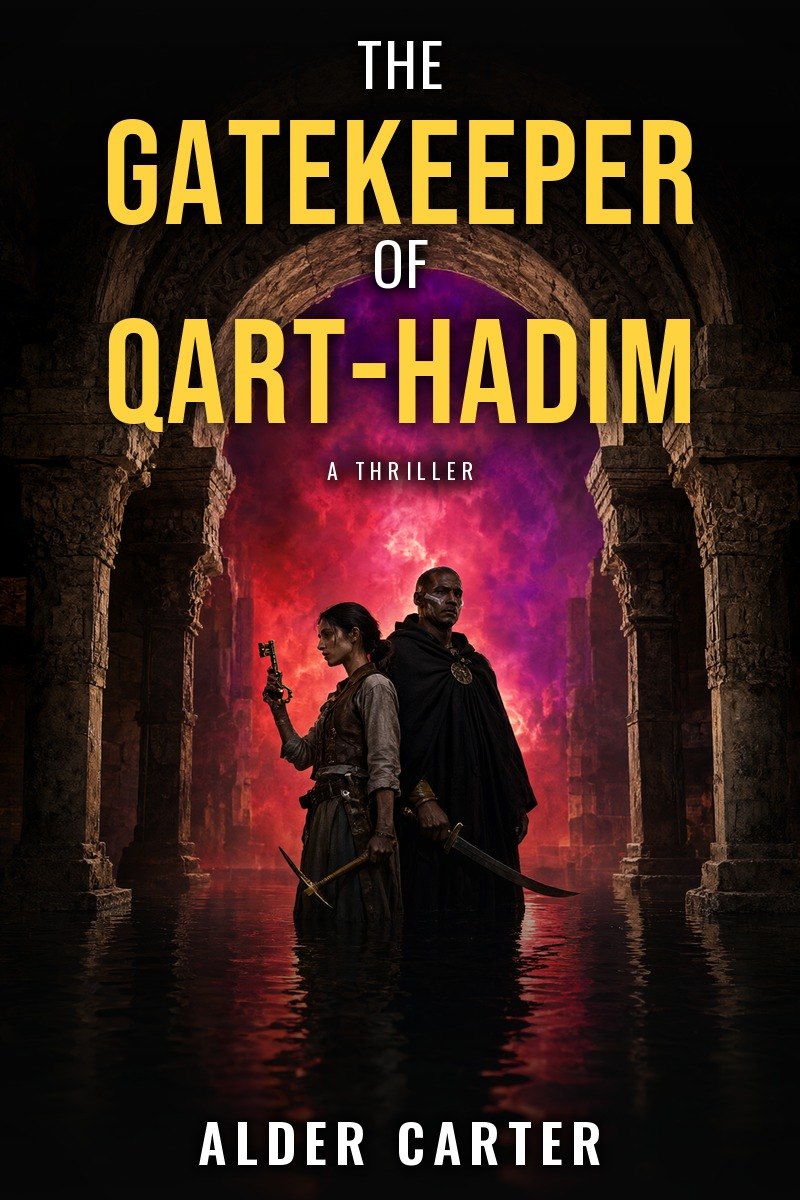
Chapter 2
The scout’s cipher smelled of expensive oil and cedarwood, two things that had never belonged in the drowned belly of Qart-Hadim.
I sat on a slab of damp sandstone three feet above the black water of the cistern, turning the solid brass disc over in my palms. The edge was cut with seven concentric teeth, each notch filed to a hair’s breadth to match the resonance pins of a high-tier transit frame. In the center sat the stamped sigil: a coiled viper biting the shaft of an olive branch, the private mark of High Merchant Baalat.
Down in the dark, the unconscious warrior groaned against his bonds. I had stripped his leather cuirass, bound his wrists and ankles with tarred hemp, and rolled him into the dry alcove of an abandoned sluice gate. He wouldn't wake properly for another hour, not after taking a mouthful of dry lime and a face full of granite flagstone.
"You picked the wrong door, cousin," I muttered under my breath.
My mentor, Master Hannibaal used to call Qart-Hadim a labyrinth of stone that only tolerated the people walking between its ribs. When he died three winters ago of the wet lung, he hadn't left me an estate on the Upper Terraces or a purse of golden drachmas. He had left me three iron picks, a pouch of powdered chalk, a belt of worn bronze keys, and the unwritten layout of two hundred secret gates rotting beneath the lower wards.
Guard the thresholds, Khez, he had wheezed into his wool blanket on the last night. The High Houses think the stone belongs to their ledgers. They don't know the weight of what sits below.
Now Baalat was carving up that weight to buy peace from the desert warlords.
I slipped the scout’s brass cipher into the inner pocket of my leather vest, next to my mason's chisel and iron wedges. If this single disc could force the Beggar’s Gate open from the cisterns, the scout hadn’t walked here through the public tunnels. He had transited in from a deeper node—a staging threshold where someone had aligned the city's ancient transit veins to bypass the exterior watchtowers entirely.
The tide in the Old Sump would turn at third bell. When the floodgates opened from the upper canals, five feet of sewage and river runoff would scour these flumes clean. If I wanted to find where the scout had stepped through the stone, I had less than an hour.
I picked up my hooded oil lantern, kept the shutter down to a pencil of pale yellow light, and dropped into the knee-deep water.
The cold hit through my sheepskin boots like a row of copper nails. The Old Sump was the city’s forgotten lung, a network of low-arched hydraulic flumes built four centuries ago by the first dynasty of stone-shapers. Above my head, the masonry groaned under the weight of the Lower Quarter—thousands of mudbrick tenements, spice kilns, and bakeries stacked four stories high.
Every transit gate in Qart-Hadim drew its stability from balance. When two threshold arches opened to each other across the wards, they displaced air and stone harmonics. A skilled lock-ward could feel the residual drift for hours, like the lingering heat of a hearth fire after the coals had been banked.
The scout’s wake pulled south, against the sluggish flow of the drain.
I reached the Sump Junction, where four blind bulkheads converged beneath the Great Market’s foundation. The water swirled here in a greasy vortex, thick with mutton tallow and rotting straw from the butcher pens three levels above.
I stopped against the central pier, holding my lantern high.
To an ordinary street patrol, the four tunnels looked identical: slimy granite arches dripping with calcium stalactites, black water vanishing into the dark. But stone never lied about trauma.
I held my hand four inches off the curved lintel of the western conduit. Nothing. Just the dead chill of river silt.
I moved to the eastern arch. A faint tremor buzzed against my fingertips, vibrating in the marrow of my knuckles.
I leaned in, sweeping the shutter beam across the mortar seams. There, along the second voussoir stone, a hairline fracture ran through the salt crust. A smear of lime dust drifted on the surface of the stagnant water, carried out by a backdraft that shouldn't exist in a sealed culvert.
Someone had forced a heavy transit through the eastern conduit within the last two hours.
"Careless," I whispered, though my throat tightened.
The danger wasn't just the intruders. The eastern conduit was fitted with an old hydrostatic balancing valve—a six-ton slab of counterweighted basalt designed to drop if the water level shifted too quickly, sealing the Lower Quarter against river floods. If the intruders had jammed the transit line open without resetting the pressure locks, the entire chamber was sitting on a hair trigger. One wrong footstep could drop sixty tons of canal water straight onto my head.
I set my lantern on a stone corbel, unhooked my mason's plumb line, and dropped the lead bob into the water.
The cord didn't hang true. It drifted three inches toward the submerged sill, tugged by an artificial siphon created by an active gate resonance.
I measured the drift against the joints of my knuckles. Three fingers of offset. A ninety-degree shear.
I didn't touch the iron release lever on the wall. Instead, I worked a thin steel spatula between the second and third floor pavers, wedging the valve's copper relief trigger into its locked notch. The counterweight shuddered above me with a dry, metallic groan, then held still.
I exhaled slowly, wiped the cold sweat from my brow with the back of my sleeve, and waded into the eastern conduit.
The tunnel sloped upward, shedding the foul river water until the floor turned into dry, packed sand. The air grew warmer, carrying the sharp, bitter tang of burning pitch and something else—the dry, alkaline scent of desert wool.
I extinguished the lantern wick entirely.
The undercity was never truly dark to someone who had mapped its veins blindfolded. I ran my scarred left palm along the dressed stone of the tunnel wall, counting the courses of ashlar masonry. Thirty paces. A dog-leg turn to the left to deflect siege rams. Another twelve paces.
Ahead, a faint amber glow washed across the ribbed vaulting of a wider chamber.
I flattened myself against the rough-cut stone of the archway, slipping my iron pick from my belt.
The chamber beyond was the old Water Exchange, a vaulted hypostyle hall that had been walled off during the Second Blockade fifty years ago. Twelve massive octagonal pillars of red granite held up a ceiling thirty feet above, lost in thick shadows and spiderwebs of mineral rot.
In the center of the hall, someone had set up a forward field command.
Three bronze braziers burned low, their charcoal smoke venting into an old air shaft. Crates of dried mutton and sealed water skins were stacked along the pillars. The advance scouts had secured the perimeter with cold efficiency: the side archways had been spiked with iron wedges, and the heavy chains of the southern sluice grate had been winched high and padlocked to the masonry to keep the corridor clear. But it was the far wall that made my blood run cold.
Across the three primary transit arches of the Water Exchange, someone had painted fresh geometric alignment circles in powdered cinnabar and ground lapis. In the center of the floor sat a heavy brass measuring armature—a surveyor’s table inscribed with the master transit lines of the entire city.
I crept from pillar to pillar, keeping to the deep shadows cast by the braziers. The room was empty of guards for the moment, but the ash in the braziers was hot and fresh.
I reached the surveyor's table and looked down.
Laid out across the brass plate was an inked map on fine goatskin parchment. It wasn't a crude scout's sketch. It was a precise harmonic alignment chart of Qart-Hadim's lower transit grid, stamped at the top with the official seal of the City Architect and countersigned in crimson wax with Baalat's viper.
Three separate lower-ward gates were circled in fresh red ink: the Beggar's Gate, the Weaver's Culvert, and the Charcoal Postern.
Each circle carried an entry schedule, calculated down to the quarter-bell.
This wasn't a tentative scouting mission. This was a coordinated, three-pronged vanguard infiltration. Baalat wasn't just trading secrets to appease the desert clans; she was handing them the exact transit vectors to move an entire strike force beneath the city walls before the sun reached its zenith.
And according to the chart on the table, the main vanguard detachment wasn't scheduled to arrive tomorrow.
They were due at third bell today.
I rolled the goatskin chart tightly, shoved it into the oiled leather cylinder at my hip, and reached into my pocket for my iron spike and hammer. If I drove the wedge into the primary alignment hinge on the central arch, the resonance loop would shatter, collapsing the transit bridge before the rest of their troops could jump through.
I raised the hammer.
A sharp, violent drop in air pressure slammed into the chamber.
The flames in the three braziers flattened sideways, hissing violently as blue sparks crackled across the granite floor. The air tasted suddenly of scorched copper and desert wind—hot, dry, and smelling of sun-baked rock.
They're early.
The transit arch in the center of the wall flared with a blinding flash of white light.
I threw myself behind the nearest octagonal pillar, pressing my back against the cold granite as five figures stepped through the shimmering veil of stone.
They didn't stumble. They emerged in perfect, disciplined formation, their boots hitting the flagstones with the dull thud of seasoned killers. They were tall, lean, and draped in charcoal-dyed desert wool, their faces wrapped in black cloth that left only their eyes exposed. Ash-blackened steel blades hung at their hips, curved and heavy.
Then the veil parted one last time, and their commander stepped through.
He was a head taller than the others, with broad shoulders that filled the width of the transit arch. His black woolen cloak was clasped with a heavy disc of hammered iron, and the skin of his throat and cheekbones was ritualistically marked with bands of pale gray river ash. He didn't wear a helmet; his dark hair was shorn close, exposing a sharp, unyielding jawline that looked as though it had been carved from the same basalt as the city's foundations.
He didn't draw a blade. He didn't look at the map table.
His dark, cold eyes swept the high vaulting of the chamber once, cataloging every shadow, every pillar, every breath of air.
"Clear the perimeter," he said. His voice was low, gravelly, and stripped of all ornament—the voice of a man who gave an order once and expected the world to obey it. "The scout should have returned ten minutes ago."
Two of the vanguard warriors fanned out toward the north corridor. A third walked straight toward the surveyor's table.
"Commander," the warrior called out, his hand hovering over the empty tabletop. "The alignment chart is gone."
The commander didn't flinch. His hand dropped to the pommel of the heavy broadsword at his waist, his thumb flicking the iron guard up by a fraction of an inch.
"The seal is broken," the commander said, his gaze dropping to the floor. "There are wet sheepskin tracks near the third pillar."
I froze. I had left a trail of damp silt from the Sump.
I didn't wait for them to circle me. I lunged from behind the pillar, sprinting toward the narrow drainage bypass at the south end of the hall.
"Halt," the commander snapped.
An iron throwing axe whistled past my ear, splintering the stone jamb two inches from my cheek. I ducked, scrambled through the low dry arch of the bypass, and reached for the emergency release lever, hoping the ancient counterweight could tear free from the scout's padlock.
I slammed the lever down with all my weight.
The rusted iron groaned, but the chain holding the grate open held fast.
Heavy, deliberate footsteps echoed on the stone behind me.
I spun around, pressing my shoulder blades against the cold stone of the archway wall, my mason's pick raised and my breath catching in my throat.
The Sutarim commander stood in the low archway, blocking the entire corridor. He didn't draw his sword. He just stood there, towering over me in the dim light of the braziers, his ash-marked face expressionless, his dark eyes locked onto the leather tube at my hip.
"You have something that belongs to the Pact, thief," he said.
I tightened my grip on the pick, the cold iron biting into my scarred palm. "You're in my ward, warlord."
He looked at my pick, then back to my eyes, unblinking.
"Not anymore."

Comments
Loading comments…