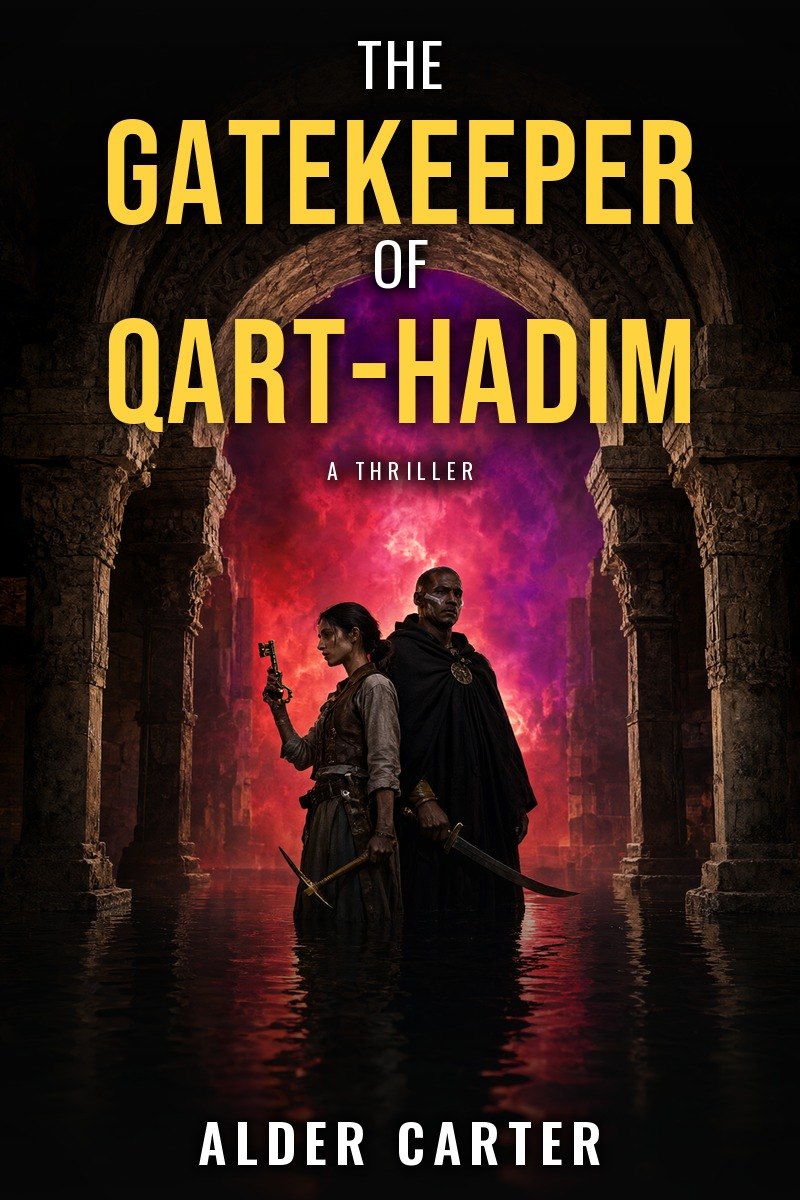
Chapter 6
A dead merchant in your garden is an inconvenience; a dead merchant with a desert blade planted in his chest is a death sentence from the City Council.
I gave myself three heartbeats to look at Yakhin’s slack face, then reached down and took the knife.
The Sutarim steel came free with a wet, sucking scrape. Dark blood welled into the froth of the marble basin, staining the water dark as crushed mulberries beneath the garden lanterns. I wiped the blackened fuller against the hem of Yakhin’s tunic, wrapped the iron in a square of oiled sheepskin, and slid it into the sleeve of my saffron coat.
My estate was still humming with the aftershocks of fifty drunk aristocrats and six Sutarim captains. Laughter drifted down from the upper colonnade, thin and brittle against the desert wind. If Baalat’s watch wardens found the body here, the Binding Pact would crack before dawn, and my neck would be the first one in the hemp.
I tapped the brass chime at the garden archway twice.
Basir stepped out from the shadows of the cypress trees. He had worked my cellars for nine years, mute by birth and deaf to the squawking of the Merchant Families. He took one look at Yakhin slumped across the marble lip, gave me a single, flat nod, and went back into the pantry passage. Two minutes later, he returned with a heavy wicker hamper lined with coarse canvas and three bags of pickling salt.
"The lower tannery vats," I murmured, keeping my voice below the rustle of the leaves. "Beneath the third lime pit. No questions, no marks."
Basir didn't waste time nodding again. He hoisted the dead weight of the merchant into the basket with the practiced efficiency of a butcher packing salted mutton, dumped the coarse crystals over the graying skin to stifle the copper stench, and strapped the wicker lid shut. By the time the fifth bell’s lingering echo faded over the high towers, my pomegranate fountain was scrubbed with citrus oil, and Yakhin of House Sereq had ceased to exist within the upper city.
I changed out of the blood-splattered silk gown into a riding coat of dark indigo, pulled my hair back beneath a linen dust-wrap, and went down.
· · ·
The Saffron Vault sat eighty feet below the Spice Market, carved into the porous limestone where the air tasted of ground turmeric, damp chalk, and old fat. It was neutral ground, maintained by the guild of draymen who didn't care which flag flew over the citadel as long as the copper kept clinking against the counter.
Steam rose in thick, fragrant clouds from copper kettles boiling anise tea. In the far corner, beside an archway blackened by grease and tallow smoke, a man sat with his back to the dry wall.
He had a wooden bowl of cold lentils in front of him and a heavy, iron-bound cudgel propped against his knee. He didn't look up when I crossed the threshold, but the scarred fingers of his left hand relaxed off the handle of a notched hunting dirk.
"You're late, Safinat," Malakh said. His voice sounded like dry gravel dragged across slate. "The tea's cold, and the watch just doubled their patrols along the canal weir."
"I had housekeeping to attend to," I said, slipping onto the bench across from him. The rough cedar wood was sticky with spilled molasses. "You didn't light a brazier."
"Fires make shadows. Shadows give nervous men an excuse to loose a crossbow." Malakh chewed a mouthful of lentils with methodical indifference. He had gray threading his short, bristle-cut beard, and the skin beneath his left eye was furrowed by an old saber burn from the eastern border skirmishes. "Talk fast. I charge three silvers an hour just to sit in your company, and twice that if your dress smells like lye."
"I could offer you fresh mint infusion from the upper gardens," I said smoothly.
"I’d rather drink ditch water," he grunted. "Eastern dysentery was cleaner than whatever slow poison you keep in your teapot."
"I brought something better than tea," I said softly.
I reached beneath my cloak, produced the wrapped package, and set it on the greasy table between us.
Malakh didn't touch it immediately. He picked up an iron spoon, used the tip to flick back the oiled sheepskin, and stared at the dark camel-leather grip and the horn pommel. The skin around his scarred eye tightened.
"Sutarim vanguard issue," he muttered. "Third cohort, judging by the cross-hatching on the hilt. Where did you pull this out of?"
"Merchant Yakhin's sternum," I said. "Thirty minutes after he told me why the transit gates in the lower ward are shattering."
Malakh stopped chewing. He picked up the dagger, tested the balance with a flick of his thumb, and smelled the dried residue on the fuller. "House Sereq's Yakhin? The one who held the cold-storage charters for the lower reservoirs?"
"The very same."
"He was an idiot," Malakh said flatly. "A fat, trembling idiot who drank too much fig brandy and thought his cousins on the Council would protect him from the rot." He pushed the dagger back toward me with the wooden spoon. "Who stuck him?"
"Not a desert man," I replied, watching the mercenary's face. "His throat was slit ear-to-ear before they planted this blade upright in his chest like a tavern signpost. A Sutarim captain wouldn't butcher a man like a pig and leave his own ceremonial steel behind. This was an undercity hit, dressed in desert iron to frame the vanguard."
Malakh picked up his stone mug, took a swallow of cold anise water, and made a sour face. "You didn't need to pay me sixty drachmas to tell you that. Every sellsword between here and the harbor knows Baalat has been hiring contract blades through the Blind Canal."
"I didn't hire you for your forensic eye, Malakh," I said, leaning in. The scent of damp limestone and roasted chicory hung thick between us. My gaze dropped beneath the rough table lip, catching the faint glint of taut crossbow wire rigged to his knee peg, before tracing the stamped falconet crest worn smooth into the cuff of his left vambrace. "And you can relax your foot off that trigger wire. I know you took a reconnaissance contract near the Tanner's Hinge three days ago. House Sereq's crest is stamped right on your wrist guard."
Malakh set his mug down with a dull clatter, the tension in his boot slackening. His eyes, pale gray and flat as river pebbles, fixed on mine. "That contract was with a private factor. Not you."
"Your private factor was Yakhin," I countered. "He paid your retainer out of Sereq's lower-vault reserve. And Yakhin is currently resting under three bags of pickling salt on his way to the lime pits. His accounts are closed, Malakh. Mine are open."
I withdrew a small leather purse from the inside pocket of my coat and dropped it beside the dagger. The coins inside hit the cedar planks with the heavy, muted thud of solid silver.
"Tell me what you saw at the Tanner's Hinge," I demanded.
Malakh looked at the purse. He didn't reach for it. A veteran of the eastern wars didn't survive twenty years in the mud by grabbing at shiny metal before he knew what kind of trap it was baiting.
"Four men," he said slowly. "Moving under merchant house badges, but wearing desert raider shrouds over their breastplates. They carried tempered steel wedges and heavy mallets. Not sappers. Breachers."
"They weren't trying to open the gate," I said, the pieces clicking into cold alignment. "They were trying to fracture the resonance casing."
"They wanted a back-surge," Malakh confirmed, leaning his elbows on the greasy table. "You jam a hardened steel spike into the transit anchor while the harmonic line is drawing power, and the stone shears apart like over-fired pottery. The shockwave blows out every connected threshold for five hundred paces. If they did that at the Tanner's Hinge during the fourth bell surge, half the lower district would lose its fresh water, and the drainage valves would lock shut."
"It happened," I whispered. "Fourth bell. The relay blew. The lower ribs are flooding right now."
Malakh let out a dry, rattling breath that ended in a cough. "Then Baalat got what she paid for. But why drown the tanners? That's common ground. Mud, tallow, dyers, and beggars. There's no gold down there, Safinat. Just cheap labor and bad teeth."
I remembered Yakhin’s terrified, drunken whispers in my garden before the blade found him. The secret I had carved into the bone hilt of my hidden dirk.
"The Silk-Rot," I said, keeping my tone so low Malakh had to tilt his head to hear. "It’s mutating. The spice tincture isn't stalling the tremors anymore. The High Merchants are going blind and mad in their silk pavilions, and the only thing that arrests the decay is fresh, immune blood."
Malakh’s brow furrowed. "The lower wards."
"The lower wards," I confirmed. "The dyers and the weavers have lived in the shadow of the spice mills for three generations. Their blood has adapted to the runoff; they don't catch the rot. Baalat isn't just sabotaging the alliance to break the Pact. She's collapsing the lower gates to flood the neighborhoods, force the refugees into the municipal emergency shelters, and harvest them like cattle."
The mercenary stared at me for three long beats. He didn't blink. The cynicism that usually shielded his weathered features cracked, revealing the raw, ugly fatigue beneath.
"Three hundred amphorae," Malakh murmured, his voice barely audible over the hissing tea kettles. "That's what they loaded into Vault Three just before fourth bell today. I thought it was stolen oil. I was on the loading dock for an hour before the harbor guard chased my scouts off."
"It wasn't oil," I said.
Malakh rubbed his thumb across the scar beneath his eye. "Gods of the dust. Those bastards aren't just greedy. They're rabid."
"Which brings me to my contract," I said, sliding the purse an inch closer to his scarred knuckles. "Yakhin is dead because he knew the timeline. If Baalat's syndicate wanted the Tanner's Hinge down, that was only the diversion to draw the garrison away from the central line. Where is the real target?"
Malakh looked at the heavy purse, then looked at the wrapped Sutarim dagger. His jaw set in a hard, rigid line. He reached out, took the purse, and tucked it into the leather pouch at his hip.
"The Primary Aqueduct Relay," Malakh said. "The Great Siphon beneath the North Cistern."
The cold hit the pit of my stomach. "The Great Siphon feeds the entire municipal pressure system. If they fracture the transit hub there, the back-surge won't just flood an alleyway. It will collapse the subterranean foundations from the Lower Ribs all the way to the Beggar's Arch."
"Aye," Malakh said. "And guess who Baalat assigned to 'secure' the lower ward gates this morning?"
"Tammuz," I realized, the blood draining from my face. "She gave him the gatekeeper girl as a guide, sent them into the lower lines, and now she's going to blow the foundations under their feet. The Sutarim commander dies in an unexplained municipal collapse, the desert vanguard blames the city, the city blames the desert saboteurs, and while everyone is butchering each other in the streets, Baalat locks the vaults and bleeds the survivors dry."
"It's a clean plan," Malakh said with grim appreciation. "Brutal, efficient, and impossible to trace unless someone catches the strike team with the mallets in their hands."
"Then you catch them," I ordered.
Malakh let out a short, bark of laughter. "Me? I've got one good knee, three broken ribs that never set right, and six sellswords who won't cross the street without a deposit. The team Baalat sent to the Great Siphon isn't a four-man rabble. It's a full assault squad led by house veterans."
"You have six men and sixty silver drachmas," I told him, fixing him with a gaze that had broken younger and stronger men in the drawing rooms of the Council. "And if you stop that team at the relay, I will triple your pay from my private treasury, provide forged transit ciphers for you and your crew, and see that you have a merchant villa in the upper hills when this war is over."
Malakh tilted his head, studying me. "You care an awful lot about the rabble in the lower ward, Lady Safinat. That's unusual for a woman who wears twenty yards of saffron silk to breakfast."
"I care about my skin," I said sharply. "If Qart-Hadim burns, there are no drawing rooms left to rule. And I have no intention of letting Baalat turn my city into an open slaughterhouse."
Malakh picked up his heavy cudgel and pushed himself up from the bench. He leaned heavily on his right side for a second, testing the bad knee, before straightening his broad shoulders. His movements were deliberate, measured, and lethal with thirty years of street fighting.
"The strike team moves at the seventh bell," he said, buckling the weapon belt around his waist. "If Tammuz and the gatekeeper are already down in the wet, they might still be breathing—or they might already be fish food in the culverts. Either way, I'll take my boys to the Siphon."
"Don't kill the squad leader if you can help it," I said, rising to meet his gaze. "I want a name. I want a signed confession on House Sereq parchment."
Malakh gave a tight, crooked grimace that passed for a smile. "In the dark beneath the cistern, Safinat, you don't ask for signatures. You just make sure your steel goes in deeper than theirs."
He turned and limped out through the steam and the smell of roasting chicory, disappearing into the dark tunnels that led toward the city's flooded belly.
I picked up the Sutarim executioner's dagger, tucked it firmly against my ribs, and turned toward the upper stairs. The sixth bell was still a breath away.
The city was still asleep, but the water in the pipes was already turning red.

Comments
Loading comments…