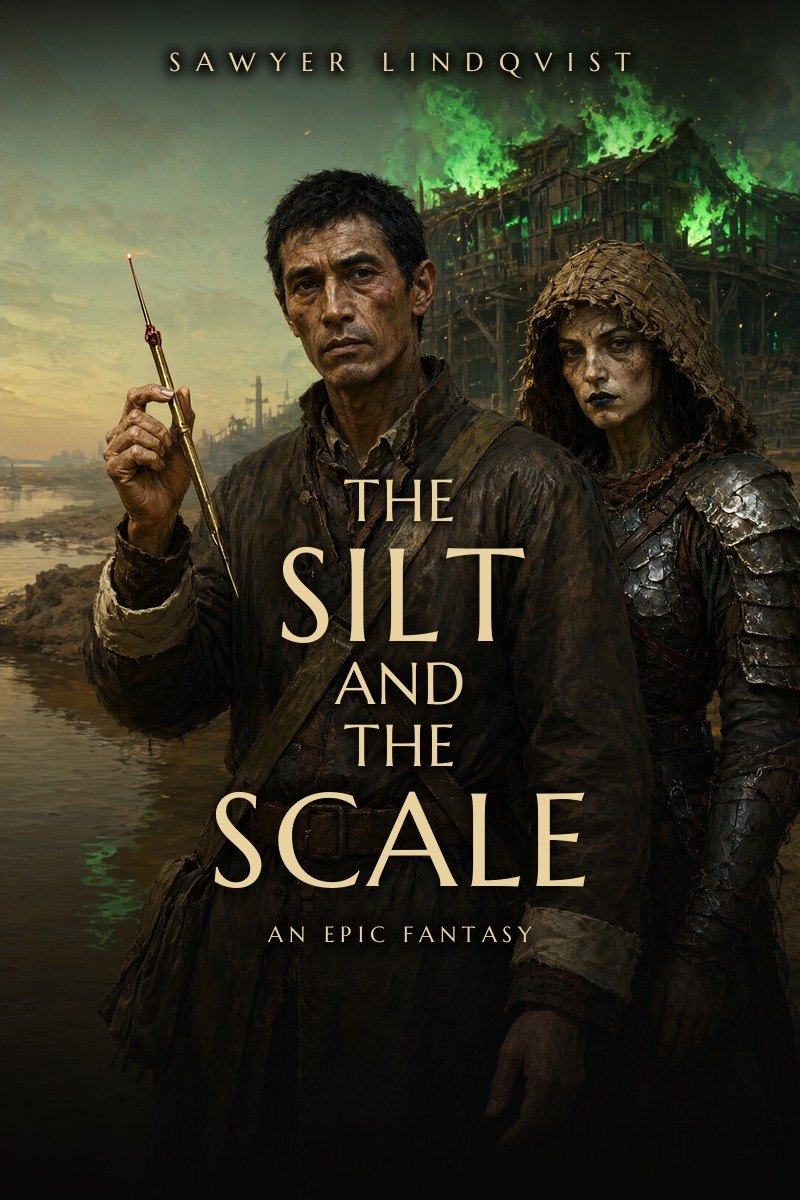
Chapter 15
How long could a body run on borrowed breath before the lungs simply refused the debt?
Tawa-uay had asked himself that question over patients twice already this week, and he was asking it again now, watching Sisa-qa's chest rise in a shallow, counted rhythm across the drying shed's smoke-stained floor. She wasn't drowning. Not yet. But the pause between her breaths had a hitch in it he hadn't heard three days ago, a half-second catch like a hinge dragging over grit, and no amount of argument was going to buy her lungs more time than her blood already owed.
She gave no sign she knew he'd noticed. She was too busy standing over the spread tarp between them, jabbing a finger at the honey-dark phial like it had personally wronged her.
"We have three samples," she said. "A wax code. A tasting log that'll hold up to any apothecary in the delta who isn't bought. We have everything we need to drag this into the open today, and you want to wait."
"I want to live long enough to use it," Mallki-ta said. She hadn't sat down since they'd gathered. She stood the way she used to stand in a shield line, weight forward on the balls of her feet, the ruined knuckles of her badge-hand curled loose at her side. "Urqu-uay knows someone hit his courier. He doesn't know who yet. That window closes the day he does."
"Then close the window on him," Sisa-qa snapped. "Not on me."
Kuntur, cross-legged by the cove-side opening with the stolen manifest unrolled across his knees, didn't look up. "For what it's worth," he said, "if both of you die arguing about this, the going rate on a dead informant's evidence is nothing. Nobody pays for a story no one's left to swear to."
"Helpful," Sisa-qa said.
"I try." He smoothed a crease in the manifest with his thumb, the seal pressed into its corner catching the last gray light off the water. "Just pricing it out. Professional habit."
Tawa-uay let the argument run a little longer. Not out of patience — he had none to spare — but because an argument, run far enough, told you more than a calm conversation ever would. He'd learned that off patients long before he'd learned it off allies: ask a man where it hurts and he'll point to the wrong place half the time, lie about the rest out of pride. Watch where he guards himself without meaning to, and you'll find the truth every time.
Sisa-qa guarded her left hand. She kept it tucked against her ribs, out of the lamplight, where the fine tremor wouldn't show. She wasn't arguing for exposure because exposure was the better strategy. She was arguing because some clock in her own blood had started running loud enough that she could hear it over everything else, and she'd rather burn Wayna's operation down today than discover, in three weeks, that she hadn't lived to see it.
Mallki-ta guarded nothing. That was its own tell. She stood square to the room the way she used to stand square to a line of recruits, chin level, voice flat — and her right hand kept finding the strap where her oar-haft used to ride, closing on empty air before she caught herself and let it drop. She wasn't afraid of Urqu-uay retaliating. She was afraid of watching someone else die on her watch the way Urqo had died under the clinic lintel, buried under a decision she hadn't been fast enough to stop — and she was still carrying a patrol sergeant's memory of her face, one wreck report away from a warrant that already had her name on it.
Two different kinds of running out of time. Neither of them was wrong to be afraid.
"Sit down," Tawa-uay said. Not loud. He never needed to be loud; a man who spoke quietly in a clinic full of screaming made people lean in to hear him, and leaning in was half of listening. "Both of you."
Mallki-ta sat first, which told him something too.
"You're not arguing about Urqu-uay," he said. "You're arguing about which one of you runs out of chances first. Sisa-qa thinks it's her. Mallki-ta thinks it's whoever she's standing next to."
Sisa-qa's jaw tightened, a small, involuntary clench he'd have missed if he hadn't spent four days watching her face for exactly that sign. "That's not —"
"Your hand's been shaking since you came in," he said, not unkindly, "and you've kept it out of the lamp the whole time so none of us would see how badly. I have one needle left that'll touch what's moving in you now. One. I'm not going to pretend that isn't part of this room."
Silence took the shed the way silence takes a wound after the pressure's finally found right.
Kuntur, mercifully, didn't fill it with a joke. For once.
"So what," Mallki-ta said, rougher than before, "we pick one and let the other wait?"
"No." Tawa-uay crouched by the tarp, between the confession, the testimony, and the stolen seal, and looked at what three separate people's risk had bought them. Qhari-ta's careful, too-steady signature. Phuyu-qa's terrified, half-coherent account. A manifest bearing a crest that belonged to no guild they could name. The courier's wax-sealed venom vial, proof the shipment had been real and not invented. Taken alone, any one of them could be denied, burned, or disappeared along with whoever carried it. Together, they were a case that outlived the person holding it.
"So we split it," he said. "Not copies — a signed confession and a pressed seal don't copy honest, and nobody above the delta will take our word over tracing paper. Qhari-ta's confession and the lead seal go into one drop, somewhere only Kuntur knows the route. The manifest, the vial, and two of your three samples go into a second, somewhere else entirely. Phuyu-qa's word and the wax code, we write out twice, since that's testimony and not an object — it costs nothing to say twice. None of it comes within a mile of Urqu-uay's depot. If that goes wrong, we lose people. We don't lose the case."
"And Urqu-uay?" Mallki-ta asked.
"Lives long enough to answer for the chain above him," Tawa-uay said. "You don't kill the only man who's met whoever's standing over Wayna. You take his depot apart, you take him with it, and you let him tell us what he knows before anyone decides what he deserves." He looked at her, let it sit a beat. "You get your window. It just doesn't end in a body you can't question."
Mallki-ta's mouth worked once, like she wanted to argue the order of operations and found she couldn't fault the logic of it. She gave a short nod instead — the kind she used to give a sergeant whose plan she hadn't picked, but would execute anyway because it was sound.
"And me?" Sisa-qa said. Her voice had lost its edge. What was left under it sounded almost like asking permission, which from her was close to begging.
"You get it public," Tawa-uay said. "After. The moment the depot falls, your samples and your wax code go to every apothecary stall from here to the Lower Slips before Wayna can bury the story. That's not slower than today. That's today, with enough behind it that it sticks." He paused. "And you get the needle before any of us go near that depot. Not after. I'm not walking you into Urqu-uay's reach with one treatment left in your blood and no one counting the hours since."
She didn't thank him. That wasn't her register. But she let her shoulders drop half an inch, which from Sisa-qa was the same thing.
Kuntur rolled the manifest closed and set it on the tarp between the other evidence, next to the courier's lead seal, like a man totaling a ledger of hazards rather than proof. "For what it's worth," he said, "splitting it the way you've got it means I'm the one running the second drop through water Urqu-uay's already hunting me over. Just so we're square on who's carrying the most expensive half of this plan."
"You're the only one who can," Mallki-ta said.
"I know." He didn't sound pleased about it. He didn't sound like he was going to refuse, either. "Just pricing it out."
Nobody argued further. Tawa-uay watched the evidence settle into its two piles on the tarp like something finally weighed and balanced, and understood that what he'd just brokered wasn't trust, not yet — Sisa-qa still watched Mallki-ta sideways, and Mallki-ta still said Urqo's name like an unpaid bill. It was something narrower and more useful than trust. Each of them had been handed a stake they could live with losing, and none of them had been asked to carry more than their own fear would let them.
That would have to be enough to walk into Urqu-uay's depot on.
He picked up the last hollow needle from his satchel and turned to Sisa-qa, and for the first time since the argument started, nobody in the shed had anything left to say.

Comments
Loading comments…