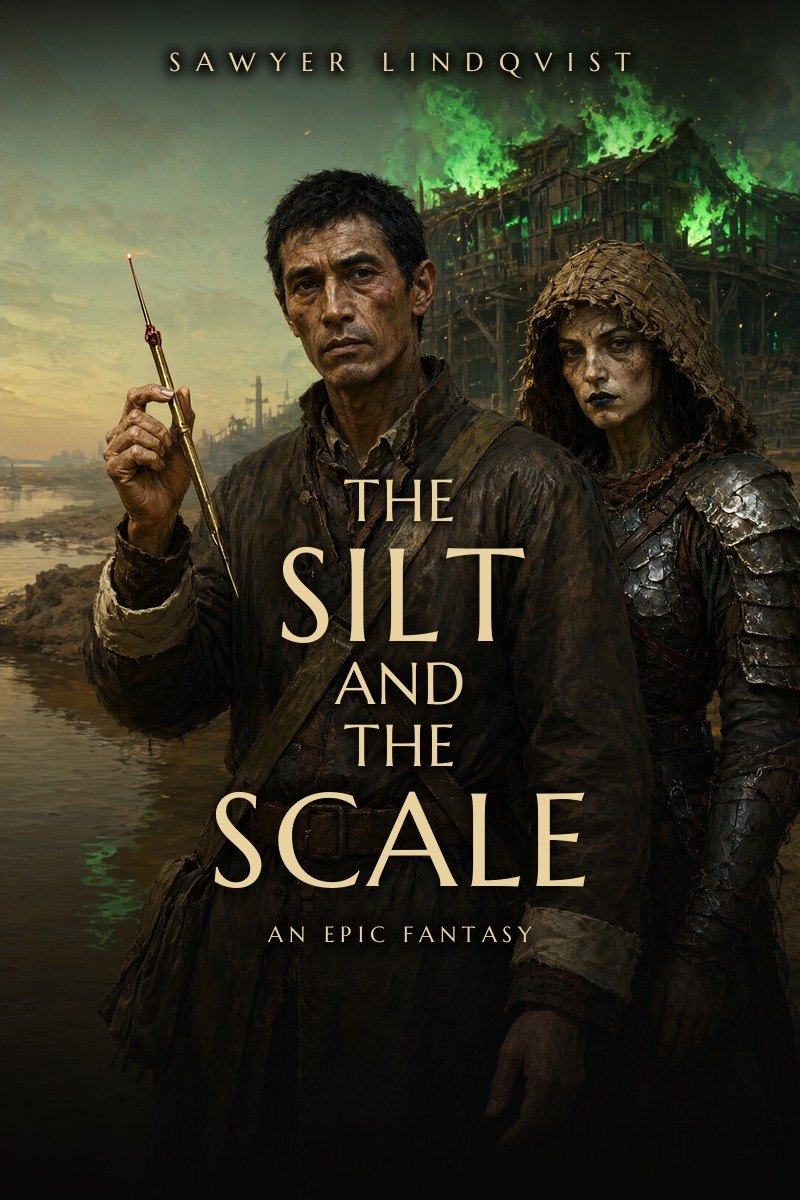
Chapter 6
The iron hook bit into the heel of Mallki-ta’s left boot, testing whether six feet of drowned muscle would drag easily into the reeds. Water pooled in her ears, thick with estuary clay and the sulfur stench of the lower mud-flats, but the cold scrape against her sole was distinct. If she kicked, the river-wasp venom burning through her thigh would lock the joint and give her away. If she waited until the river-picker leaned close enough to check her teeth for silver fillings, her good right arm could take his throat.
She kept her eyelids slitted, watching through a crust of gray silt.
A wiry silhouette crouched above the tideline where the Yaku-mayu spread into shallow, weed-choked braids. The boatman wore trousers caked in dried river mud and a patched hemp tunic that had absorbed so much delta slime it looked like wet slate. A flat-bottomed punt drifted four paces behind him, tied to a bundle of drowned willow roots, its cargo hold loaded with rusted iron chain links, waterlogged cedar ribs, and a heap of brass grommets fished from the channel bottom.
The boatman gave the ash pole another sharp tug. "Too heavy for a drowned apprentice from the kiln sluices," he muttered to himself, his voice high and dry, like two oyster shells grating in a bucket. "Cuirass is cracked clean through the spine-plate, but the rivets are rolled copper. Three pence at the forge. Maybe four if the smith on Charcoal Lane is drunk enough to overlook the river rot."
He slung his ash salvage pole over one shoulder and stepped into the shallows, the brown water rising past his knees. He drew a notched skinning knife from his rope belt, leaning forward to saw through the shoulder strap of her broken breastplate.
Mallki-ta did not flinch when his calloused fingers brushed the sodden leather over her ribs. She waited until the blade tip cleared the sheath and his center of balance shifted over his left knee.
Her right hand shot out from the silt like an oar-stroke, fingers clamping the meat of his windpipe.
The boatman’s breath tore out in a wet squeak. Before his skinning knife could descend, Mallki-ta rolled across the mud-shelf, twisting her torso beneath him. Her cracked left collarbone flared with jagged heat, the bone edges grinding beneath her collar, but she ignored the pain, driving her right elbow up into his armpit while snagging his kicking ankle behind a submerged tangle of fibrous marsh-reed runners. With a sharp wrench of her right heel, she cinched the tough root-web tight around his shin, locking his lower leg fast in the riverbed trap.
They slammed into the tidal shallows with a muffled splash. Pinned by the snarled reed-trap and two hundred pounds of armored muscle, the boatman could not twist away. Mallki-ta drove her right knee into his sternum, knocking the remaining air from his lungs, and jammed his own knife against the soft hollow beneath his jaw.
"Drop the pole," Mallki-ta growled, spitting a mouthful of brackish silt onto his collar.
The ash salvage pole had already slipped from his fingers, bobbing in the slow eddy beside the punt. The man’s mud-smeared face went gray beneath its rind of delta dirt. His dark eyes darted left and right toward the reed thickets, calculating escape routes across the shallow banks.
"Easy, soldier," he gasped, his fingers splaying wide in the dark water. "No silver in your teeth anyway. I wasn't going to stick you. A drowned corpse is honest scrap; a live one is just a loud noise that brings the harbor cutters."
"You touched the leather," Mallki-ta said, her voice gravelly from the estuary water she had swallowed in the clinic sluice. "Under the Basin Charter, stripping a wounded officer carries five inches of cold iron through the palm."
"The Basin Charter drowned three miles upstream, sergeant," the man wheezed, his gaze dropping to the ragged tear on her tunic where Tanqo had torn away her bronze scale-badge. "And by the look of your chest, somebody already cashed your commission and threw the receipt in the river."
Mallki-ta tightened her grip on the knife until a single dark bead welled beneath his chin. "Name."
"Kuntur," he said quickly, keeping his chin tilted back. "Just Kuntur. I work the mud-flats between the Salt Slips and the Timber Reach. I dredge drift-iron and scrap timber. I don't touch guild business, and I don't carry messages for the Directorate."
"You lie about the drift-iron," Mallki-ta said. Her left leg gave an involuntary, violent tremor as the venom in her thigh muscle pulsed against the femoral nerve. A sharp, rhythmic cramp seized her quadriceps, threatening to jerk her hip out of alignment. She clamped her molars together until the spasm subsided, keeping the knife blade steady against his windpipe. "Your punt carries two grappling poles, four oilcloth sacks, and a muffled oarlock greased with tallow. You run contraband past the toll-chains during the ebb tide."
Kuntur squinted at her through the caked silt on his eyelashes. "You have a sharp eye for a drowned woman with half her shoulder caved in."
"I spent eight years policing the lower sluices," Mallki-ta said. "I know every mud-lark who hides under the timber piers, and I know how much cane-gin it takes to bribe a dock bailiff to look at the sky. You have a flat-bottomed punt that draws four inches of water and doesn't scrape on the mud-banks."
"And you have a river-wasp sting working into your marrow," Kuntur countered, his voice dropping into a dry, wary drawl. "Look at your thigh, sergeant. That dark purple knot under the wet leather isn't a river bruise. In another hour, that leg won't bend at the knee. In two, your groin swells shut and your heart starts skipping beats like an overloaded waterwheel."
"Then we understand each other," Mallki-ta said. She eased the pressure of the knife by a fraction of an inch, though she did not lower it. "You have a boat. I have a working arm and a blade at your throat. You are going to pole me to Timber Wharf Warehouse Seven."
Kuntur let out a dry, rattling cough that ended in a spray of brackish spit. "Warehouse Seven? You are out of your mind. That whole slip is under private lockdown. The River's Scales have two heavy iron-sided patrol barges moored across the mouth of the basin, and the Directorate has watchers on every crane platform from here to the cooperage."
"I know what is waiting at Warehouse Seven," Mallki-ta said.
"Then you know it is a slaughterhouse," Kuntur said. "I am a scavenger, sergeant. I pick up things people drop in the dark. I don't row straight into a guild cordon to see which enforcer shoots me first."
Mallki-ta shifted her knee deeper into his sternum, holding him immobile with her body weight. Keeping the knife blade hovering near his throat, her right hand dipped inside the front of her torn leather jerkin. Her fingers closed around the heavy, cold lead cylinder she had ripped from Tanqo’s chest before the sluice burst. She pulled it free and thrust the stamped end directly against Kuntur’s nose.
The deep impression of Factor Wayna’s personal signet—the coiled water-viper biting a balance beam—stood out sharply in the dull gray metal.
Kuntur’s eyes widened. He stopped looking toward the reeds and stared at the lead tube. "Where did you get that?"
"From the lieutenant who tried to drown me," Mallki-ta said. "Tanqo’s squad is sweeping the sub-canals right now, burning the lower clinics and putting iron through anyone who saw Malqui’s body. Do you know what happens to independent scavengers when the Directorate locks down the delta?"
Kuntur remained silent for three beats. His throat bobbed against her knife. "They drop drag-nets with iron sinkers from the toll-bridges," he said quietly. "They dredge the silt until they find anything that breathes, and they nail it to the pilings as a flood-buoy."
"Tanqo’s patrols started at midnight," Mallki-ta said, her voice cold and deliberate. "By the third hour of the morning watch, his cutters will be combing the reed-shallows with flared lanterns and grease-fire arrows. Your punt is three feet wide and smells of swamp gas. You will not make it two hundred yards past the Salt Slips before a cutter runs you down and slices your belly open just to see if you swallowed any guild silver."
Kuntur stared at the lead cylinder, his jaw working. "And if I take you to Warehouse Seven?"
"You get behind the cordon before the perimeter seals," Mallki-ta said. "And if Tanqo’s men corner us, they will not be looking for a mud-lark. They will be looking for me."
Kuntur let out a long, sour hiss through his teeth. "You enforcers are all the same. Even when you are half-dead and leaking poison into the mud, you still talk like you own the river."
"I don't own the river," Mallki-ta said, withdrawing the knife and rolling off his chest onto the mud-bank with a sharp grunt as her left shoulder protested. "I just know where the current takes dead men."
She sat up slowly, her left arm hanging limp against her ribs to keep the broken collarbone from grinding. Her left thigh felt swollen and dense, as though someone had poured hot tallow beneath the muscle casing. She touched the tear in her trouser leg; the flesh surrounding the puncture wound was stained a dark, mottled indigo, the skin taut and burning hot to the touch.
Kuntur scrambled to his feet, wiping estuary mud from his chest with the hem of his ragged tunic. He glanced at the water where his ash pole floated, then looked back at Mallki-ta. For a fraction of a second, his weight rocked toward the deep reeds—a scavenger’s natural impulse to bolt into the dark and leave trouble behind.
Mallki-ta didn't raise the knife. She simply watched him with cold, steady gray eyes, her right hand resting on the hilt of the skinning knife she had taken from his belt.
"The mud in the South Slips is chest-deep at low tide, Kuntur," she said mildly. "If you run on foot, you will sink to your waist in the blue clay before you reach the willow-dikes. The cutters will find your tracks by sunrise."
Kuntur cursed under his breath, a string of colorful delta oaths involving river-leeches and guild bailiffs. He waded into the dark water, caught the ash pole by its iron fork, and dragged the punt closer to the mud-shelf.
"Get in," he muttered. "And keep your blood off the cedar ribs. River-wasp venom ruins the grain."
"You don't have grain worth saving on this scow," Mallki-ta said, grabbing the gunwale with her right hand and hauling her heavy frame over the side.
The punt rocked under her bulk, the shallow draft dipping within two inches of the dark water. Kuntur steadied the craft with a practiced thrust of his pole, his lean shoulders bunching beneath the hemp cloth. He moved with the effortless balance of someone who had spent his boyhood standing on grease-soaked logs in the lumber booms.
"Sit in the middle, near the salvage sacks," Kuntur instructed, pushing off from the bank with a smooth, silent stroke that left barely a ripple in the black current. "If you lean to the left with that shoulder, we will capsize before we clear the reed-heads."
Mallki-ta wedged herself between two coarse sacks filled with scrap iron and unraveled hemp rope. She laid the skinning knife across her lap and used her right hand to loosen the wet leather ties of her boot, relieving the pressure on her swelling left ankle.
The punt glided into the narrow channel between two towering walls of yellow marsh-reeds. Overhead, the delta sky was a vault of bruised purple, choked with low river mist that tasted of woodsmoke and rotting vegetation. The city rose to the north, a layered shadow of stone wharves, towering timber warehouses, and the distant, glowing braziers of the guild watchtowers.
"How long until the tide turns?" Mallki-ta asked, keeping her voice low.
"An hour," Kuntur replied, working the ash pole with short, rhythmic jabs into the mud-bed. "Maybe less if the upper mountain runoff pushes hard against the estuary bar. If the flood tide meets the sluice-surge while we are in the sub-canals, the water will rise to the ceiling joists. We will be swimming with the sewer rats."
"Then push harder," she said.
"Easy to say when you are sitting on my salvage sacks like a sack of wet flour," Kuntur grumbled. He glanced down at her torn sleeve and the bruising across her collarbone. "What did they hit you with? A barge crane?"
"A ceiling deadfall," Mallki-ta said flatly. "Rigged with lead counterweights and sawed beams."
Kuntur gave a low whistle. "That is Directorate work. Expensive. When the Scale-Guards want to kill an ordinary dock rat, they just drop three copper coins in a tavern and let the knife-boys do the work. Who did you cross?"
"Nobody," Mallki-ta said. "I did what I was ordered to do. That was the mistake."
Kuntur nodded slowly, his face half-hidden in the shadow of the reeds. "Aye. That will do it every time. My cousin used to haul timber for the South Slips. Honest man. Paid his guild dues every new moon. One day the factor told him to sign a tally for twenty crates of seasoned teak that never left the yard. Next morning, my cousin was floating face-down near the eel-traps with an iron weight tied to his belt. The guild said he slipped on wet algae."
He dug the pole into the silt, levering the punt around a sharp bend where the water turned sluggish and brown.
"The guilds don't leave loose threads," Kuntur added, casting a wary glance at her. "Which means having you in my boat is about as safe as carrying a jar of live scorpions in my waistband."
"You still have your throat," Mallki-ta noted.
"A temporary condition," Kuntur retorted, though a faint, wry twitch touched the corner of his mud-crusted mouth. "I should have stripped your boots and run for the willow-dikes. At least boots don't argue."
"My boots have holes in the inner soles," Mallki-ta said. "You wouldn't have gotten two copper bits for them."
"I could have sold the nails," Kuntur said without missing a beat. "Iron is dear this season. The smiths on Charcoal Lane are melting down everything from broken hinges to stolen cook-pots."
They moved deeper into the labyrinth of delta backwaters. Here, where the river split around dozens of low silt islands, the water was nearly stagnant, coated with a film of pale green duckweed and oily sheen from the tanning vats upstream. The air grew thicker, smelling of sulfur, wet lime, and the sharp, chemical tang of bone-tincture wash.
Mallki-ta leaned her head against the cedar gunwale, fighting the wave of dizziness that rolled through her temples. The venom in her leg was spreading upward; the flesh of her lower abdomen felt numb and cold, while her thigh throbbed with a sickening, rhythmic heat.
She pressed her good right thumb into the groin crease on her left side, locating the swollen lymph node. It was hard as a river pebble and twice as tender.
"Tanqo was using river-wasp extract," she murmured, more to test her own voice than to inform the boatman. "Stabilized with something caustic. It didn't clot like ordinary swamp venom."
Kuntur paused his poling for a second, sniffing the damp air. "West Canal tincture," he said, his tone turning grim. "The syndicate cooks it in the brick kilns behind the Salt Wharf. They mix wasp bile with calcified bone broth to keep the venom liquid in cold water. If it touches open blood, it locks the muscles until the heart tears itself apart trying to pump against closed pipes."
Mallki-ta looked up at him. "You know a lot about illegal venoms for a drift-iron scavenger."
"A man who fishes dead bodies out of the shallows learns what killed them," Kuntur said, dipping the pole back into the mud with smooth precision. "Drowned men are soft and gray. Knife-kills have pale lips and clean cuts. But the ones that come out of the West Canal sluices? They look like they were carved out of dark purple cedar. Hard as timber, eyes wide open, fingers curled into claws so tight you have to break the bones just to get their rings off."
He spat into the dark water. "I don't touch those. Bad luck. You touch a venom-corpse with bare hands, and your own skin turns yellow by morning."
"I am not dead yet," Mallki-ta said.
"Give it forty minutes," Kuntur said cheerfully. "Though if we hit the Timber Wharf before you lock up, maybe you can break a few heads for me before you turn into a fence-post."
"If I turn into a fence-post," Mallki-ta said dryly, "you can sell my breastplate rivets for three copper pence."
"Four," Kuntur corrected. "I told you, the smith is drinking tonight."
The reeds began to thin, replaced by the towering, slime-coated timber pilings that supported the lower docks of the trade district. Above them, massive squared beams of delta cedar stretched out into the gloom, supporting the weight of multi-story warehouses, crane houses, and elevated walkways. The sound of the river changed, echoing hollowly off the stone bulkheads and submerged cross-bracing.
Here, beneath the city’s floorboards, the water was black as pitch, illuminated only by sporadic shafts of yellow lantern light filtering through the floorboards forty feet above.
Mallki-ta uncurled her right hand and gripped the lead cylinder again. Her tactical instincts, honed through fifteen years of squad patrols, took over despite the fever burning behind her eyes. She scanned the shadows between the massive cedar boles.
"Cut the poling," she whispered, her voice tightening with command. "Use the guide-ropes along the piling lines."
Kuntur didn't argue. He shipped the ash pole, letting it lie flat across the gunwales, and reached out with his bare hands to catch the slimy, weed-draped mooring hemp strung between the pilings. He hauled the punt forward foot by foot, his movements utterly soundless.
"We are two hundred paces from Warehouse Seven’s water-gate," Kuntur breathed, leaning down so his mouth was close to her ear. "The sub-canal widens ahead into the timber seasoning slip. Usually, there is one watch-skiff and an old night-bailiff drinking tea in the crane booth."
"Look higher," Mallki-ta murmured, pointing with her chin toward the cross-timbers thirty feet above the water level.
Between the heavy cedar lintels and the iron winch housings, shadows shifted.
Not the loose, swaying motion of hanging hemp or drying nets. These were crisp, motionless silhouettes stationed every ten paces along the gantry rails. Men in oiled leather brigandines, crouching low with heavy delta repeating crossbows resting on the timber ledges. Their iron quarrel tips caught the faint glimmer of the distant braziers, smeared with a dull greenish sheen that Mallki-ta recognized all too well.
Below the gantries, across the wide entrance to the seasoning slip, two heavy patrol barges were anchored abreast. Their sides were reinforced with iron plating, their rowlocks muffled with grease-soaked rags. On their foredecks, swivel-mounted harpoon throwers were trained directly on the narrow mouth of the channel.
A complete tactical cordon.
Kuntur’s hand froze on the mooring rope. The wiry scavenger sucked in a ragged breath through his teeth, his knuckles whitening as he gripped the slime-covered hemp.
"They didn't just lock down the slip," Kuntur whispered, his voice shaking with sudden, cold dread. "They have turned the entire basin into a fish-trap. Anyone who rows into that water-gate gets thirty iron bolts through their ribs before their hull touches the dock."
Mallki-ta stared at the silent iron barges, her teeth clenched against the throbbing fire in her thigh and shoulder.
"Tanqo isn't just guarding the warehouse," she said, her voice dropping into a razor-sharp whisper as she felt the weight of the stamped lead cylinder in her fist. "He is waiting for someone to try to break in."

Comments
Loading comments…