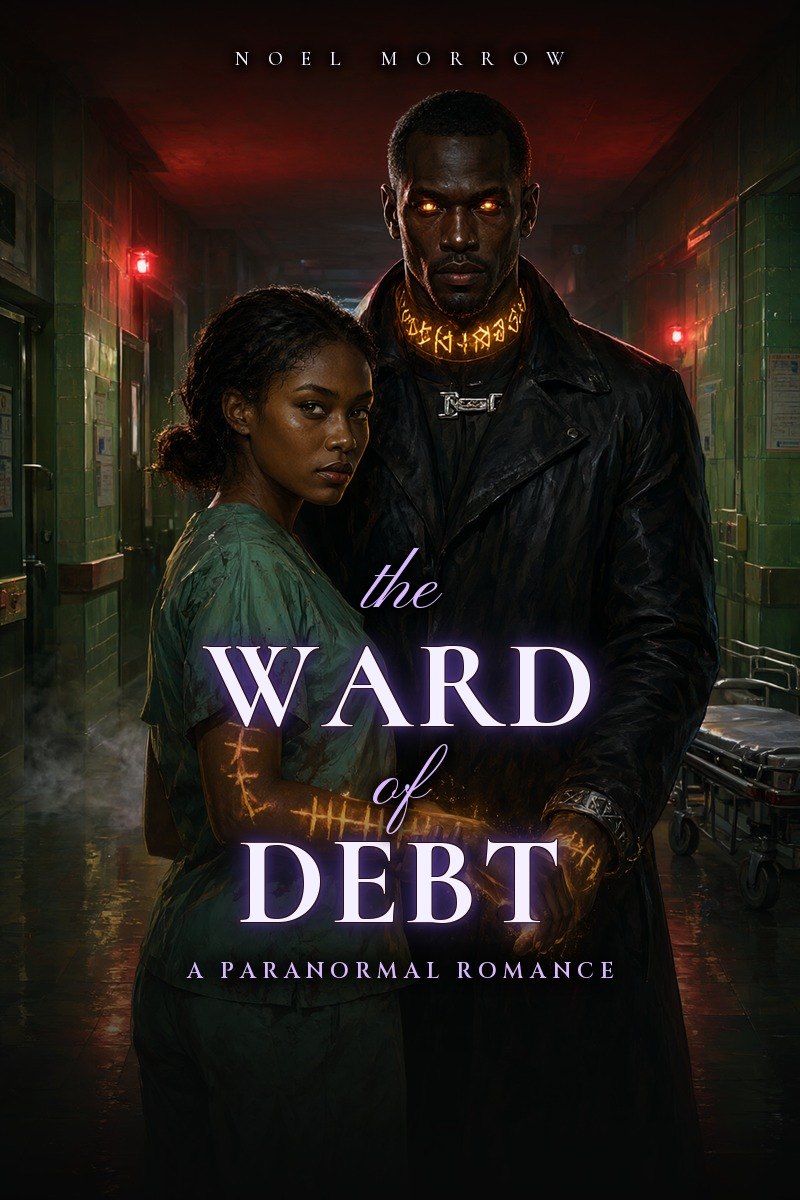
Chapter 10
How long can a man survive breathing acid before his windpipe rots through?
Thirty seconds was what the enforcer manuals promised. Thirty seconds before the lining of the bronchi sloughed away in yellow foam. I had twenty-five when I dragged Nneoma through the rusted inspection hatch and slammed the iron door shut against the descending fog.
The hatch rim screeched against the frame. Corrosive purge mist hissed through the gap, blistering the knuckles of my right hand and singeing the hair on my forearm like an open furnace. I jammed the carbon-steel trench knife through the dog-latch eyelet, kicking the handle down with the heel of my combat boot. The latch bit. The steel groaned under the pressure of the expanding gas behind it, but the lock held.
I fell back against the tiled floor, my chest convulsing in violent, ragged spasms.
My lungs burned with liquid heat. Every breath felt like inhaling ground glass dipped in lye. My wolf surged against my sternum, snarling in blind animal fury, clawing at my ribcage to shift, to heal, to tear through the bulkhead.
Hold, I snarled inward, forcing the beast into the dark corner of my mind. Not here. Not yet.
Beside me, Nneoma knelt on the cold stone, the rubber skirt of the Grade-Four respirator clamped tight against her mouth and nose. The twin charcoal canisters rattled with each sharp breath she took. Through the clear polycarbonate eye-shields, her dark gaze locked onto mine, wide with alarm. She grabbed my tactical harness with both hands, hauling me upright against the tiled wall.
"Breathe through your nose," her voice came through the exhalation diaphragm, muffled and tinny. Her fingers dug hard through my leather duster, finding the skin at my collarbone. "Kameke. Don't take deep drafts. Let your saliva wash the acid out. Spit it."
I leaned forward, vomiting a mouthful of sour, chemical phlegm onto the cracked ceramic floor. The discharge smoked faintly where it struck the tiles, eating through thirty years of dried grease.
"Wolf marrow," I rasped, my throat raw and stripped of bark. "Takes... five minutes to seal the mucosal lining."
"You're an idiot," she said, though her touch lingered on my chest, her fingers trembling slightly. The mate bond between us hummed like a low-voltage wire, warm and insistent against the freezing air of the room. Her skin against mine pushed back the cold nausea in my belly, steadying my erratic heart.
She reached for her scav-pack, pulling free her canteen. She unhitched the respirator's lower seal just enough to wet a clean surgical sponge with sterile saline, pressing it against my blistered lips. The cool saline tasted of salt and zinc. It stung savagely, but it cut the bite of the carbolic acid.
I took the canteen from her, swished a mouthful, and spat the gray wash into the floor drain.
"Better," I said, rising to a crouch.
My left shoulder throbbed with a dull, vicious ache. The two silver staples that had torn loose during the vertical drop swung free from my deltoid, trailing dark threads of clotted blood against my tactical shirt. I reached up with thumb and forefinger, gripped the twisted wire, and yanked the broken staples out of my flesh. The pain was clean and sharp. I wiped the blood on the leather of my duster and checked my sidearm.
The service revolver was dry. My three-foot titanium grounding probe sat securely in its forearm sheath, its chisel tip bent three degrees from where I had driven it into the flue wall, but structurally intact. Inside our packs, the freight remained accounted for: the 1984 brass lockbox holding forty drops of stabilized ward-mercury and Elder Obioma's purge warrant; twenty-three drops in Nneoma's personal pocket vial; eight ampoules of refined silver-marrow painkiller; the Oloye duct schematic spindle; and the Priority Alpha transit ticket that had lured us into the drop shaft.
"Where did that flue drop us?" she asked, snapping the respirator back over her mouth.
I adjusted my tactical harness and looked into the gloom.
· · ·
We were crouched in a wide, low-ceilinged sterilization staging bay.
The room smelled of stale disinfectant, rusted iron, and mineral oil that had settled into a stagnant skim across the flagstones. High above our heads, thick copper pipes ran across the vaulted concrete arches, wrapped in crumbling asbestos and dripping condensated water into rusted galvanized buckets. A row of six industrial autoclaves—massive cylindrical boilers made of riveted cast iron—stood dormant along the southern wall, their heavy round doors hanging open like dead mouths.
A thin, milky vapor hovered two feet off the floor, cold and damp. It was not the purge mist; this was the condensation of an unheated basement wing that had seen neither sunlight nor central heating since the 1980s.
"The Oloye Surgical Wing," I said, keeping my voice low. "Specifically, the preparatory decontamination staging bay for Operating Theater Three. This is where surgical teams scrubbed and boiled their tools before Ward Four was walled off."
Nneoma adjusted the canvas strap of her pack, keeping her weight off her left side. The fresh gauze pad over her stapled ribs showed a small coin of dark crimson, but the bleeding had slowed. "If it’s abandoned, why did Obioma dump three thousand gallons of purge gas into the flue to keep us out?"
"Because nothing in Odimene General is abandoned," I said. "It is only reallocated."
I pulled my grounding probe from its sheath, holding the cool titanium rod at the balance point.
Enforcer instinct prickled at the nape of my neck. My wolf raised its head, its ears flattening against its skull. The beast caught the faint, metallic scent before my human eyes registered the danger: ozone, heated copper, and the sharp, vinegar tang of battery acid.
"Stay behind my heel," I whispered.
I stepped forward into the staging bay, my boots making no sound on the wet tiles.
Five feet from the autoclave row, the air smelled wrong. A foot above the floor, cutting straight through the pale ground-fog, ran a faint, shivering shimmer of heat.
Automated perimeter defense.
The elders hadn't left this corridor open to scavengers. The floor was wired with obsolete Mk-II thermal tripwires—thin threads of electrified tungsten alloy stretched between the steel table legs, tied directly to high-yield floor-mounted discharge canisters hidden beneath the iron drain grates. If an intruder crossed the beam, their body heat broke the thermal differential. The circuit tripped, releasing eighty thousand volts of elder-static directly through the water on the floor. In a flooded room, anyone standing within twenty yards would have their nervous system fried into tallow.
"Thermal tripwires," Nneoma murmured behind me. She had caught the telltale orange shimmer through her respirator's visor. "Vintage model. Standard installation for high-security quarantine bays in 1982."
"Three inches off the floor," I noted. "Coupled to four-gauge copper leads."
I knelt on one knee, inspecting the nearest anchor point. The tungsten wire was fastened to the rusted leg of a stainless-steel wash sink. The wire itself was almost invisible, thinner than a strand of fishing line, but where it met the sink leg, a small brass junction box pulsed with a tiny, intermittent amber diode.
Click. Hum. Click.
The firing circuit was armed and cycling every four seconds.
"Can you sever it?" she asked.
"Severing a closed circuit drops the line resistance to zero," I replied. "The capacitor interprets that as a trip and detonates the floor charges. We don't cut. We bleed the current."
I studied the layout. The stainless-steel wash sink was four feet wide, fitted with two deep basins and double swan-neck faucets. The drainpipes below the sink were solid cast iron, sinking directly into the hospital's central sewage bedrock. Ground potential: absolute.
I took the bent chisel tip of my titanium grounding probe and positioned it half an inch from the junction box's primary resistor. With my left hand, I unscrewed the valve of the saline wash line feeding the sink. A trickle of clear, mineral-heavy water spilled into the right-hand basin, running down the open drain with a quiet, hollow gurgle.
"Watch the diode," I told her.
I jammed the titanium chisel into the junction casing, bypassing the trip relay and driving the live circuit directly into the sink's steel frame.
A violent, silent spark of blue fire erupted from the probe's tip. The tungsten wire shuddered, glowing dull orange for a split second as four hundred volts of captive static arced up the titanium shaft. The shock rattled through my forearm, numbing my elbow, but the probe's heavy grounding braid carried ninety percent of the surge straight into the sink's cast-iron drain.
The amber diode died.
The orange heat shimmer across the floor blinked out with a faint, sighing click.
Across the room, three hidden solenoids beneath the floor grates unlatched with a dull metallic thump, disarming the blast charges.
I exhaled slowly, my breath fogging in the freezing air. The hair on my forearms stood on end from the residual ionization, but the path was clear.
"Tidy," Nneoma said, stepping carefully over the slack tungsten wire. "You missed your calling, Collector. You should have worked maintenance."
"The pay in enforcement was better," I said, standing up and sliding the probe back into my forearm sheath. "And the uniforms were cleaner."
"Not tonight they aren't."
She wasn't wrong. My leather duster was scorched, caked with yellow purge residue, and soaked through the left sleeve with my own blood. We looked like two carcasses that had crawled out of the hospital's incinerator chute.
Which was uncomfortably close to the truth.
· · ·
We moved past the autoclaves into the central supply corridor.
The walls here were lined with green ceramic tile, cracked by seismic shifts and webbed with black mold. Overhead signage hung askew from rusted chains: OPERATING THEATERS 1–4. AUTHORIZED SURGICAL PERSONNEL ONLY.
At the end of the corridor stood a locked steel preparation cage—a reinforced equipment locker used by surgical orderlies to store heavy bone instruments and sterile trays. The wire-mesh doors were forged from ward-iron: thick, cold-rolled steel alloy infused with five percent lead and silver, designed to withstand the thrashing of rogue patients or predatory entities attempting to breach the operating rooms.
The door was locked with a heavy bronze padlock bearing the crossed-scalpel insignia of the Oloye Surgery Guild.
Nneoma stopped before the cage, her eyes raking over the shelves inside.
Through the heavy mesh, her gaze locked onto a rectangular stainless-steel instrument box sitting on the middle shelf. The lid was secured by two heavy toggles, but the stenciled label was clearly legible: SURGICAL AMPUTATION SET - TEMPERED TITANIUM.
"Kameke," she said, pointing a gloved finger through the iron mesh. "Look at the blades on the secondary tray."
I stepped beside her. Inside the open lid of the kit lay three heavy surgical bone-saws. They were not human-grade medical tools. The frames were twelve inches long, forged from solid, tempered aerospace titanium with counter-balanced pistol grips and heavy diamond-toothed blades. The teeth were set at three-millimeter intervals, designed to chew through dense supernatural bone—lycanthrope femur, hardened ghoul carapace, and reinforced ward-iron fixtures.
"Those saws can cut through the reinforcement bolts of an emergency blast shutter in under two minutes," she murmured. "And the teeth are coated in industrial diamond slurry. If we run into another locked security gate, we won't need to blow up a solvent line."
"Stand back," I said.
The bronze padlock was old, but the shackle was an inch thick. I didn't have time to let Nneoma read its tumbler history; every minute we spent in this corridor was another minute for Obioma's sweep teams to track the ventilation drop.
I drew my trench knife, slid the flat of the carbon-steel blade behind the shackle, and drove the chisel tip of my titanium grounding probe into the lock's keyway.
I set my boots against the door frame, took a breath through my teeth, and heaved.
The muscle in my left shoulder screamed as the staples pulled again, but my wolf surged into the lever, lending its raw, predatory force to the steel. The bronze alloy buckled under the mechanical stress. With a sharp, ringing snap, the padlock's internal pins sheared. The latch blew open, clattering across the floor.
I swung the cage door wide.
Nneoma stepped inside without hesitation. Her fingers moved fast and sure over the stainless-steel tray. She lifted the primary amputation saw, testing the balance in her grip. The titanium frame weighed nearly four pounds, but the balance was immaculate, engineered for steady, brutal efficiency.
Beside the saws lay two spare diamond-toothed replacement blades wrapped in oiled butcher paper, and a pair of heavy surgical rib-spreaders forged from the same dark metal.
"Take all of it," I said.
She slid the spare blades into the internal pocket of her scav-pack, wrapping them in canvas to keep them from clinking against the 1984 lockbox. She handed the primary bone-saw to me. I lashed the titanium tool to the side loops of my tactical rig, next to my grounding probe.
A concrete acquisition. In the belly of this hospital, having the tools to cut through steel and bone was the difference between an escape route and a dead end.
"Now," Nneoma said, securing her pack flap. "Where is Dr. Ikenna?"
I pointed toward the heavy double doors at the end of the hallway.
Above the threshold, a painted sign read: OPERATING THEATER THREE.
A single wire-mesh observation window was set into the upper half of the doors, darkened by heavy blackout curtains. But through the seam beneath the door frame, a faint, flickering slit of light danced across the threshold.
Not electrical light.
The cold, erratic flicker of battery-operated surgical field lamps.
And with the light came a smell that stopped my boots dead on the tile.
· · ·
The scent was thick, foul, and wrong.
The first note was scorched copper—the unmistakable reek of high-voltage wire burning through rubber insulation. The second was raw ozone, heavy and sharp like a lightning strike inside a sealed tomb. But beneath the electrical scorch was a scent that made the hair on the back of my neck stand straight up.
Predatory marrow.
The scent was thick, wild, and curdled with pain. It was the smell of a wolf’s blood boiled down to essence, mixed with something synthetic and dead—a chemical preservative that smelled of embalming fluid and battery acid.
My wolf bared its teeth behind my ribs, pacing violently, letting out a silent, ragged snarl that echoed in my skull.
Abomination. Tainted flesh.
"Kameke?" Nneoma whispered, her hand finding my forearm. She felt the sudden rigidity in my muscles, the tension coiling through my frame. "What do you smell?"
"Keep low," I ordered.
We moved down the hallway, pressing our backs flat against the tiled wall until we reached the double doors.
The small observation window was six inches wide and twelve inches high, fitted with thick wire-reinforced safety glass. The internal blackout curtain had slipped slightly on its track, leaving a half-inch vertical gap near the lower brass frame.
I leaned in, my tactical eye taking in the interior of the theater.
Operating Theater Three was massive, built like a tiered anatomical amphitheater from the early twentieth century. Empty wooden spectator benches rose in concentric semicircles toward the dark ceiling, draped in dust sheets and cobwebs. In the center of the sunken stone floor, beneath the dead chandelier of sixty-cycle surgical bulbs, a temporary field triage station had been erected.
Two heavy battery packs sat on mobile carts, humming with a low, irregular rattle as they powered four portable LED surgical lamps. The bright, sterile white beams were angled directly down onto a heavy cast-iron operating table.
At the head of the table stood a man.
He was tall, lean, and wore stained green surgical scrubs beneath a heavy rubber butcher’s apron caked in dried, oxidized blood. His arms were bare to the elbows, corded with sinew, his dark skin glistening with a film of sweat under the glare of the lamps. A white surgical mask hung loose around his neck, revealing a sharp, exhausted face with deep, dark hollows under his eyes and a graying beard trimmed close to the jawline.
Dr. Ikenna. The Bone-Setter of Ward Four.
In his right hand, he held a curved surgical needle threaded with heavy silver suture wire. His fingers moved with frantic, desperate speed, his knuckles twitching with the rhythmic muscle memory of a man who had performed ten thousand amputations under shellfire.
Every five seconds, his head jerked toward the heavy blast doors leading to the main corridor, his jaw clenched, listening for footsteps.
He was terrified.
And on the table beneath his hands lay the patient.
I focused my vision through the glass, narrowing my pupils against the glare of the surgical lamps.
The body on the table was a man—or what was left of one. He was strapped down with three-inch leather restraints reinforced with steel cable. His chest rose and fell in shallow, hitching gasps, his skin mottled with gray cyanosis.
He was not being treated for trauma.
His torso had been split open from the sternum to the navel. But instead of standard surgical retractors holding the wound open, six brass conduction clamps were anchored directly into the cartilage of his ribs. Thick, braided copper wires ran from the clamps into a heavy glass vessel resting on a metal stool beside the table.
Inside the glass vessel, suspended in thirty drops of cloudy, amber ward-fluid, sat a humming core of refined supernatural marrow.
The marrow was not being infused into the patient to heal him.
It was being harvested.
Dr. Ikenna was weaving conductive silver filament directly into the patient's major arteries, stitching the living tissue to the copper leads. Every time the needle pierced the muscle, the patient's limbs convulsed against the leather straps with a sickening, shuddering tremor. A faint, violet static pulsed along the silver thread, lighting the surgeon's bloody rubber gloves with a sickly halo.
"Mother of mercy," Nneoma breathed beside me. She had pressed her face to the glass, her eyes wide behind the respirator's visor. Her breath came in short, jagged bursts through the diaphragm. "He isn't repairing the tissue. He's... he's wiring the circulatory system."
"It's soul-conduction," I said, my voice dropping into a flat, deadly whisper.
The pieces came together in my mind, cold and terrible.
The 1984 purge orders. The missing medical transports in the lower tunnels. The constant, insatiable soul-debt quotas demanded by Elder Obioma.
The hospital was not treating patients who couldn't pay their debts. It was converting them.
When a debtor's brand burned down to zero, they weren't executed. They were brought to these dark, blacked-out surgical theaters in Ward Four. Their marrow was harvested, and their living veins were retrofitted with conductive silver filaments to transform their bodies into biological batteries—living soul-conductors capable of channeling and storing the elders' crushing administrative magic.
A living conduit of agony, built to fuel the wards.
And Ikenna was the craftsman holding the needle.
"Look at the doors," I whispered, pulling her back an inch from the glass.
On the far side of the operating theater, flanking the reinforced double blast doors that led out into the main Ward Four concourse, stood two hospital wardens.
They were not orderlies. They were elite enforcers from Obioma’s personal retinue.
They wore matte-black tactical armor with heavy ceramic chest plates and full-face visors tinted deep crimson. In their hands, they held heavy shock-staves tipped with silver-mesh discharge prongs, and holstered sidearms chambered for heavy tungsten rounds. They stood with their boots spread, their arms crossed over their chests, watchful and still.
They weren't guarding Ikenna from intruders.
They were watching him. Ensuring he finished the quota before the shift ended.
I backed away from the observation window, pulling Nneoma down into the shadow of the door recess.
My wolf was silent now, curled tight behind my ribs, its hackles raised in pure, calculating hatred. The enforcer oaths I had sworn five years ago felt like ashes on my tongue. I had served an institution that ground people into ink to balance its ledgers, but this was industrial slaughter disguised as medicine.
Nneoma looked at me, her hands gripping the strap of her pack. The gold ring around her iris flared briefly in the dark, her pulse hammering against her throat.
"We need that keycard to the Biological Archives," she whispered, her voice tight with fury. "The schematic spindle said Ikenna holds the master bypass."
"He does," I replied, glancing back through the narrow slit at the surgeon's trembling hands. "And he has two wardens watching his neck. If he screams, the shock-staves will take us down before we clear the threshold."
"He won't scream," she said, her eyes hard as obsidian. "Look at his hands, Kameke. He isn't doing this because he wants to. He's doing it because they have a brand around his throat."
She leaned her back against the cold tile, her fingers closing tight around the handle of the titanium bone-saw lashed to my rig.
The hunt had changed. We weren't just running from an audit anymore.
We were looking at the butcher shop. And the butcher was waiting for an excuse to drop the knife.

Comments
Loading comments…