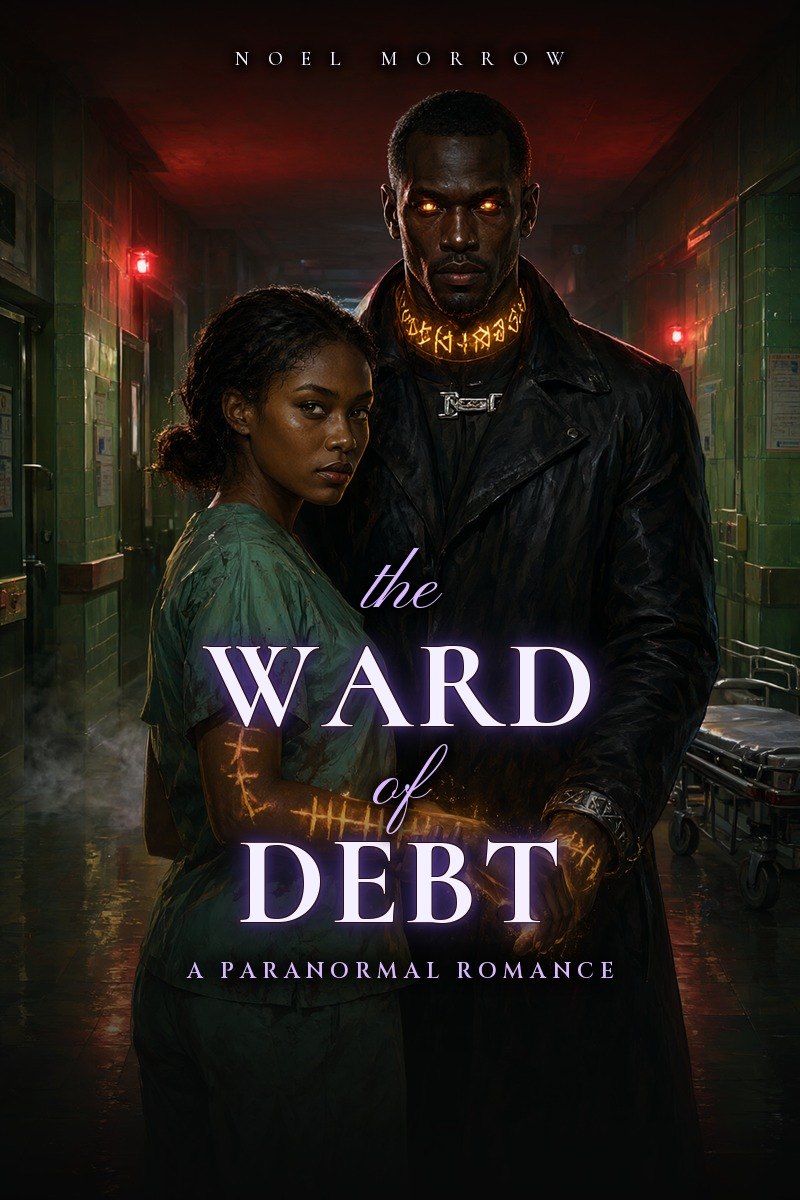
Chapter 12
The question wasn't whether the hospital was trying to kill me, but which department held the requisition order.
Down in the subterranean marrow of Odimene General, homicide was never an act of passion. It was an administrative procedure, signed in duplicate on three-part carbon paper and filed under general maintenance. Standing outside the reinforced blast doors of the Okike Biological Archives, I clamped a gloved hand against my left ribs, feeling the sharp pinch of my fourth surgical staple grinding against raw bone. The pain was immediate, sharp, and familiar. It kept me grounded while the sub-basement air tried to freeze the moisture off my eyelashes.
Beside me, Kameke leaned against the riveted bulkhead, breathing with the slow, controlled discipline of an apex predator measuring every cubic inch of oxygen. His dark eyes flickered between the security junction and the corridor behind us. The chemical burns in his throat from the gravity flue were still rough, but his shifter regeneration had already stitched the worst of the tissue into tough, quiet resilience. In his right fist, he held the three-foot titanium grounding probe, its tip angled downward. The twelve-inch tempered bone-saw we had liberated from the Oloye prep cage hung from his tactical harness, cold and heavy against his thigh.
"The air is dropping three degrees every thirty seconds," Kameke said, his voice a low scrape against the humming ductwork. "Sub-zero circulation. They keep the biological archives cold enough to preserve marrow tissue."
"They keep it cold enough to make trespassers crack like cheap glass," I muttered.
I took the magnetic bypass keycard Dr. Ikenna had handed over in exchange for two ampoules of stolen silver-marrow painkiller. The plastic was thick, bordered with gold-leaf circuitry and stamped with the stylized caduceus of the Okike guild. On the back, an alphanumeric serial code had been half-melted with an acid swab, leaving only the operational glyphs: ARCH-BIO-V4.
Ahead of us stood the vault door. It wasn't standard hospital iron. It was a six-inch slab of cast molybdenum-steel, frosted with a crust of crystalline frost. A brass digital keypad and a dual-channel induction reader sat flush against the frame, but the telltale frost pattern around the housing warned me away from a simple swipe.
"Wait," I said, catching Kameke's tactical vest before his shoulder crossed the red perimeter line painted on the concrete.
His gaze snapped down to my fingers on his canvas harness. Even through the heavy fabric and my rubber utility gloves, the mate-bond gave a sudden, electric shudder. It wasn't the violent lightning that had shattered his collar in the service conduit, but a steady, thrumming pull—a subterranean tide of heat answering the frost on my skin. His pulse knocked against his throat, steady and dark. For a heartbeat, his jaw hardened, fighting the animal instinct to step closer, to crowd me against the bulkhead until neither of us had to breathe the sterile cold alone.
"What is it?" he asked, his tone clipped to hide the roughness.
"Look at the condensate around the housing," I whispered, kneeling beside the card terminal. "This isn't just an electronic bolt. It's a thermal siphon lock. If you slide Ikenna's card while the secondary glycol valve is seized, the mechanism registers a forced breach. It drops liquid nitrogen straight into the tumbler assembly. The pins freeze instantly, contract, and shatter under spring pressure. Then the whole door welds itself shut with zero-point sealants."
Kameke knelt beside me, his bulk shielding the doorway from the draft whistling down the corridor. "Can you bypass the siphon?"
"Not from the front," I replied, pulling my flashlight and the surgical rib-spreaders from my utility pack. I aimed the narrow beam at the conduit gap beneath the reader's brass faceplate. "The maintenance crew never replaces the purge gaskets. Look at that yellow build-up. It's calcified coolant residue from the 1980s."
I took the flat end of the rib-spreader and wedged it between the conduit ring and the steel frame. My scavenger sense prickled across my fingertips—an itch of history, the ghost memory of every wrench that had turned against those frozen bolts forty years ago. I felt the precise tension where the bypass valve had frozen open in 1984 during the sector purge.
"Here," I instructed, tapping the grounding probe in Kameke's grip. "I need you to earth the primary induction pin behind the keycard slot. If you short the line while I manually relieve the siphon pressure, the board will cycle into diagnostic mode. It'll think the temperature drop is an authorized calibration cycle."
"How much current?" Kameke asked, his knuckles whitening on the titanium rod.
"Thirty-six volts," I told him. "Whatever is lingering in the auxiliary capacitor. If you draw more than fifty, the surge will fry the magnetic strip on Ikenna's card, and we'll be stuck out here with thirty pounds of useless scrap."
"Thirty-six volts," he repeated.
He didn't question the estimate. He didn't ask how a night-shift scavenger who spent her life sorting contaminated bandages could read the electrical tolerance of an archivist's blast door. He simply adjusted his grip on the bent titanium probe, wedging the tapered tip into the upper grounding port while I held the rib-spreader against the frozen valve.
"Three," I counted under my breath. "Two. One. Ground it."
Kameke leaned his weight into the probe. A blue spark popped in the darkness, snapping like a dry twig. A thin coil of ozone rose between our faces. At the exact instant the indicator light flickered from amber to pulsing violet, I twisted the rib-spreader forty-five degrees to the left. The calcified glycol crust broke with a muffled crack. A jet of supercooled gas hissed out of the relief port, coating my rubber gloves in instant white rime.
I slid Ikenna's encrypted card through the channel.
The reader clicked once. A mechanical relay inside the jamb groaned, followed by the deep, resonant thud of four hydraulic counterweights shifting inside the steel frame. The heavy door unsealed with a gasp of pressurized vapor, rolling back three inches on its greased tracks.
A wave of bitter, chemical chill poured over us. It smelled of industrial freon, formalin, and the deep, stale tang of vintage marrow—the scent of blood that had been frozen so long ago it had forgotten the body that carried it.
Kameke stood first, his trench knife in his left hand and the bone-saw drawn in his right. He swept the room beyond in two clean strides, checking the angles before waving me in.
"Clear," he murmured. "Automated climate control only. No biological signatures inside the vault."
I stepped through the gap, pulling my collar up around my throat. My breath billowed in thick clouds before my eyes.
Vault Four was not an administrative office. It was a mausoleum disguised as a laboratory. Two dozen rows of floor-to-ceiling brass shelving stretched into the darkness, each bay fitted with frosted glass tubes, vacuum-sealed canisters, and copper capillary lines feeding into a central cryogenic trough. Frost clung to every surface like lace. The silence here was heavy, unbroken except for the rhythmic chug-chug of an antique compressor beneath the grated metal floorboards.
"Look at the classification markers," I said, running my beam across the brass tags soldered to the shelves.
They weren't organizing files by patient name or medical history. The labels bore inventory classifications: BATCH 12-A: HIGH-CONDUCTANCE LYMPH, SERIES 7: REINFORCED PERIOSTEAL MARROW, CLASS-THREE SOUL GRAFTS.
This was where the night hospital stored the raw materials for their debt economy. Every jar, every sealed ampoule contained pieces of indebted patients who had failed to settle their ledgers. Their life force had been distilled into tradeable currency, sitting on shelves waiting to be injected into the failing bodies of the hospital elders.
"Over here," Kameke called softly from the center aisle.
He was standing before a reinforced steel pedestal near the main cryogenic trough. Unlike the common shelving, this pedestal was anchored into the foundation with eight heavy anchor bolts, surrounded by a frozen bath of stabilized ward-mercury that had congealed into a mirror-like slurry. Resting atop the pedestal was a massive binder bound in blackened pigskin and framed with tarnished brass reinforcement plates.
A frosted label across the spine read: OKIKE EXPERIMENTAL LEDGER — 1984: LINEAGE INCUBATION PROTOCOLS.
My chest tightened. The air suddenly felt too thin to breathe. Forty years ago, my mother had worked the night shifts during the Great Purge, the same purge that Elder Obioma had ordered to harvest Ward Three. And now I was looking at the ledger Ikenna had described—the document that proved my 420-ounce debt was never a monetary reckoning.
"Is this it?" Kameke asked, his voice tightening as his predator senses caught the unnatural stillness of the object.
"It's the trial ledger," I said.
I approached the pedestal, my boots crunching on the frost-coated floor. My hands trembled, not from the cold, but from the sudden, violent prickle running across my palms. My Scavenger's Sight didn't wait for my permission; it flared alive behind my retinas, turning the world into layers of fading copper light. The brass corners of the book hummed with an agonizing psychic frequency. It felt like standing near an unshielded power generator, vibrating with grief, terror, and the unmistakable scent of burning hospital linen.
"Nneoma," Kameke said, stepping closer. His fingers hovered near my forearm, restrained, respectful of my space, but coiled with protective urgency. "Be careful. A ledger that old has absorbed the pain of every soul recorded in its parchment. The psychic backlash could tear through your neural pathways."
"I spent twenty-four years believing my mother died because she couldn't pay her bills," I said, stripping off my right utility glove and letting it drop onto the metal grating. "I spent my entire adult life hiding from debt collectors, scrubbing blood off the ward stairs, thinking I was born broken. If the truth is in this ledger, I am taking it."
I laid my bare palm flat against the frozen brass spine of the book.
The world vanished in a roar of white noise.
The cold of the archive didn't just touch my skin; it plunged straight into my blood like a fist of ice. The psychometric vision slammed into my consciousness with the force of an oncoming freight train, blowing past my mental barriers before I could brace myself.
The darkness ruptured into blinding fluorescent light.
The air smelled of burning plastic, scorched bone, and cheap chlorine. I was seeing through two eyes that were not mine, looking down at a pair of small, scarred hands clamped over a trembling belly.
1984. The old triage bay of Ward Three.
Outside the reinforced glass windows, red emergency strobes painted the smoke-filled corridors in rhythmic blood-red flashes. Distant screams echoed through the ventilation shafts, cut short by the wet thud of bone-cleavers and the roar of industrial incinerators. The sector purge was already underway.
"You cannot protect what has not yet drawn breath, Adanna," a cold, cultured voice echoed across the room.
Standing before the surgical table was Elder Obioma. Forty years younger, but wearing the exact same immaculate, ivory-white administrative coat she wore today. Her hair was pulled back into a severe, lacquered bun, completely unruffled by the slaughter happening fifty yards away. In her gloved right hand, she held an antique brass syringe filled with an iridescent, violet-silver fluid—synthetic soul-marrow, glowing with ungodly heat.
"Spare my unborn line," my mother gasped. Her voice was cracked, raw from breathing smoke, her body trembling with terror on the blood-soaked gurney. "Take me. Throw me into the furnace with the rest of the staff. But do not harvest the seed of my womb."
Obioma smiled—a thin, symmetrical movement of the lips that held neither warmth nor malice, only the absolute indifference of an accountant balancing a column of figures.
"A dead debtor pays nothing," Obioma said, her tone smooth and level. "Your lineage carries the rare marrow porosity required to incubate synthetic conductor channels. The elders require biological hosts. If I incinerate you tonight, forty years of selective breeding vanish into the ash flues. But if you accept the inoculation covenant, I will grant your future child a passage from the furnace."
"A passage?" Adanna wept, her hands digging into her stained scrubs. "You'll brand whatever child I bear. You'll hunt her through the wards the moment she comes of age."
"I will assign her a phantom balance," Obioma corrected calmly, stepping toward the table. "Four hundred and twenty ounces of soul-debt. High enough to keep her bound to the night shift where my collectors can monitor her, but low enough that she will strive to pay it rather than flee. And while she grows, her biological core will nurture the generational marrow graft, refining the conductor matrix until it reaches full maturity in her blood."
Obioma raised the brass syringe. The heavy needle gleamed in the red emergency light.
"Agree to the host graft, Adanna. Allow me to seed the primary conduit into your own sternum. If you refuse, I will drop you into the incinerator right now, and your bloodline ends in cinder."
My mother closed her eyes. Her breath came in ragged, desperate sobs. Her hands shook violently as she reached out with a trembling finger, signing her name in blood at the bottom of the open ledger.
"I accept the covenant," Adanna whispered, her voice shattering like dry glass. "Put the seed in me. Let the debt wait for the child."
Obioma pressed the heavy needle straight into my mother's sternum.
The agony struck me across forty years of time.
It wasn't merely a memory; it was the generational resonance of the synthetic marrow graft sleeping inside my own ribcage, detonating in sympathetic harmony with my mother's historic trauma. The pain ruptured through my central nervous system, blowing through my skull like an overcharged circuit.
I threw my head back, a silent scream tearing through my throat.
A hot, thick gush of blood burst from both of my nostrils, pouring down over my lips and chin. A second later, a sharp, piercing pop rang in my ears, and warm crimson began trickling down the sides of my neck. My knees gave out completely.
Before my skull could shatter against the frozen steel grating, heavy arms locked around my ribs, hauling me backward into a wall of solid heat.
Kameke caught me.
"Nneoma!" His voice was a harsh roar against the ringing in my ears.
The physical contact closed the circuit of the mate-bond. The sheer volume of my agony—the phantom burn of forty-year-old soul-grafts, the horror of my mother's sacrifice, the physical tearing of my neural tissue—flooded directly across the bond into his predatory core.
He took the impact without flinching. His chest expanded with a ragged, shuddering gasp as his inner beast absorbed half the psychic shockwave, relabeling my pain as his own. His eyes flashed an incandescent, predatory gold in the dim light of the vault. The muscles across his shoulders bunched like wound steel cable, his breathing turning into a low, rumbling growl that rattled the frost off the nearest cryogenic pipes.
Mate. The word vibrated through the marrow of our joined bones, not spoken, but hammered into the space between our frantic heartbeats.
"Breathe," he ordered, his hand pressing firmly against the back of my neck, forcing my head forward to keep the blood from choking my airway. "Look at me, Nneoma. Come back. The memory is dead. You are here."
I gasped, coughing up a mouthful of copper-tasting bile and blood. My vision cleared in violent, stuttering pulses. The glowing memory of 1984 faded back into the dim brass shelves of Vault Four. I was shivering violently, my scrub shirt soaked in sweat and fresh blood, but my fingers were still locked around the edges of the pigskin binder.
With a final, desperate jerk of my arm, I ripped the experimental ledger off the frozen pedestal. The brass hinge sheared away from the security brackets with a shrill screech of tearing metal.
The physical theft was what tripped it.
Above our heads, a tiny glass sensor pod on the ceiling shattered with a soft tink. It wasn't a standard hospital siren that responded; this was the biological vault of the elite elders. A low, subsonic vibration began thrumming through the floorboards—a silent bio-resonance alarm designed to broadcast a containment breach directly to the sector security wardens.
Red emergency diodes flickered to life along the baseboards, casting long, bloody shadows across the frozen shelves.
"The sensor," I croaked, wiping the sleeve of my scrub top across my bloody nose, smearing scarlet across my cheek. "It felt the ledger leave the pedestal."
Kameke didn't waste a syllable lecturing me. He hauled me to my feet, his arm wrapping securely around my waist to steady my trembling legs until my boots found their purchase on the metal grating. With his free hand, he shoved the heavy 1984 ledger into my canvas field pack, pulling the drawstring tight.
"Can you run?" he asked, his voice dead flat, tactical, and utterly lethal.
"I can walk fast enough to stay ahead of an autopsy," I wheezed, pressing a sterile gauze pad from my pocket against my bleeding ear.
Down the outer corridor, the heavy blast doors we had bypassed scant minutes ago hissed open.
Then came the sound that turned the cold in my gut to solid lead: the synchronized, heavy cadence of six pairs of steel-toed combat boots pounding across the outer concrete floor.
It wasn't ordinary wardens. The footsteps carried the rhythmic, mechanical click of reinforced bone-grafts striking metal—the unmistakable signature of Chief Orderly Chidalu's personal strike squad, armed with shock-mauls and heavy cleavers, moving in a tight wedge formation toward the vault entrance.
Kameke shifted his stance, placing himself squarely between the open doorway and my battered body. He unlatched the primary titanium bone-saw from his harness with a crisp, metallic snap, his knuckles locking white around the grip as the golden glow in his eyes burned bright against the descending red shadows.
The heavy boots reached the threshold. The cold mist in the doorway parted, and the first iron-plated orderly stepped into the light.
I gripped my rib-spreaders, set my feet against the bloody grating, and waited for the clash.
The distance between us vanished in the span of a single heartbeat. Chidalu's lead orderly didn't bother with an administrative warning or a formal debt demand; he lunged forward with a two-handed swing of an electrified bone-cleaver, the steel blade crackling with blue-white arc fire that lit up the frost on the ceiling.
Kameke didn't give an inch. He stepped into the arc, parrying the cleaver with the flat of his titanium grounding probe. The collision sent a shower of bright sparks raining into the cryogenic mist, illuminating the cold, unyielding fury carved into the line of his jaw.
Behind him, I backed into the shadow of the brass shelving, my bloody fingers curling tight around the strap of my field pack. The ledger was safe against my spine, cold and heavy with the truth of my existence, while the narrow vault turned into a slaughterhouse of ringing steel and boiling marrow.

Comments
Loading comments…