Chapter 6
Nneoma
How many ways could a hospital kill someone who was already working a twelve-hour shift?
Down here, past the second maintenance rung, the answer smelled like scorched copper and wet zinc.
My boots hit the iron grating of the lower ladder platform with a wet clang. Soot drifted through the vertical shaft, swirling in the beam of my pocket flashlight like black snow. Above me, the hatch we had just sealed was a dark square. Below me, the tunnel narrowed into the intake throat of Station Two: the Burn Ward.
I glanced at my left wrist. The sulfur brand burned with a pale, toxic yellow light under my skin.
01:02:14.
One hour and two minutes.
Sixty-two minutes to clear Station Two, drop fifty drops of ward-mercury into the official ledger terminal, and keep my soul from becoming hospital collateral.
"Watch the third step," Kameke said from right behind me.
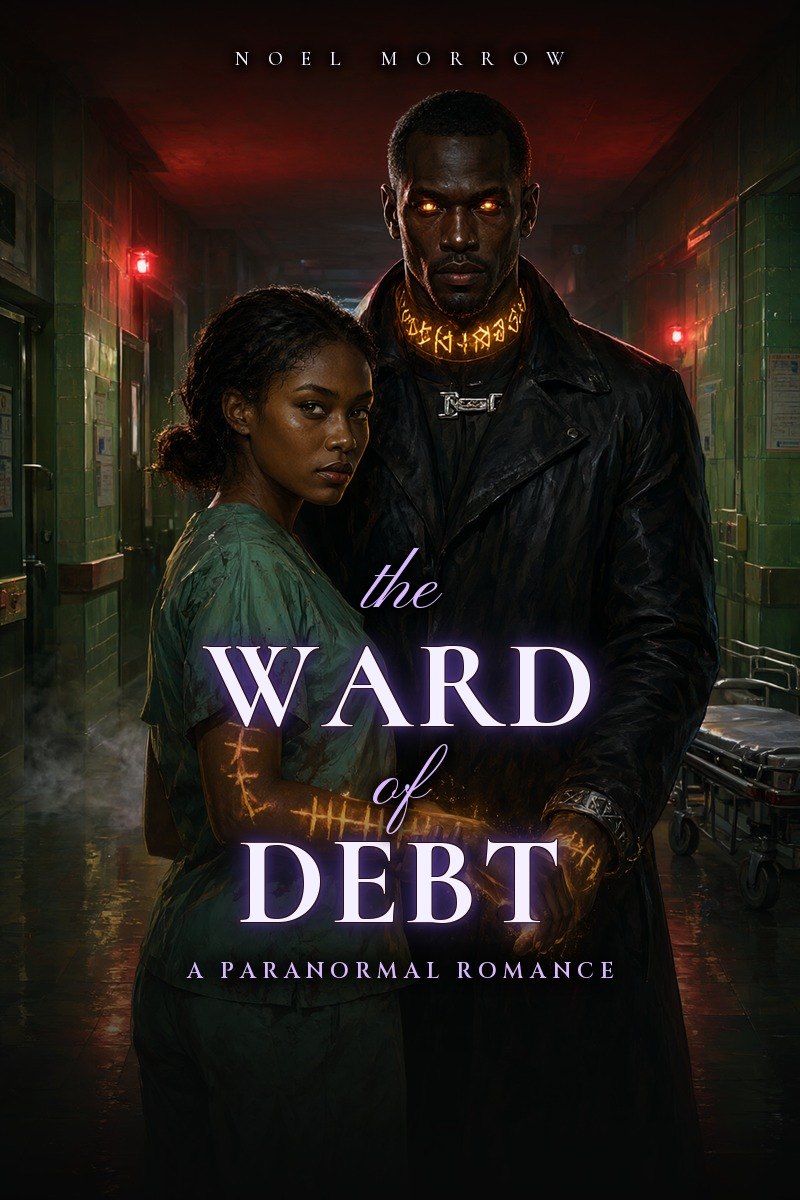
His voice was lower now. Rougher. Without the silver audit runes biting into his jugular, his throat was a raw topography of blistered skin and charred linen. But when his bare shoulder brushed mine in the narrow shaft, heat flared between us. It was not the cold static of an audit collar. It was the heavy, suffocating warmth of a furnace door swinging open.
My skin prickled across my collarbone. My pulse jumped against my ribs.
Mate.
The thought was not mine, and it was not quiet. It sat in my chest like a swallowed ember, stubborn and heavy.
Did I have time to dissect why my instincts wanted to lean into six feet of lethal muscle? Absolutely not. My student loans had never carried a death penalty, but Elder Obioma's ledger certainly did.
"I see the step," I muttered, shining my light on the corroded tread. "The rust ate through the flange forty years ago."
"How can you tell?"
"The color of the scale," I said, stepping over the gap and landing lightly on the concrete landing. "Fresh rust is orange. This stuff is black and flakes like burned toast. 1984 boiler blow-out."
Kameke dropped beside me without making a sound. His dark eyes caught the edge of my flashlight beam, glowing with that faint, predatory gold that belonged to the wolf pacing behind his ribs. He carried the heavy brass lockbox under his left arm like an ordinary lunch pail. In his right hand, he held his tactical steel pen, thumb resting over the thumb-stud.
"Station Two intake is thirty yards down this corridor," he said. "The airlock should be manned by a single gate clerk and two low-tier wardens."
"Should be?" I asked. "Or was when you filed your last shift report?"
"Station Two does not change," he replied, his tone clipped. "The Burn Ward is an isolation sink. Nobody gets transferred here unless they broke protocol or offended an Elder. The staff is lazy, resentful, and predictable."
"I love predictable," I said, adjusting the strap of my cryo-case over my shoulder. "Predictable means I get to keep my fingernails."
The corridor opened into a high-ceilinged transit foyer.
It did not look like the pristine tile of Intake Ward upstairs. The walls here were clad in riveted steel plates, discolored by decades of caustic steam and chemical soot. Overhead, flickering fluorescent tubes hummed in rusted cages, casting jaundiced yellow rectangles across the floor. A faded hazard placard hung crooked beside the intake wicket: STATION TWO – THERMAL RECOVERY & PYRO-ISOLATION – UNAUTHORIZED DISCHARGE WILL RESULT IN IMMEDIATE DEBT FORECLOSURE.
The air was hot. Thick enough to coat the back of my throat with the taste of sulfur and lye.
"Where is the intake clerk?" I whispered, slowing my pace.
The wicket ahead was a reinforced booth made of bulletproof wire-glass. The rolling steel security shutter was halfway up, but the swivel stool behind the counter was empty. A half-eaten styrofoam cup of instant noodles sat on the desk next to a dormant terminal. Steam was still rising from the broth.
Kameke's arm shot out, barring my chest.
His fingers were warm through my faded teal scrubs. Every muscle in his forearm was rigid.
"Stay behind me," he said.
"What is it?"
"The scent," he murmured, his nostrils flaring slightly. "It is not ward clerks."
"Then who is it?"
"Sanitation," he said, the word dropping from his mouth like cold lead. "Obioma's private sweepers."
Before I could ask why an administrative Elder would deploy a sanitation crew to an intake gate, the fluorescent lights died.
A heavy pneumatic thump echoed through the ceiling vents. Red emergency beacons kicked on, spinning in silent, bloody circles against the soot-stained walls.
From the service alcoves on either side of the wicket, four figures stepped into the red glare.
They did not wear the standard linen coats of hospital nurses. They wore heavy, full-body aprons made of galvanized zinc, strapped over padded grey jumpsuits. Their faces were obscured behind thick mica-glass respirators, but I could see what was missing behind the glass.
Their eyes had no pupils. Only flat, milky cataracts laced with silver needle marks.
"Shock orderlies," Kameke growled, shifting his stance to block the wide aisle. "The ones who failed their five-year contracts."
My stomach turned.
These were the men Kameke had told me about in the conduit. Enforcers who had refused their final quotas, stripped of their memories, their wolves lobotomized by elder silver, turned into mindless meat to haul heavy cargo and clean up bio-slaughter.
The lead orderly raised a five-foot rod of blackened iron. The tip was tipped with a glowing marrow-capacitor that crackled with blue arc-light.
"Debtor Nneoma," a synthetic, flat voice rasped from the loudspeaker mounted on the orderlies' chest plates. It was Elder Obioma's voice, pre-recorded and synthesized through the hospital intercom grid. "You have deviated from your designated transit conduit. Surrender the 1984 lockbox and submit to immediate soul extraction. Refusal will accelerate your brand timer to zero."
"She knows we have the box," I whispered.
"She does not know I am alive," Kameke replied softly. "She thinks you are carrying it alone."
The four orderlies advanced in a coordinated wedge. Their heavy magnetic boots clomped against the iron floor, vibrating through the soles of my sneakers. The two on the flanks raised pneumatic restraint tethers—thick steel cables armed with barbed harpoons designed to pin a rogue wolf to the concrete.
"Can you take four?" I asked, backing toward the left wall.
"They are dead men with batteries in their spines," Kameke said, his jaw tight. "They do not feel pain. But they are slow."
"Good," I said. "Because I have no intention of letting them touch this case."
The center orderly lunged forward, thrusting the shock rod straight at Kameke's chest.
Kameke did not dodge back. He stepped inside the arc of the staff, his left hand catching the orderly's wrist with a sickening crack of bone. The shock rod buzzed, blue lightning grounding harmlessly through his combat boots. With a fluid, brutal twist, Kameke drove the titanium heel of his tactical pen directly into the orderly's respirator valve.
The mica-glass shattered. A burst of pressurized gray gas hissed into the air, and the orderly collapsed like a puppet with cut strings.
The second orderly fired his pneumatic tether.
The steel cable hissed through the air. Kameke caught the line with his bare forearm, wrapping it once around his wrist and yanking with monstrous force. The orderly was pulled off his feet, crashing face-first into the concrete.
But the remaining two orderlies did not hesitate. They adjusted their formation, raising dual marrow-probes to box him against the steel counter. At the same time, the overhead shutter above the intake gate began to grind downward.
CLANG. CLANG. CLANG.
Heavy magnetic lock-pins slammed into place along the blast doors behind the wicket.
"They are sealing the gate!" I yelled, dodging a spray of sparks as the fallen orderly's staff shorted against the floor. "If those blast doors lock, we are trapped in the foyer!"
"Nneoma! Get to the control panel!" Kameke shouted, ducking beneath a sweeping blow from an iron staff. He drove a vicious elbow into an orderly's ribs, but the man did not even grunt, simply swinging back with a blunt fist that clipped Kameke across the collarbone.
I sprinted toward the intake wicket.
The security console inside the booth was completely dead. The keyboard had been crushed by an iron pry bar, and the primary circuit breakers were welded shut with molten lead.
Obioma had not just sent an ambush; she had burned the bridge behind them.
I looked at the heavy blast doors blocking the exit to Station Two. They were three inches of solid rolled steel, stamped with the hospital's interlocking serpent seal. On the right jamb, a thick cluster of pneumatic lines and copper conduits fed into a massive industrial autoclave valve.
The valve was ancient. Its brass wheel was caked in black scale, stamped with an inspection tag from November 1983.
Why would a 1980s sterilizer line be plumbed directly into a modern security blast gate?
I ripped off my leather work glove.
I slapped my bare palm against the frozen brass valve.
Vision hit me like a bucket of boiling oil.
The world dissolved into a storm of roaring steam and blinding heat.
December 14, 1984. 4:12 AM.
A technician in rubber coveralls was screaming, his skin peeling from his arms as superheated vapor tore through the main flange. “The purge pressure is too high! The Elder bypassed the governor! The whole line is going to blow!”
Another man in a business suit—bearing Obioma’s gold serpent seal on his lapel—held a wrench to the bypass cock, deliberately jamming the secondary release valve shut. “Let it cook,” the man said through his respirator. “Ward Three burns from the inside out. When the tank hits four hundred pounds, it takes the entire floor with it.”
The tank ruptured.
A wall of white fire and shrapnel ripped the room apart.
I snapped back to the present.
Blood trickled warm and sharp from my left nostril. I wiped it away with the back of my hand, breathing hard. The pain behind my temples was a dull, rhythmic hammer, but the picture in my head was crystal clear.
The sterilizer line was not an auxiliary heater. It was the original high-pressure conduit from the 1984 purge. The hospital had never removed the old pipes; they had simply capped them and welded the new blast gate frame directly over the volatile pressurized reservoir.
The dormant tank behind that steel bulkhead was still holding forty years of stagnant, compressed chemical solvent.
All it needed was an ignition source.
"Kameke!" I shouted over the din of clashing metal. "The blast wall is hollow! There's an unvented solvent line behind the door frame!"
Kameke threw the third orderly across the room into a bank of steel lockers, the metal denting with a thunderous bang. He turned, breathing heavily, blood dripping from a cut above his left eyebrow. The fourth orderly was already climbing back to his feet, raising a heavy pneumatic ram.
"Can you breach it?" Kameke called out, stepping between me and the advancing shock orderly.
"Not with a crowbar!" I unclipped my cryo-case and flipped the latch. "I need an energetic catalyst!"
"You have the ward-mercury!"
"Ward-mercury needs a thermal trigger to decompose!" I pulled the brass 1984 lockbox toward me, thumbing open the catch.
Inside, fifty drops of stabilized ward-mercury rested in their velvet-lined glass ampoules, glowing with a deep, liquid silver light. Next to them was the signed purge order.
I pulled out a single ampoule.
What else did I have?
My pocket flashlight. A cheap, heavy aluminum casing powered by a high-draw lithium battery pack.
I grabbed the flashlight, smashed the lens against the iron counter, and yanked out the exposed LED diode and the bare copper wiring. The lithium cell was warm in my palm.
"Nneoma, whatever you are doing, do it now!" Kameke roared.
The last shock orderly charged, swinging a five-hundred-pound hydraulic spreader like a club. Kameke stepped forward, taking the impact across his raised forearms. The force drove him down to one knee, the concrete cracking under his boots. His inner beast snarled—a deep, chest-rattling sound that vibrated the very air in the room. His fingers hooked into the orderly's zinc collar, ripping the heavy metal plating away with terrifying wolf strength, exposing the cybernetic spinal harness underneath.
I didn't have time to watch him tear the monster apart.
I jammed my thumb into the inspection port of the 1984 brass valve, feeling for the weak seam I had seen in the memory.
There. A hair-line fracture where the solder had crystallized forty years ago.
I snapped the neck of the mercury ampoule with my teeth.
The taste of metallic ozone flooded my mouth, sharp and bitter as battery acid. I spat the glass onto the floor, held the open ampoule over the crack, and let three heavy drops of stabilized ward-mercury trickle directly into the dormant solvent chamber. Then I quickly tipped the remaining seven drops into the rubber-stoppered vial in my scrub pocket, saving every drop of my hard-won harvest.
The mercury hit the stagnant chemical residue inside. A high-pitched, tea-kettle hiss immediately shrieked through the copper pipes.
"One drop of mercury accelerates combustion tenfold," I muttered to myself, wrapping the bare copper leads of the flashlight battery around the valve stem. "Three drops should turn forty-year-old solvent into a shaped charge. Please let the math work."
I looked at the timer on my wrist.
00:58:12.
Fifty-eight minutes left.
"Kameke! Get down!" I yelled.
Kameke didn't ask questions. He snapped the last orderly's neck with a sharp, violent wrench, grabbed the fallen zinc apron from the floor, and threw his entire body over me, pressing us both flat against the reinforced concrete base of the wicket counter.
His weight was heavy, solid, and warm. His scent—crushed cedar, cold iron, and the wild, musky heat of his wolf—wrapped around me like armor.
I touched the positive lead of the shorted battery to the negative terminal.
SPARK.
A blinding blue arc jumped from the copper wire into the brass valve.
For half a second, nothing happened.
Then the wall shrieked.
A deafening, concussive CRACK tore through the transit foyer.
The dormant solvent reservoir behind the door frame ignited with the fury of a contained bomb. Orange and silver flame erupted outward in a tight, directed jet, tearing through the three-inch steel blast doors like wet cardboard.
The shockwave slammed into the wicket counter, rattling my teeth in my skull. Concrete dust, shredded steel, and superheated vapor rained down over Kameke's broad back. The zinc apron he held over us deflected a hail of jagged shrapnel with a series of frantic metallic thuds.
The heat was suffocating. But beneath the heat, I felt the steady, unbroken rhythm of Kameke's breathing against my neck.
When the roaring blast finally subsided into a crackling hiss of severed pneumatic lines, Kameke pushed himself up.
He shook the debris from his dark hair, looking down at me. His eyes were wide, gold-flecked, and fiercely alive.
"You blew a hole through a Grade-Four containment bulkhead," he said, his voice laced with disbelief.
"The plumbing was forty years past inspection," I coughed, wiping a smear of black soot from my cheek. "Technically, it was a routine maintenance hazard."
A faint, sharp tilt touched the corner of his mouth. "Remind me never to audit your tool kit."
"You couldn't afford it anyway," I said, grabbing my cryo-case and checking the latch. All eight painkiller ampoules were intact. The 1984 lockbox was secure, with forty drops of ward-mercury still sealed inside, plus the twenty-seven drops in my pocket vial. Total: sixty-seven drops.
I stood up, stepping over the smoking wreckage of the intake wicket.
Where the three-inch steel blast gate had once stood, there was now a jagged, glowing breach four feet wide, opening directly into the central transit corridor of Station Two.
The way forward was clear.
We had beaten the ambush. We had dismantled Obioma's shock squad.
I stepped through the smoking threshold, ready to run for the next terminal.
Then the ceiling above us exploded with light.
Not a bomb.
A blinding, strobing crimson flare that turned the entire corridor into a slaughterhouse wash of red.
From the walls, from the ventilation shafts, from every intercom speaker along the mile-long transit artery, a massive, deafening siren began to wail.
WHOOP. WHOOP. WHOOP.
A harsh, automated dispatch voice cut through the blaring klaxon, vibrating with absolute emergency priority:
“WARNING. PRIMARY SECTOR BREACH DETECTED AT STATION TWO INTAKE. HIGH-ORDER DEMOLITION REGISTERED. CONTAINMENT PROTOCOL EPSILON ACTIVATED. ALL CORRIDORS SEALING IN SIXTY SECONDS. ALL SENTRY HOUNDS RELEASED.”
Down the long, smoke-filled hallway ahead, heavy iron fire-shutters began slamming down from the ceiling in rapid succession, one after another, racing toward us like falling guillotines.
Kameke gripped my arm, his claws extending half an inch from his fingertips.
"Run," he said.

Comments
Loading comments…