Chapter 3
The heat rising from the intake pit did not smell of burning coal; it smelled of scorched lard and pulverized bone. Three hundred feet below our ledge, two dozen interlocking manganese gears churned inside a fog of superheated grease, each tooth the size of a hay cart, grinding in counter-rotations that shook the basalt foundation under my boots. My chest was already seizing with a dry, warning flutter, but I had one hundred and twenty seconds to find a dry path across the mesh before the intake cycle sealed us in the dark forever.
I did not have the breath for a sprint. A single dead sprint across iron grating would blow the valve in my left ventricle before I reached the midpoint, dropping me directly into the teeth.
"Keep your eyes on the axle hubs," I said. The words tore against the raw lining of my throat. "The outer teeth travel at thirty paces a second. The centers barely move."
Tevrik-oglu stood half a step ahead of me on the precipice, his silhouette cut black against the orange glare of the pit. The iron cuffs on his wrists clinked as he adjusted his grip on the slack chain between them. Blood from the cut above his brow had dried into a crust across his temple, but his shoulders were square, his balance centered over the balls of his feet like a man waiting for the drop of a duel banner.
"You expect me to hop between axle caps?" His voice was low, flat, unaffected by the roaring din below.
"I expect you to follow where I step," I said, leaning over the brink to track the rotational rhythm. "Or you can leap into the drive mesh and let Orhan-bek shovel your grease into the boiler. Your choice, prince."
He gave me a single, sideways glance. His jaw hardened, a sharp ridge of bone in the firelight.
"Lead," he said.
Around us, the chasm erupted into slaughter.
Conscripts from the adjacent cells—convicts from the salt flats, deserters from the frontier regiments, street thieves dragged out of the capital sewers—were hurling themselves off the drop. Some tried to leap across the wide bronze rims of the secondary gears. The metal was slick with hydraulic runoff. A burly man in an unbuckled iron cuirass hit the first wheel, lost his footing, and slid screaming down the face of a ten-foot bevel into the point where two drive drums converged. The crunch of his armor was a wet, muffled pop, drowned instantly by the shriek of pressurized steam.
The world stopped. The heat scorched my skin. The iron floor shivered. The drop waited below.
"Now," I said.
I dropped off the lip.
The drop was eight feet down to the stationary housing of the primary intake shaft. My boots struck the cold, oil-slicked granite block with a sharp jar that sent a spike of white fire through my collarbone. My left shoulder went instantly cold—the familiar, sickening phantom pain of my heart stalling under sudden impact. I dropped into a low crouch, palms slapping the stone to arrest my momentum, breathing in four short, shallow bursts through my nose to keep the pulse from hammering itself to pieces.
A heavy clatter of iron announced Tevrik-oglu landing right behind me. He absorbed the impact with bent knees, the chain between his wrists held taut so it wouldn't snag on the granite seams. He didn't look down at the dead man below us. He looked at my back.
"Next seam?" he asked.
"Ten paces out," I told him, pointing through the boiling yellow fog. "The spoke of the third drive wheel. It locks with the lateral transfer drum every four beats. We cross on the lock."
"That spoke is three inches wide," he said.
"Then don't miss."
I sprang before he could argue. The courier trails along the high gorges of the Blackroad had taught my boots how to trust narrow ledges that offered no second chances. You do not look at the drop; you look at the friction point where the sole meets the rock. In the Loom, the friction point was a bronze spoke rotating clockwise through a curtain of hissing vapor.
One. Two. Three.
The spoke swung level with our stone perch. I stepped onto the bronze bar. The vibration traveled up through the leather of my soles, humming against my shins. Ten feet below my toes, the immense planetary gears chewed air and grease, their massive teeth gnashing with the force of falling boulders. The wind from their displacement whipped my hair across my eyes.
I took four swift, light strides along the bronze rib, using my outstretched arms to counter the rotational drift. Halfway across, the spoke tilted toward the downstroke. Gravity tried to pull my hips outward toward the grinding void. I dropped my center, planted my right heel hard against a raised rivet, and jumped for the stationary pivot cap at the center of the secondary pinion.
My boots hit the bronze cap. I slid two inches before the tread on my left sole bit into the rough cast iron.
Behind me, Tevrik-oglu moved with a terrifying, heavy grace. He lacked the light footwork of a mountain runner, but his leg drive was immense. He hit the turning spoke, took two crushing strides, and leaped. His boots came down on the edge of the pivot cap just as my hand caught the shoulder of his tunic to keep his weight from carrying him over the lip.
The impact drove the air from my chest. For a second our faces were inches apart in the orange murk. I could smell the sharp tang of sweat, dry limestone dust, and old copper on his skin. His dark eyes locked onto mine, unblinking, assessing the strength in my fingers.
"You're shaking," he noted.
"I'm keeping you from becoming machine lubricant," I muttered, shoving him back onto his own heels. "You're welcome."
"Move," he said, nodding toward the next tier. "The intake valve is venting."
He was right. Fifty yards ahead, high on the staging wall, a massive iron sluice gate was slowly descending, its counterweights rattling inside vertical guide tracks. Above the gate, standing behind a protective balustrade of reinforced plate, Master Builder Orhan-bek stood motionless. In the glow of the furnace flues, his long leather coat hung straight as a plumb line. He held a brass timing sphere in his right hand, watching the conscripts die below him with the quiet curiosity of an assayer weighing dust.
More than half the jumpers were already gone. A knot of four conscripts had made it to the central catwalk, but two of them were fighting over a narrow ladder, throwing wild punches while the floor beneath them swung toward the steam vents. A jet of pale, high-pressure vapor erupted from a pressure release nozzle directly beneath the ladder, engulfing both men. Their screams were cut short as the heat stripped their skin to the meat, dropping them into the lower casing.
My pulse skipped two beats, hung in empty silence, and then slammed against my sternum like an iron hammer. The world grayed at the edges. A cold numbness crept down my left forearm into my thumb.
Not here, I ordered my body. Not in the grease.
"Koray-tay." Tevrik-oglu's voice had dropped its mocking edge. It was sharp, clipped, commanding. "The path."
I blinked away the gray film over my vision. My spatial memory kicked in, laying the grid of the chamber over the noise and smoke. The Loom wasn't random chaos. It was an intake pump. It breathed in cycles. Three counter-rotating wheels to the left, two planetary drums to the right, and a central transfer shaft that shifted laterally on every seventh revolution.
"The transfer drum," I said, pointing toward a thick, ribbed cylinder spinning twenty feet above the pit floor. "We have to hit the cross-brace on the fifth stroke. On the seventh stroke, the bevel teeth underneath will engage and chew anything within three yards."
Tevrik-oglu looked at the rotating drum. "The gap is eight paces. My chains won't allow that stride."
"Then you jump high and let your momentum carry you," I said. "And don't hesitate. If you freeze on the fifth stroke, the seventh will split you in half."
"I don't freeze," he said.
"Prove it."
We moved together. The timing was brutal. The air in the lower intake was growing hotter by the second as the boiler draft opened, pulling toxic fumes up from the deep combustion wells. My lungs burned with every inhalation, each breath feeling like raw glass scraping my windpipe.
We leaped from the pivot cap to a stationary guide beam, ran the length of the beam, and hit the edge of the transfer casing just as the fifth stroke locked the cylinder in place.
I hit the ribbed surface first, scrambling on hands and knees across the spinning steel before it could gain full rotational speed. Tevrik-oglu came right behind me, his heavy boots clanging against the ridges.
Then came the telltale mechanical groan: a deep, shuddering vibration that traveled through the metal plate into my marrow.
The seventh stroke.
Tevrik-oglu had already pushed himself upright, planting his feet to leap for the staging ladder hanging six feet above us. He didn't hear the internal release. He didn't know the Spire's mechanical tolerances. He couldn't feel the secondary bevel gear sliding out of its housing along the lateral rail beneath his feet.
If he leaped now, the rising tooth of the bevel would take him at the waist.
"Tevrik!" I shouted.
I didn't think about my heart. I didn't think about the brand burning on my collarbone or the ignition pin hidden in my boot. I lunged forward, throwing my entire weight sideways, and hooked my right arm through the chain between his shackled wrists.
I dragged him backward with everything I had.
"What are you—" he snarled, his balance breaking.
We hit the iron grating of the transfer platform together, tumbling in a tangle of limbs and bruised bone.
A split second later, a solid steel tooth three feet wide and six feet tall sheared through the empty air where Tevrik-oglu had been about to jump. The metal slammed into its receiving slot with a deafening crash that sent a spray of sparks raining over our heads. The backdraft of compressed air blew my hair back and tore the breath straight out of my mouth.
If we had been two inches taller, the displacement alone would have crushed our skulls.
Tevrik-oglu lay beneath me on the vibrating plate, pinned under my torso. The sparks hissed as they died in the grease around us. His chest rose and fell in heavy, controlled surges, his eyes wide and dark, staring directly into the place where his body would have been severed.
He looked up at me. His pupils were dilated with raw adrenaline, but his jaw remained locked tight.
"You saw the slide," he whispered.
"I felt the pressure drop in the casing," I gasped, my throat burning. "I told you... the seventh stroke."
He didn't speak. For three heartbeats, he just looked at me—not as a mountain rat, not as a conscript thief who had stolen his royal cipher, but as the only person in this cavernous hell who understood the ground beneath his feet. His hand came up, iron cuffs rattling, and caught my forearm. His grip was bruising, steadying, hard as the manganese gears around us.
"Get up," he said quietly.
"I'm trying," I wheezed. My chest was spasming violently now, a tight knot of agony that made it impossible to draw a full breath. The edges of my vision were blackening.
Tevrik-oglu didn't wait for my lungs to clear. He surged to his feet, hooked his chained hands under my arms, and hoisted me bodily onto his shoulder.
"The ladder," I managed to croak, pointing toward the staging wall. "Before the gate drops."
He didn't argue. Carrying my weight as if I were nothing more than a courier pack, he took three long, explosive strides across the cleared platform and launched himself across the final chasm.
His boots caught the lower rung of the iron ladder just as the intake gate reached the four-foot mark. The iron frame groaned under our combined weight. With a ferocious grunt, using only the raw power of his back and thighs, Tevrik-oglu hauled himself up the rungs, ducked under the descending iron teeth of the sluice, and threw us both across the stone threshold of the staging platform.
We rolled onto the solid basalt floor just as the gate crashed down behind us.
BOOM.
The sound echoed through the staging hall like a cannon blast. The heavy iron slab sealed into its granite sill, cutting off the orange glare, the screaming conscripts, and the roar of the lower gears in an instant.
Silence fell over the platform, thick and suffocating, broken only by the sound of ragged breathing.
I lay on my back against the freezing stone, staring up at the vaulted ribs of the ceiling. My heart was flopping inside my ribs like a landed trout, fluttering in irregular, terrifying spasms. I pressed both hands hard against my sternum, digging my heels into the rock, forcing myself to count seconds.
One. Two. Three. Breathe.
One. Two. Three. Breathe.
Slowly, agonizingly, the flutter caught a rhythm. The cold numbness in my left arm began to recede into a dull, throbbed ache. I survived. The cipher pin was still safe in the lining of my left boot; I could feel the hard, narrow cylinder pressing against my ankle bone.
A shadow fell over me.
Tevrik-oglu stood over my sprawled form, his breathing already settling into an even tempo. He looked down at me, his hands resting against his thighs, the iron chain dangling between his knees. His dark eyes were hooded, unreadable, but the tension in his shoulders had not eased.
"You pulled me back," he said. It was a statement of fact, not gratitude.
"The machinery is expensive," I said between dry gasps. "Didn't want your blood clogging the intake."
A tiny, dry twitch pulled at the corner of his mouth. It wasn't a smile—men like Tevrik-oglu didn't smile in holding pens—but it was something close to recognition.
"Next time," he said softly, "leave the chain."
"Next time," I retorted, rolling onto my side and pushing myself up onto one elbow, "watch where you put your royal feet."
I looked around the staging hall.
Of the sixty conscripts who had been thrown into the holding cells tonight, only nine of us were sitting on the basalt floor.
Across the room, a wiry woman with grease-stained cheeks and copper goggles pushed up into her matted hair sat against the wall, methodically checking the tension of a short wrench she had somehow hidden in her sleeve. She caught my eye, noted the courier dust on my trousers and the royal heir standing beside me, and gave a sharp, cynical shake of her head. That had to be Simat-tay, the forge apprentice the guards had been cursing in the intake line.
The other six survivors were bleeding, shivering, or staring mutely at their boots.
Heavy, measured footsteps echoed down the stone corridor leading into the platform.
The survivors went rigid. Even Tevrik-oglu straightened his spine, stepping half an inch to the side to put himself between me and the approaching sound, though whether by instinct or habit, I couldn't tell.
Master Builder Orhan-bek emerged from the shadows.
He carried no weapons. He didn't need them. In the Loom, he was the voice of the machine itself. His pale gray eyes swept over the nine survivors, lingering on the blood on Tevrik-oglu's brow, and then dropping to me where I sat on the floor.
"Nine," Orhan-bek said. His voice was calm, conversational, carrying effortlessly through the vaulted chamber. "A respectable yield for a primary intake run. The lower boilers received eleven hundred pounds of organic mass. The pressure in the Third Spire will hold for another four days."
A cold disgust twisted in my gut. He spoke of human lives as if they were cords of dry firewood.
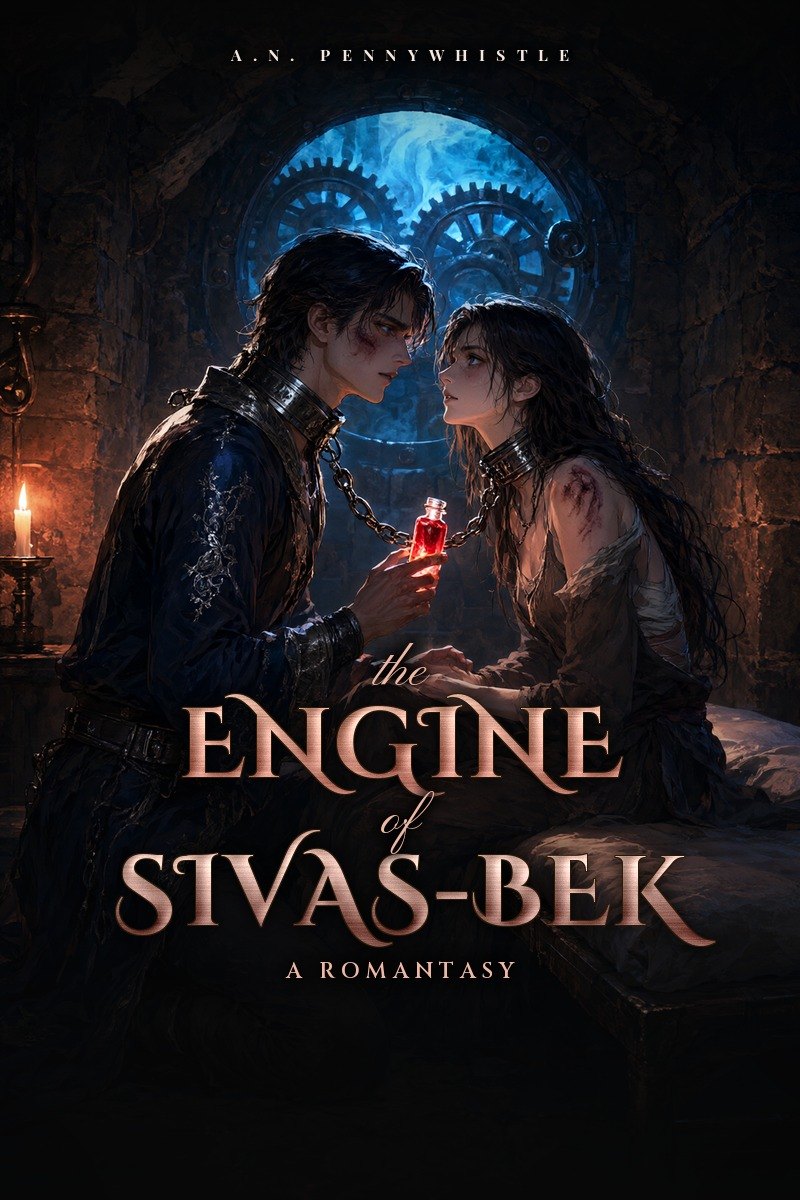
Orhan-bek stepped toward the center of the platform. Behind him, two armored enforcers wheeled a heavy iron cart into the light. On the cart sat nine thick collar rings forged of dull, blackened iron, connected in pairs by a four-foot length of heavy, reinforced chain.
"The initial culling is complete," Orhan-bek continued, clasping his hands behind his back. "You have demonstrated individual reflex, spatial perception, and a basic will to breathe. None of these traits will keep you alive in the deeper chambers."
He gestured to the iron cart.
"The Iron Loom does not operate on individual will. It is a dual-piston mechanism. Every pressure chamber requires balance; every valve requires an opposing weight. From this moment until you are broken or chosen, you do not exist as singular souls."
He paused, his gaze fixing directly onto Tevrik-oglu, and then shifting down to me.
"The rule of the Loom is the Dual-Tether," Orhan-bek said, his tone devoid of cruelty or mercy. "You are bound in pairs. You eat from the same ration trough. You sleep in the same alcove. You enter the trials linked by iron."
He stepped closer, his boots clicking with terrifying precision on the stone.
"And remember this above all: if your tether-partner perishes during a trial, whether by gear, fire, or lack of resolve, your tether is considered broken. An unbalanced piston destroys the housing. Therefore, if one of you dies, the survivor is taken to the intake shaft and executed on the spot."
A collective intake of breath hissed through the chamber.
"That's butchery," a conscript near the wall rasped. "If my partner slips on a rail, I die for it?"
Orhan-bek did not even look at the man. "Then ensure your partner does not slip."
He pointed a long, leather-gloved finger at Tevrik-oglu, and then at me.
"First pair," Orhan-bek said. "The fallen Commander of the Third Spire, and the mountain courier who carried his stolen secrets."
The enforcers stepped forward, their heavy iron tongs lifting the first linked collar from the cart.
Tevrik-oglu did not move. He stood tall, his jaw clamped shut, watching the enforcers approach. I saw the corded muscle in his neck tighten, but he did not resist. Resistance in front of Orhan-bek was simply an invitation to be fed to the boilers early.
An enforcer stepped behind Tevrik-oglu, fitting the heavy iron ring around his throat. With a sharp clack-snap, the locking bolt drove home, sealing the collar with a spring-loaded rivet that could only be released with an overseer's key.
The second enforcer approached me.
The cold iron touched the skin of my neck, heavy, rough, smelling of sulfur. The collar snapped shut. The weight settled against my collarbone, right above the raw brand Orhan-bek had burned into my skin hours earlier.
Between Tevrik-oglu and me, four feet of heavy blackened iron links hung suspended, clinking softly as we moved.
Orhan-bek stepped between us, looking down at the tether with cold satisfaction.
"You saved his life on the transfer drum, courier," Orhan-bek said softly, his voice meant for our ears alone. "I observed your timing. Very precise. Very clever. Let us see if your failing heart can keep both of you alive when the trials truly begin."
He turned on his heel and walked toward the inner corridor, his coat flaring behind him.
"Escort them to the lower barracks," he called out over his shoulder. "Give them their ash rations. The second test begins at second bell."
The enforcers prodded us forward with the butts of their shock-pikes.
I stood up, the chain between Tevrik-oglu and me pulling taut with a dull, metallic chime. Every step he took pulled against my neck; every stumble I made threatened to jerk his balance. We were two gears forced into the same housing, doomed to turn together or grind each other to dust.
Tevrik-oglu looked down at the iron collar around my throat, then down at the chain linking us.
"It seems you are stuck with me, mountain rat," he said, his voice quiet, dangerous, and entirely devoid of fear.
I met his gaze, feeling the cipher pin hidden in my boot, the throbbing ache in my chest, and the cold iron at my throat.
"Then don't die on me, prince," I said. "Because I have no intention of letting them throw me down that hole."

Comments
Loading comments…