Chapter 5
How many heartbeats did I have left before the iron collar around my throat snapped my neck?
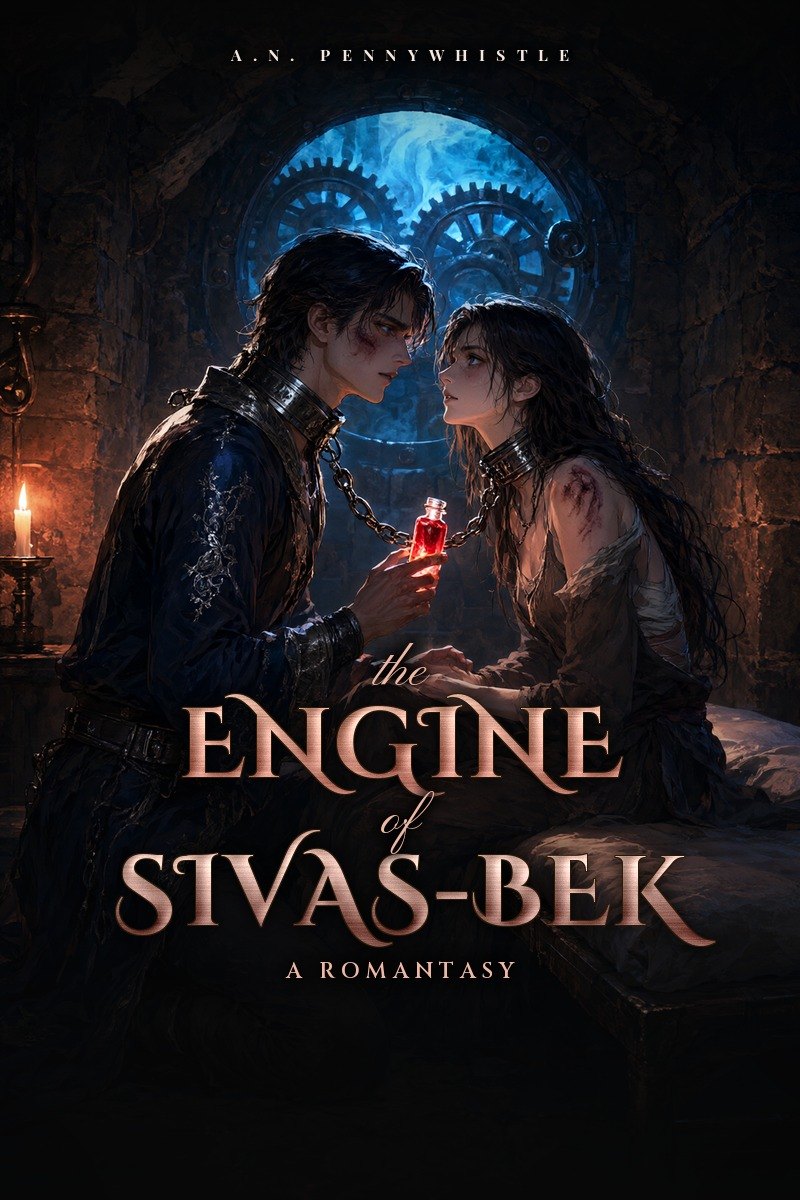
The morning gong sounded through the foundation vaults, vibrating the basalt beneath my straw pallet before the strike reached my ears. The refined Red Ash resin Tevrik-oglu had bought in the dark had done its work. The violent fluttering in my chest had quieted to a firm, rhythmic thump, though every inhale still tasted of sulfur and hot grease. Three feet away, the prince rose in one clean motion, the central link connecting our collars ringing against the flagstones.
"Stand up, courier," he said, not looking back. "Orhan-bek does not strike the bell twice."
I swung my boots off the pallet, pressing my thumb against the stiff outer seam of my left leather boot. The stolen cipher cylinder's ignition pin remained tucked inside the lining, a cold sliver of hardened steel against my ankle. If Tevrik-oglu knew I carried the firing mechanism to the intelligence cylinder he had lost on the high road, he would have strangled me with the tether before breakfast.
Instead, he gave the central chain a short, measured tug, pulling the slack taut.
"I can walk without your help," I said, rising to my feet on the damp stone.
"Then walk faster."
He stepped out of the alcove into the central corridor, forcing me to match his long, arrogant stride. The other surviving conscripts emerged from their cells like grey specters, iron collars glinting dull under the yellow sulfur lamps. Across the hall, Simat-tay emerged from her cell, her mouth set in a thin, defiant line. Her tethered partner, a stocky stonecutter with scarred forearms named Berik-tay, dragged the central chain between them with the sullen endurance of a pack mule. Simat-tay caught my eye and gave a grim, microscopic nod. Neither of us needed words to acknowledge the obvious: we were still alive, which made today twice as dangerous as yesterday.
We marched through three separate pressurized airlocks, the pneumatic valves hissing like coiled vipers as the damp chill of the lower barracks gave way to dry, suffocating heat. By the time we reached the upper staging tier, the heavy smell of scorched tallow and machine oil hung thick enough to coat the back of the tongue.
The conditioning yard was not an open drill ground. It was an echoing testing vault suspended fifty feet above the Loom's secondary churn, spanned by six narrow iron rails and dominated by four massive brass pendulums. The polished weights swung in relentless, hypnotic arcs across the center of the chamber, slicing the air with a low, mournful drone. At the lowest point of each downward stroke, the five-ton counterweights cleared the narrow balance beams by barely four inches. Down below the iron rails, the intake chutes yawned wide, black and fathomless, venting plumes of superheated steam from the belly of the machine.
Master Builder Orhan-bek stood on the high observation catwalk above the intake chasm, his heavy iron baton resting across his shoulder like an executioner's axe.
"The Loom does not tolerate drag," Orhan-bek called down, his voice cutting through the iron grind of the gears below with terrifying clarity. "A single hesitation in the field jams the shuttle. When the shuttle jams, the fabric tears. Today you learn to move as one pulse. Take the rails. Pick up your staves."
At the base of the central walkway lay pairs of lead-weighted oak sparring staves. Tevrik-oglu took two, tossing one at my chest without a word of warning. I caught the weapon against my ribs, the dull shock rattling through my collarbone.
"You have the left stance," he said, stepping onto the central iron rail. The beam was barely six inches wide, polished smooth by decades of oil mist and metal filings. "Match my center of gravity. If you tilt, we drop."
"And if you tilt?" I asked, stepping up behind him and planting my boots firmly on the cold steel.
"I do not tilt."
"Right. You just get thrown into holding cells by mentors who find you arrogant."
His jaw tightened, a sharp muscle jumping along his neck. He pivoted on the rail, leveling the blunt tip of his staff at my throat in a single, vicious snap.
"Defend," he said.
He did not wait for my reply. The oak staff came down in an overhand sweep designed to crack collarbones and shatter forearms.
I ducked beneath the descending arc, shifting my weight back onto the ball of my right foot. The iron collar dragged against my throat as the central chain snapped taut, the metal burning the skin beneath my tunic. The sheer force nearly yanked me off the six-inch beam. Down below, twenty feet beneath our boots, the intake chutes rumbled, hungry for anyone who lost their footing.
"Too slow," Tevrik-oglu said, driving the blunt end of his staff toward my ribs.
I parried with the middle of my staff, seasoned oak striking weighted wood with a sharp crack. The vibration traveled straight up my arms, jarring my chest. My heart skipped a fraction of a beat, catching with a dry click before the Red Ash resin forced it back into a steady rhythm.
"You fight like a line officer," I hissed, ducking a lateral thrust. "Everything forward. No recovery."
"In the vanguard, forward is the only direction that matters."
"This is not a vanguard charge, prince. Look at the swing."
The second brass pendulum swept across the rail between us, a wall of whistling metal four feet wide.
The world stopped.
Brass gleamed cold.
Air rushed hot.
Gears ground below.
Tevrik-oglu dropped flat to the iron rail, his chest pressed tight against the slick steel as the counterweight screamed three inches over his back. The sudden drop jerked our central tether downward, pulling my neck toward the iron surface. If I dropped straight down behind him, the trailing curve of the brass weight would take off the back of my skull.
I did not drop. I leaned back into the empty air, locking my heels over the lip of the rail and letting gravity pull my torso down below the plane of the walkway. The pendulum passed overhead with a deafening roar of displaced wind, tearing loose strands of black hair from my braids.
As the brass mass cleared, I snapped my hips, using the momentum of the swing to pull myself back onto the iron rail. The chain went slack between us, coiling loose against the metal.
Tevrik-oglu rose to one knee, staring at me with dark, unreadable eyes.
"Where did you learn that recovery?" he asked, his voice low over the hiss of the steam vents.
"The Blackroad gorges do not have handrails," I said, wiping a streak of black machine grease from my cheek with the back of my sleeve. "When a scree slide breaks under your rucksack, you learn to let the weight carry you instead of fighting the drop."
"Courier tricks."
"They keep you breathing. Which means they keep you breathing, too."
He stood up, resetting his grip on the lead-weighted staff. "Again. The third pendulum is faster."
For the next hour, we moved across the iron rails in a brutal, exhausting cadence. Every five paces, a swinging brass pendulum cut through our path, forcing us to drop, roll, or vault in perfect synchronization. When Tevrik-oglu moved too fast, the collar bit viciously into the nape of my neck, threatening to pull me into the open chutes below. When I hesitated, his momentum threatened to drag both of us over the edge.
He did not hold back a single strike. He attacked with cold, calculated precision, testing my ribs, my knees, my balance. But every time his staff came whistling toward my head, he left an inch of clearance, forcing me to read the angle before the strike landed.
It was not cruelty. It was a drill. He was carving away my wasted movements until every dodge was minimal, efficient, and lethal.
"Your left side drops when you pivot," he said between short, harsh breaths, parrying my upward strike with a flat slap of his staff. "Fix it."
"My left side is where my heart sits," I countered, sweeping my staff low against his shins.
He hopped the wood cleanly, using the landing to drive his armored shoulder directly into mine. The impact knocked the wind from my lungs, but instead of stumbling back, I hooked my left boot behind his calf and spun.
The central tether wrapped around his staff.
I dropped my weight straight down, using the leverage of the iron link to yank his weapon out of alignment. His center of gravity broke. For the first time all morning, Commander Tevrik-oglu stumbled sideways on the six-inch rail, his boots skidding on the oily iron.
I planted my staff against his chest, catching his fall before he tipped over the edge.
We stood frozen on the narrow beam, breathing hard, the oak staff wedged firmly between his breastplate and my hands. The chain hung taut between our throats, humming with the deep vibration of the machinery below.
Tevrik-oglu looked down at the staff pressed against his sternum, then slowly raised his eyes to mine. His jaw worked once, but he did not knock the staff away.
"Not dead weight," he murmured.
"Never was," I said.
A sharp, agonized shriek tore through the vault from the far left rail.
Fifty paces away, two conscripts from the lower iron mines had mistimed the fourth pendulum. The heavier man had dodged late; the brass counterweight clipped his shoulder with a wet crunch, pitching him off the rail into the chasm.
The falling man screamed as he plunged toward the lower intake chutes.
His partner, a lean youth with soot-stained cheeks, braced his boots against the rail, desperately trying to hold the chain with both hands. But the dead weight of a falling body was impossible to anchor. The iron tether ripped the youth from the rail, both of them tumbling together into the darkness below.
They did not hit the floor.
A massive set of pneumatic shears snapped shut across the intake hatch with a deafening crack of pressurized iron. The blades severed the chain in mid-air, slicing through bone and steel with equal ease.
Before the echoes of the shears could fade, the automated collar assembly on the overhead catwalk engaged.
The remaining high-tension wire attached to the staging system whipped taut with a terrible, singing note. The surviving youth was caught by the secondary clamp mechanism at the edge of the pit. The pneumatic piston fired once.
A single, dry snap echoed off the basalt walls.
The youth's body went limp instantly, his neck broken before his feet could touch the staging floor. The iron clamps released, dropping the corpse cleanly down the disposal chute into the furnace below.
Silence descended over the yard, broken only by the rhythmic, whistling swing of the four brass pendulums.
High on the catwalk, Orhan-bek lowered his iron baton. He did not look at the empty rail. He did not look at the furnace vent where black smoke was already beginning to rise.
"The Loom requires balance," Orhan-bek said, his flat voice echoing through the chamber like an iron bell. "When the tether breaks, the survivor is merely fuel. Dismissed to the refectory. Second trial commences at second bell."
Tevrik-oglu did not look back at the pit. He took the staff from my hands, laid both weapons neatly across the central stanchion, and turned toward the exit ladder.
The chain pulled tight against my collar, cold and unyielding.
I followed him down the iron steps, my boots steady against the rungs, but the chill around my throat was no longer just the weight of the metal. It was the certainty that in this place, survival was not an agreement between two people.
It was a machine that never stopped cutting.

Comments
Loading comments…