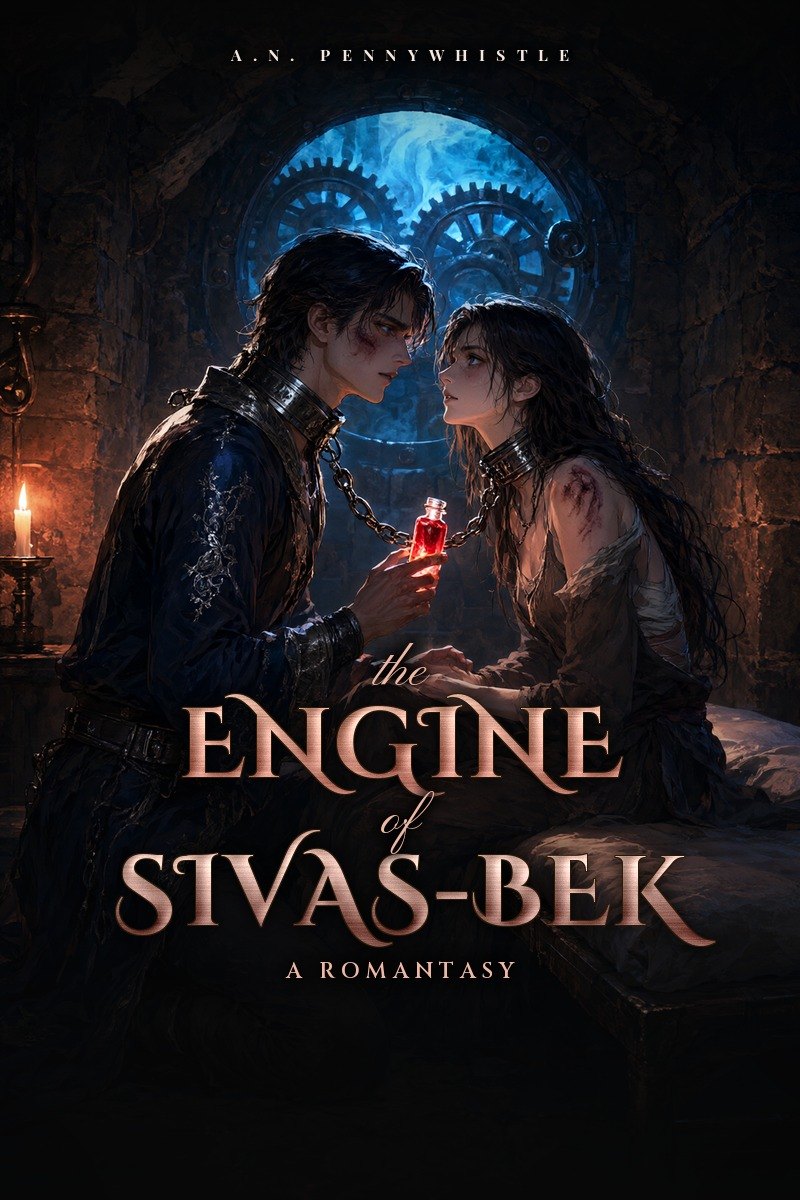
Chapter 6
How many pounds of coal did it take to burn out a woman’s memory of her mother’s voice? Sitting on a grease-slicked bench in the lower refectory with an iron collar scraping my collarbone and ninety minutes left before the second bell called us to the Blood Crucible, I knew the answer wasn't coal at all. The black flues vibrating behind our mess table didn't smell of slag, sulfur, or mountain pitch; they smelled of sweet cedar, scorched milk, and ancient summer rain.
I held my wooden spoon motionless above the gray barley mash, listening to the stone beneath my boots.
The refectory was a low, subterranean vault of damp granite carved into the foundations of the Third Spire. Condensation trickled down the soot-blackened barrel vault, dripping into the tallow troughs with a steady, maddening cadence. Seven conscripts sat along the center trestle—the ragged remainder of the nine who had entered the yard that morning before the pendulum shears did their work. Nobody spoke. The only sounds were the scraping of iron spoons against wood, the heavy breathing of exhausted bodies, and the distant, rhythmic thumping of the Loom’s central pistons four levels below.
Two armed overseers leaned against the heavy oak exit doors, shock-pikes resting in the crooks of their elbows, their eyes dull with the indifference of men who watched bodies go into the furnace every week.
Across the room, Berik-tay had his thick stonecutter forearms flat on the timber, his forehead pressed against his calloused thumbs as he snored through broken teeth. At his neck, the four-foot tether ran to the iron collar clamped around Simat-tay’s throat.
Simat-tay was not sleeping. She sat rigidly upright, staring at the steam vents above the scullery trough, her right hand buried deep in the pocket of her grease-stained apron, her fingers working in small, rhythmic circles around a piece of concealed metal.
"Eat the tallow, mountain rat," Tevrik-oglu said beside me.
His shoulder brushed mine on the narrow bench. His dark wool tunic was damp with sweat from the pendulum drills, carrying the sharp scent of bitter salt, dried blood, and cold iron. His collar sat flush against the skin of his neck, unyielding, but his dark eyes were fixed on the far archway where an overseer herald had just appeared with a stamped copper tablet.
"Tallow slows the legs," I muttered, setting the wooden spoon down. "And cold grease fouls the lungs."
"You won't need lungs if your ribs cave in at second bell," he replied. His voice was pitched low, barely carrying across the rough timber between us. "The Blood Crucible isn't a footrace. It's a hydraulic test."
"You seem very certain for a man who lost his command three days ago."
"I know the architecture of this Spire."
"You know the drawing rooms," I said, meeting his gaze. "You don't know the pipes."
His jaw hardened, the muscle ticking once beneath his bronze skin. Before he could deliver whatever cutting dismissal he had prepared, the herald struck the iron-shod butt of his staff against the threshold flag.
"Commander Tevrik-oglu," the herald called out, his tone tight with the strained courtesy mandated by the Loom Codex. "The Arch-Assayer requires the heir’s seal for the morning casualty registers. You have one quarter-turn at the upper wicket."
Tevrik-oglu did not move immediately. He looked at the herald, then down at the blackened chain linking our throats.
Under the Dual-Tether decree, a conscript could only be detached from their partner at an authorized iron station. An overseer stepped forward from the doorway, a heavy brass key in his leather-gloved fist. With a sharp twist, the guard unlocked the central swivel loop between us, detached Tevrik-oglu’s lead, and snapped my end of the chain into the heavy ring bolt anchored into the stone floor beneath the bench. The collar remained locked around my throat, three pounds of cold iron biting into my collarbone, but my tether was now fastened to sixty tons of solid Spire bedrock.
"Stay on the bench," Tevrik-oglu said, rising to his full height.
"Where would I go?" I asked, rattling the three feet of slack. "To the baths?"
"If you pull that pin while I am in the upper tier, the floor sleeve triggers a spring-loaded tension latch," he said, leaning down until his lips were inches from my ear. "It shears the bolt and drops you forty feet into the drainage sump."
"Thank you for the geography lesson," I whispered.
He turned without another word and followed the herald through the reinforced gate, his stride steady, silent, and arrogant despite the iron ring locked around his neck.
The heavy door clicked shut behind them. The two remaining overseers by the doorway settled back against the masonry, pulling a pair of bone dice from a pouch and rolling them against an empty ration crate.
Across the table, Simat-tay moved.
She slid along the bench until she was sitting directly opposite me. The chain between her neck and the sleeping stonecutter hung loose across the rough timber, barely clinking as she leaned forward until her nose was inches from my bowl.
"He's right about the sump," Simat-tay whispered, her voice rough with urgency. "The center floor bolt has a spring shear. But the wall bench doesn't."
I looked at her grease-streaked face. "What are you holding in that apron pocket, Simat?"
She kept both hands below the table. With a faint metallic scrape, she produced a flat brass pry-shim, no longer than a courier's parcel pin, ground down to a razor taper along the edge.
"Berik worked the quarry hoists for eight years before they conscripted him," she murmured, glancing sideways at her snoring partner. "He knows how these lock sleeves are pressed. The Spire engineers don't forge every ring bolt from fresh iron; they reuse the old carriage brackets from the lower armory. The cotter pins are soft zinc."
My chest tightened, the steady, heavy beat of the Red Ash resin holding firm behind my ribs. "You want to go into the flues."
"The Blood Crucible is down on sub-level six," she said, her brown eyes burning with frantic calculation. "Every pair that went into that vault yesterday came back in canvas bags. Two conscripts were culled at the pendulum this morning. If we walk down that stair at second bell without knowing the flow valves, we are dead meat for the machine."
"Orhan-bek has trip-levers on every service grate," I warned her.
"He has trip-levers on the main shafts," Simat-tay corrected, leaning closer. "Not on the secondary condenser flue behind the scullery boiler. The cooks use it to dump rancid lard into the exhaust churn. There are no pneumatic wires on a grease pipe."
I shifted my gaze toward the scullery thirty paces away.
Above the large lye trough, a circular iron hatch was bolted to the stone masonry, its edges blackened with soot and crusted grease. A faint, curling ribbon of warm air drifted from the lower seam. I closed my eyes and drew the draft in through my nose, filtering out the cabbage water, wet wool, and tallow of the refectory.
Behind the grease, the current was unmistakable: a low-pressure barometric draw pulling north-northwest toward the central Spire core. It carried an acoustic tremor of eighteen cycles per minute—the exact stroke rhythm of the primary steam baffles.
"The condenser flue leads to the turbine manifold," I said quietly, opening my eyes. "If the turbine rotates while we're in the throat, the bronze blades will slice us into ribbons."
"Then we don't crawl through the turbine," Simat-tay whispered. "We use the maintenance crawlway along the outer casing. You're the courier. You know how to read subterranean drafts."
"And Berik?"
"He took two draughts of poppy syrup after the pendulum drill to numb his broken fingers," she said, nodding toward the sleeping giant. "He won't twitch for an hour. If we move right now, we have twenty minutes before the herald brings your prince back from the register."
I looked down at the iron floor bolt holding my chain.
Tevrik-oglu had told me to stay on the bench. He had paid for my Red Ash with his family allowance, but he had done it to keep his own throat from snapping in the yard. In ninety minutes, Orhan-bek would herd us into the Crucible, and whatever blood the Loom demanded, Tevrik-oglu would expect mine first. A courier who waits for the mountain road to clear is a courier who freezes in the snow.
"Show me the shim," I said.
Simat-tay dropped her hands beneath the table.
She worked with the practiced speed of a shipyard thief. First, she slid the tapered brass shim into the zinc swivel holding her own lead to Berik-tay's chain, easing the retaining pin free so the sleeping stonecutter remained anchored without her. Then, sliding the shim between the zinc cotter pin and my floor plate, she gave a sharp, muffled twist of her wrists. The soft zinc sheared away. The floor ring popped loose from its sleeve with a faint click that was completely swallowed by the roar of the scullery boiler.
I gathered the three feet of blackened chain into the wool of my left sleeve, wrapping the links tight to kill any acoustic rattle.
"Three minutes to the scullery," I whispered. "Keep your head below the kettle rim."
We moved together.
I kept low, letting my boots roll silently along the mortar lines where the floor moisture dampened the stone. The two overseers by the doorway were cursing softly over their bone dice, their backs turned to the steam kettles.
We slipped behind the copper boiling vat. The heat was suffocating, thick with scalding steam and the reek of boiled turnip greens. The circular hatch above the lye trough was secured by two heavy wing-nuts caked in black lard.
Simat-tay jammed her steel wedge into the first nut. She threw her weight against it, grunting through clenched teeth until the threads yielded with a wet, greasy snap. I took the second nut, twisting it loose with my bare fingers, ignoring the hot brine that scalded my palms.
The hatch swung outward on dry, ungreased hinges.
A blast of dry, superheated air struck my face.
It was unlike any draft I had ever tasted on the high mountain passes. It didn't smell of rock, snow, or high pine. It smelled of toasted barley, dried marigolds, the sharp tang of copper ore, and the unmistakable sweetness of burning honeycomb.
My chest gave a sudden, violent flutter. The Red Ash in my blood surged in response, warming my throat like swallowed brandy.
"That's not furnace gas," I whispered, pulling myself up onto the grease sill.
"It's Loom exhaust," Simat-tay muttered, scrambling in behind me. "Everything in the Spire vents down here."
We crawled into the darkness.
The shaft was a square conduit of riveted iron plates, barely three feet wide, sloping downward at a steep pitch into the foundation bedrock. The metal walls were burning hot to the touch, vibrating with the deep, visceral hum of colossal machinery operating somewhere in the dark below.
I took the lead, my courier senses reaching out into the blackness.
A courier in the high gorges navigated by barometric pressure, feeling the shifts in air density that signaled an oncoming squall long before the storm clouds crested the ridge. Inside the iron belly of the Spire, the physical laws were identical.
The air rushed past my ears in rhythmic surges.
Hiss. Expand. Collapse.
"Hold," I whispered, flattening my chest against the scorching iron floor.
Simat-tay stopped inches behind my boots. "What is it?"
"Turbine intake," I breathed, touching the rivet seam with my fingertips. "Feel the vibration. The bronze blades are sweeping the casing forty yards ahead. Five seconds of vacuum, one second of exhaust."
"Can we clear it?"
"Only if we cross during the pressure drop. If you hesitate in the neck, the vacuum pulls your tunic straight into the housing."
I pulled myself forward on my elbows, dragging the muffled chain against my ribs.
The conduit opened into a wider chamber—a narrow catwalk of suspended iron grating hanging over a yawning cylindrical pit. Down in the darkness, four massive bronze impellers were spinning with terrifying speed, their blades gleaming with streaks of dull red grease. Above the impellers, a network of thick copper pipes converged on a central manifold, each conduit wrapped in insulated horsehair and stamped with the imperial crest.
The heat was blistering. Sweat poured down my forehead, stinging my eyes.
"Look at the manifold drum," Simat-tay hissed, pointing toward the copper nexus.
The pipes were not carrying steam.
Through the heavy quartz inspection ports of the central drum, a pale, luminescent vapor was churning in violent spirals. It wasn't white like water vapor, nor yellow like sulfur. It was a clear, piercing azure, glowing with the cold intensity of star-ice on a winter peak. Every time the pressure valve pulsed, a cloud of the blue mist vented into the exhaust flue, filling the shaft with that strange, intoxicating perfume.
I crawled onto the catwalk, gripping the iron mesh with both hands.
As the azure vapor washed over the gantry, my senses seemed to fracture.
The smell struck my palate first: wet cedar needles after a mountain frost. Then came the taste of wild blackberries crushed against a child’s tongue. A split-second later, a sound echoed in the back of my mind—not a noise in the room, but a memory that did not belong to me.
A woman laughing under an apple bough. A boy’s hand clutching a wooden toy horse. The cold ache of a river swim at sunrise.
The impressions flashed through my consciousness with blinding, terrifying clarity, accompanied by a sharp, tearing agony behind my temples.
I gasped, pressing my forehead down against the iron grate.
"Koray?" Simat-tay whispered, her voice trembling in the dark. "What's happening to you?"
"The fuel," I choked out, my fingers digging into the mesh until the iron bit into my knuckles. "The Loom... it isn't burning coal."
"What are you talking about?"
"It's burning memories," I said, my voice shaking with raw horror. "The people... the conscripts who don't survive. It strips their minds. It consumes their lives to keep the magnetic barrier charged."
Simat-tay stared at the glowing blue manifold, her face turning chalk-white in the azure light. "That's impossible. The priests said the Spire runs on subterranean fire."
"Subterranean fire doesn't remember the taste of plums," I snapped, forcing myself up onto my knees. "Every time the Spire expands the border defenses, someone pays for it with their history. That's why the heirs are conscripted. That's why Orhan-bek culls the weak."
The realization settled in my gut like lead.
The kingdom wasn't defended by clockwork engineering. It was defended by systematic, mechanized butchery. The Loom was an altar disguised as an engine, and we were the fuel waiting to be shoveled into the hearth.
"We have to get back," Simat-tay whispered, her eyes wide with mounting panic. "If Orhan-bek finds us near the manifold—"
A shadow fell across the catwalk.
A heavy boot struck the iron grating, and both the steam and blistering heat abruptly died.
I froze. My hand dropped instantly to my left boot, fingers resting against the lining where the stolen cipher ignition pin was hidden.
From the dark mouth of the upper maintenance conduit, a tall figure stepped out onto the suspended gantry. The low blue glow of the manifold caught the broad line of his shoulders, the dark wool of his torn tunic, and the heavy iron collar clamped around his throat.
Tevrik-oglu stood ten paces away, holding a short iron pry-bar in his right hand.
"You are remarkably bad at following orders, mountain rat," he said softly.
Simat-tay scrambled backward on the catwalk, her back hitting the casing wall with a hollow clang. "Tevrik—how did you—"
"The herald's register was on the second tier," Tevrik-oglu said, not taking his eyes off me. He walked forward, his stride steady, his boots making no sound on the grating. "The royal conduit connects directly to the turbine room. I knew you'd look for a draft the moment my back was turned."
"You followed us," I said, rising slowly to my feet, keeping the chain wrapped tight in my sleeve.
"I didn't need to follow you," he said. He stopped three paces away, towering over me in the narrow shaft. "I knew where you were going before you even touched the floor bolt."
"Then call the overseers," I said, lifting my chin to meet his gaze. "Tell them you caught two rats in the flue. Let them shovel us into the manifold."
"If I wanted you dead, courier, I would have let your heart seize on the straw last night."
He stepped closer. The heat radiating from his chest was intense, but it wasn't the heat of a man who had been crawling through boiler rooms. It was the crackling, electric warmth of the manifold itself.
Then he lifted his head into the blue light.
The breath caught in my throat.
His dark eyes were no longer brown.
Pulsing within his irises were thin, brilliant filaments of azure light, swirling in the exact same counter-rotational pattern as the vapor inside the Loom's central drum. The raw current of the machine was coursing through his veins, humming under his skin with a quiet, lethal frequency.
He wasn't just surviving the Loom.
He was connected to it.
"You're drawing from it," I whispered, the words slipping out before I could stop them. "You're siphoning the engine."
Tevrik-oglu looked down at me, his gaze cold, ancient, and terrifyingly clear.
"The second trial begins in eighty minutes," he said, his voice dropping into a low rasp that vibrated against the iron collar around my throat. "And you are going to help me steal the rest of it."

Comments
Loading comments…