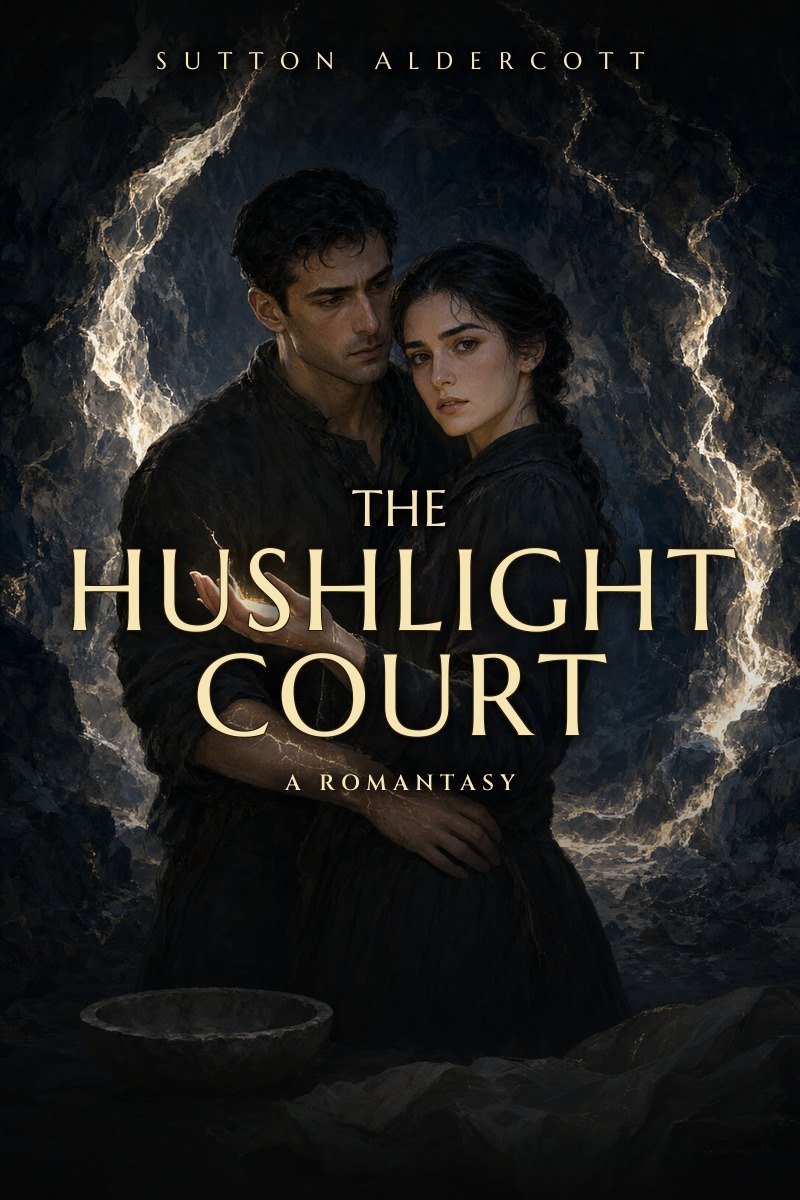
Chapter 10
The hardest part of inspecting a dead man who has turned to stone is remembering that he was breathing five minutes ago.
Lord Vardashan lay across the junction of the east corridor like an unfinished statue tumbled from a mason's cart. The plum velvet of his formal coat was already stiffening where the mineral frost had crept through the weave, turning rich cloth into something brittle enough to snap under a heavy boot. His lips were parted, frozen in the shape of a syllable he would never finish, and the violet light pulsing through the crystalline ridges along his jaw had settled into a dull, milky violet that gave off no warmth at all.
Ten paces away, the copper heating flue continued to hum, blowing its steady, sweet-scented breath into the empty hall.
"Don't touch him," Kavir said. He had not stepped back from the corpse, but his hands were at his sides, his fingers curled into tight fists. The pale scars on his forearms still carried a faint afterglow from the flare he had quelled in my palm only minutes earlier. "The mountain's salt hasn't finished setting. If you break the skin while the light is cooling, the marrow splinters like glass."
"I don't need to touch his marrow," I said, keeping my voice low. "I need to know why a man who looked healthy enough to eat two roasted capons at last night's hearing turned into a mantlepiece ornament between breakfast and noon."
Before Kavir could reply, boots clattered on the stone stairs above us.
Four guards from the inner ward came down the spiraling steps, their iron breastplates rattling against their sword belts. Behind them walked an older man in the pleated gray robes of the Seneschal's office, holding a long linen cord knotted with bronze markers. His face was gray as mutton tallow, and he kept a folded kerchief pressed tight against his nose and mouth, as if the air in the lower vault had already soured into pestilence.
"Lord Kavir," the gray-robed official said through his linen mask. His eyes darted to Vardashan's body, flickered with raw terror, and immediately fixed on the Kindler's boots. "The Master of the Mint has reached the High Hall. Lady Vosha commands your presence before the dais immediately. The council has closed the inner doors."
Kavir did not move for two heartbeats. His gaze remained locked on Vardashan's face. "The body cannot stay in an open draft. If the air currents carry the cooling dust into the lower barracks—"
"The Cleansing Bureau has already been dispatched," the official cut in, his voice trembling at the edges. "Master Hethran and his bearers are bringing the lead sheets and the sulfur coals. The Shah wants you in the solar, my lord. Now."
Kavir looked sideways at me. His gray eyes were flat, measuring, carrying that terrible calm he wore whenever the mountain demanded blood. He did not say a word about my hand, or the writ of audit resting inside my tunic, or the fact that my brother's name was still tied to two crates of illicit ore buried somewhere in the court's belly.
"Go to the archive," he told me quietly. "Stay with Feriz. Do not leave the reading table until I return."
He turned and followed the Seneschal's men up the stairs, his boots taking the stone steps two at a time without making a sound.
I waited until the scrape of their boots faded into the upper galleries. Then I turned toward the archive doorway, where Feriz was hovering like an anxious crane, his ledger clutched against his ribs and his knobby knees practically knocking together inside his wool breeches.
"He told us to stay inside," Feriz whispered, his eyes wide. "Nesh, you heard him. He said stay at the table."
"Kavir is the Kindler," I said, walking briskly toward him. "His job is keeping the mountain from freezing. My job is finding out who is setting fire to the furniture."
"That man isn't furniture!" Feriz hissed, pointing a trembling finger down the corridor toward Vardashan. "That man is solid quartz! He was talking about horse breeding in the great courtyard yesterday morning, and now he looks like something they dig out of a riverbed after an earthquake!"
"Which means someone killed him, Fez. Men don't turn into quartz because they ate bad salt."
"And when Master Hethran arrives with his lead sheets and his sulfur pots," Feriz said, his voice rising in panic, "they are going to burn every rag on that floor, scrub the flags with vinegar and lye, and seal the archway with wet lime. You know court cleaners. When a high noble dies of something embarrassing, they don't hold an inquiry. They paint the wall white and fine anyone who asks what color it was yesterday."
I stopped in front of him, looking him straight in the eye. "Exactly. Which means we have about six minutes before they cart him away, and once he's in a lead box, we'll never know whether he swallowed poison or breathed it."
Feriz looked down at his cedar-bound ledger, then at the doorway where two of the palace guards had been posted to watch the junction. The guards carried seven-foot pikes and looked like men who would rather face a pack of mountain wolves than stand twenty feet from a corpse that glowed in the dark.
"What are you thinking?" Feriz asked, his voice sinking into that familiar, miserable resignation he always showed right before I made him do something dangerous.
"I'm thinking you are the chief tally clerk of the Ovaldar Concern," I said, tapping the heavy brass hearth-token resting against my collarbone. "And Shah Vosha gave us an unescorted writ for material audit. If those guards think we are interfering with a death rite, they'll drop their pikes on our necks. But if they think they are about to lose their winter rations because of an administrative error, they won't look past your nose."
Feriz blinked. A spark of tradesman pride cut through his terror. "What kind of administrative error?"
"The kind involving sixty sacks of furnace charcoal and a missing commissary seal," I said, snatching Kavir's brass lantern from the archive table and tucking its amber beam against my hip. "Make it loud, Fez. Make it confusing. And whatever you do, do not let them look behind the curtain."
*\n\nTwo minutes later, the junction outside the archive echoed with the sound of pure commercial outrage.
"I don't care if the mountain is falling down your chimney!" Feriz's voice roared, bouncing off the damp basalt ribs of the corridor ceiling. He was standing three paces from the lead guard, brandishing a heavily ink-stained vellum scroll like a battle flag. "This is an imperial audit pass issued under the Shah's personal hearth-token! Look at the wax! Is that the split anvil or is it not? Answer me, soldier!"
The guard, a burly mountain man with a scarred nose and a nervous twitch beneath his left eye, gripped his pike with white knuckles. "Sir, nobody passes this arch. Lord Vardashan is under quarantine by order of the Seneschal—"
"And who pays for the quarantine salt?" Feriz shouted, stepping squarely into the guard's space and jabbing a blunt quill at the man's chest. "The Seneschal? The Mint? No! The intake accounts are drawn against the third-level fuel reserve! If you close this passage without countersigning Schedule Four, sixty barrels of tallow scheduled for the lower garrison kitchens will remain impounded at the west hoist! Do you know what happens to mountain soldiers when they eat dry barley for six weeks without mutton fat? They get the gravel in their kidneys! Are you taking personal responsibility for forty cases of gravel, Sergeant?"
"I'm... I'm not a sergeant," the guard stammered, glancing frantically between Feriz's fierce scowl and the official-looking columns of numbers inked across the vellum. "I'm only a corporal on the watch—"
"Then get me your sergeant!" Feriz thundered, dropping a heavy brass ruler onto the stone floor with an ear-splitting clang. "Get me your quartermaster! Because until someone signs this clearance, my audit has jurisdiction over every cubic foot of air between here and the furnace vents!"
While the second guard hurried over to help his partner decipher the bogus tallow manifest, I slipped past the canvas quarantine drape they had hastily strung across the eastern archway.
The space behind the curtain was dead quiet.
The air smelled intensely of sweet hushkaran oil, sharp copper, and the cold, metallic stench of fresh stone. Vardashan lay exactly as Kavir had left him, flat on his back on the damp flagstones.
I dropped to one knee beside the corpse, keeping my leather-gloved hands hovering an inch above the velvet. My right palm throbbed with a dull, phantom ache beneath the leather, as though the dormant thread inside my own flesh could sense the sleeping violence locked inside the dead man's bones.
I forced myself to look closely, using the methodical eye my mother had drilled into me during our early trading seasons along the river markets. When a shipment arrives ruined, you do not curse the weather; you examine the rot.
First, his face.
The porcelain transformation was complete from the mid-chest upward. His skin had lost all elasticity, smoothed into a flawless, translucent white that resembled high-fired ceramic. Through that white surface, a web of crystalline veins spider-webbed across his neck and cheeks, frozen in shades of deep amethyst and pale lavender.
I leaned in, holding my breath, and gently lifted his lower jaw with the blunt wooden handle of my skinning knife.
His mouth was fixed half-open. His tongue was white, but smooth. There were no chemical burns, no blistering on the palate, and no signs of the black corrosion that marked the ingestion of furnace salts or raw mineral poisons. If someone had slipped an accelerant into his morning wine, his throat would have shown the tears where the crystals ate through the mucous lining.
He had not swallowed it.
Next, his hands.
Vardashan's right hand was resting against his hip, his fingers loosely curled. They were not clawed into the stone, nor were the nails torn from scraping the floor in agony. A man dying of a sudden seizure fights the ground; he thrashes, he clutches at his chest, he tears at his collar. Vardashan's fingers looked relaxed, almost peaceful, like a sleeper letting go of a blanket.
Finally, I examined his clothes.
He wore a doublet of heavy plum velvet, bordered with silver cord and lined with gray mountain fox fur. Around his neck stood a high, stiffened collar designed to frame the jaw in the current court fashion.
I tilted my head, letting the amber light from Kavir's abandoned lantern fall across the fabric.
Along the right side of the collar, just where the stiff velvet had rested against the curve of his neck, something was wrong with the cloth. The velvet pile wasn't soft; it was crusty, dusted with an extraordinarily fine, glittering residue that looked like violet hoarfrost.
My heart gave a heavy, deliberate thump against my ribs.
I leaned closer, bringing my nose within three inches of the collar. The residue did not smell of perfume or tallow. It smelled of ozone, hot iron, and that cloying, suffocating honey scent that had nearly knocked me off my feet when I opened Dash's contraband crates seven nights ago.
The dust had settled on the collar from the outside.
I looked up at the wall. Ten feet away, set low into the masonry, the copper heating flue puffed another wave of dry, warm air into the passage. The draft moved in a steady, gentle current, rising from the floor and washing directly across the spot where Vardashan had been standing when he paused to warm his hands.
He hadn't ingested the poison. He hadn't touched a tainted cup.
He had simply stood in front of the vent, breathed the warm air, and let the invisible draft dust his neck with the finest mineral powder the mountain had ever produced.
The accelerant was airborne.
"Someone turned the heat into an executioner," I murmured under my breath.
From the other side of the canvas curtain, Feriz's voice reached a fever pitch. "Don't you wave that pike at me, young man! My mother was a Master Weaver of the Lower Basin, and she taught me that a man who cannot account for his tallow is a man who steals bacon from his own children! Show me your register or step aside!"
Time was running out.
I drew my skinning knife from its sheath. The blade was four inches long, made of plain lowland steel, honed thin enough to slice silk without snagging. Working with absolute care, holding my breath so the draft from my lungs wouldn't scatter the residue, I brought the flat of the blade against the stiffened velvet of the collar.
The frost was brittle. If I scraped too hard, it would disintegrate into useless gray dust.
I slid the razor edge beneath a tiny, crystallized flake that had adhered to the silver piping. With the gentlest flick of my wrist, using the muscle memory of a woman who had spent years testing the purity of raw spices and powdered dyes, I lifted the flake free.
It rested on the flat of the steel: no larger than a grain of crushed salt, hexagonal, glittering with a faint, iridescent violet sheen.
Even detached from the fabric, the flake seemed to possess an unnatural weight. When I tilted the blade toward the lantern light, the violet core of the crystal pulsed once, a tiny, sluggish heartbeat of pale purple fire.
A chill ran down my spine that had nothing to do with the mountain's cold.
I pulled a small brass screw-top vial from my belt pouch, the kind we used for holding saffron samples, tapped the flat of the knife against the rim, and watched the flake slide inside. I screwed the cap down tight, wrapped the vial in a scrap of oiled linen, and tucked it into the hidden lining of my left boot.
The moment the vial vanished into my leather, heavy, measured footsteps echoed from the far end of the eastern corridor.
These were not the hurried, clattering steps of guards, nor the panicked scuffling of clerks. They were slow, rhythmic, and muffled, accompanied by the distinct clink of iron chains and the hollow thump of a swinging brazier.
"The Cleansing Bureau," I thought, the hair on the back of my arms standing up.
I sheathed my knife, wiped my gloved hands on my trousers, and took two quick steps toward the edge of the canvas curtain.
Before I could slip through, a gloved hand drew the canvas aside.
A man stepped into the enclosure.
He was tall and extraordinarily thin, dressed from head to foot in a hooded tunic of heavy unbleached linen that fell to the tops of his felt-soled slippers. Over his face he wore a mask of beaten lead, punctured with two small eyeholes and a brass breathing grille shaped like a closed mouth. In his left hand he carried a smoking iron censer that vented thick, yellowish clouds of burning sulfur and pitch; in his right, a wide pair of iron tongs.
Two younger attendants followed behind him, carrying a massive roll of sheet lead that creaked with heavy, metallic stiffness.
The hooded man stopped when he saw me. Through the round eyeholes of his lead mask, two pale, watery eyes fixed on my face with utter, emotionless detachment.
He did not shout. He did not draw a weapon. He simply stood there, swinging the smoking censer in slow, hypnotic arcs that filled the small space with the suffocating stench of brimstone.
"Outsider," his voice came through the brass grille, flat, muffled, and entirely devoid of human inflection. "This vessel has attained the Stillness. It is no longer subject to the concerns of the waking."
"I was looking for my tally stick," I said smoothly, keeping my hands visible, fingers spread wide in an open, harmless gesture. "One of my parchment markers blew under the archway when your guards dropped their pikes."
The lead-masked official did not look at the floor for my tally stick. His gaze remained locked on my face, sliding slowly down to the brass hearth-token hanging against my chest.
"The Kindler's mark grants you passage through the stone," the official said, his voice dropping lower. "It does not grant you passage through the Quietness. Go back to the archives, daughter of the river. What is sealed in lead belongs to the court."
"Of course," I said, offering a curt, respectful nod that didn't reach my eyes. "Peace to the vessel."
I slipped past his linen-draped shoulder, holding my breath against the choking sulfur smoke that billowed from his censer. As I stepped through the canvas opening, I heard the heavy, metallic clatter of the sheet lead being unrolled across the flags behind me, followed by the dull, sickening scrape of iron tongs gripping Vardashan's petrified limbs.
They weren't investigating his death. They were burying it.
Outside the curtain, Feriz was still glaring at the two guards, his arms crossed over his chest like an angry schoolmaster. The corporal looked entirely defeated, clutching a piece of scrap parchment covered in Feriz's nonsensical fuel calculations as if it were a death warrant.
"We have what we need, Feriz," I said, catching his woolen sleeve and steering him firmly toward the archive passage. "The quartermaster can wait until tomorrow."
Feriz didn't argue. He snatched his ruler up from the flags, shoved it into his belt, snapped his ledger shut with a loud, authoritative crack, and gave the bewildered guards one final, scathing glare before following me down the corridor.
"Did you find it?" he whispered the moment we were out of earshot, his voice trembling so hard his teeth clicked.
"Walk faster," I told him under my breath. "And don't look back."
*\n\nWe didn't stop until we reached our private quarters in the guest vaults beneath the west bastion.
I shoved the heavy oak door shut, dropped the iron bar into its slot, and leaned against the timber for three long breaths, listening to the heavy silence of the mountain outside. Aside from the steady drone of the heating pipes along the floor, there was no sound. No shouting, no running feet, no alarm horns.
Feriz collapsed onto his straw pallet, burying his face in his hands. "I'm never doing that again, Nesh. By all the gods of the river, I am never doing that again. That lead man looked like a corpse that learned how to walk."
"Master Hethran's crew cleans up the Still Ones when their families don't want the court to see them fade," I said, walking over to the small wooden table in the center of the room. "They're undertakers, Fez. Strange ones, but undertakers."
"Undertakers carry shovels," Feriz muttered from between his fingers. "They don't wear lead masks and carry burning sulfur."
"They wear lead masks because raw hushlight dust settles in the lungs," I said.
I pulled the brass vial from my boot, unscrewed the cap, and carefully tipped the scrap of oiled linen onto the table.
With the tip of my skinning knife, I unfolded the linen.
The tiny hexagonal flake lay in the center of the cloth, catching the yellow light of the single tallow candle on the table.
Feriz lifted his head, squinting through the dim light. "What is that? A piece of his button?"
"It's a flake of raw ore accelerant," I said. "Recovered from the upright seam of Vardashan's collar. The draft from the wall vent blew it straight against his skin."
"Raw ore?" Feriz scrambled off his pallet, kneeling beside the table to peer at the speck. "How can it be raw ore? The ore we saw in the mining carts was dark gray, like greasy ironstone. That thing is violet."
"It's refined into a suspension," I said, thinking through the process as I spoke. "Crushed down into flour, mixed with salt-pitch, and dried until it forms microscopic crystals. When the hot air from the furnace passes over it, the crystals don't burn. They sublimate. They turn into an invisible vapor that travels through the copper pipes until it hits an open room. Then it settles on the first cool surface it touches."
"A person," Feriz whispered, his face going pale again.
"A person," I agreed grimly. "And once it touches skin that has even the slightest trace of hushlight inside it, it acts like oil thrown onto dry kindling. It forces the light to consume the flesh in seconds instead of decades."
I reached into my pocket, pulled off my right glove, and set my bare hand on the table next to the linen cloth.
The faint gold scar on my palm was still quiet, a pale, branching thread under the skin.
Slowly, carefully, I brought my right thumb within two inches of the hexagonal violet flake.
The reaction was instantaneous.
The violet crystal on the linen didn't just shine; it jumped. A tiny, violent spark of violet-gold light arced across the two-inch gap between the stone and my skin. Beneath my flesh, the dormant gold thread flared with sudden, sharp heat, twisting toward the crystal like an iron needle pulled by a lodestone.
Feriz gasped, falling backward onto his heels.
I pulled my hand back, clenching my fist to smother the reaction, but my eyes remained glued to the crystal.
It wasn't just raw hushkaran.
The color of that spark, the jagged, violent frequency of its pulse, the peculiar amber-violet tint that danced along the edges of the fracture: I had seen that exact shade before.
Not in the court's pale, serene lamps. Not in the Kindler's hearth-lantern.
I had seen it seven nights ago, in the dark hold of our fourth trade wagon, when I cracked the false bottom of Dash's plum crate and found two sacks of unrefined mountain ore hidden beneath thirty bushels of dried fruit.
My breath locked in my throat.
The accelerant that had just turned Lord Vardashan into a block of marble hadn't come from the mountain's deep veins. It hadn't come from the official mines operated by the court.
The chemical signature was identical to the contraband my own brother had smuggled through the generational gate.
*\n\n"You didn't throw it away," Kavir's voice was barely a rustle against the pillow, dry as birch leaves in late autumn.
I looked down at the pewter basin on the nightstand. The water was lukewarm now, gray with the mineral dust I had washed from his temples an hour before dawn. His eyes were half-open, watching me through the thin, filtered gray light of the bedchamber window. The gold threads under his cheekbones were quiet tonight, but they had reached the curve of his ear, mapping his skull with the patient geometry of the mountain.
"I kept it in that saffron vial for three years," I told him, dipping my fingers into the water and testing the chill. "Carried it in my left boot until the brass turned green against my skin."
"You should have given it to Vosha that morning," he murmured, his dry lips barely moving. "It would have saved you a dozen nights in the cold vaults."
"If I had given it to your mother," I said, picking up the damp linen cloth and smoothing the edges with my thumbs, "she would have executed my brother's wagoners before they reached the river valley. She would have hung the Ovaldar name from the lower battlements and called it justice."
A faint, dry chuckle rattled in his chest, followed by a soft cough that tasted of iron. "Dash was always an idiot, Nesh."
"He was my brother," I said softly, laying the cool cloth gently across his burning temple. "And you were the one standing next to the vent."
Kavir closed his eyes, leaning his head slightly into the damp linen, his breathing leveling out into a steady, shallow rhythm. "We were both idiots."
"Probably," I whispered, resting my hand against the cold wood of the bedpost, looking down at the slow, beautiful ruin of his face. "But at least we were thorough."

Comments
Loading comments…