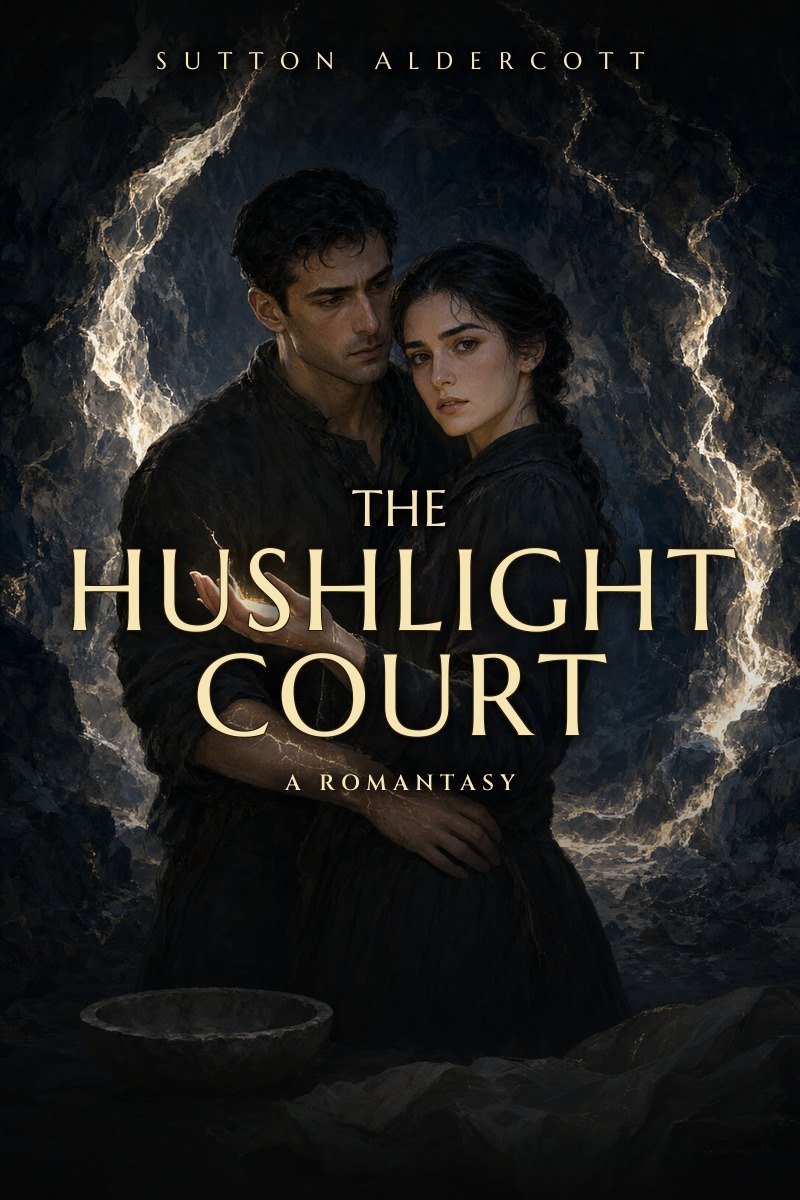
Chapter 15
A dying man does not weigh what he owes you, but he weighs every ounce of his boots.
I knelt in the draft from the broken casement, my knees wedged against the dolomite floor of Lady Sorai's solar, holding Kavir's head in the crook of my elbow. His breath came through his teeth like sand dragged across tin. Along the left side of his neck, the violet branching was not fading; it was climbing. A pale, brittle crust had already reached the hollow beneath his ear, turning the olive tone of his skin into milk glass, hard and slick to the touch.
If I screamed for the High Pavilion's chirurgeons, three things would happen inside ten minutes. The guards would seal the corridor, Lord Melikran's allies would step forward with vials of soothing draughts to ensure the Kindler never woke, and Sorai would be led into a closed cloister to await her own peaceful erasure.
I needed cold, I needed salt, and I needed someone whose hands did not shake when there was blood on the carpet.
The heavy oak door swung inward on oiled hinges. Feriz slipped through the opening sideways, carrying two heavy zinc buckets that sloshed with gray cellar slush and coarse packing salt. A roll of lead roofing foil was tucked under his left arm like an oversized bolt of cloth. He kicked the bolt home with his heel, dropped the latch into its iron cradle, and stood there sucking air through his nose until his chest stopped hitching.
Then he looked at the floor.
The Still Accord's operative lay face-down beside the hearth, his limbs bound with curtain cords, the bronze fire dog still resting near his ear where I had dropped it. Across the chamber, Sorai sat on her backless cedar stool, watching us with the placid, untroubled gaze of a woman observing rain on a courtyard fountain. Between them, Kavir lay across my lap, barely shivering as the frost spread toward his jaw.
"You told me the cellar," Feriz wheezed, wiping kitchen brine from his chin with the sleeve of his wool jacket. "You didn't mention the third landing was swarming with Vosha's spearmen, or that the pantry master keeps two mastiffs chained to the larders. I had to tell three cooks that the Shah's personal preserves were spoiling in the upper pantry before they gave me the salt."
"Did anyone follow you?" I demanded. My voice was stripped of breath, grating against my throat.
"No," Feriz said. He set the zinc tubs down with a dull clang that made Sorai tilt her head half an inch. "Because unlike the nobility of this mountain, I know how to use the laundry chutes. Nesh, his face is turning to salt. What did they hit him with?"
"Accelerant," I said. "Undiluted. The whole charge went into his chest and throat."
Feriz crouched beside me, his chatter dying in his throat. He reached out two fingers, hovering them above Kavir's collarbone without making contact. Even an inch away, the cold radiating from the Kindler's skin made Feriz pull his hand back as if he had grazed an open furnace door in reverse.
"We can't carry him down," Feriz whispered. "If we move him into the hall, he'll shatter."
"We aren't moving him anywhere," I said. "Unroll the lead foil across the rug. Pack three inches of the salt-slurry over the middle, then fold the edges inward so the brine doesn't touch his back. We have to draw the core heat out before his carotid calcifies."
"Salt and lead," Feriz murmured, unrolling the heavy gray metal with quick, practiced jerks of his wrists. "That's how we cool overheated tin ingots in the foundry yard."
"His blood isn't tin," I said. "It's full of raw hushkaran. If we let the crystallization reach the base of his skull, his mind stops. He turns into a statue that breathes once an hour."
Together, we eased Kavir onto the prepared bed of lead and salted ice. The shock of the freezing brine made his chest heave once, a violent, jagged spasm that tore a hoarse groan from between his blue lips. The branching violet lines across his collarbone flared with sudden, angry luminescence, pulsing in rapid, terrified syncopation against the cold.
I knelt at his right shoulder, peeling away the ripped remnants of my charcoal court lace.
Beneath the fabric, my right palm was already burning. The thin gold thread planted under my skin during our first days inside the sealed gate had woken the second Kavir collapsed. It was throbbing with an electric, sickening heat, pulling toward the concentrated mass of accelerant locked in his flesh.
I unpinned the lead wrapping from my wrist and threw the foil aside.
"Nesh," Feriz said sharply, his hands pausing on the edge of the zinc tub. "What are you doing? You touch that while it's flaring, it'll jump straight into your marrow."
"The salt takes the heat, but it doesn't take the resonance," I told him, keeping my eyes fixed on the pale glaze creeping up Kavir's neck. "Refined accelerant needs a live vein to ground itself. Without a counter-pull, it will bore straight through his spinal sheath. I'm grounding it."
"You're a trade fixer, not a lightning rod!"
"Work the slush around his ribs," I ordered, my tone flat enough to cut timber. "Keep the ice off his heart. When his breathing stops, you push his sternum. Do not touch my skin until I tell you."
I didn't give myself time to calculate the odds. In the Concern, when an ore vat fractured, you didn't debate the value of the leather gloves; you seized the tongs before the floor caught fire.
I laid my bare right palm flat against the base of Kavir's throat.
The agony hit me not as heat, but as a hammer made of black ice driven through the center of my skull.
My vision bleached into blinding white. The gold thread in my palm didn't just warm; it snapped tight like a drawn bowstring, tearing an agonizing pathway along the bones of my forearm. Through the contact of our skin, the accelerant inside Kavir's blood recognized the foreign contaminant in mine. It surged toward the junction of our hands with the predatory hunger of starved flame.
The violet lattice on his neck shifted, the sharp branches bending backward, drawn toward the heel of my palm.
Under my left hand, Kavir's throat bucked. He arched off the lead sheet, his fingers digging into the dolomite floorboards with enough force to splinter the grain. His teeth snapped together, a thin trickle of dark blood leaking from his lip where he bit down on his own tongue.
"Hold him!" I screamed, the sound tearing out of my chest before I could choke it back.
Feriz threw his weight across Kavir's thighs, his boots slipping in the brine, while Sorai, without a word or a change in her placid expression, reached out from her stool and laid both hands against her brother's forehead, steadying his skull against the cedar floor.
The pain in my arm deepened from cold into pure, vibrating numbness. I could feel the crystals forming along the radial artery, tiny sharp needles prickling under my skin, drinking my warmth and replacing it with mountain glass. My teeth clicked together uncontrollably. My lungs refused to expand, paralyzed by the sympathetic freeze that was traveling up my bicep toward my shoulder.
Not my chest, I told myself, grinding my cheek against Kavir's cold velvet sleeve. Take it from his neck. Just his neck.
I leaned my full weight onto the heel of my palm, pressing his flesh into the salted lead beneath him, using the brine to suck the displaced thermal violence away into the gray slurry. The zinc tubs hissed as the salt melted, steam rising from the slush in pale, foul-smelling ribbons that carried the bitter odor of crushed sulfur.
Minute by minute, the room shrank to the sound of three people breathing.
Kavir's pulse under my thumb went from a chaotic flutter to a slow, stubborn thud. One beat. Two beats. Long pauses between them, but the cadence was steadying, dropping into the deep, sluggish rhythm of an animal surviving winter under the snow.
The violet web along his jawline began to dull. It did not vanish—the damage was done, carved deep into the living tissue—but the edges ceased their predatory march. The translucent milk-glass skin along his collarbone solidified into a permanent, pale ridge, smooth as polished horn, running from the hollow of his throat to the underside of his left ear.
The current broke.
The sudden release of pressure sent me tumbling backward onto my hips. My right arm fell limp against the floor, my hand gray, numb, and curled like a frozen claw. I dragged air into my chest in great, ragged sobs, my vision swimming with dark purple spots.
· · ·
In our bedchamber now, when the night fire burns low and the shadows stretch long across the cedar ceiling, I still trace that line with my thumb.
I don't use my right hand—the two middle fingers never fully recovered their flex after the High Pavilion—so I use my left. His neck is warm now, warmer than it was that night, but there is always a boundary where the skin along his jaw stays cool to the mouth. A permanent winter, held in place by what we chose not to surrender.
People who write chronicles of courts like to describe devotion as an altar where lovers sacrifice themselves with clean linen and tidy speeches. It isn't an altar. It is two people kneeling in foul brine and mutton tallow, dragging each other back from the dark by the hair, smelling of vomit and crushed salt, knowing that whatever pieces they salvage will never fit together the way they did before.
We did not speak of love that night. We did not have the breath for it.
· · ·
Feriz collapsed back against the wall, his arms soaked to the elbows in gray slush, his chest heaving under his salt-stained tunic.
"Tell me he's alive," the boy croaked, his eyes wide as he stared at the still figure on the lead sheet. "Tell me I didn't steal eight pounds of coarse salt from the Shah's personal pantry just to watch Lord Tarnashah turn into a headstone."
"He's alive," I whispered. My voice was a ruined scrap, but my fingers found the carotid artery below Kavir's jaw.
The pulse was there. Hard. Slow. Human.
A low, dry cough broke from Kavir's chest. His eyes opened.
The milky haze was gone, burned away by the extraction, leaving his irises that sharp, uncompromising slate-gray I had learned to read across negotiation tables and darkened corridors. He blinked twice against the amber starlight from the window, his gaze traveling from the cedar rafters down to Sorai's motionless hands on his forehead, then across the floor to Feriz, and finally to me.
He tried to sit up, but his elbows gave way immediately, his shoulders sinking back into the damp lead.
"Sorai," he rasped. His voice sounded like dry gravel ground beneath an iron wheel.
"She's whole, Kavir," I said, crawling forward on my knees until I was level with his shoulder. "She didn't take a grain of it."
His gaze shifted to my right arm, hanging uselessly at my side, the fingers swollen and gray against the skirt of my ruined gown. His jaw tightened—the right side moving naturally, the left marked by that newly carved, motionless ridge of pale violet frost.
"Your hand," he said. It wasn't an inquiry. It was an accusation directed at himself.
"My hand is fine," I lied, though every nerve from my wrist to my shoulder felt as though it had been scrubbed with coarse emery paper. "The Concern has lost more fingers than this to bad cargo."
"You used... sympathetic pull." He had to pause between words, his chest struggling to lift the heavy air of the high solar. "The resonance... could have stopped your heart, Neshtaran."
"Then you should have caught the bulb lower, like you said," I replied, my chin lifting despite the trembling in my knees. "You don't get to die on my watch, Lord Kindler. I haven't collected my family's fee for the winter yet."
A faint breath left his mouth, not quite a laugh, but the dry, guarded irony that was his truest defense against the mountain's weight. Slowly, with an effort that made the cords in his neck stand out like wire, he lifted his left hand from the lead sheet and reached for me.
His fingers were cold, but not with the lethal chill of the accelerant. It was the honest cold of mountain stone. He closed his hand over my bruised, lead-stained knuckles, his grip firm enough to steady the tremor running through my wrist.
"I owe you my sister," he murmured, his eyes holding mine with a fierce, quiet clarity that stripped away every courtier's mask he had ever worn. "And my breath."
"You don't owe me anything," I said, leaning closer until the smell of his cold velvet filled my senses, driving out the sulfur reek of the brine. "Just stay on your feet tomorrow when we burn Melikran's house to the ground."
"Tomorrow," he agreed softly, his thumb pressing once against the back of my hand before he let his arm rest against his chest. "We start with the foundries."
Beside us, Feriz cleared his throat with deliberate, exaggerated loudness.
"As touching as this family reunion is," Feriz said, pointing a salt-encrusted boot toward the hearth, "we still have a package on the carpet. And unless you want me to roll him out the bay window into the gorge, someone needs to figure out what we're telling the watch when dawn breaks."
I pulled my attention away from Kavir, the cold reality of the chamber settling back over my shoulders like an iron mantle.
The operative was still alive. His breathing was shallow and wet, his broken windpipe whistling faintly behind his clamped jaw, but his pulse was steady. He had been trained to endure blunt trauma, which meant he was not a common foundry hand hired for three copper coins in the Lower Ring.
I pushed myself up, using Kavir's shoulder for leverage, and crossed the chamber to the hearth.
"Strip his coat," I told Feriz. "Check the lining, the seams of his boots, and behind his collar. Men who carry clockwork dosing valves don't travel without their receipts."
Feriz grunted, pulling his skinning blade from his belt to slit the tough wool of the man's tunic. We worked in silence for three minutes, the boy slicing through padding while I used my left hand to turn out the pockets of his heavy canvas trousers.
We found two brass lockpicks, a vial of sulfur salt for waking stunned operatives, and three blank identity scrips stamped with the seal of the Middle Ring Water Gate. Professional tools, cleanly kept, entirely devoid of names or ranks.
Then Feriz sliced through the inner lining of the man's left boot.
A small, heavy disc of blackened iron slipped from the leather sheath, striking the dolomite flags with a sharp, flat ring.
I picked it up.
It was an iron tally token, two inches across, heavy and worn smooth around the rim by years of pocket wear. Stamped into the center of the iron was a mark I had seen dozens of times during my first eight days in Vessaran: the cleft-chisel of the Lower Gate freight line.
Beside the chisel mark was a secondary stamp—a deeply notched numeral four, scored with the distinctive curved chisel used only by the Threshold Reeve's inspection clerks to certify uninspected sealed ballast.
Feriz leaned closer, his eyes narrowing as he recognized the geometry. "That's Marzhad's freight mark," he breathed, his voice dropping to a harsh whisper. "The lower mountain supply route. The one we shut down when the Shah took his measuring cord."
My fingers tightened around the cold iron until the notched edges bit into my skin.
Marzhad was gone, stripped of his office and his keys, living under house watch in the lower cloisters. But his supply line had not died with his disgrace. The cleft-chisel token was fresh, the wax seal in the center barely hardened, stamped within the last three days.
Melikran hadn't built a new network to move his accelerant into the High Pavilion. He had simply stepped into the empty shoes Marzhad left behind, using the old smuggling channels my own family had helped uncover.
"He didn't just buy the valves," I said, staring at the cleft mark in the dim starlight. "The Still Accord is using our old trade routes to move the poison."
From the lead sheet behind us, Kavir's voice came through the quiet, low and clear despite the damage to his throat.
"Then we don't just take the Speaker," Kavir said, his fingers curling into the velvet of his tunic as he looked toward the window where the first gray light of dawn was beginning to touch the jagged peaks. "We take the whole mountain back."
I pocketed the iron token, resting my hand against the intact cylinder of accelerant hidden in my bodice.
The night was over. The Kindler was breathing. And the hunt had just begun.

Comments
Loading comments…