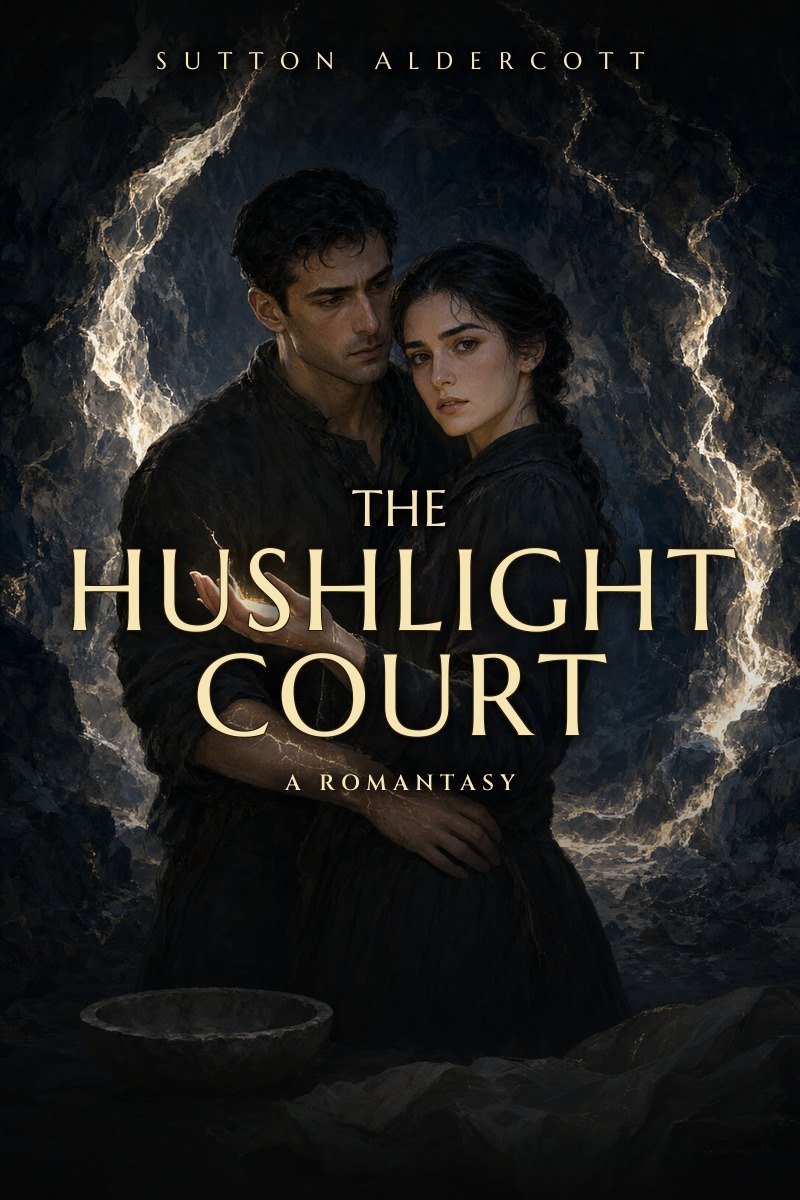
Chapter 14
I didn't gather my skirts. Silk costs three silver marks a yard in the lower wards, but silk does not buy back a woman's throat once the marrow turns to glass.
I hit the heavy oak doors of the Great Hall at a full sprint. My shoulder took the iron latch with a dull, bruising thud that jarred my teeth, shoving the left leaf outward into the cold corridor. Behind me, the banquet collapsed into a ragged roar of chairs scraping stone and guards shouting for order, but the noise felt thin, already muffled by the freezing draft howling down the north stairwell.
Footsteps struck the flags behind me. Fast. Heavy. Evenly spaced.
I didn't look back to see if Shah Vosha had ordered her spearmen to bring me down. If spearmen were behind me, I was already dead. If it was Kavir, every breath spent turning around was a breath stolen from his sister.
"Third landing," his voice cut through the draft, low and hard as hammered iron.
He pulled level with me as we reached the foot of the spiral stair. The parade scraper was bare in his right hand, the dull steel blade catching the dim amber glow of the wall sconces. He had torn open the high collar of his formal charcoal velvet tunic somewhere between the dais and the threshold, the silver clasps wrenched wide at the throat to give his lungs room to work.
"Melikran said the draft was open," I panted, taking the stone steps two at a time. The embroidered hem of my banquet gown caught the toe of my velvet slipper, nearly pitching me face-first onto the riser. I cursed, caught the rough granite wall with my left palm, and tore the hem away with my right hand, the charcoal court lace ripping with a sharp screech of shredded silk. "Four yards of formal velvet train are useless for defending against an assassination."
"Hold still," Kavir said without breaking stride. "I can take the skirts off at your knees with the scraper."
"Don't touch the hem," I wheezed. "Melikran said tonight. He was smiling when he said it."
"He wouldn't use the central flue," Kavir said. His breath was steady, his stride long and effortless despite the brutal pitch of the stairs. "The Great Hall would catch the backdraft. Sorai's solar sits on an isolated feeder line from the upper north battery."
"How many doors between here and her chambers?"
"Three. Two are locked from the outside at dusk."
"Can you take them?"
"I have the Kindler's keys," he said flatly. "And if the locks are spiked, I have seventy pounds of tempered iron in my shoulder."
He reached out, his bare left fingers catching my upper arm just as my shoe slipped on a patch of slick condensation. His grip was shocking in its temperature—a dry, burning chill that bit through the lead-washed foil and velvet of my sleeve like frost through linen. He didn't let go until my footing was solid, hauling me upward into the curve of the stair.
"You run well for a merchant," he murmured.
"I run well when people are trying to poison my clients," I snapped back, lungs burning in the thinning air of the High Pavilion. "Or their sisters."
He didn't answer that. He only lengthened his stride, taking three risers in a single leap, his boots ringing against the granite like a hammer on an anvil.
· · ·
In the quiet room where we sleep now, years away from that stair, the mountain wind still sounds like running water against the glass.
I sit by the edge of the low mattress and watch the blue veins in his wrist. When the weather changes, or when the deep winter freeze settles into the foundations of the court, the skin along his collarbone tightens and turns the pale, milky color of skimmed horn. He sleeps with his hands open, as if he is still waiting for the weight of an iron scraper to be pressed into his palms.
Every time I look at the dark line tracing the hollow behind his left ear, I remember the sound of our feet on those sixty-four steps. I remember the exact smell of the cold gallery—lamp grease, dried rose hips from the previous summer's potpourri, and that faint, metallic sweetness that tastes like zinc on the back of the tongue.
People outside the mountain think haste is loud. They think when you are running to save someone's life, the world is full of brass bells and screaming. It isn't. The world narrows until it is only the rasp of air tearing down your windpipe and the knowledge that if your knee buckles on a spiral riser, someone you love stops breathing before you can touch them.
· · ·
We cleared the second landing. The corridor here was narrow, lined with high, arched slit-windows that let in the bitter black teeth of the mountain night. Snow dust swirled across the dolomite flags, fine as powdered bone.
Kavir reached the first door—a banded cedar barrier that separated the public galleries from the royal apartments. The key was already in his hand, a heavy brass spindle that turned with a dry, oiled click. He didn't wait to ease it open; he drove his boot into the timber, smashing it inward against the stone stop.
The corridor beyond was dead silent.
No servants. No torch-bearers. No guards posted at the private intersections.
The absence of people was heavier than an ambush. The Still Accord did not need an army to hollow out a room; they only needed five minutes of quiet and an empty hallway.
"The air," I whispered, halting three paces past the threshold.
The cold here was different from the clean, knife-edge freeze blowing through the casements. It had an oily weight to it. The hair on my arms stood rigid under the charcoal lace. On my right palm, beneath the layers of lead foil and linen Kavir had bound before the feast, the thin thread of hushlight began to ache with a sudden, vicious throb. It wasn't a dull ache. It was a rhythmic, pulsing heat that felt like a needle trying to stitch its way out through my dermis.
"Sympathetic resonance," Kavir breathed. His face was carved out of slate in the dim light. "The accelerant is already in the air."
"Where is her room?"
He didn't speak. He broke into a sprint down the left fork of the corridor, his boots making almost no sound on the runner of thick mountain wool.
Sorai's private solar occupied the northernmost spur of the High Pavilion, perched out over the sheer fall of the eastern cliff where the court's outer masonry met the living granite of the peak. It was a space designed for quiet—for a woman who had given up her tongue and her memory to the light, and whose family still pretended she was resting rather than disappearing.
The heavy double doors of pale linden wood were unlatched. A thin sliver of violet glow leaked through the seam, spilling across the dark floorboards like curdled milk.
Kavir didn't kick this one. He caught the brass handle with his left hand, eased it open six inches, and slid through the gap like smoke. I followed half a second behind him, my right hand dropping to the small steel skinning knife hidden inside the folds of my ruined skirt.
The room was vast, high-ceilinged, and freezing.
Lady Sorai sat where she always sat: on a low, backless cedar stool near the tall bay window that overlooked the frozen abyss of the outer valley. Her back was to the door. She was dressed in a simple shift of unbleached silk, her thick dark hair loose over her shoulders, her hands resting motionless on her knees. Her posture was so perfectly still she looked like a monument carved from tallow. Outside the glass, the winter stars hung huge and brittle in the black sky, but she wasn't looking at the stars. She was looking at nothing at all.
Ten feet to her left, kneeling before the bronze floor-grate of the secondary heating flue, was a man.
He wore the soot-streaked wool tunic of a lower-tier maintenance tender, but his boots were supple leather, silent and clean, and his hands were encased in thick gauntlets of vulcanized pigskin lined with lead plates. On the floor beside him sat a leather tool roll, three sawn-off iron screws, and a brass pressurized delivery cylinder identical to the ones Terzahan had sketched in his hidden bench notebook.
The mechanism was already bolted to the flue intake. A fine glass bulb, filled with a swirling violet powder that shimmered like crushed amethyst in kerosene, was seated in the brass delivery bracket.
The operative had his thumb on the release lever.
The world stopped.
The flue was open.
The nozzle was set.
The glass was whole.
Kavir didn't shout a warning. He crossed the room in two strides, his scraper rising in a flat, sweeping arc meant to sever the man's wrist before he could depress the spring.
The operative was faster than a foundry worker had any right to be. He didn't try to salvage the valve; he threw himself backward across the rugs, drawing a short, triangular trench-blade from his boot with his left hand while his right snapped the delivery arm downward.
The brass bracket shrieked as the iron pin sheared. The glass bulb popped free from its housing, tumbling through the air toward the low table where Sorai sat motionless.
If that bulb shattered on the stone floor, the concentrated vapor would fill the chamber in three seconds. Sorai's airways were already fragile, her lungs scarred from ten years of tending the raw hushkaran veins. One full breath of undiluted accelerant would turn her heart to solid crystal before she could blink.
"Kavir!" I screamed.
I didn't think about court protocol. I didn't think about the fact that I was an outsider in a borrowed silk dress with no legal standing to lay hands on a mountain citizen. I dropped my center of gravity, planting the flat of my slippers against the rug, and threw myself into a diving slide across the polished cedar planks.
The operative's trench-blade whistled over my hair, the tip slicing clean through the high velvet collar of my bodice with a venomous hiss.
My shoulder slammed into his knees. It wasn't an honorable strike; it was a waterfront dock-fighter's tackle, dirty and low, using every ounce of my weight to take his legs out from under him. He went down hard, the back of his skull cracking against the heavy bronze fire dog beside the unlit hearth.
The trench-blade skittered away across the floor.
Above us, the glass bulb was still falling.
It had cleared the table. It was descending directly toward the flags two feet in front of Sorai's bare feet.
Kavir was already there.
He didn't try to catch it with his cloak. He didn't try to kick it away. The glass was too thin, the charge too pressurized; any sharp impact would rupture the housing.
He dropped to his knees between the falling cylinder and his sister. He opened both hands—bare, unshielded, the old silver-and-white scars of twelve years of vein-work shining violently under the violet light—and caught the falling bulb against his chest, wrapping his arms around the fragile glass like a man sheltering an ember from a gale.
The glass didn't shatter against the stone.
It cracked against the silver clasp of his tunic.
The sound was tiny. A sharp, crystalline tink, like an icicle snapping under a bird's foot.
From the hairline fissure in the amethyst cylinder, a pressurized plume of violet vapor hissed outward. It didn't disperse into the room. It didn't drift toward the open window or billow up into the cedar rafters.
It saw Kavir's veins.
The sympathetic attraction was so violent it looked like lightning striking in reverse. The raw hushkaran inside his blood—the decades of slow, patient exposure he had carried in silence to keep the court warm—reached out for the refined accelerant like dry brush reaching for a torch.
The violet mist was sucked directly into his bare palms, into the pores of his forearms, into the exposed hollow of his throat.
Kavir didn't scream. He couldn't. His entire body locked rigid, every muscle in his back and shoulders turning to braided iron. His head snapped back against the rim of Sorai's cedar stool, his lips parting in a soundless, strangled gasp that sucked the freezing air into his chest.
Beneath the pale skin of his forearms, the silver scars didn't glow. They erupted.
Brilliant, branching rivers of violet fire tore outward from his wrists, racing up the veins of his biceps, jumping the hollow of his collarbone, and lashing upward toward the side of his neck. Where the light passed, his skin didn't burn or blister; it hardened. It took on that dreadful, polished translucence, the surface turning smooth and cold as milk glass, the fine grain of human flesh erased beneath a flawless, unyielding glaze.
"Kavir!"
Underneath me, the operative surged.
The man had shaken off the stun of the fire dog. His pigskin-gloved hand clawed into my hair, yanking my head back until the tendons in my neck creaked, his knee driving savagely up into my ribs. The breath left my lungs in a wet explosion. Pain starred across my vision in white flares.
He reached for the spare cylinder at his belt—a second glass bulb capped in brass, thumbing the valve open to vent the pressurized stream directly into our faces.
I didn't have room to draw my skinning knife. I threw my right forearm across the brass discharge valve, clamping the heavy folds of my lead-foil-lined court sleeve down over the spray nozzle to choke the pressurized vapor before it could billow into the room. The cold hissed against the lead foil like acid against grease, biting into my wrist.
With the nozzle smothered, I drove my right fist straight up into the soft hollow beneath his chin. I didn't hold back. I put my shoulder, my hips, and every ounce of terror choking my throat into the blow. The lead-wrapped knuckles crushed his windpipe with a sickening, spongy crunch.
His grip in my hair went slack. His eyes rolled upward into his forehead, wide and glassy with suffocation.
Before he could recover, I rolled off him, seized the heavy bronze fire dog by its curved neck, and brought the blunt base down across his temple.
The operative went limp. His head knocked once against the dolomite flags, and he did not move again.
I didn't look at him to check his pulse.
I scrambled across the rugs on my hands and knees, my torn skirt tangling around my ankles, my lungs heaving like broken bellows.
"Kavir. Kavir, look at me."
He was still kneeling, but his balance was gone. He was listing slowly to the right, his forehead resting against the edge of Sorai's silk skirt. His fingers were still clenched around the cracked brass housing of the cylinder, his knuckles stark white, his knuckles fused around the metal as if the bone had knitted straight to the bronze.
The violet fire in his neck was dying down, but what it left behind was worse.
The frost had reached the hinge of his jaw. It traced a thick, branching web of pale violet crystal that pulsed with a slow, dying rhythm, three beats to every one of his labored breaths. His skin was so cold that when my bare left hand touched his cheek, it felt like pressing my fingers into packed lake ice.
"Kavir. Breathe. Come on, breathe."
His eyelashes fluttered. His gray eyes, usually so sharp, so guarded, so impossibly steady, were clouded with a milky, iridescent haze. He looked at me, but it took two long, agonizing seconds for his pupils to find my face.
"Sorai..." his voice was a ruined whisper, dry as crushed autumn leaves. "Is she..."
"She's fine," I choked out, my fingers digging into the velvet of his tunic to hold him upright. "She's untouched. The glass didn't reach her, Kavir. You took it. You took all of it."
A faint, terrible shadow of a smile touched the unglazed corner of his mouth.
"Careless," he whispered. "Should have... caught it... lower."
"Shut up," I said, tears burning hot and useless behind my eyelids. "Don't talk. Don't you dare make a joke right now."
His body gave a violent, shuddering heave. The rigid tension in his shoulders broke all at once, his weight collapsing forward against my chest.
I caught him, wrapping both arms around his neck, my knees sliding out on the blood-flecked rug as I pulled his head into the hollow of my shoulder. He was so heavy. He had always seemed lean and quiet, a man who moved without disturbing the air around him, but in my arms he felt like a falling column of granite.
Beside us, on the cedar stool, Lady Sorai did not cry out.
She didn't stand up. She didn't flinch away from the reek of spilled accelerant or the unconscious assassin sprawled across her hearth.
Slowly, with the agonizing, unhurried grace that was all the light had left her, she reached out her right hand.
Her long, pale fingers—already smooth and unlined as porcelain from four years of Stillness—descended through the air. She didn't touch me. She laid her palm gently against the back of Kavir's head, her cool skin resting against his dark hair with a quiet, terrifying tenderness.
"Brother," she murmured. Her voice had no inflection, no rise or fall, like water dripping into an empty basin. "You brought the cold inside."
My throat closed so tight I couldn't draw air.
Under my hands, Kavir's breathing was growing shallow. The pulse beneath his jaw was fluttering, faint and erratic, like a moth beating against paper. The accelerant hadn't just exposed him; it had short-circuited the natural clock of his body. What should have taken another five years of careful maintenance—what should have been a slow, dignified retreat into the mountain's silence—had been compressed into sixty seconds of violent, chemical theft.
He was slipping. I could feel the will leaving his muscles, the heavy, deadening slackness settling into his limbs.
"No," I hissed into his hair. I tightened my grip until my knuckles ached through the lead wrapping. "No. You don't get to do this. You don't get to save everyone in this damned court and leave me here alone with them."
His hand moved weakly against my hip, his thumb brushing once against the torn charcoal lace of my sleeve, before his arm fell limp against the floorboards.
He didn't speak again. His eyes slid shut, the thick lashes dark against the terrifying, violet-marbled frost of his cheek.
I looked down at the floor between my knees.
The cracked delivery cylinder lay where it had fallen from his grip. The glass bulb was empty, its contents spent inside his veins, but tucked inside the operative's leather tool roll, half-hidden beneath a set of brass screwdrivers, was a second vial.
An intact, sealed, undiluted cylinder of Still Accord accelerant. The liquid inside was calm, dark violet, swirling with heavy suspended crystals that caught the starlight from the window.
It was the proof. It was the weapon that linked Melikran's commission directly to an attempted murder in the High Pavilion.
I reached out with my lead-bound right hand, seized the cold brass cylinder, and shoved it deep into the inner pocket of my bodice, pressing it hard against my ribs.
Then I gathered Kavir closer, my cheek pressed against his freezing forehead, listening to the thin, fragile whistle of his breath against the dark.
The operative was down.
The proof was mine.
And the man who had given me his keys was dying in my arms.

Comments
Loading comments…