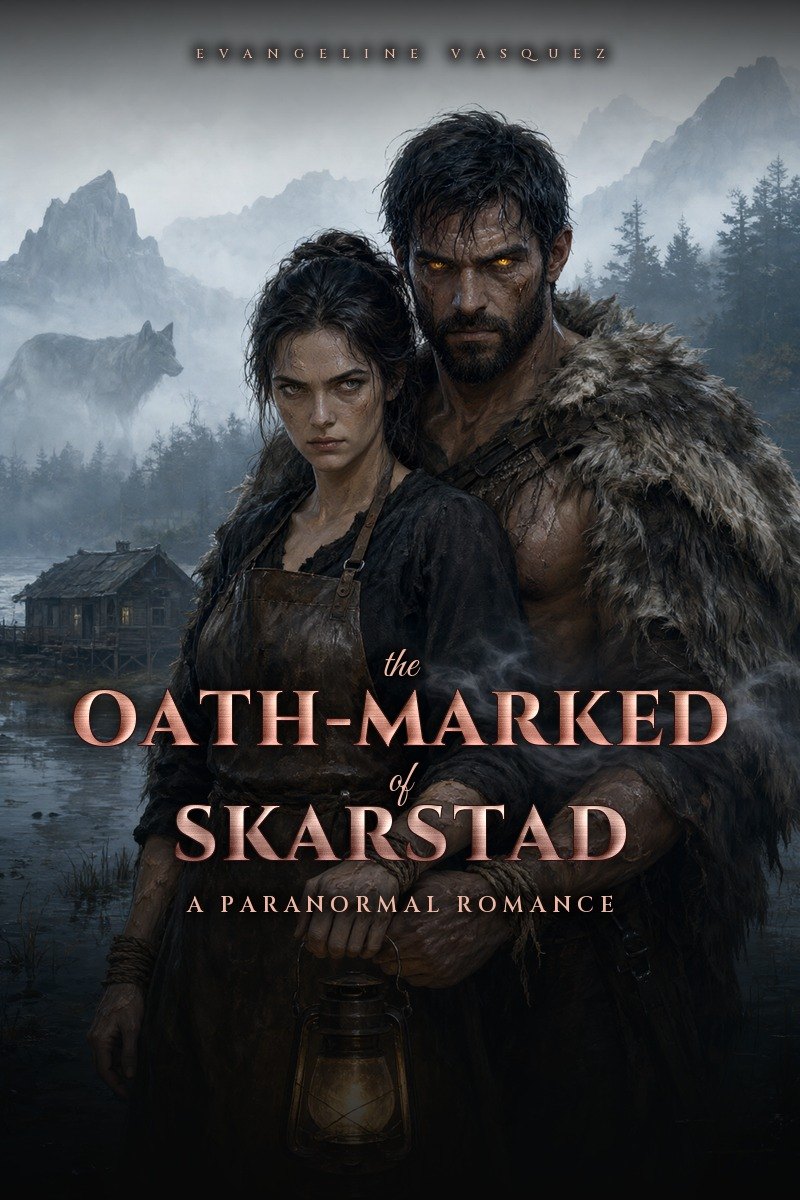
Chapter 2
The heavy brass knocker on my front door struck iron three times.
The sound cracked through the salt-damp silence of the clinic like a mallet hitting an oak wedge.
I froze, one bloody hand still hovering over Haldor's collarbone.
Below me, the massive outsider did not move. His golden eyes, which had flared open with that impossible, guttural northern word just seconds earlier, had already slipped back into unconsciousness. His breathing was a wet, shallow scrape against the copper shunt I had jammed into his torn brachial artery.
If someone walked through that front door right now, I was dead.
Worse than dead. I would be dragged up the gravel bluff to the council hall in chains, charged with harboring an unnatural entity, and stripped of my clinic before dawn.
"Open the door, Vigdis," a voice boomed from the porch. "We saw your lantern."
Mayor Torstens. Of course.
The man possessed the instincts of a starved gull when it came to smelling blood or municipal violations.
"Hold on," I called back, keeping my voice flat, dry, and irritated. "I'm in the middle of a septic debridement. Unless you want gangrene on your boots, give me two minutes."
"You have one," Torstens snapped through the fir planks.
I looked down at Haldor.
His skin was burning hot where the mate bond had sparked through my fingers, but his extremities were dead cold. The black frost along his torn ribs was weeping a slow, foul grease onto the floorboards. If Torstens caught one whiff of that ozone stench, no amount of medical jargon would save me.
I moved with the cold precision that had kept me alive since Vargund.
First, the patient. Haldor weighed at least two hundred and forty pounds of dense bone and corded muscle. I could not drag him to the cellar without tearing out my copper shunt and painting the floorboards in arterial spray.
Instead, I reached for the heavy oiled canvas curtain hanging from the ceiling track. It was meant to partition off contagious cholera cases. I yanked it across the kitchen alcove, cutting the room in half. The lead weights in the hem hit the floor with a dull thud.
Next, the smell.
I grabbed a gallon jug of carbolic acid and dumped half a cup straight into an iron kettle on the cast-iron stove. The acid hit the hot iron and hissed violently. A cloud of acrid, stinging vapor billowed outward, smelling like crushed coal, lye, and scorched sheep dip. It was nauseating. It burned the back of my throat instantly.
Perfect.
Nothing short of a bloodhound could smell black frost through a haze of boiling phenol.
I grabbed a clean linen apron, smeared two fresh streaks of sheep fat and iodine across the front, and kicked the bucket of bloody surgical towels under the back sink.
Finally, I wiped my hands with raw turpentine until the skin stung, unbolted the heavy deadbolt, and pulled the door open six inches.
"Mayor Torstens," I said, blocking the opening with my shoulder. "It is past two in the morning. Did another logging crane collapse at the timber boom, or are you just here to inspect my laundry?"
Torstens stood on my cedar porch, wrapped in a heavy seal-fur coat that smelled faintly of stale pipe tobacco and damp dog. Behind him, holding an unlit hurricane lantern, stood his nephew Karr, a thick-necked boy of nineteen with dull eyes and the posture of an unworked draft horse.
Torstens was fifty, stout, and red-faced from a lifetime of salt pork and council brandy. His small, watery blue eyes flicked immediately past my shoulder, trying to pry into the dark clinic behind me.
"We had a report," Torstens said. His voice had that oily, bureaucratic rumble that always made my teeth itch. "Brandur was seen leaving your wharf at dusk with three fresh stitches and a mouth full of wild stories."
"Brandur is an idiot who sliced his wrist on a hemlock branch because he was looking at a gull instead of his winch cable," I said coldly. "I charged him three tokens, and he paid every one of them into my jar. If you are here to collect municipal tax on three stamped zinc pieces, you're wasting your kerosene."
Torstens did not laugh. He took a heavy step forward, bringing his boot against the threshold.
"Brandur said there was shouting down by the high-tide line," Torstens said. "He said the timber dogs along the north fence have been howling since midnight. He said he smelled sulfur."
"Brandur smelled the mud flats at low tide," I replied without blinking. "And the dogs are howling because the seasonal fog is rolling in from the shelf. You know how wolves work in October, Torstens. They push the deer toward the salt marshes."
"We don't have wolves in Skarstad," Torstens said instantly.
The correction came so fast it sounded rehearsed. It was the council's official line. There were no wolves in Skarstad. There was no rot in the timber. The border fault fifty miles north did not exist, and the black frost that killed the sheep in the upper pastures was just 'unseasonable mold.'
To admit the supernatural was to admit the town sat on a crumbling metaphysical fault line. If the timber companies in the south found out, the shipping contracts would vanish overnight. Torstens would rather drown in denial than lose his winter timber subsidies.
"If there are no wolves," I said, leaning against the doorframe, "then why are you standing on my porch with an axe handle in your nephew's belt?"
Karr shifted uncomfortably in the dark, his hand dropping away from his hip.
Torstens ignored the barb. He sniffed the air, wrinkling his bulbous nose as the boiling carbolic acid hit his nostrils. He coughed, pulling a silk handkerchief from his coat to cover his mouth.
"God above, Vigdis. What are you burning in there? A dead horse?"
"Septic lymph," I lied smoothly. "I had a vagrant trapper come through from the western inlet at midnight. Advanced gangrene of the lower foot. I had to lance three pockets of necrotic abscess and flush the bone with carbolic before sending him on his way to the county hospital in Narvik."
Torstens squinted suspiciously through the haze.
"A vagrant? Where is he now?"
"Walking down the south road," I said. "Unless he collapsed in the ditch. If you hurry, you might catch him and offer him a ride in your carriage. Of course, the exudate from his sores carries Streptococcus pyogenes. If Karr touches his sleeve, his skin will be sloughing off in wet sheets by Thursday."
Karr took half a step backward into the fog.
"Don't be a fool, boy," Torstens growled at his nephew, though he himself did not push any closer to the threshold. He looked at me, his eyes narrowing into two sharp slits. "Under Section Four of the Skarstad Municipal Health Ordinance, the mayor's office retains the right to inspect any clinic operating within town boundaries during an active biological threat."
"Section Four applies to quarantine wards with three or more infected beds," I retorted, citing the municipal code I had memorized four years ago precisely for this occasion. "This is an outpatient surgery with a single private license. If you enter without a signed writ from the district magistrate in Tromsø, you are trespassing on a medical sanctuary."
"I am the magistrate in this valley, Vigdis," Torstens said, his voice dropping into a low, threatening register.
"Then go home, write the writ, sign it, and bring it back at sunrise," I said. "And while you're writing it, remember who sets the bones of your loggers when the boom chains snap. If I close this clinic and move my practice to the upper fjord, who stitches your men? You? Or are you going to let Karr sew their fingers back on with fishing twine?"
For three agonizing seconds, neither of us moved.
Behind the canvas curtain in the dark, I heard a faint, wet rattle.
My heart hammered against my ribs like a trapped crow. Haldor was shifting. The copper shunt in his arm was barely secured by four loops of linen thread. If he tore the suture, the arterial blood would pool under the curtain within ten seconds.
Torstens frowned, his ears twitching toward the noise. "What was that?"
"My tea kettle rattling on the iron trivet," I said without missing a beat. "Because the water is boiling down to dry scale. Which means if you don't let me shut this door, the bottom of my kettle is going to burn out, and I will bill the town council four zinc marks for a replacement."
Torstens stared at me. He looked at my blood-smeared apron, the cold grease on my knuckles, and the sharp, unblinking fury in my eyes.
He was a bully, but he was a bureaucratic bully. He operated on ledgers, threats, and comfortable margins. Confronted with a stubborn woman holding a scalpel and threatening him with airborne necrosis, his resolve buckled.
"Forty-eight hours, Vigdis," Torstens said, pointing a fat, leather-gloved finger at my face. "I am issuing a temporary municipal quarantine on this building. You don't leave this wharf, and you don't take in any more 'vagrants' from the inlet. On Wednesday morning, the town council inspects every room in this house. If I find one drop of unregistered blood, I'll have the constables board up your windows."
"I look forward to Wednesday," I said. "Bring a cleaner coat. That seal fur has moth rot along the hem."
I slammed the heavy door in his face.
I threw the deadbolt, dropped the iron security bar into its brackets, and pressed my forehead against the rough timber.
My legs were shaking so hard I had to brace my hands against the frame.
Forty-eight hours.
I had bought two days of silence. Two days before the town council showed up with pry bars and constables.
I let out a shuddering breath, the chemical fumes of the carbolic acid scouring the inside of my lungs. I reached up and pulled the iron kettle off the stove with a pair of blacksmith's tongs, setting it on the hearth stones before the base melted entirely.
Then I turned and pulled back the oiled canvas curtain.
"Haldor?" I whispered.
The sight that met me made the air turn to ice in my throat.
The massive outsider was not resting. He had rolled onto his side, his huge, scarred back arched in violent, rigid agony. His left arm—the torn shoulder I had just spent two grueling hours rebuilding—trembled violently as his hand clawed into the cedar floorboards, leaving deep, splintered gouges in the wood.
The linen bandages I had wrapped around his chest and shoulder were soaked through.
Not with red blood.
The fluid leaking from his shredded flesh was a thick, iridescent black slush. It pooled around his ribs, sizzling softly as it touched the salt-treated cedar floor. A thin, sickly gray smoke rose from the timber where the fluid pooled, smelling of wet slate and crushed copper ore.
The black frost wasn't just killing his tissue.
It was reacting with the wood. The floorboards beneath him were rotting in real time, the grain turning brittle, gray, and powdery as if a century of fungal decay had taken hold in sixty seconds.
"Damn it," I hissed, dropping to my knees beside him.
The floor was freezing. The chill radiating from his body wasn't natural winter cold; it was the dead, metaphysical vacuum of the high northern fault. If this rot ate through the floorboards, it would drop through into the tidal mud beneath the pilings, poisoning the clam beds and signaling the town's dogs within hours.
I reached out and seized his shoulder, trying to force him flat. "Haldor! Stop moving. You're tearing the shunt!"
The moment my bare palm touched the burning heat of his skin, the mate bond struck again.
It wasn't a gentle pull. It was a violent, electric jolt that raced up the nerves of my arm, igniting the calcified scars on my knuckles with searing, phantom fire. My breath caught in my throat.
The world narrowed to the sound of his ragged pulse.
His scent flooded over me—crushed pine needles, cold iron, and the sharp, metallic tang of ozone right before a lightning strike.
Mine.
The word echoed in the dark chambers of my mind, deep and primal, vibrating with a desperate, animal certainty that terrified me.
No, I told myself, clamping down on the instinct with every ounce of willpower I possessed. He is a patient. He is an outsider. I do not swear oaths, and I do not take mates.
Haldor's head snapped back. His amber eyes flared open, wild and unfocused, burning with a feverish gold light.
His right hand shot up like a striking viper, locking around my scarred throat.
His grip was terrifyingly strong. Even drained of blood and half-frozen by necrotic frost, he had enough power in those thick fingers to crush my windpipe in a single squeeze.
I didn't scream. I didn't beg.
I reached into the pocket of my leather apron, pulled out my heaviest steel bone-scraper, and pressed the sharp triangular point directly against the carotid artery on the right side of his neck.
"You squeeze," I whispered, holding his feral golden gaze with my own, "and I sever your external carotid. We both bleed out on this floor in forty seconds. Is that how the Wolf of Vargund dies? On a kitchen floor in a human fishing village?"
For two heartbeats, the world stopped.
The knife point indented his skin, drawing a single bead of dark, steaming blood. His fingers remained locked around my throat, the calluses on his palm rough as sandstone against my pulse.
Then, slowly, his pupils contracted.
The wild, predatory madness in his eyes receded, replaced by a cold, razor-sharp awareness. He looked at the steel point at his throat, then up at my unyielding face.
A faint, gravelly sound rumbled in the back of his chest.
It wasn't a roar. It was a dark, dry bark of laughter.
"Vigdis," he rasped, his voice scraping like iron on stone.
His fingers loosened on my throat, sliding down to rest against the hollow of my collarbone before falling limp against the floorboards.
"You haven't changed," he muttered, his breath coming in ragged, shallow gasps. "Still holding a blade to anyone who tries to touch you."
I lowered the bone-scraper, rubbing the red marks on my neck with the back of my wrist. My pulse was hammering, but I kept my face an emotionless mask.
"You recognized me earlier," I said, leaning over him. "You spoke the high northern dialect. How do you know my name?"
Haldor closed his eyes, his massive chest heaving. The black slush around his wound hissed against the rotting cedar.
"I didn't come to Skarstad by accident, healer," he whispered.
"Then why did you come?"
He opened one gold eye, staring past me toward the smoke-stained ceiling.
"Because the border at the northern fault has broken," he said. "And you are the only one who knows how to sew it shut."

Comments
Loading comments…