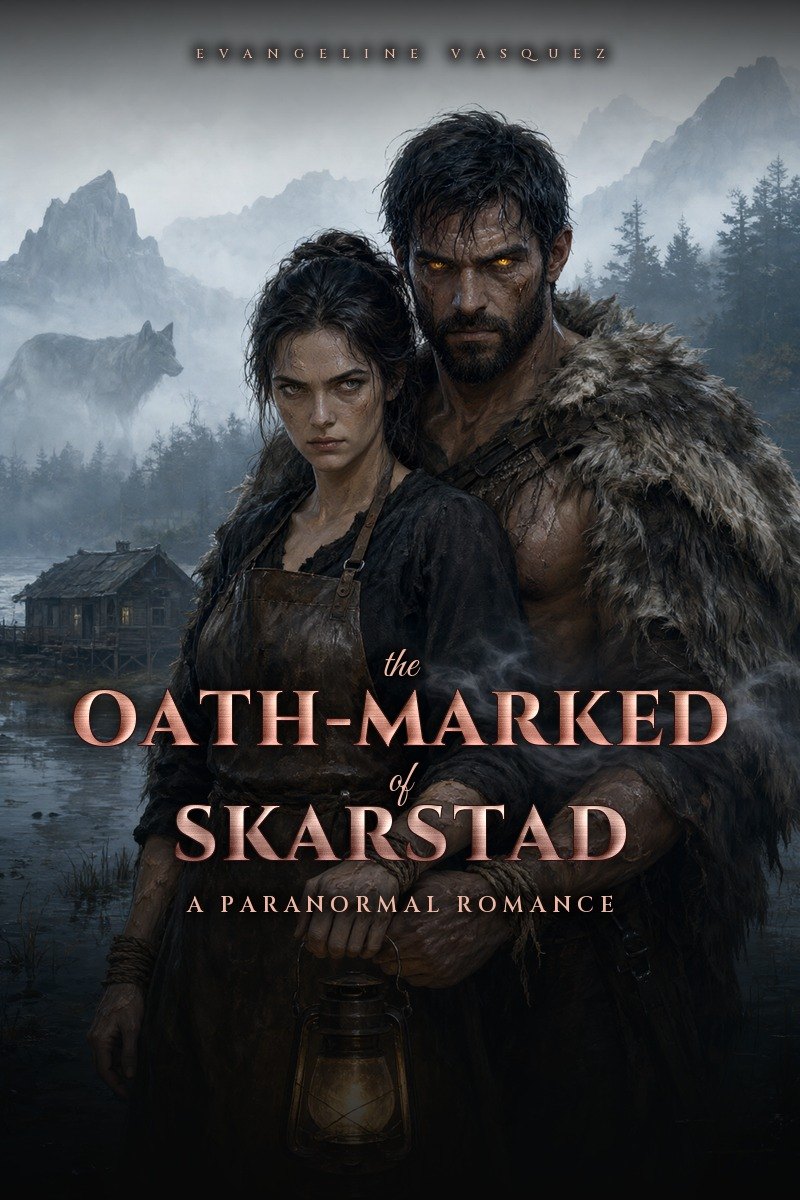
Chapter 4
How many bad decisions does it take to get killed in an October bog?
I asked myself that at four in the morning. My boots sank three inches into frozen peat with every step. The logging road had ended two miles back. Behind me, Skarstad was a faint smudge of chimney smoke and collective cowardice. Ahead of me, the northern spruce forest stood dead and gray under a heavy ceiling of Atlantic fog.
I wanted three viable clumps of silver-veined svart-moss. I wanted them alive. Most of all, I wanted to get back to my clinic before Mayor Torstens started his morning rounds.
The mayor had a habit of prowling the boardwalks before dawn with a cup of chicory coffee and a clipboard. If he decided to check on my quarantine shack and found an empty cot, my medical license was finished. So was my neck if anyone looked under the floorboards and found a fugitive bleeding black ice into the harbor pilings.
My scarred fingers throbbed inside my stiff leather mittens. The calcified tissue burned with a deep, grinding ache. It felt like someone was scraping the bones of my knuckles with an oyster knife.
That was the first sign. The border fault was close.
I stopped near an ancient hemlock stump and pulled out my brass pocket compass. The dial was frosted over with sea salt. I tapped the glass with my thumb.
The needle did not point north. It spun in slow, drunken circles, wobbling erratically before settling toward the basalt cliffs.
"Grand," I muttered. "Just perfect."
I put the useless compass away and checked my field kit. I had two glass vials of coarse salt, a jar of slaked quicklime, three linen wraps, and Haldor's silver-chased hunting knife tucked into my belt.
The knife was heavy. The balance was terrifyingly good. It pulled at my hip like a solid lead weight, a reminder that I was risking my skin for a man who had nearly crushed my windpipe two hours ago.
I pushed deeper through a dense tangle of dwarf hemlock. The smell hit me immediately.
It was not the clean, resinous tang of coastal timber. It was Haldor's world bleeding across the threshold.
I pulled the strip of his woolen cloak higher over my nose. The coarse fabric smelled of crushed spruce needles, cold iron, and fresh snow. It carried the bitter, gamey undertone of an apex predator. The scent was sharp enough to bite the back of my throat.
Haldor had told me to wear it so the border wolves would think twice before tearing my throat out. I felt ridiculous. I felt like a stray goat draped in a butcher's apron.
Did it work?
My ribs buzzed with a low, vibrating heat. My own blood answered the wool against my collarbone. A sudden flutter seized the center of my chest, like a hot wire brushing my ribcage. The room temperature did not change, but my skin flushed hot beneath three layers of boiled wool. The air grew strangely muffled, as if the entire forest had held its breath.
Then came the scent. Pine resin, bitter frost, and the unmistakable metallic tang of his blood.
Mate.
The thought was not mine. It echoed through the base of my skull, low and possessive.
I blinked hard and rubbed my temples through my wool cap. "Shut up," I whispered to the empty trees. "I'm harvesting moss."
The unwanted pull lingered, an irritating ache right behind my sternum. It was like drinking black tea too fast on an empty stomach. I shoved it down. Work kept people alive in Skarstad. Sentiment got them buried in unmarked gravel pits behind the church.
The ground began to climb steeply toward the High Fells.
Here, the trees stopped growing upright. The hemlocks twisted into sideways knots, their boughs warped by the metaphysical pressure of the rift. Thick rinds of black frost coated the bark, weeping a greasy, foul-smelling sap that hissed against the frozen ground.
The silence was unnatural.
A healthy autumn woods made noise. Owls hunted voles in the scrub. Pine martens scurried across rotting windfalls. Wind rattled the dry alder leaves.
Here, nothing breathed. The silence pressed against my ears with the heavy weight of ocean water.
Then the path dropped out from under my left heel.
It was not a rockslide. It was a spatial fracture.
My boot came down on what looked like solid granite, but my foot plunged straight into empty, freezing air. The world tilted forty-five degrees to the right. The horizon flipped sideways for a single, nauseating second.
My knee buckled. I threw my arm out and grabbed a low spruce bough to keep from tumbling into the void.
The moment my leather mitten touched the needles, they disintegrated. The branch turned to a cloud of fine black soot that drifted into my face.
I scrambled backward on hands and knees, gasping for breath. The air tasted of sulfur and crushed pennies.
"Careful, Vigdis," I told myself. "Stay on your feet."
I unbuttoned the side pouch of my satchel and retrieved a vial of coarse sea salt. I pulled the cork with my teeth and tossed a handful of crystals ahead of me.
The salt grains did not drop to the ground. They drifted horizontally through the gray fog, hanging suspended in midair like dust motes in a sunbeam. Three feet out, they hit an invisible seam, flared with a faint blue spark, and plummeted into a bottomless chasm that had looked like flat moss five seconds earlier.
The fissure had not been there last winter.
Haldor was right. The northern fault was not merely cracking. It was unraveling.
Five years ago, when I shattered my oath on the northern ice, the border had shuddered like a dying ship. I remembered the blinding white flash, the sound of tearing iron, and the agony of my hands burning down to the periosteum. The town elders had called it a miracle that I survived. I had called it a curse. I had fled south to Skarstad, hoping three hundred miles of salt water and logging camps would keep the rift behind me.
Now the rot had caught up.
I picked my way around the floating salt crystals, keeping my boots firmly planted on the native basalt.
The basalt ridge jutted out of the mountainside like the shattered vertebrae of a giant whale. The stone was dark, porous, and ice-cold to the touch. Svart-moss did not grow on common loam or rotten cedar. It required living volcanic basalt saturated by the cold bleed of the rift and fed by mineral silver veins.
I climbed another fifty yards, my breath puffing in ragged white plumes.
Ten minutes later, beneath a sheltering overhang of split slate, I found the patch.
The moss clung to the north face of the rock in dense, velvety cushions. In the dim fog, it appeared ink-black, like clotted blood frozen against the stone. But when I held my tin lantern closer, thin silver threads pulsed beneath the dark fronds.
The veins expanded and contracted with a slow, rhythmic cadence.
It was alive. It was breathing.
"Got you," I whispered.
I set my canvas field kit on a dry shelf of slate and knelt in the frost. My hands moved into the familiar groove of clinical routine.
Harvesting living svart-moss required exact surgical precision. If you used iron tools, the silver veins suffered an electric collapse, dumping toxic hydrocyanic acid into the fronds within seconds. If you tore the roots with bare skin, the border cold would freeze your fingers down to the bone.
I unclasped Haldor's hunting knife.
The silver runes inlaid along the blade caught the lantern light. As soon as the edge neared the moss, the silver glowed with a faint, steady azure light. The runes hummed against my palm, absorbing the metaphysical static radiating from the rift.
"Good steel," I murmured.
I opened my jar of slaked quicklime. Using a small horn spatula, I laid a thin ring of white powder around the perimeter of the largest moss cushion.
The quicklime hissed softly as it touched the rock, neutralizing the acidic boundary secretions. The moss shuddered, its fronds tightening against the stone, but the silver veins remained bright and open.
I brought the blade down at a shallow angle.
I slid the silver edge directly along the interface between the living root-caps and the volcanic basalt.
A high-pitched chime rang through the rock. It was not sound; it was a physical vibration that rattled the fillings in my molars. A puff of pale frost vented from the severed roots, frosting the leather of my thumb.
Haldor's silver blade took the brunt of the cold. The runes flared ice-blue, drinking in the discharge without letting it reach my flesh.
The cushion peeled away from the basalt in one unbroken sheet. The silver veins continued to pulse, steady and viable.
I caught the living moss in a cedar harvesting tin lined with linen and powdered chalk.
"One," I counted under my breath.
I shifted to the next cluster. My movements were clean, practiced, and unhurried. Lay the lime barrier. Slide the silver blade. Absorb the frost shock. Lift and pack.
"Two."
When my knife touched the third cluster, a sudden jolt traveled up the blade.
It was not frostbite. It was heat.
A thick, heavy pulse shot through the pommel, straight into the scarred nerve endings of my right palm. The heat climbed my forearm, pooling in my chest with the force of an open flame.
My breath caught in my throat.
Three miles to the south, inside my locked clinic kitchen, Haldor had shifted on his cot. I felt the deep, agonizing drag of the copper cannula in his arm as if it were lodged in my own flesh. I felt the grinding restlessness of his fever, the heavy thrum of his heartbeat, and the raw, snarling instinct of his wolf pacing the dark edges of his mind.
Patience, I thought, the impulse escaping before I could stop it.
The psychic feedback cut out instantly, leaving me gasping in the freezing fog.
I pressed my forehead against the cold slate rock for two seconds. "Get a grip, Vigdis," I told myself. "You are a physician, not a mystic."
I finished slicing the third cushion, sealed it into the cedar tin, and snapped the brass latch shut. Three intact doses. It was enough to brew a regenerative poultice, debride the necrotic tissue in his brachial artery, and stabilize the copper shunt before the vessel collapsed.
I wiped Haldor's knife on an oiled rag and slid it back into the scabbard.
The work was done. I had what I needed. All that remained was a two-mile trek back down the logging trail, slipping past the harbor patrol before Mayor Torstens noticed my chimney wasn't smoking.
Then the wind shifted.
A sharp gust dropped from the high glacial plateau to the north, cutting through the heavy blanket of sea mist. It carried a reek that made the hairs on my nape bristle.
It smelled of fresh arterial blood and wet, predatory fur.
I flattened myself against the basalt shelf. I extinguished my tin lantern with a quick twist of the hood.
Fifty yards below me, where the upper logging road crossed the frozen creek bed, a heavy wooden timber snapped with the sound of a pistol shot.
A normal timber stag did not splinter four-inch seasoned pine logs.
I pulled Haldor's woolen cloak scrap over my mouth and nose, filtering the frozen air. I crawled on my belly through a patch of frozen ferns to the lip of the ridge.
The creek below was choked with gray slush and shattered ice.
Splayed across the gravel bar lay the carcass of a bull moose. The kill was monstrous. The animal's spine was snapped in three places, twisted entirely backward. Its chest cavity had been ripped open from throat to groin by jaws that could crush oak barrels. The rib cage was hollowed out, the heart and liver gone, and the heavy femur bones were cracked clean in two, sucked dry of marrow.
Steam was still rising from the shredded meat. The blood pooling in the gravel was bright red, steaming against the ice.
The kill had happened less than fifteen minutes ago.
I adjusted my gaze to the snowy bank surrounding the carcass.
The footprints in the mud made my blood turn to ice water.
They were massive wolf tracks. Five-toed pads with thick, curved claw gouges driven three inches deep into frozen clay. Each print was broader than my outstretched hand.
There were three separate sets of tracks.
The center set was massive, deep, and heavy, belonging to an elder brute with an uneven gait in his right hind paw. Flanking him were two leaner, faster sets of prints. They had not stopped to feed in leisure. They had butchered the moose on the dead run, tearing chunks of steaming flesh away without breaking stride.
They were hunting in formation.
I traced the line of tracks across the creek bed. They tore through the boundary fence of the municipal logging tract, smashed a survey marker to kindling, and aligned directly down the center of the main haul road.
South.
Straight toward Skarstad.
I leaned closer, reading the stride length in the churned snow. The lead wolf was leaping ten feet per bound. They were not wandering aimlessly; they were locked onto an airborne scent corridor.
Haldor's scent corridor.
Hours ago, Haldor had dragged himself across the border fault, bleeding black frost and arterial blood across two miles of tidal marsh. He must have thought the collapsing rift had cut his trail.
He was wrong.
The Vargund kill-pack had crossed the fault line behind him. They were already past the outer timber boundary. They were less than three miles from my clinic door, moving through the fog at a steady, relentless lope.
If I took the main logging road, I would run directly into their rear guard within ten minutes. If I took the western salt marsh, the mud would slow me down, but the saltwater tide would mask my scent and give me a chance to reach the clinic first.
I tightened the straps of my field kit until the heavy canvas dug into my collarbone.
I drew Haldor's silver hunting blade, holding it low and reversed against my right forearm.
"Hold on, you arrogant bastard," I whispered into the mist.
I turned my back on the easy road and plunged down into the freezing marsh grass, running as fast as my boots could carry me.

Comments
Loading comments…