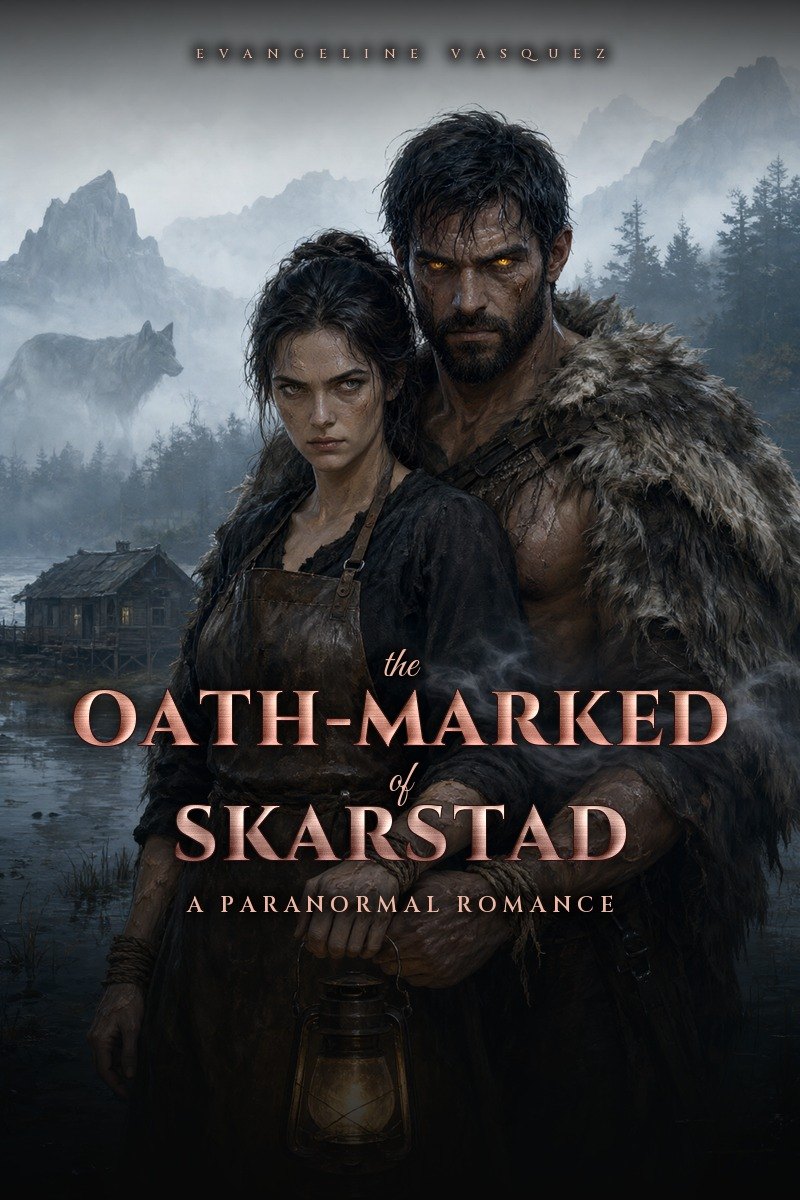
Chapter 7
The dead scout smelled worse than rotten lingcod.
Caustic black grease dripped through the hole in my floorboards, sizzling against the cold seawater twelve feet below the pilings. Where the beast's blood hit raw pine joists, the wood bubbled into green foam. If that rot reached the crossbeams, my entire examination room would drop into the bay before noon.
Could three gallons of slaked lime and saturated copper sulfate neutralize twenty pounds of dissolving border-slag? I had no idea. It was the only alkaline slurry I had left in the wash-house.
"Do not touch the liquid with bare skin," I told Haldor. I dragged a sixty-pound cast-iron wash tub across the sound floorboards with my good shoulder. "The acid eats through wool in four seconds. It will take your dermis down to the periosteum before you feel the heat."
Haldor stood by the woodstove, watching the dark tide swell under the broken floor. He had his right hand wrapped around the hilt of his silver knife. His left arm hung in the splint I had bound against his ribs, the living svart-moss graft sealed under fresh wax linen.
"The hound was a culling scout," Haldor said. His voice was low and gravelly, rough as shale. "A bloodhound bred in the deep rifts behind the High Fells. It was not sent to kill me. It was sent to pin my position."
"Well, it failed," I said. "Now grab the ash shovel with your right hand. Scoop the dry quicklime into this tub before the floor joists snap."
He moved without arguing. He favored his left side, moving with the quiet, predatory economy I had come to expect. His broad shoulders remained tense under the dark wool tunic, but his breathing stayed even. The copper shunt in his brachial artery was holding. I watched the pulse point at his neck with a medic's eye. Steady. No arterial flutter, no leakage darkening the gray linen sleeve.
I dumped half a sack of wood ash into the iron tub. I added three measures of crushed quicklime and tipped a bucket of cold brine over the mixture. The slurry hissed violently, throwing up a cloud of hot white steam that smelled of lye and sulfur.
My eyes watered. I pulled my wool neck-wrap up over my nose.
"Pour the copper sulfate crystals," I ordered. "Slowly."
Haldor uncorked the glass jar with his teeth and tilted the blue crystals into the boiling lime. The slurry turned the color of bruised slate.
"Why copper?" he asked. He kept his eyes on the bubbling mix. "The beasts of Vargund fear silver. Copper is base metal."
"Silver kills them," I said, stirring the thick paste with an iron fire-poker until the slag dissolved into an oily curd. "Copper binds the necrotic residue so it stops eating my foundation. I do not have thirty feet of silver plate to rebuild my floor, Haldor. I have ten pounds of orchard fungicide and four buckets of lime. In Skarstad, we use what does not cost a gold crown."
I scooped a shovel of the gray paste and slapped it over the smoldering joist. The chemical reaction screamed. The black grease seized, hardening into a crust of brittle chalk. The bubbling stopped.
I worked in silence for twenty minutes. I packed every charred edge of the timber, sealing the wood against the damp salt air. Haldor hauled three spare spruce planks from my woodbox with his right arm, sliding them across the breach. His grip was steady. Sweat beaded along his jawline, catching the cold gray light spilling through the eastward window.
The bond pulsed between us then, low and persistent in the marrow of my fingers. It was not pain, but a deep, rhythmic thrum that matched his pulse. My skin prickled beneath my heavy work shirt. It felt like the static electricity that rises off dry wool blankets before a winter storm.
Did he feel it too?
He paused as his fingers brushed mine over the spruce timber. His slate-gray eyes shifted to my face, pupils dilating until the iris was a thin ring of stormcloud gray. A scent rose off him, cutting straight through the stink of lime and burnt bone. Crushed juniper needles and cold river stone.
My mouth went dry.
Mine, a voice murmured in the dark cellar of my skull. It was an instinct I had spent six years trying to starve.
I pulled my hands back and picked up my three-pound iron hammer.
"Hold the plank flush against the stringer," I said, keeping my voice flat. "Do not let it slip while I drive the spikes."
Haldor looked at me for two seconds. He did not smile, but the hard angle of his jaw softened by a fraction of an inch.
"You give orders like a battle-surgeon," he said. He planted his right palm firmly on the raw spruce plank.
"I am a surgeon," I replied, driving a five-inch iron nail through the plank with three clean strikes. "And this is my clinic. If you want to bleed to death on municipal ground, you can walk out to the harbor. If you stay under my roof, you hold the timber where I tell you."
The iron spikes bit deep into the cedar frame. The floor stopped groaning. We had a solid patch over the tide, rough and smelling of wet lime, but strong enough to bear a man's weight.
I set the hammer down on the workbench and wiped my forehead with the back of my sleeve. The cheap tin clock on my medicine shelf ticked steadily. Six-forty in the morning. Outside, the fog over Skarstad was turning the color of skimmed milk as the northern sun tried to break through the overcast.
I took the oilskin bundle from the counter and laid it on the clean pine table.
Inside lay the tracking core we had carved from the scout's pericardium. It looked like an elongated chunk of sea-glass, dark indigo at the center and frosted with silver veins that pulsed with a faint, cold luminescence. Every few seconds, the crystal hummed, sending tiny ripples through the puddle of brine on the tabletop.
"It is calling the other two," Haldor said. He leaned his hip against the table edge, his eyes fixed on the stone. "They are already south of the High Fells. They will track this beacon straight to the salt flats."
"How far?" I asked.
"Ten miles. Perhaps twelve. If they run in wolf form along the timber haul roads, they will reach the outskirts before the fog lifts."
"Then we drown the signal," I said.
I pulled down an earthenware crock from my top shelf. The crock was half-full of heavy leaded glaze I kept for sealing apothecary jars. I dropped the glowing core into the thick gray glaze. The humming muted instantly, the light swallowed by the heavy lead suspension. I pressed a wax-sealed cork into the mouth and bound it tight with tarred twine.
"That will buy us some time," I said. "Now sit down on the cot. Let me see the graft."
Haldor sat without protest. He unfastened his tunic, pulling the rough wool off his broad shoulder.
The skin around the wound was angry and red, but the black frost was completely gone. Over his left brachial artery, the living silver-veined svart-moss had rooted into the flesh, weaving fine emerald-and-silver fibers across the copper tube. It looked strange and alien against his pale, hard skin, but when I pressed two fingers against his radial pulse at the wrist, the beat was strong, regular, and clear.
"No inflammation," I murmured, checking the margins of the incision. "The moss has taken. The copper hasn't thrown a clot."
"The pain is gone," he said. He watched my fingers on his wrist. His skin was warm, far warmer than an ordinary man's. "Only a dull throb remains."
"That throb is the moss feeding on your blood," I said, wrapping a clean strip of boiled linen over the site and pinning it with a brass clasp. "It will keep you alive, but it requires fuel. You will need to eat double rations of salt pork and oats today, or your body will cannibalize its own muscle to feed the plant."
"A fair trade," Haldor said.
I stepped back and washed my scarred hands in a basin of warm vinegar. The burn scars on my palms twitched, tight and pale against my skin. The memory of the broken oath stirred in the pit of my stomach, cold as well-water.
"Tell me what crossed the border, Haldor," I said. I did not look at him; I kept my focus on scrubbing the lime dust from beneath my fingernails. "No more half-truths. No more cryptic warnings about the High Fells. If two more culling wolves are running down the timber line, who is driving them?"
Haldor was quiet for a moment. The only sound in the room was the splash of vinegar in the earthenware basin and the steady drip of the tide receding through the pilings.
"The border fault did not fail by accident, Vigdis," he said at last.
I turned around, drying my hands on a rough hemp towel. "Explain."
"The boundary monoliths at the northern crest were carved three centuries ago," he said, leaning forward. His voice dropped into a dark, deliberate cadence. "They were anchored by blood oaths sworn by the seven clans of Vargund. For three hundred years, those stones held the rift closed. But three nights ago, the Iron Fang warband took the northern pass. They smashed the monoliths with iron sledges. They broke the seals from the inside."
A chill settled behind my ribs. "Why would they break their own border?"
"Because their lands are freezing," Haldor said bluntly. "The deep frost beyond the fells is creeping southward. Their herds are dead. Their timber is rotting under black mold. Their warlord, Jarl Varkon, has gathered five hundred blades at the northern divide. He does not want a treaty. He wants Skarstad."
I stared at him. "Skarstad is a town of four hundred loggers, two sawmills, and a cannery. We have fifty constables armed with wood-axes and rusted shotguns. We have no army. Why would a warlord march on a mudhole in the salt marsh?"
"Because Skarstad sits on the anchor well," Haldor said. He pointed a finger toward the center of town. "The physical rift cannot expand into the lowlands while the foundation stone beneath your town square remains intact. If Varkon takes the square and shatters the foundation stone, the entire border collapses. The fells will swallow this valley. The fog will never lift."
"And Mayor Torstens thinks he can stop this with a forty-eight-hour municipal quarantine," I said, a dry, bitter laugh catching in my throat.
"Torstens is a fool," Haldor said. "He believes if he ignores the wolves, they will stay in the fells. He thinks his town ordinances have power beyond the tree line."
"He is not just a fool," I said, remembering the cold certainty in the mayor's pale eyes when he stood on my doorstep. "He is terrified. Torstens knows the border is fragile. His father was on the council that laid the municipal charter thirty years ago. They buried the truth under logging ledgers and fish quotas because admitting the supernatural exists means admitting we have no defense against it."
"Then you must make them see," Haldor said. He stood up, towering over the small clinic room. His presence filled the cramped space, solid and unyielding. "The scout I killed was only the lead runner. The other two will scout the town perimeter by mid-morning. If Varkon's vanguard arrives before Skarstad prepares its defenses, the slaughter will be over before sunset."
I looked at the lead-sealed crock on my counter. Inside sat the heart of a monster that had tried to tear through my floor.
Could the town be convinced?
I knew how Skarstad worked. If I walked into the tavern and told the loggers that five hundred northern shifters were marching down the fells, they would laugh me out into the mud. If I showed them the lead crock, Torstens would seize it, lock me in the municipal cell for disturbing the peace, and claim I had poisoned a stray sheepdog with sheep-dip.
To break their ignorance, I needed more than words. I needed leverage.
Before I could answer, a heavy, rhythmic clang shattered the morning silence.
CLANG. CLANG. CLANG.
The sound rolled across the gray harbor, deep and brassy. It was the emergency bell atop the Skarstad Municipal Hall.
Seven slow, deliberate strikes.
Haldor's head snapped toward the window, his eyes narrowing into slits. "What is that?"
"The assembly bell," I said. My heart gave a hard, sudden thud against my ribs. "Seven strokes means a mandatory town meeting in the square. Torstens is calling the town together."
"Why now?"
"Because somebody found what was left of that moose by the haul road," I said, walking to the front window and parting the muslin curtains.
Through the salt-filmed glass, I could see the narrow streets of Skarstad coming alive. Men in heavy oiled-wool coats were spilling out of the boarding houses, boots clattering against the wet wooden boardwalks. Constables in yellow oilskin slickers were jogging down toward the waterfront, herding the mill workers toward the town square.
In the center of the crowd walked Mayor Torstens, surrounded by his nephew Karr and three armed bailiffs. Torstens carried a sheaf of municipal notices in his fist, his face pale and drawn tight.
"He is going to declare a total curfew," I said, watching the mayor ascend the courthouse steps. "He will tell the town that a rabid bear came down from the mountains. He will order every man inside their homes by sundown, and he will post guards on the haul roads to keep anyone from looking into the woods."
"If they stay inside their homes, they will be slaughtered in their beds," Haldor said. He stepped up beside me, his shoulder grazing mine. The warmth radiating from his body was a furnace against the morning chill. "You cannot let him lock them in."
"I have no standing with the council," I said softly. "To them, I am just the disgraced healer with burned hands who lives on the tide line."
Haldor looked down at me. For a moment, the lethal warrior from Vargund disappeared, replaced by something ancient and steady.
"You brought me back from the grave with three inches of copper and a handful of moss," he said, his voice dropping into that quiet, gravelly certainty. "You killed a Vargund hound in your kitchen with an iron hammer and a bucket of lime. You have more authority in your scarred hands than that fat bureaucrat has in his entire council chamber."
He reached out with his right hand, his rough thumb lightly brushing the back of my knuckles. A jolt of pure heat flared along my nerve pathways, sweet and sharp as distilled spirits.
"Will you let him bury this town, Vigdis?" he asked.
I looked down at my hands. The old burn scars were ugly, jagged lines carved into my skin by a promise I had failed to keep six years ago. I had spent years hiding in this salt-bleached clinic, patching cuts and setting broken bones, praying that the world would leave me in peace.
Peace was over. The border was coming to Skarstad, whether the town wanted it or not.
I pulled my heavy leather coat from the peg behind the door and jammed my arms into the sleeves. I took my iron bone-mallet from the bench and slipped it into the deep interior pocket, alongside a sealed jar of slaked quicklime.
"No," I said, tying my hair back with a piece of tarred cord. "I will not."
I turned to Haldor, checking the drop-bolt on the clinic's back entrance.
"Stay inside," I ordered him. "Keep your knife ready and watch the floorboards. If the other two hounds sniff out the crock, do not chase them into the marsh. Kill them at the door."
Haldor gave a single, tight nod. "And you?"
I picked up the lead-sealed crock, feeling the cold weight of the tracking core resting inside the clay.
"I am going to the town hall," I said, resting my hand on the front door latch. "It is time to show Torstens what kind of beast is hunting his woods."

Comments
Loading comments…