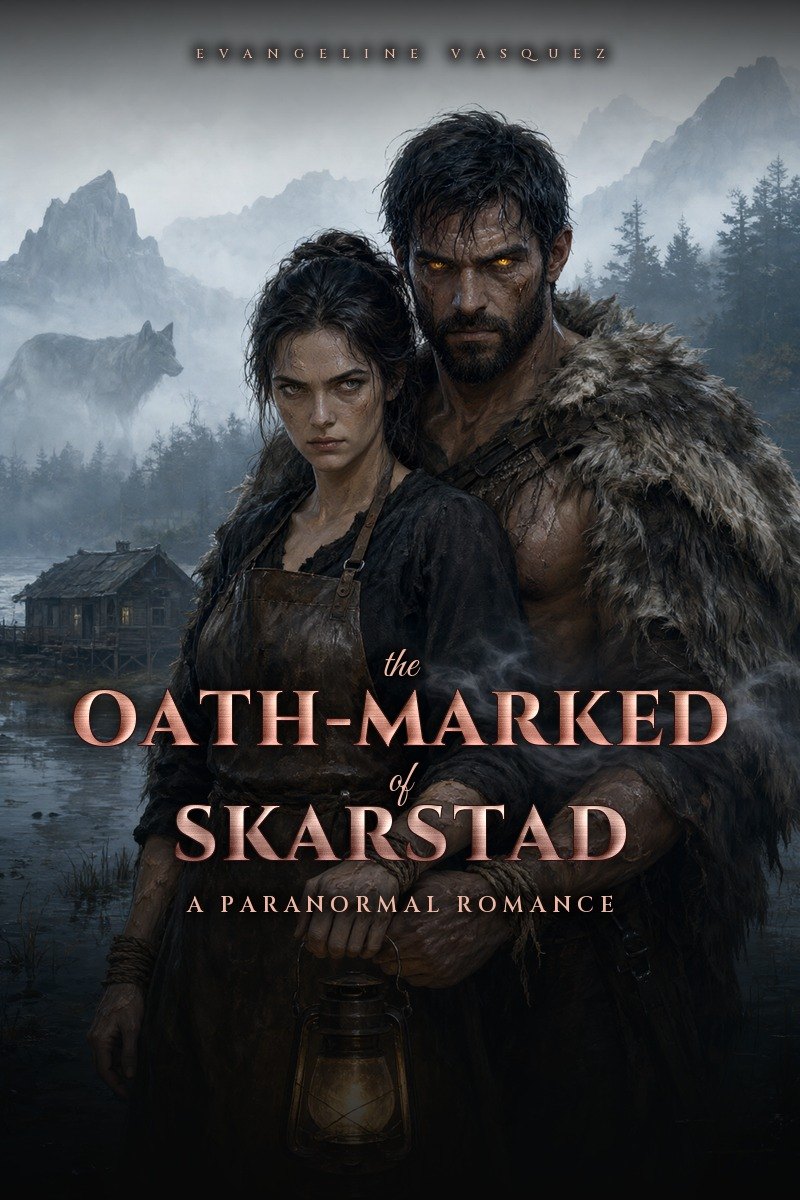
Chapter 8
The Skarstad municipal bell had stopped its seven-stroke toll, but the heavy iron resonance still hung in the salt fog, vibrating against the cedar shingles of the harbor warehouses.
I crossed the square with the lead-glazed earthenware crock tucked firmly under my left arm. The jar of slaked quicklime weighed down my deep outer coat pocket, balanced on the right by the three-pound iron bone-mallet resting against my ribs. My boots sank an inch into the coastal slush with every step. At seven in the morning, the harbor square usually smelled of fried barley cakes, boiled chicory, and the damp cedar shavings blowing from the planer mill. Today, beneath the peat smoke and low-tide kelp, the air carried a sharp, chemical bite. It was the scent of crushed zinc and dead winter drifting down from the High Fells.
The heavy spruce doors of the municipal hall stood propped wide with split hemlock wedges. Yellow lantern light spilled across the threshold, cutting amber wedges through the drifting mist.
Inside, fifty-odd people were packed shoulder to shoulder between the rough pine benches. Loggers from the upper cuts with sap-crusted sleeves, sawyers with pitch-blackened forearms, harbor dockers in stiff oiled canvas coats, and women from the salting sheds had crowded into the hall until the cedar walls groaned under the collective heat of their bodies. The room smelled of wet wool, pipe tobacco, stale tallow, and raw, unspoken dread. Nobody was sitting down.
At the far end of the hall, on the raised timber dais beneath the carved municipal seal, stood Mayor Torstens.
He had dressed for the performance. A dark wool frock coat with polished bone buttons sat stiffly across his sloping shoulders, though he had forgotten to shave the left side of his jaw in his hurry. His ledger lay open on the oak lectern before him—a massive, iron-bound volume filled with timber tax assessments, harbor wharfage rates, and sixty years of municipal records that maintained the quiet fiction of an ordinary coastal logging settlement. His nephew Karr stood two paces behind him, thick arms crossed over a padded leather jerkin, resting both hands on an iron-shod bailiff's cudgel.
"Quiet down, the lot of you," Torstens shouted, slamming his palm onto the open pages of the ledger. "I did not ring the emergency bell so you could bray like gulls in a squall!"
The murmurs died down to a tense, shuffling rumble. Near the third row of benches, Brandur shifted his weight. The logger caught my eye across the crowded room. His left wrist was still wrapped in the clean linen bandage I had sewn the evening before, his broad thumb hooked tightly into his heavy leather work belt. When he saw the gray crock in my arm and the dark stains on my coat, he frowned, glancing toward the open double doors as if calculating the shortest route to the street.
"We have two timber heifers dead in the north pasture," Torstens announced, leaning out over the lectern. His voice had that practiced, rolling cadence he used during harbor lease auctions, smooth and dismissive. "A hay barn on the ridge line had its northern siding kicked in. The tracks in the mud are large, yes. But they are the tracks of a rogue highland timber-wolf pack driven down from the fells by early mountain frost. Nothing more."
A logger with a gray-streaked beard called out from the fifth row. "Wolves don't melt an iron harrow, Torstens! My brother went out to the timber road at dawn. The gravel was frozen black and steaming like battery acid!"
"Your brother is an idiot who drinks grain alcohol before breakfast, Hauk," Torstens snapped without missing a beat. "What he saw was marsh gas venting through frost heave. Every five years we get an early cold snap from the strait, and every five years men start seeing monsters behind the woodpiles."
Torstens paused, adjusting his brass-rimmed spectacles and scanning the assembly with narrow, calculating eyes.
"To ensure public order and prevent unneeded panic," Torstens continued, tapping a freshly inked parchment pinned to the desk, "the town council is enacting an immediate dusk-to-dawn curfew. All logging crews will pull back two miles from the northern haul road until the constable's squad finishes a thorough sweep. In addition, under Section Four of the Skarstad Municipal Health Code, we are placing an immediate quarantine on all isolated dwellings along the tide line."
The room went completely still.
"Starting with the marsh clinic," Torstens added, his gaze locking directly onto me as I stepped past the rear benches into the central aisle. "We have received credible reports of contaminated biological waste and uninspected carcasses being dragged across the mudflats. Constable Karr and four armed men will clear and fumigate the premises by noon."
A dozen heads turned toward the back of the hall. The sawyers nearest to me took a synchronized step back, their eyes dropping from my face to the scarred, burn-callused skin of my right hand. The old stigma never faded in Skarstad: Vigdis the oath-breaker, the disgraced medic who brought bad luck from the fells, the woman whose flesh had blackened when she swore a vow beyond the northern border.
I didn't slow down. My boots hit the scrubbed cedar floorboards with steady, unhurried thuds.
"You won't clear that clinic by noon, Torstens," I said.
My voice carried through the packed hall like an amputation saw through dry linen. The loggers parted ahead of me, pressing their hips hard against the benches to clear the central lane.
Torstens stiffened. His fingers gripped the edges of his oak lectern until the knuckles turned white. "Vigdis. You were not invited to this assembly. You are under municipal quarantine orders."
"Then you had better arrest me yourself," I said, stopping five feet from the foot of the dais. "Because your nephew won't be enough."
Karr shifted his grip on the iron-shod cudgel, his thick jaw jutting forward. He took a heavy half-step down from the platform, his boots thumping on the timber riser. But as he looked me over, his eyes caught the thick iron mallet head protruding from the inner pocket of my coat, followed by the flat, unblinking look in my eyes. The boy was nineteen and thick in the neck, but as he took in the heavy iron mallet in my coat, he looked entirely unsure how to handle a woman who routinely sawed through gangrenous bone without blinking. He hesitated on the bottom step, glancing sideways at his uncle.
"Go back to your marsh, Vigdis," Torstens said, lowering his tone to a sharp hiss. "You have no standing here. You broke your oaths in the northern fells six years ago, and this council took your guild seal. You do not dictate town policy."
"I am not here to dictate policy," I said.
I climbed the three steps of the dais. Torstens pulled his frock coat back as though I carried typhoid.
With deliberate precision, I set the lead-glazed earthenware crock on top of the municipal ledger, directly over the column recording timber wharfage fees. Next to it, I placed the sealed jar of slaked quicklime, followed by the three-pound iron bone-mallet. The iron head struck the oak surface with a dull, resonant crack that echoed through the high cedar rafters.
"You told these men that two heifers were killed by timber-wolves," I said, turning to face the packed rows. "Did the wolves carry silver-hilted hunting knives, Torstens? Did they walk on two legs before they dropped to four in the brush?"
A low rustle of uneasy whispers rippled through the benches.
"What is this nonsense?" Torstens demanded, gesturing frantically at the gray pot. "Karr, get this filth off my desk!"
"Touch that crock without lead tongs, Karr, and you will lose the dermis off your forearms before dinner," I said without looking at the boy.
Karr froze in place, his fingers hovering inches above the pottery.
I reached down and pulled the wax-coated hemp cord from the lip of the jar. With a firm twist of my scarred fingers, I pried the lead seal open.
The ambient temperature on the dais dropped ten degrees in a heartbeat.
The yellow lantern flames in the overhead iron chandeliers dipped instantly, turning a sickly, pale violet. A thin skim of geometric hoarfrost bloomed across the oak lectern, spreading in sharp crystalline fractures across Torstens' open ledger. The black ink on the pages crackled, turning to brittle gray powder that drifted away like ash in the sudden downdraft. From inside the open crock, a low harmonic vibration hummed through the timber floorboards—a rhythmic, pulsing frequency that matched the slow thrum of a predator's resting pulse.
Brandur pushed his way to the front row of benches, his face drained of color. "By the hearth... what is that?"
"That is the resonance marrow of a Vargund culling hound," I said, projecting my voice across the frozen room. "One of three that breached the northern border fault three hours before dawn. It broke into my clinic through the tidal pilings while you were sleeping in your beds."
Torstens slammed his hand down, though his fingers trembled against the frosted oak. "She is using parlor tricks! Saltpeter and chemical smoke! She is trying to incite a riot to cover her own quarantine violations!"
"There are no parlor tricks that freeze seasoned oak at fifty degrees Fahrenheit, Torstens," I replied. "Look at your ledger. The wood is rotting under the frost. That beast was not a stray wolf. It was an advance scout sent ahead of the Iron Fang warband. Jarl Varkon's northern host broke the boundary monoliths along the High Fells. Five hundred warriors are marching south down the haul road. They are not coming for timber heifers. They are coming to shatter the anchor well beneath this square and drown Skarstad in the border tide."
The silence in the municipal hall was suffocating.
Fifty men and women stared at the frosted ledger, then at the pulsing gray crock, and finally at their mayor. The collective denial that had shielded Skarstad for thirty years—the stubborn, comfortable lie that the northern fells were empty wilderness—fractured from floor to rafter.
Torstens opened his mouth to speak, but no sound came out.
A terrible, unnatural howl tore through the morning fog outside.
The sound had nothing in common with a timber wolf. It was a low, mechanical grinding screech, like two iron millstones rubbing together under twenty feet of freezing salt water, layered with the high whine of tearing iron.
The heavy glass panes in the eastern transom windows rattled violently in their lead casings.
"They smell the core," I said, reaching for my iron mallet. "The second scout followed the resonance line straight to the square."
Panic erupted instantly. Two women near the rear benches screamed, shoving toward the main doors. Loggers scrambled over benches, kicking over pine stools as they surged toward the street.
"Bar the doors!" I shouted, my voice cutting through the rising hysteria. "Do not run into the square! If you scatter in the fog, it will butcher you one by one!"
Brandur was the first to move. The big logger seized a heavy cedar bench and rammed it across the left wing of the main double doors, shouting at two sawyers. "You heard the healer! Grab the timber bars! Move, you bastards!"
A deafening crash obliterated the eastern wall of the municipal hall.
Spruce framing and cedar siding exploded inward in a blizzard of splinters and white plaster dust. A massive, gray-furred monstrosity lunged through the breach, its frame twice the size of any highland timber wolf. Its bristling pelt was matted with jagged needles of black ice, and its elongated jaws gaped open to reveal three rows of translucent, serrated fangs dripping with corrosive black saliva. Where its front paws struck the floor, the wood hissed, smoking with immediate chemical rot.
Torstens let out a high, terrified shriek and scrambled backward, tumbling over his chair into the narrow alcove behind the lectern. Karr dropped his iron-shod cudgel with a clatter, his knees buckling as he pressed his spine hard against the plaster wall.
The beast's pale, pupilless eyes locked onto the open crock on the dais. It bunched its massive hindquarters, preparing to vault clean over the benches toward the platform.
I didn't hesitate. I grabbed the jar of slaked quicklime from the lectern, twisted the lid off with a single wrench of my scarred left hand, and leaped down the three steps of the dais.
The hound sprang forward.
I threw the entire contents of the jar directly into the creature's face.
The fine, caustic white powder struck the beast's moist nostrils and wide, unblinking eyes mid-leap. In a split second, the slaked quicklime reacted with the creature's acidic oral fluids, generating a violent, blinding exothermic heat. The beast shrieked—a high, bubbling wail—and crashed onto the central aisle four feet short of the dais, thrashing wildly as the chemical burn ate through its ocular membranes.
"Brandur! The stifle joint!" I shouted, circling wide of the flailing claws. "Keep clear of the jaws!"
The beast whipped its head blindly, its snapping jaws splintering a pine bench to kindling. Corrosive foam spattered across the toe of my leather boot, burning through the outer hide in seconds.
I stepped inside the sweeping arc of its front claws, planting my heels firmly on the cedar boards. Gripping the three-pound iron bone-mallet with both hands, I drove the heavy steel face downward with every ounce of my leverage, striking the creature's left rear stifle joint—the precise anatomical junction where the lateral collateral ligament met the lower femur.
Bone cracked like dry hemlock under the blow.
The hound's rear left leg buckled inward, robbing it of all forward drive. It twisted in fury, its fangs snapping within an inch of my coat, but without its rear leverage, it could not rise.
"Now!" I yelled.
Brandur charged from the side, swinging a heavy double-bitted felling axe with the full, seasoned momentum of a timber cutter. The broad iron blade buried itself three inches deep into the creature's cervical vertebrae, right where the base of the skull met the spine.
Two other sawyers joined him, driving iron pry-bars and heavy timber wedges into the monster's neck.
The hound let out a shuddering, gargling gasp. Its massive frame convulsed once, twice, and then collapsed limp across the central aisle.
Nobody moved.
The only sound left in the ruined hall was the ragged, heaving breath of fifty terrified men and women and the steady, acidic hiss of chemical reaction.
Within five seconds of its death, the beast's outer flesh began to disintegrate. The black frost encrusting its fur liquefied into oily gray steam that rose toward the high rafters. The gray muscle tissue withered, turning to brittle, cinder-like ash, while the bones dissolved into pools of caustic black slush that ate slowly into the timber floorboards.
In less than a minute, all that remained of the massive predator was an eight-foot scorch mark on the municipal floor, a scattering of brittle gray slag, and a second glowing crystalline resonance core resting in a puddle of smoking frost.
Brandur stood leaning heavily on his axe handle, his chest heaving, his face covered in cold sweat. He stared down at the dissolving puddle, then looked up at me.
"That wasn't marsh gas, Vigdis," he whispered.
I lowered the iron mallet, my forearms trembling from the impact. My leather coat was spattered with gray frost and acid burns, but my balance was solid.
"No," I said, wiping the chemical dust from my knuckles. "It wasn't."
I walked back up the steps of the dais. Torstens was still huddled in the corner, clutching his dark frock coat around his chest like an old blanket. His face was entirely devoid of color, his brass spectacles hanging crookedly from his left ear. He stared at the gaping hole in the eastern wall, then at the black scorch mark in the aisle, and finally up at me.
His municipal authority was gone. It had burned away with the quicklime and dissolved into the puddle on his scrubbed cedar floor.
I picked up the lead-glazed crock, fitted the heavy lid back into place, and twisted the lead ring tight to choke off the harmonic beacon. Then I turned to face the room.
The loggers, the sawyers, the dockers, and the shopkeepers were all looking up at the dais. Not at a disgraced oath-breaker, and not at a clinic medic with scarred hands, but at the only person in Skarstad who knew how to kill what was coming out of the fog.
"Torstens' curfew is dead," I told them, my voice cutting through the cold hall. "If you stay in your houses, they will pull your roofs down while you sleep. Brandur, take twelve men to the harbor salt warehouse. We need every bushel of rock salt and slaked quicklime hauled to the northern timber gate by noon."
Brandur didn't hesitate. "Consider it done."
"Hauk," I pointed to the gray-bearded logger. "Get the blacksmiths firing their forges. Silver scrap, copper wire, and cold iron. Melt down whatever old timber fittings you have. Every axe head and spear point needs to be washed in copper sulfate before nightfall."
"Aye, Healer," Hauk called out, turning to rally four of his crew.
"And send a runner to my clinic on the marsh," I added, looking toward the open door where the mist was beginning to burn off under the morning sun. "Tell the outsider to open the armory chests."
I picked up my iron mallet and slipped it back into the deep pocket of my coat.
Mayor Torstens sat shivering against the plastered wall of his ruined dais, his mouth working silently as the last of his sixty-year lie blew out through the shattered eastern wall.
"You can keep your quarantine, Mayor," I told him quietly, stepping past his slumped shoulder toward the broken doorway. "We are going to need the clinic beds."
Outside, the North Sea mist was parting over the harbor, revealing the cold, jagged crests of the High Fells. The town of Skarstad had finally opened its eyes, but the price of seeing was already written in the frost eating through the cedar boards beneath our feet.

Comments
Loading comments…