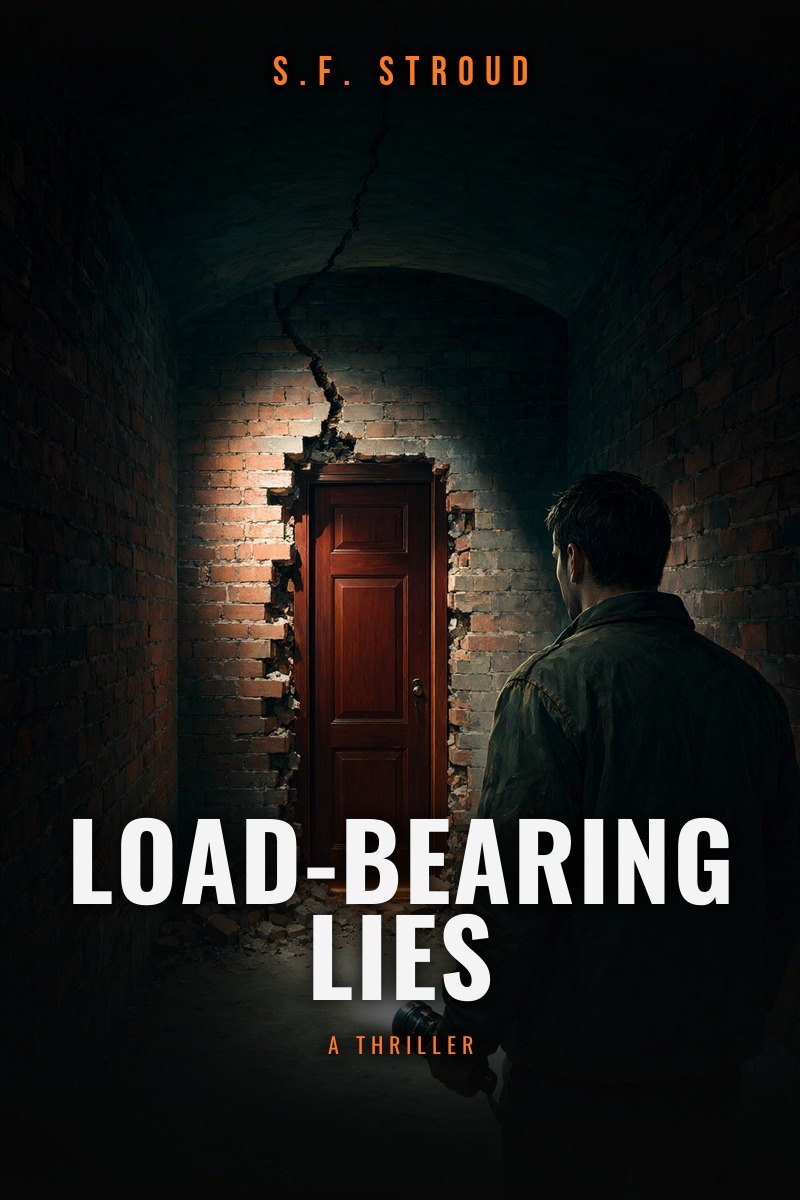
Chapter 13
The iron spiral stair did not rattle under Berkan’s boots until he passed the level of the lower archive vaults, twenty feet below the street pavement. Above that point, the central column was bolted to the masonry drum of the elevator shaft, rigid and cold; below it, where the limestone gave way to the rough shale bedrock of the river terrace, the stringers hung free, swaying a quarter of an inch toward the damp brick wall every time his heel came down on the diamond tread.
He counted forty-two risers from the archive landing before his boots struck the gravel bedding of the sub-cellar. The air here had changed since morning. The sharp scent of vinegar-cured wood glue that clung to the upper restoration floors was gone, replaced by the bitter, alkaline stink of wet lime and the sulfurous oil film that seeped from sixty-year-old machine sumps. In the dark, ten paces ahead, the emergency work lights Baran’s patrolmen had strung along the primary corridor hummed with the flat sixty-cycle vibration of a municipal generator running outside in the alley.
Berkan paused at the bottom riser, reached into his canvas jacket, and drew out the heavy brass skeleton key Baran had taken from Vural Aktanbek’s credenza. It was five inches long, cold against his bare fingers, with three notched bits cut into the barrel and a square guide pin that smelled faintly of gun oil and cedar shavings. He checked his watch by the amber pilot light on his inspection lantern. Eleven minutes remained before the precinct reinforcement van cleared the harbor perimeter checkpoint and backed down the delivery ramp. Once four uniformed officers and an assistant prosecutor stood in the corridor with evidence cartons and tape reels, every door on this level would be sealed under judicial impoundment. An engineer’s survey permit would buy him standing on the structural perimeter, but no prosecutor in the province would allow a demolition contractor to crawl inside an active flue while the chain of custody was being logged.
He walked past the sealed double doors of the primary vault. The municipal evidence tape Baran had slapped across the jambs hung straight and unbroken, the wax seals glossy under the hanging incandescent bulbs. Beyond that wall lay the chamber he had stepped into that morning—the hydraulic press, the forty-inch concrete slabs, the thermal deflection that had bent the floor an inch and an eighth out of plumb over three generations of fraud. But the black morocco register in Vural’s office had not pointed to the primary chamber doors. The spidery violet ink initialed by Perihan Aktanbek two weeks ago had routed Lot 1382—and forty kilograms of refractory combustion flux—to the secondary intake flues behind the eastern foundation revetment.
Berkan turned left into the narrow utility tunnel that ran beneath the Long Wing’s condemned load-bearing piers. Here, the floor dropped another two feet through a raw trench hacked through the shale in the early nineteen-twenties. Steam pipes from the decommissioned central heating system ran along the ceiling like rusted arteries, wrapped in sagging horsehair insulation that wept gray moisture onto the shale floor.
At the far end of the trench, half-concealed behind three stacks of discarded terracotta drain tiles, stood a narrow iron door. It had no handle, no decorative escutcheon, and no threshold marker on the city’s 1928 drainage survey. The frame had been mortared directly into the seam between the 1890 rubble foundation and the smooth, unrecorded firebrick wall that formed the rear jacket of the Közeltay vault. A single square keyhole sat three inches below a heavy slide-bolt that had been pulled home, its sliding bar recently wiped clean and glistening with a thin film of fresh grease.
Berkan set his lantern on a dry chimney tile. He gripped the slide-bolt; the bar glided back smoothly with a muffled metallic snick, offering none of the resistance of abandoned cellar iron. He slipped the brass skeleton key into the keyhole.
Inside the heavy box lock, the levers were oiled and clean, kept in working order for routine deliveries. The brass key turned with a dull, heavy clunk that vibrated through the iron plate into his wrist.
Berkan lifted the iron drop-latch, leaned his shoulder against the cold plate, and pushed.
The door moved inward on quiet bronze pintles, parting a faint scuff of recent boot tracks pressed into the shale dust along the threshold. A puff of air billowed out through the widening seam—not the cold, stagnant damp of an unventilated cellar, but a dry, feverish draft that carried the distinct, stinging bite of calcined refractory flux, bitter wood pitch, and hot iron.
Berkan picked up his lantern, stepped across the raised iron threshold, and pulled the heavy door shut behind him until the latch clicked into the keeper. He did not throw the bolt from the inside; if the masonry above settled while he was down here, an unthrown latch was the only thing standing between him and a locked tomb.
He raised the lantern beam.
The space was not a storage room. It was a narrow, low-ceilinged plenum chamber, barely four feet wide and six feet high, running eighty feet along the hidden perimeter of the Közeltay vault. The floor beneath his boots was not shale or gravel, but a continuous bed of vitrified firebrick laid in herringbone courses, dusted with an unbroken layer of fine, dark gray powder that swirled in the draft of his movement like soot over an open hearth.
To his right rose the inner wall—the blind structural envelope of the chamber itself. Up close, without the plaster facing that hid the exterior corridor, the masonry told a violent structural history. The lower six courses were heavy granite blocks, laid with lime mortar in the late nineteenth century. But twelve inches above the floor, the granite ended abruptly in a ragged shear line, replaced by dense, yellow refractory brick stamped with the maker’s mark of an industrial iron foundry that had closed in 1941. Above that, another repair layer began: two feet of dark basalt brick bound with modern aluminous mortar, bearing fresh, chalky salt efflorescence where intense heat had driven water out of the masonry core within the past month.
Berkan ran his gloved hand along the seam between the yellow refractory brick and the basalt repair. The mortar here was crumbly, brittle as dry biscuit. In three separate places, the vertical joints had widened into hairline stress cracks that ran upward into the barrel vault of the ceiling.
Municipal boiler inspectors would have condemned this entire cellar seventy years ago on masonry clearances alone, long before anyone read the fine print about Dutch masters and forged provenance. A municipal code officer would have pulled the building’s occupancy certificate on the spot: an unvented combustion plenum sharing a structural bearing wall with a public gallery overhead was an invitation to a flue fire that would bring down the entire east wing in twenty minutes. Yet the Aktanbek family had kept it hidden, braced, and burning for three generations.
He moved methodically down the herringbone floor, keeping his boots near the outer foundation wall where the bedrock provided solid footing. Every few paces, he directed the lantern beam toward the floor to check the ash.
The soot here was not uniform. Near the entrance, it was soft, dark, and greasy—the residue of bituminous coal or heavy oil used to preheat the draft. But twenty feet in, where the plenum narrowed between two massive brick buttresses, the soot shifted in color and texture. It became pale gray, fine as powdered bone, with a sharp, vinegar-like chemical odor that caught in the back of his throat.
Wood ash. But not the soft, flaky ash of an ordinary hearth. This was the dense, calcined residue produced when dense hardwood is starved of oxygen under high static pressure, its volatile resins baked out and driven through the flue until only pure carbon and mineral slag remained.
Above his head, a network of heavy iron ducts dropped from the ceiling, converging into three vertical masonry shafts built into the foundation piers. The dampers were closed, their brass counterweights locked into place with rusted wing nuts.
Berkan paused beneath the middle shaft. He took off his leather work glove, wet the tip of his forefinger, and held it near the seam of the iron damper.
A distinct, upward suction pulled at the moisture on his skin.
The draft was still live. Even with the primary press idle and Rustem Sungurbek locked in a holding cell five miles north, the natural thermal chimney created by the four-story rise of Ozentay House’s abandoned service flues was still drawing air through the plenum. The draft was pulling cold cellar air across the floor, through the seams in the firebrick, and up toward the roofline.
He followed the draft line to the base of the central masonry pier.
There, set flush into the yellow refractory brick six inches above the herringbone floor, was an iron cleanout door. It was two feet square, secured by two heavy dog-bolts with square forged heads, their threads caked in dark graphite paste to keep the extreme heat from seizing the iron. Above the door, a steel inspection plate was riveted to the brickwork, stamped with a serial number and a single hand-stamped inscription: KÖZELTAY II — 1956.
The 1956 Ruisdael pour. The date Harun Aktanbek had condemned one hundred and twenty board feet of Flemish paneling to pour six inches of basalt across the failing foundation.
Berkan knelt on the soot-covered bricks. He unslung his tool roll from his shoulder, laid it out on the dry floor, and selected an eight-inch adjustable spanner and his thin-bladed masonry scraper.
He did not immediately fit the spanner to the dog-bolts. The masonry arch directly above the cleanout door carried thirty tons of vertical load from the pier above. If the mortar around the iron frame had degraded under recent thermal stress, the shock of loosening a seized bolt could pop the lintel brick out of alignment and bring three courses of yellow firebrick crashing down into his lap.
He took his brass hammer and tapped the brick arch above the lintel, moving from left to right.
Clink. Clink. Clunk. Clink.
The third brick from the left gave back a dull, hollow resonance—a sign that the bed mortar behind it had turned to sand. But the key brick at the center of the arch rang true and solid, held in place by the lateral compression of the adjacent masonry. The arch would hold, provided he did not torque the frame sideways.
Berkan braced the heel of his left hand against the cast-iron frame to absorb the shear force, fitted the spanner over the top dog-bolt, and applied steady, downward pressure with his right arm.
The square bolt groaned, shed a crust of baked graphite and red rust, and backed off a quarter-turn.
He worked the bolt half a turn, reversed it an eighth of a turn to clear the threads, and repeated the motion until the dog swung free on its hinge pin. The lower bolt yielded more easily; the threads were still damp with fresh, dark lubricating grease that had not yet fully charred—proof that someone had opened this hatch within the last two weeks.
Berkan eased the second dog aside. He hooked his fingers into the recessed iron handle and drew the cleanout door forward.
The door swung open with a dull, heavy scrape. A wave of stagnant, concentrated heat rolled out of the dark cavity behind it, carrying an odor so intensely bitter it made his eyes water behind his protective goggles. It was the smell of ancient timber subjected to hundreds of degrees of contained radiant heat—parched tannin, scorched linseed oil, and the sharp, chemical reek of industrial refractory flux.
Berkan adjusted his headlamp, focused the narrow beam, and shone it into the belly of the cleanout hopper.
The hopper was a cast-iron chute two feet deep, sloping down from the combustion floor of the hidden press above into a heavy collection tray. It was nearly full. A mound of dark, irregular debris lay banked against the back lip of the iron tray, sloping forward toward the cleanout lip.
It did not look like coal ash. It did not look like furnace clinker.
Berkan reached into his kit, pulled out a pair of long-handled assayer’s forceps and a clean tin sample container, and leaned in closer.
The top layer of the pile consisted of charred, splintered fragments of wood, each piece no larger than a man’s thumb. But these were not raw firewood offcuts. Through the coating of black soot, Berkan could see the precise, geometric tool marks of eighteenth-century joinery: the crisp ninety-degree bevel of a picture-frame rebate, the hollow cove of an ogee molding, and the delicate, hand-planed sweep of an antique panel tongue.
He touched one of the splinters with the tip of the forceps. The wood was brittle, carbonized throughout, but the cellular structure remained intact. Even without Nergiz Solaktay’s comparison microscope, the coarse, open pore ring of European oak was unmistakable along the fractured edge.
This was the physical residue of the missing mass.
This was where the four metric tons had gone. The antique panels and walnut stalls hadn’t simply been planed into veneer backing; the portions that could not be used, or the donor boards that had cracked under the eighty-atmosphere clamping pressure of the press, were dropped down the secondary intake flues to serve as high-heat carbon fuel, bathing the chamber in authentic period combustion gases while driving out every trace of modern moisture from the new substrate.
Berkan used the forceps to lift a three-inch section of charred molding and set it gently into his sample tin. As he lifted it, the splinter parted along its growth rings, revealing a core of vitrified, glass-like resin that had melted and recrystallized in the intense heat.
He shifted the lantern beam deeper into the chute, where the ash gave way to heavier, darker clumps banked against the refractory throat.
Down in the corner of the collection tray, half-buried under a crust of gray wood ash, sat a dense, irregularly shaped lump the size of a fist. It had the dark, pitted surface of iron slag, but where the raking light of his lantern caught the edge, a thin rim of vitrified glass gleamed with an unnatural, greenish-black sheen.
Berkan reached in with the scraper, slipped the flat steel blade beneath the lump, and worked it free from the iron floor of the tray.
It was unexpectedly heavy—far denser than any piece of carbonized oak or walnut. It weighed at least three pounds, cold and solid in his gloved palm as he brought it out into the lantern light.
He set the lump on his clean canvas tool roll, took a stiff brass-bristle brush, and gently cleared away the loose soot clinging to the surface.
The outer layer was composed of calcined wood cells—the unmistakable tracheid lattice of ancient oak, charred black and fused into a glassy matrix by intense heat. But the wood had not melted on its own. It had fused directly to the surface of something else.
Beneath the crust of burned timber, a jagged piece of dark, machined metal protruded from the slag.
Berkan leaned down, holding the lantern six inches from the specimen.
It was not eighteenth-century wrought iron. It had no hand-forged hammer marks, no fibrous slag inclusions, and no wrought-iron grain. The edges were clean, die-stamped, and razor-sharp, bent at a precise forty-five-degree angle where extreme mechanical force had sheared it from a larger assembly before the heat took hold.
Along the flat upper flange of the metal, protected from the direct flames by the fused crust of oak, a row of tiny, machine-stamped letters stood out in high relief:
CR-V 42CrMo4 — HT-SPEC 2021
Chrome-vanadium alloy steel. An industrial, high-tensile structural mounting bracket, manufactured to high-temperature specifications within the last three years.
Berkan felt the stillness of the cellar settle heavily around him.
The Közeltay chamber had not merely been consuming antique donor art to transfer chemical age onto new paintings. In its final, desperate weeks, as the seventy-year-old seals failed and the foundation sagged beneath the Long Wing, someone had driven the combustion temperatures beyond anything the original 1924 Austro-Hungarian design was built to withstand. To brace the degrading press and force the failing hydraulic seals to hold, they had installed modern, high-spec industrial alloy fittings directly into the combustion throat.
And the intense heat of the recent burns had melted the modern hardware, fusing it into the very slag of the centuries-old oak it was supposed to compress.
From the far end of the utility plenum, through the closed iron door and the eighty feet of dark trench, a faint, metallic vibration traveled through the bedrock beneath his knees.
It was not the generator above. It was the heavy, rhythmic thud of solid steel boots descending the iron service stairs, one slow, deliberate riser at a time.
Baran’s precinct reinforcements were still less than two minutes away. The footsteps on the spiral stair were not moving with the hurried scramble of police patrolmen carrying evidence cartons; they were measured, unhurried, and heavy, pausing on the landing above as an iron latch clicked open in the dark.
Berkan did not reach for his spanner. He did not call out into the tunnel.
He picked up the heavy lump of fused slag, wrapped it securely in a clean shop cloth, and slid it deep into the reinforced interior pocket of his canvas jacket. He zipped the pocket shut, closed the iron cleanout door, and swung the top dog-bolt back over the keeper, leaving the threads finger-tight so no metallic clink would carry through the masonry throat.
He stood up, extinguished his headlamp, and dropped the lantern to its lowest pilot wick, letting the shadows of the yellow firebrick vault swallow him whole as the distant iron door of the sub-cellar creaked open against the shale.

Comments
Loading comments…