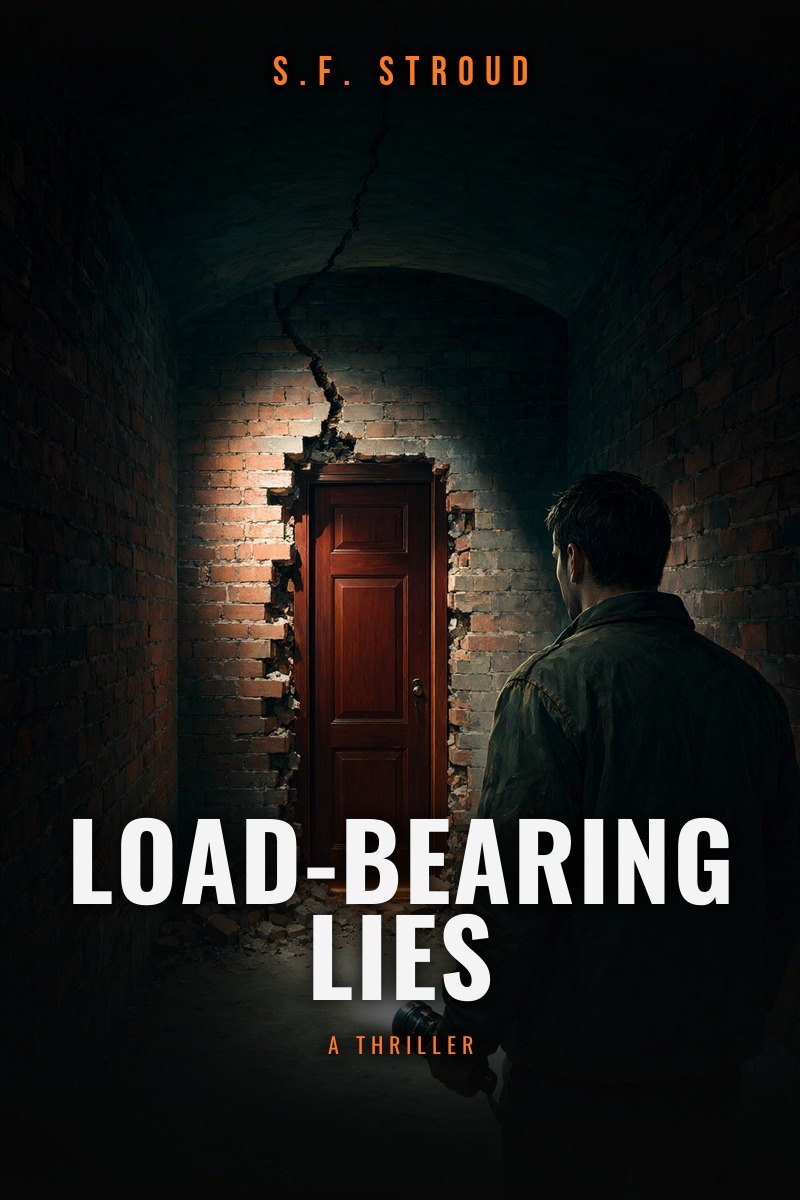
Chapter 14
The sound of iron scraping against stone in a cellar that should have been empty had an exact acoustic frequency. It was low, hollow, and amplified by the forty-foot chimney draft running through the flue above Berkan's head. Whoever had turned the key in the sub-cellar access hatch upstairs was not an inspector checking a meter, nor were they an archivist hunting for misplaced vellum. An archivist dragged their heels, caught the hem of their wool slacks on the door sill, and fumbled with the switch plates. These footsteps came down the riser with the rhythmic, ball-of-the-foot cadence of a man who knew precisely how much noise his soles made against damp sandstone, and who carried his weight balanced across his hips to keep his hands free.
Berkan did not move from the shadows beneath the 1956 brick arch. The pilot wick of his carbide lantern was dialed down to a yellow pinpoint no larger than a match head, shielded behind the rolled cuff of his work glove. The lump of vitrified slag—three pounds of antique oak fused to a modern 2021 alloy bracket—sat hard and cold against his lower ribs inside the zippered breast pocket of his duck canvas jacket.
Thirty feet down the crawlway, where the utility plenum opened into the wider shale excavation, the iron door creaked back on dry pintles. A circle of harsh white halogen cut through the hanging dust. The beam did not swing wildly. It moved in deliberate horizontal sweeps, checking the corners first, then the floor where fresh mortar crumbles might have betrayed a passage, and finally the row of secondary cleanout doors set into the yellow firebrick footing.
The man holding the torch stepped into the vault.
He was broad-shouldered and thick through the chest, wearing an oil-stained quilted vest over a heavy gray work shirt, with heavy leather riggers' gauntlets tucked through his belt. In his right hand he carried a twenty-inch hexagonal alignment bar—drop-forged steel with a tapered pry point at one end and a chisel blade at the other. It was the sort of tool ironworkers used to drift bolt holes in structural frames, but down here, where no crane would ever reach, it served as an efficient, silent breaker of things.
The face belonged neither to the executive suites on the third floor nor to the conservation benches where Esen Baturhan had spent her life. Berkan had logged the man twice during preliminary site surveys: once smoking beside the hydraulic lift in the delivery bay behind the north carriage gate, and once unloading unmarked chemical drums from a flatbed under the personal supervision of Perihan Aktanbek's chauffeur.
His name was Cevdet Narbek. On the House payroll, if Ilkay's cross-referenced facility records were accurate, he was listed as an auxiliary plant mechanic. On the ground, he was the man who moved the things the curators were not permitted to log.
Cevdet paused three paces past the iron threshold. His boots were heavy composite work boots, double-soled and steel-capped. He raised the halogen torch toward the ceiling, tracing the path of the live flue where the hot updraft hissed against the dampers. Then his light dropped to the cleanout hopper Berkan had just closed.
The fresh brass scrape on the cleanout dog-bolt caught the beam. A thumb-sized flake of black soot lay on the flagstones beneath the tray, dislodged less than three minutes ago.
Cevdet did not shout. He shifted the alignment bar to his left palm, reached into the pocket of his vest with his right, and brought out a brass-jawed padlock and a heavy steel hasp. Judging by the hasp, he intended to seal the hopper permanently, drive wedges through the latch, and ensure no further survey would ever scrape the slag from the firebox.
Then he stopped. His head tilted toward the darkness beneath the low arch.
"You're making a lot of draft back there, Kayabek," Cevdet said.
His voice was flat, carrying the gravelly rasp of someone who had spent thirty years breathing coal dust and industrial flux. He did not ask if anyone was there. He did not raise the flashlight to his eyes. He leveled the beam straight down the center line of the crawlway, letting the spill illuminate the crumbling mortar joints and the temporary shoring posts that held the center of the vault.
Berkan did not step back. Retreating in a collapsed tunnel was an amateur's reflex; it put distance between you and the threat while robbing you of sightlines, turning every loose header into a blind fall. Instead, he reached out with his left hand, picked up his eight-pound engineer hammer from the timber cribbing where he had rested it, and slid his four-inch cold chisel into his right fingers.
He stepped out from behind the return of the yellow firebrick pier, emerging into the perimeter of the halogen glow.
"You're stepping on unrated shale, Narbek," Berkan said, his tone as conversational as if they were discussing rebar spacing on an open jobsite. "The municipal permit posted at the north gate restricts this section to licensed structural engineers and sworn officers of the department. Your name isn't on the schedule."
Cevdet let out a dry, rattling cough that ended in a chuckle without warmth. He did not turn around to look at the open iron door behind him. He planted his boots wider on the uneven floor, his weight settling with the deliberate calm of a man accustomed to dealing with contractors who asked too many questions.
"The municipal permit belongs to Vural," Cevdet said, rolling the alignment bar across the calluses of his knuckles. "Vural is currently having coffee with a police detective who thinks ledgers can bring down a building. Upstairs is for people who sign papers. Down here is Aktanbek property. Has been since your grandfather was laying brick in the canal ward."
"My grandfather laid lime mortar that stayed where he put it," Berkan replied mildly. "He didn't need to prop his arches with hydraulic jacks from an auto repair shop."
Cevdet took half a step forward. The steel cap of his right boot crunched into a pile of spalled refractory brick. The sound was sharp, brittle, and immediately followed by a dull, hollow ping from the iron column five feet to his left.
Berkan raised the chisel, pointing the ground carbon-steel tip not at Cevdet's chest, but directly at the ceiling joint three inches above the man's head.
"Don't take the second step," Berkan said.
Cevdet smiled thinly, his eyes narrowing in the glare of the torch. "You think you're going to stick me with a cold chisel from eight yards away, builder? I've seen three dozen of you come through these foundations over thirty years. You carry clipboards, you measure the settling, you write a report that says the ground is damp, and then you take your check and go buy lumber. You don't have the stomach for what happens when the work gets dirty."
"I don't need to stick you," Berkan said. He wedged the hardened blade of his cold chisel deep into a live mortar fissure running behind the arch footing. With a single sideways press of his palm, he levered the crack open a hairline fraction, letting dry lime dust trickle onto the shale. "I'm looking at your boots. Double-density soles. Steel toes. Steel shanks. You're carrying roughly two hundred and ten pounds of bone and muscle, plus another fifteen pounds of steel bar and dead weight in that vest. When you stepped on that spall, the floor beneath your right heel deflected three-sixteenths of an inch."
Cevdet didn't move, but the smug ease around his mouth hardened slightly. "The floor is bedrock."
"The floor is unsupported shale that was undercut in the autumn of 1956 to make room for the intake draft," Berkan corrected him, his voice level and steady. "Look at the column next to your left elbow. That's a four-inch cast-iron pipe. It was salvaged from the old carriage house water main sixty-eight years ago. Cast iron doesn't bend, Narbek. It holds its load until its crystalline structure shears, and then it explodes into four pieces like an artillery shell. Notice the white chalk marks on the collar?"
Cevdet's gaze flicked sideways for a fraction of a second. The white lines Berkan had drawn forty minutes earlier ran across the flange in three diagonal bands, intersecting a hairline fracture that wept a faint trickle of red rust.
"That crack runs through forty percent of the diameter," Berkan continued, stepping forward half a pace, his boots setting down silently on the solid footing of the pier foundation. "Right now, that post is carrying nine tons of dead weight from the Long Wing's third-floor archive. It's under pure compressive stress. But the moment you walk past that yellow brick header, you step onto the cantilevered edge of the slab. Your weight transfers horizontally through the timber cribbing directly into the side of that pipe. That's eccentric loading. That iron pipe wasn't designed for shear. If you put twenty foot-pounds of lateral torque on that flange, it shears off clean at the base."
Cevdet shifted his grip on the alignment bar, but his boots remained frozen to the shale. "You're full of talk, Kayabek. If that arch goes, you're under it too."
"That's where the difference in our trades comes in," Berkan said, allowing himself a faint, humorless smile. "I'm standing behind the thrust line of the 1924 keystone. The arch above my head was turned in hydraulic lime and bonded into the bedrock of the north wall. If that post goes, this vault sheds load to the left. The thirty tons of rubble, flue soot, and century-old brick in the middle drops straight down into the intake trench—exactly where you're standing. I get an earful of dust and a ruined pair of overalls. You get buried under six feet of slag and unreinforced masonry before you can get that pry bar up to your chin."
The air between them went completely still, save for the dry, rhythmic hiss of the chimney flue above.
A single crumb of dried mortar loosened from the ceiling joint between them, falling through the beam of the halogen torch and striking Cevdet's shoulder with a dry click. The man did not flinch, but his eyes tracked the dust motes as they swirled in the draft.
"You're bluffing," Cevdet muttered, though the volume had dropped out of his chest.
"Try it," Berkan said calmly. "Put your weight on your left heel and lean two inches toward the pipe. Let's see how much safety factor Harun Aktanbek budgeted for when he bought scrap pipe in the fifties. I've been bringing down buildings since I was twenty-two, Narbek. I know what sixty tons of masonry sounds like half a second before it lets go. It starts with a creak like green wood breaking under ice, and then there's no running. The air in this plenum will compress so fast it'll blow the ear drums out of your skull before the bricks even touch you."
Cevdet stood motionless for three long breaths. His heavy fingers tightened around the hexagonal bar until the tendons stood out against his dark skin. He looked at the cracked iron collar, then at the chalk marks Berkan had scored across the flange, and finally at Berkan's eyes.
There was no weapon in Berkan's posture. He wasn't squared up for a fistfight. He stood with the relaxed, heavy balance of an engineer waiting for a concrete pour to cure, his hammer resting lightly against his thigh, his cold chisel held loosely in his callused fingers like a pencil. It was the absolute lack of panic that did the work. A man bluffing a collapse looked around for an exit; a man calculating shear stress kept his eyes on the fracture.
"You think you're clever," Cevdet said, his teeth showing in a tight, bitter grimace. "You think because you pulled Rustem out of his office, you've solved something. Rustem was a salesman. He sold whatever was put in front of him and took his four percent. He didn't know how the fires were lit, and he didn't care where the wood came from as long as the buyer's bank transferred the funds to Zurich."
"I know where the wood came from," Berkan said. "Lot 748. Baltic oak. Lot 1402. Antique oak panel. And the Dalmatian walnut choir stalls. Three generations of minor deaccessions, chopped up and burned in this trench so Demir and Harun could sell Dutch masters to private collectors who were too proud to ask for the bill of lading."
Cevdet let out a short, harsh bark of laughter. "That's history, builder. That's old paper. You think a hundred-year-old receipt matters to anyone who matters in this town? You think a judge is going to put the Aktanbek family in an iron cell because of a timber chopped up before your father had his first pair of shoes?"
"The modern flux matters," Berkan said, tapping the breast pocket of his jacket with the knuckle of his left thumb. The dull clink of the heavy alloy against the canvas was distinct. "The chrome-vanadium brackets stamped 2021 matter. The four metric tons of missing art that never left this basement matters."
Cevdet's laughter died instantly. His face went rigid, the halogen light catching the deep lines around his mouth and the dark, wary glint in his eyes.
"You've been in the ash hopper," Cevdet said, his voice dropping to a low, dangerous murmur.
"The hopper is cast iron," Berkan replied. "The dog-bolts were loose. Whoever tightened them after the last burn didn't know how to seat a thread. Probably someone who uses an alignment bar instead of a torque wrench."
Cevdet took a slow, deliberate breath. He did not advance, but his shoulders squared, the alignment bar lowering by an inch. "You should have stayed on the demo site, Kayabek. Tearing down the Long Wing would have made you a rich man. Perihan had three other contracts lined up for you in the west province. Real estates. Sound foundations. Work that would have kept your crew fed for five years."
"I don't take contracts from people who stage roof collapses to murder conservators," Berkan said.
"Esen was a fool," Cevdet spat, though there was no heat in the insult, only the tired contempt of an operator who viewed conscience as a mechanical failure. "She wanted to put a microscope on everything. She thought the world was built on truth. Nothing in this city is built on truth. You put a million dollars on a wall, and everybody in the room agrees it's real because if it isn't real, their portfolios are worth twenty cents on the dollar. The House didn't invent that. The House just kept the gears oiled."
"And what happens when the gears eat the machine?" Berkan asked. "You're burning refractory flux at eleven hundred degrees down here. That's three hundred degrees hotter than yellow firebrick is rated for. The foundation is spalling. The shale is cracking under the thrust line. In six months, this whole east quadrant will settle two inches into the sewer line. You can't keep this chamber running without bringing the roof down on your own heads."
"We don't need six months," Cevdet said.
The words dropped between them with the heavy finality of dropped lead.
Berkan kept his face entirely still, but his grip on the cold chisel tightened by a fraction of an ounce. "You're running another burn."
Cevdet didn't answer with words. A cold, ugly smirk broke across his battered features. He took half a pace backward—moving his right boot with extreme, painstaking care, avoiding the pile of loose spalls and keeping his center of gravity well clear of the cracked cast-iron post.
"You think you've cornered Vural," Cevdet said, his voice dropping into a dry rasp that barely carried above the draft. "Vural is an ornament. A brass knocker on a mahogany door. My people don't take orders from Vural, and they don't answer to the precinct detectives sitting in his leather chairs."
"Who do they answer to?"
"To the people who pay for the heat," Cevdet said. He took another step back toward the open iron doorway, his eyes never leaving Berkan's hands. "You hold onto your little piece of slag, builder. Show it to your detective. Show it to the woman in the laboratory with her fancy lasers. Write your structural survey. File your safety citations. None of it means a damn thing."
He reached the threshold of the sub-cellar door. The heavy iron frame stood open behind him, the cool air of the lower tunnels swirling around his legs.
"Why doesn't it mean a thing, Cevdet?" Berkan asked, keeping his voice quiet and even.
Cevdet paused on the iron sill. His hand caught the heavy latch of the plate door.
"Because the truck is already on the road," Cevdet said. The smirk vanished, replaced by a flat, dead certainty that chilled the plenum more than the damp shale ever could. "The Thursday shipment isn't antique scrap from an estate sale, Kayabek. It isn't scrap wood from a church choir or a moldy panel from a canal house. It's live stock. High-grade. The kind of piece people don't sell unless someone makes them an offer they can't refuse. By the time your police get their search warrants stamped by a magistrate, the burn will be cold, the panel will have forty years of verified patina, and the House will have certified another miracle."
He didn't wait for Berkan to answer.
Cevdet pulled the heavy plate door shut with a single, violent heave. The iron slammed into its rebate with a deafening, booming crash that sent shockwaves rippling through the narrow confines of the utility plenum.
Above Berkan's head, the cracked masonry arch shuddered.
A shower of dry, lime-rich mortar rained down into the darkness, pattering against the shoulders of Berkan's canvas coat like dry gravel. The cast-iron pipe let out a sharp, metallic groan—a tortured screech of stressed crystal that vibrated through the shale floor beneath his boots.
Berkan did not run. He did not duck. He braced his back against the solid bedrock pier of the 1924 foundation, kept his boots planted squarely across the load-bearing shale, and watched the chalk marks on the iron collar.
The crack opened by the width of a fingernail, weeping another puff of rust dust into the air. The screw jack settled a sixteenth of an inch into its wooden cribbing.
Then the motion stopped.
The load path found its new equilibrium. The ancient lime mortar in the outer ring of the vault held. The high-pitched ping subsided into the low, hollow rush of the chimney draft.
Silence returned to the sub-basement—heavy, suffocating, and thick with the smell of sulfur and centuries of pulverized brick.
Berkan stood motionless in the gloom for three full minutes, listening to the house above him. No further footsteps sounded on the iron risers. No shouts echoed down the intake flue. Through the soles of his boots, he could feel the faint, rhythmic thrum of the city above: the distant rumble of evening delivery trucks on the boulevard, the hum of the electric subway four blocks west, the quiet respiration of a massive stone institution settling under its own immense, unyielding weight.
Slowly, with the methodical economy of a man who treated every tool with respect, Berkan wiped the tip of his cold chisel against the leg of his canvas trousers and slipped it into the leather sheath on his belt. He picked up his engineer hammer, checked the hickory handle for fresh stress cracks, and returned it to its loop.
He reached inside the breast pocket of his jacket. His callused fingers closed over the heavy, jagged contours of the vitrified slag. The chrome-vanadium bracket was cold now, its sharp edges pressing firmly through the shop cloth into his palm. It was real. It was physical. It was proof that the machine in the sub-cellar was not a forgotten relic of founder Demir Aktanbek's ambition, but an active, ravenous beast that was being fed modern steel and fresh materials to keep its appetite alive.
The warning stayed in the cold draft of the vault: the truck was already on the road.
Berkan looked down at his watch. The luminous hands on the dial showed twenty minutes past six in the evening.
It was Tuesday.
That left less than forty-eight hours before Thursday's delivery reached the loading bay.
He dialed the pilot wick of his carbide lantern back up to a working flame, bathing the arched brickwork in warm, amber light. He surveyed the narrow crawlway one last time, noting the fresh cracks, the displaced shale, and the dark mouth of the ash hopper where the remains of four metric tons of destroyed art had settled into gray dust.
There was no way out through the sub-cellar door; Cevdet had undoubtedly thrown the external dog-bolts and wedged the keeper from the other side. But the original 1924 mechanical elevation blueprints showed the old gravity air intake running straight into the coal cellar beneath the east stable court.
He squeezed past the shoring posts, keeping his shoulders low and his balance centered away from the compromised iron pipe. At the far end of the plenum, half-hidden behind a fallen curtain of corroded sheet metal, the heavy iron louvers of the lower ventilation runway stood ajar. The intake duct was three feet square, lined with rough-hewn basalt and choked with fifty years of dead leaves and coal grit, but the draft blowing through it was clean and cold, carrying the sharp scent of autumn rain.
Berkan hoisted himself into the duct. He crawled through the narrow passage on elbows and knees, the heavy lump of slag in his pocket bumping rhythmically against his chest. Ten yards down the incline, the duct terminated in a heavy cast-iron grating set into the lightwell of the service alley behind the carriage gate.
He braced his boots against the basalt walls, set the heel of his palm against the iron grating, and shoved upward with the slow, controlled power of his legs. The rusted hinges gave way with a muffled snap.
Berkan climbed out into the alley.
The rain was falling in a steady, cold drizzle, slicking the cobbles and washing the soot from his bare hands. Across the narrow lane, the brick walls of the delivery court loomed dark and silent. High above, on the third floor of Ozentay House, the tall sash windows of Vural Aktanbek's executive office were brightly illuminated, casting sharp rectangles of yellow light onto the wet asphalt. Inside, two figures were silhouetted against the linen shades: Detective Baran Kocatay, standing rigid and upright with a notebook in his hand, and Vural, slumped forward over his mahogany desk with his head buried in his hands.
Berkan pulled the collar of his canvas jacket tight against his neck to keep the rain from running down his throat. He did not head toward the main entrance. He did not call out to the uniform standing watch at the carriage gate.
He turned his back on the glowing windows of the executive suite, walked out through the iron gates into the wet boulevard, and flagged down a passing yellow cab.
"Where to, pal?" the driver asked, glancing into the rearview mirror at Berkan's soot-streaked face and work clothes.
"Third and Merdiven," Berkan said, his voice flat and unhurried as he settled into the vinyl seat. "Dr. Solaktay's residence."
He rested his arm against the cab door, his hand buried deep inside his jacket pocket, his fingers locked around the fused slag. The clock on the dashboard read 6:28. The meter clicked forward with a dull, mechanical tick, counting down the miles while the rain beat against the glass, and through the wet city streets, the invisible load of Thursday's shipment drew one hour closer to the fires.

Comments
Loading comments…