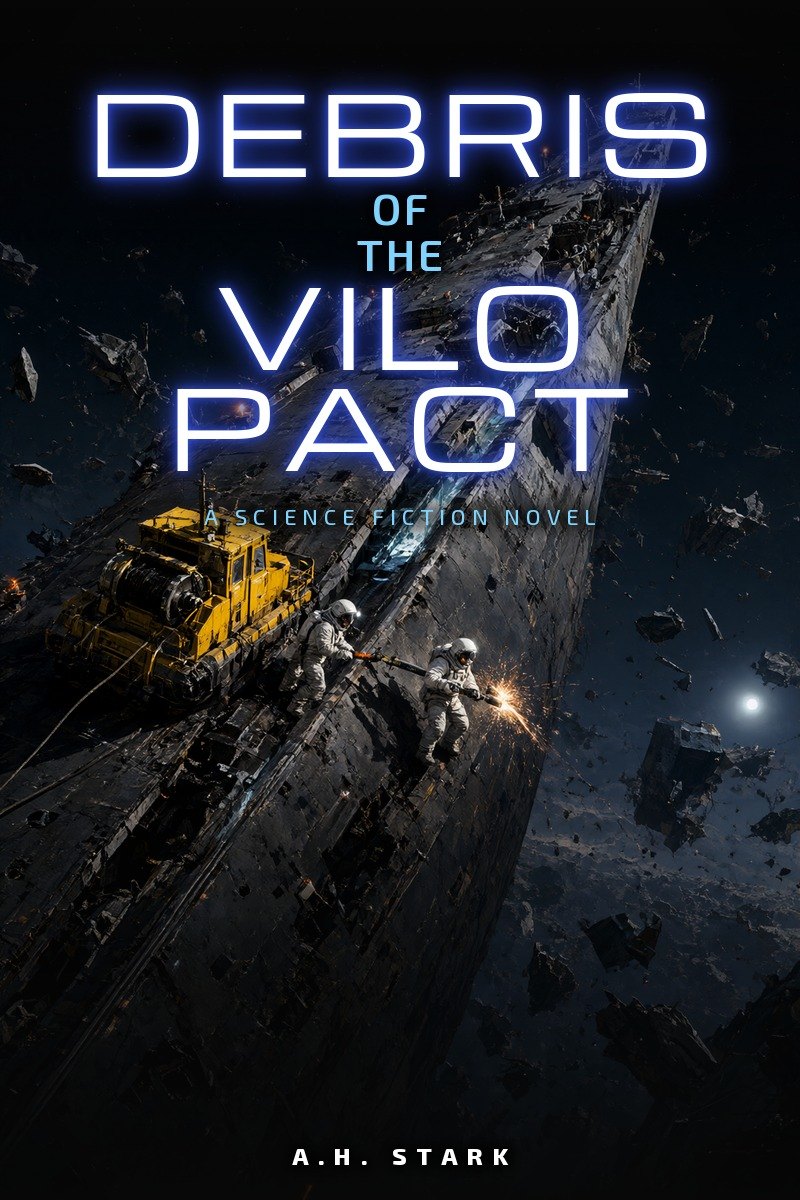
Chapter 2
The copper heat pipes behind the bulkhead had already begun to sing. It was a thin, rising whine that traveled through the soles of Kelu’s magnetic work boots, vibrating into the steel shank of his heavy environmental frame.
"Eighteen minutes," Nura said over the squad channel. She had her plasma torch unclipped from her chest rig, its braided magnetic tether trailing like a severed nerve against the frozen deck plates. "The induction coils behind the ceiling ribs are drawing thirty amps from the auxiliary capacitor banks. If you have an angle on that console, crack it now, because I have no intention of getting baked alive in a sealed pantry."
"The console is dead iron," Kelu said. He did not look back at the terminal. He knelt by the central deck grating, his thick insulated glove tracing the perimeter seam of an unpowered atmospheric exhaust riser. "The Sanitation Authority burned the logic gates into an optical chip when the Sula was built. You cannot hack a physical gate that has no write head. We don't touch the computer."
"Then what are you staring at?"
"The plumbing." Kelu unhooked his mechanical manifold gauge from his harness and tapped the heavy brass dial against the riser’s access hatch. "Compartment Four-C was designed as a heavy ordnance bay. When the automated purge triggers, the reactor doesn't pump flame down here. It pumps sixty bar of superheated ammonia through the overhead radiator grid to flash-bake every biological surface to five hundred degrees. That ammonia feeds directly from the dorsal spine."
Nura leaned over him, her tinted faceplate catching the orange warning pulses that flashed in steady three-second cycles across the reinforced bulkheads. "The dorsal spine runs along the exterior hull."
"Which puts it outside the military blast doors." Kelu slotted a hardened carbide bit into his pneumatic driver. "The quarantine program locked the pressure hatches, but it didn't weld the secondary exhaust stack. Grab your lance. Cut the four retention dogs on this riser."
Nura dropped to one knee, clicked her torch igniter, and brought the blue-white cone of pressurized plasma against the first steel dog. Brilliant white sparks sprayed in tight zero-g spirals, bouncing off their suit legs like burning hail before hardening into dark slag on the deck.
Behind them, inside the ten stasis pods, the status lights held a slow, rhythmic amber pulse. The internal thermal buffers of the pods had kicked in, circulating their internal reserves of liquid helium to fight the ambient temperature rise, but the digital readouts were already ticking downward: seventeen minutes of thermal buffer remaining. If the compartment air crossed three hundred degrees, the silicone seals would delaminate, and the hard vacuum inside would flash-boil the sleeping refugees before the heat even reached their skin.
"First dog clear," Nura grunted, dragging the torch tip across the deck to the second bolt. The sharp stench of scorched seal compound seeped through the recycling scrubbers of Kelu's helmet, sharp with chemical sulfur. "If we crawl out onto the exterior hull, we lose the umbilical to the Kaha’s secondary power."
"The Kaha is clamped to the maintenance collar forty meters aft," Kelu said, uncoupling the riser's outer hinge plate with two sharp jerks of his ratchet. "We don't need tug power. We only need to reroute the primary coolant loop before the high-pressure manifold opens."
The fourth retention bolt gave way with a wet snap of molten alloy. Kelu grabbed the rim of the round vent plate, hauled the fifty-pound disc free against the hull's faint residual magnetic pull, and sent it sliding down the dark corridor.
Below the opening lay a straight, dark shaft three feet wide, leading directly up to the exterior atmospheric dump port. The air in the compartment had already dropped to half a bar as the automated sanitation system began drawing down bay pressure before thermal sterilization.
"Tethers on," Kelu ordered, clipping his line to the interior structural rung. "Climb. Watch the sharp edges where Nura cut."
He hauled himself into the shaft first. The titanium plating was cold, but through the metal he felt the deep, rhythmic thumping of the dreadnought’s primary pumps spinning up their pre-purge cycle. The coolant was already circulating, building hydrostatic pressure behind the locked valves.
Six meters up, the shaft terminated at the exterior exhaust iris. Kelu jammed his manual pry bar into the emergency release socket, threw his full weight into the lever, and felt the frozen teeth of the mechanical latch bite into the alloy. With a dull thud that rattled through his collarbones, the outer iris parted into the black void.
The Sema graveyard opened beneath them.
The shattered remains of thirty warships drifted in a silent, jagged constellation across the starfield. Two miles away, the split hull of a heavy cruiser rotated lazily, catching the distant gleam of the system’s pale blue sun along its exposed ribbing. Directly below them, forty meters down the dreadnought's curved flank, the yellow hull of their salvage tug Kaha sat clamped to the hull like a stubborn tick, its maneuvering thrusters dark to conserve reaction mass.
"Pressure is zero on the hull," Nura said, hauling herself out of the iris and clamping her boots to the Sula’s exterior armor plates. She glanced at her wrist display. "Fourteen minutes. Where is the manifold?"
"Two ribs forward," Kelu said. "Follow the insulated trunk."
He moved across the dorsal ridge, planting each magnetic sole with deliberate, measured steps. In zero gravity, rushing was the fastest way to break an ankle or strip a tether. The Sula’s armor was pitted with micrometeorite impacts and scarred by old plasma scoring, offering dozens of handholds along the reinforced structural ribs.
Above Compartment Four-C, the dreadnought's hull swelled into a wide, raised blister. A thick bundle of conduits ran from the core casing into a distribution hub protected under an armored cowling.
Kelu unslung his tool pack, pulled two magnetic clamps from his belt, and locked his boots to either side of the housing. "Pass me the long ratchet and the diagnostic sniffer."
Nura handed him the tools, her eyes darting toward the distant horizon where the debris field thinned into open space. "Kelu. The sector patrol beacon on the high mast just flicked from standby to amber."
"That's standard protocol," Kelu muttered, fitting the socket onto the cowling’s main retaining bolt. "When a warship initiates a biological purge, it broadcasts a passive quarantine flag to warn off other fleet vessels. It’s not an active distress call yet."
"Yet," Nura repeated. "We have twelve minutes before the heat kills those pods, and if a Vilo gunboat picks up that flag, we have about twenty before they jump in and vaporize us for violating bio-containment."
"Then let's make sure there’s nothing left to purge." Kelu applied torque to the bolt. The thread groaned, rust and dry seal flaking off in a cloud of grey crystals that scattered into the vacuum. He spun the bolt out, caught it before it drifted away, and tossed it into his magnetic parts tray.
He stripped the remaining three bolts in under two minutes, levered the heavy cowling off its seat, and pushed it aside.
The primary thermal manifold lay exposed beneath.
It was a dense labyrinth of three-inch stainless steel tubing, wrapped in silver foil insulation that had yellowed with age. At the center sat a three-way distribution valve, roughly the size of a diver’s helmet, flanked by two heavy solenoid actuators and a manual override spindle. The intake pipe from the reactor was already frosting over with atmospheric condensation that instantly sublimated into vapor, while the outlet heading down toward Compartment Four-C was beginning to vibrate.
"Look at the gauge," Nura pointed her torch beam at the analog pressure wheel mounted to the manifold body. "Forty-five bar and climbing. The liquid ammonia is already heated past eighty degrees. The moment that solenoid pops, it floods the compartment."
"The solenoid won't open until the countdown hits zero," Kelu said, his fingers already examining the manual spindle. "The manual valve is a bypass. If we open it, the flow should divert away from Compartment Four-C and dump directly into Radiator Bank Three."
He pointed to a set of six long, shredded titanium radiator fins extending from the port side of the blister. They were dead, cracked during the battle that killed the dreadnought, venting straight into open space.
"If we send fifty bar of boiling coolant into a dead radiator, it vents into the vacuum," Nura realized. "The compartment stays cold."
"And the stasis pods survive." Kelu slotted his heavy box-end wrench onto the square head of the manual override spindle. "Hold my harness. I need leverage."
Nura grabbed his shoulder ring with both hands, planting her boots wide against the hull ribs. "Turn it."
Kelu braced himself and hauled on the wrench.
Nothing happened.
He leaned his full mass into the handle, muscles burning against the stiff resistance of his pressurized suit. The wrench didn't budge a millimeter.
"It's seized," Kelu ground out, his breath fogging the inner glass of his helmet.
"Hit it with the lance?" Nura asked.
"No. The casing is cast nodular iron," Kelu replied immediately, his mind calculating the thermal shock limits. "If you heat the outside while the inside is carrying cold ammonia, the housing will crack. Fifty bar of pressurized ammonia will blow this entire section off the hull, and the shrapnel will cut the stasis pod lines inside the deck."
"Ten minutes, Kelu. What else you got?"
Kelu let go of the wrench and leaned in close, inspecting the spindle collar with his suit lamp. Between the stainless steel shaft and the brass guide sleeve, a thin rim of dull reddish-gold showed through the grime.
"Cold weld," Kelu diagnosed. "The original builders used copper-faced sealing washers. Thirty years of hard vacuum and cosmic radiation stripped the oxide layers. The copper has bonded directly to the steel shaft at the molecular level."
"Can we cut the jumper line?"
"If we cut the line, we vent the whole primary loop without control," Kelu said. "The backpressure will blow the internal heat exchangers inside the hold. We have to open this valve smoothly so the pressure bleeds into the radiator fin gradually."
"Then how do you break a cold weld without heat?"
Kelu unzipped the side pouch of his harness and pulled out his acoustic resonance transducer: the handheld ultrasonic hammer he had used to loosen the seized maintenance hatch twenty minutes ago.
"Acoustic shear," Kelu said. He clicked the transducer's magnetic head onto the exposed square drive of the valve spindle. "Copper has a crystal resonance frequency around twenty-eight kilohertz. Stainless steel sits much higher, near forty-two. If I drive an ultrasonic harmonic pulse through the shaft at twenty-eight point four kilohertz, the copper atoms will vibrate faster than the steel, tearing the cold-welded junctions apart along the grain boundary."
"And if you miss the frequency?"
"Then I shatter the brass bushing and the valve stays shut forever." Kelu turned the rotary dial on the transducer, watching the digital frequency display settle: 28.40 kHz.
He thumbed the activation toggle.
A high-pitched hum shot through the wrench and traveled straight into his arm bones through his gloves. Small flakes of copper dust, shaken loose by the micro-vibrations, drifted out from the spindle seam like metallic pollen.
"Nine minutes," Nura said, her hand tight on his harness. "The intake pipe is whistling."
"Give it ten seconds to saturate the lattice," Kelu muttered, his eyes glued to the seam.
The transducer's battery indicator dropped from green to yellow, the high-frequency load drawing heavy current from the pack. Kelu felt the vibration change pitch slightly as the metal fatigue set in, shifting from a clean buzz to a rough, rasping chatter.
"Now," Kelu said.
He grabbed the torque wrench with his left hand while keeping the transducer pinned with his right. He set his feet, locked his knees against his suit frame, and wrenched downward with a sharp, violent grunt.
CLACK.
The sound traveled through the metal straight into their helmets.
The spindle jerked forward a quarter turn.
"It moved!" Nura shouted.
"Not enough," Kelu panted. He adjusted his grip, reset the wrench, and pulled again. The valve turned with a heavy, grinding groan as the torn copper fragments scraped against the brass sleeve. One full turn. Two full turns. Three.
Inside the pipe, the tone shifted.
A deep, hollow roar surged through the manifold as fifty bar of pressurized, boiling ammonia rushed past the newly opened gate. The conduit shuddered under Kelu’s boots, the hydraulic shockwave rattling the structural ribs of the dorsal spine.
Ten feet away, the torn ends of Radiator Bank Three erupted.
A massive plume of white ammonia vapor and crystal snow blasted into the vacuum of the Sema field, glittering like diamonds in the pale sunlight before dispersing into the void. The immense thrust of the venting gas imparted a faint, barely perceptible roll to the three-hundred-meter dreadnought, its hull groaning softly under the sudden lateral force.
Kelu scrambled back to the open diagnostic port on the manifold and plugged in his data pad.
The numbers flickered across the small green screen:
MANIFOLD PRESSURE: 12.4 BAR (DROPPING)
COMPARTMENT 4-C CORE TEMP: 48°C (STABILIZING)
PURGE INDUCTION LOAD: 0 kW (LOOP BYPASSED)
"Temp inside the hold is dropping," Kelu breathed, leaning back against the armored ridge as his heart hammered against his ribs. "The induction coils have nothing to draw from. The pods' internal chillers are taking over."
Nura let out a long, ragged exhale over the radio. "They're safe?"
"Compartment temperature is down to twenty Celsius and falling fast. The stasis monitors report stable vitals for all ten units." Kelu unhooked his transducer, wiped the copper dust from the casing, and slipped it back into his kit. "We bought them a lifetime."
"Don't celebrate yet," Nura said, her voice suddenly tightening.
Kelu looked up.
At the tip of the dreadnought’s primary sensor mast, fifty meters above their heads, the amber quarantine light had gone dark. In its place, a sharp, pulsing strobe of blue-white light was flashing at rapid three-second intervals.
"What is that?" Nura asked.
Kelu stared at the flashing strobe, a cold knot tightening in the pit of his stomach. He connected his pad to the mast's exterior diagnostic tap.
The screen refreshed instantly:
CRITICAL SYSTEM ANOMALY: PRIMARY COOLANT DEPRESSURIZATION DETECTED.
FAIL-SAFE 09 ENGAGED: AUTOMATED SECTOR DISTRESS BEACON ACTIVE.
TRANSMITTING TACHYON-BURST TELEMETRY TO VILO PACT AUDIT SQUADRON.
"The automated system," Kelu said quietly, his voice flat in the silence of his helmet. "It didn't just notice the purge failed. It flagged the pressure drop as intentional sabotage."
"Kelu," Nura said, grabbing his arm and pointing toward the black rim of the system's jump corridor. "How long before an audit cutter drops out of warp?"
Kelu looked down at the silent hull of the Kaha, then back at the stasis hold where ten people were sleeping beneath three feet of cold armor.
"If Ruji’s squadron is running the inner perimeter patrol," Kelu said, "we have less than an hour."

Comments
Loading comments…