Chapter 8
How much does a dead warship weigh once you burn out the ghosts?
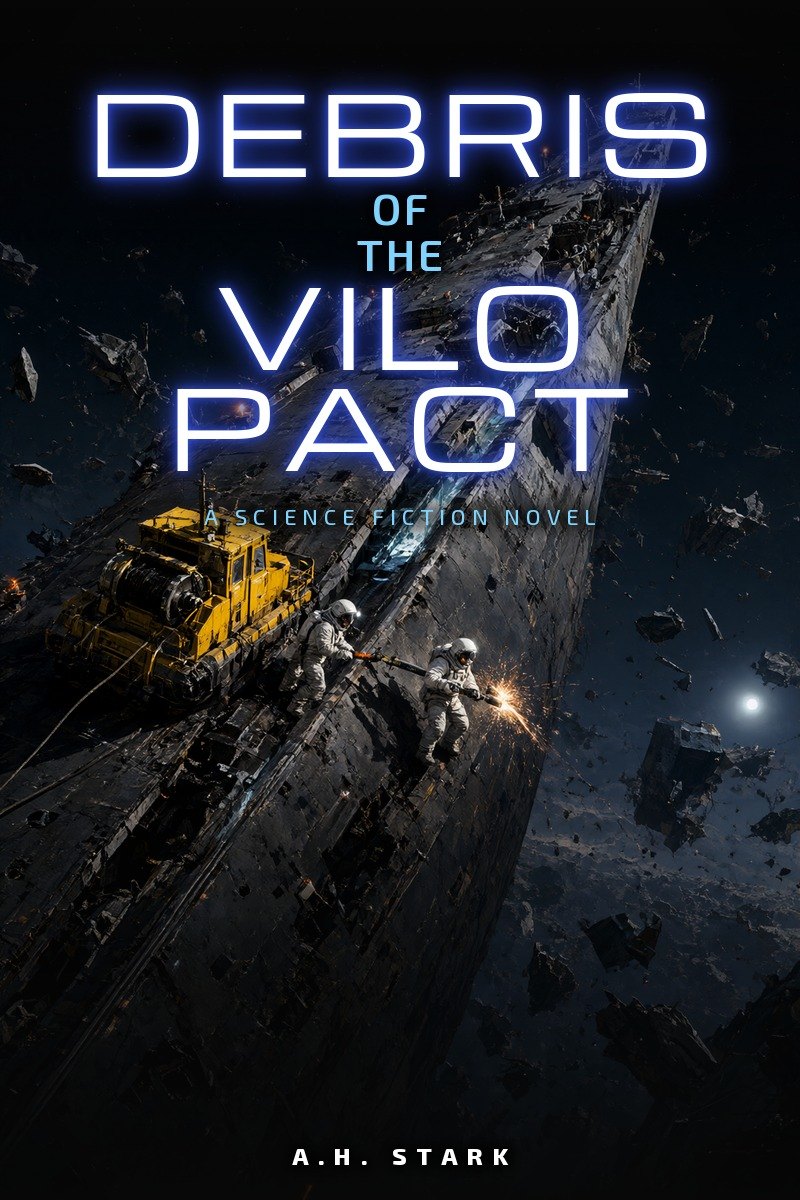
Kelu watched the digital tare scale flicker on Citadel Osta’s docking display, waiting for the numbers to settle before the automated clamp arms caught the Kaha’s forward yoke. Two hundred meters astern, the dreadnought Sula floated inside Reclamation Slip Four like a charred rib cage, venting plumes of superheated gray steam into the magnetic containment envelope. The citadel’s autonomous pre-docking thermal grid had done its work with mechanical perfection. Every square meter of internal deck plate had been scoured by twelve thousand degrees of focused plasma, turning grease, insulation, and whatever else might have been breathing in the dark into a dry, sterilized crust of carbon.
Beside him in the cockpit, Nura kept her hands flat against the environmental management board. Her fingers were gray at the knuckles, stained with hydraulic oil from the trolley winches they had stowed twenty minutes ago.
"Ballast telemetry is holding," she said, her voice dropping below the steady hum of the avionics rack. "Oxygen scrubbers in tank three are pulling three amps above baseline. If Ruji runs a direct power-tap diagnostic on the auxiliary bus, he’s going to ask why twenty square meters of lead-borated polyethylene needs forty liters of chilled air a minute."
"He won't tap the bus unless the external mass sensors throw a yellow flag," Kelu said. He adjusted the thruster trim, nudging the Kaha into the magnetic cradle until the heavy locking teeth engaged with a shudder that traveled through the deck plates into his boots. "The tare weight on our registration certificate is thirty-four tons dry. Ten people, three hundred liters of water, and ten survival kits add less than twelve hundred kilos. On an industrial hauler with six tons of borated shielding in the belly, that’s well within the slosh tolerance of our cooling slurry."
"Slosh tolerance doesn't breathe," Nura muttered.
"That's why the pumps are running," Kelu replied.
Through the forward reinforced canopy, Citadel Osta looked less like an orbital station and more like a floating foundry built out of brutalist iron slabs. It was designed for one purpose: to receive the shattered detritus of the Sema border skirmishes, boil away any biological contagion that could compromise the inner worlds of the Vilo Pact, and strip the valuable Hala cores from the scrap before feeding the remaining steel into the solar smelters.
A yellow strobe flashed on the umbilical gantry extending from the citadel’s primary audit tower. The vacuum seal hissed as the station's boarding tube mated with the Kaha’s port hatch.
The comm speaker on the central console crackled with crisp, filtered static.
"Salvage Rig Kaha, this is Port Authority Audit Control," Inspector Ruji’s voice came through, measured, calm, and utterly devoid of fatigue. "Your tow lock is verified. The derelict Sula has cleared automated pre-sterilization thermal sweep with zero detected organic anomalies. Docking collar seal is green. Stand by for physical clearance and salvage manifest reconciliation."
"Understood, Inspector," Kelu said into the pickup, letting his tone take on the rough, bored drawl of a man who had spent fourteen hours staring at exhaust temps. "We’re vented down to standard pressure. Coffee’s cold, but the logs are ready."
"I will be aboard in two minutes, Captain," Ruji said, and the line went dead.
Nura reached down, tapping the small override switch tucked beneath the cockpit deck grating. A single amber light pulsed once on the secondary monitor—a silent confirmation that the secondary ballast hold was sealed on closed-cycle air, with the manual exhaust valves locked from the inside.
"Mira knows to keep them quiet?" Kelu asked quietly.
"I gave Rian two mild sedatives for the pain in his hips, and Mira’s holding the boy’s hand," Nura said, leaning back into her harness and wiping her palms against her canvas flight trousers. "They know what happens if one of them drops a wrench against the tank wall. They’ve seen the incinerators on the approach."
"Good." Kelu unbuckled his four-point harness, rolled his shoulders until his spine popped, and stood up in the narrow gangway. "Let's go sell some ashes."
· · ·
The inner hatch of the port airlock swung inward with a mechanical groan, followed by the sharp, ozone-and-bleach scent of the citadel’s decontamination atmosphere.
Inspector Ruji stepped through first. He wore the gray, high-collared utility uniform of the Vilo Quarantine Service, crisp and unwrinkled despite the late hour, with a compact acoustic resonance scanner holstered at his hip and an audit datapad clamped to his left forearm. Behind him came two station technicians in heavy rubberized bio-containment coveralls, carrying portable fast-neutron backscatter wands and calibration canisters.
Ruji stopped at the threshold, his dark, sharp eyes taking in the clutter of the Kaha’s mid-deck: the coils of spare hydraulic hose, the racks of cutting tips, the half-eaten ration bars resting on the diagnostic bench.
"You took an unorthodox approach vector through the Pelas cluster, Captain Kelu," Ruji said, extending the datapad toward him without preamble. "Citadel traffic control logged an eighteen-minute telemetry blackout while you were in the iron core’s gravitational shadow."
Kelu took the datapad, signing his biometric hash onto the primary docking declaration with a steady thumb. "The Sula’s port stabilizer was frozen at a seven-degree pitch bias. If I’d stayed on the standard transit lane, the harmonic drag on the tow cables would have sheared our stern winch clear off the hull. I had to use the cluster’s gravity well to dampen the yaw."
"A harmonic oscillation," Ruji noted, his tone flat. He glanced toward Nura, who was leaning against the coolant manifold with a heavy torque wrench resting casually in the crook of her elbow. "And the Class-Three reconnaissance drone we deployed to verify your dorsal breach? Our logs recorded structural destruction from a collapsing ventilation gantry."
"That gantry had four tons of dead iron hanging by two rusted trunnions," Nura said, meeting Ruji's gaze with steady indifference. "Your drone flew right into the intake slipstream when the dreadnought’s internal pressure equalized. If your department wants to bill us for equipment failure on a condemned hull, go ahead and deduct it from the salvage scrip. We’re used to the tax."
Ruji’s mouth tightened into a faint, sterile line that might have been a smile on a less formal man. "The Vilo Pact does not levy arbitrary penalties, Specialist Nura. Equipment loss during hazardous salvage is covered under Ordinance 44-B, provided the wreckage yields compliant material. Let us verify that material."
He turned to the two technicians behind him. "Standard Tier-Two sweep. Check the engine room cooling loops, life support recycling filters, and primary storage holds. I will inspect the lower machinery deck and ballast manifolds myself."
Kelu felt a cold, sharp prick of focus settle behind his ribs. "The lower deck is tight quarters, Inspector. We’ve got forty barrels of recycled hydraulic fluid and dirty lead-borated cooling slurry down there."
"Quarantine protocol does not allow exemptions for cramped spaces, Captain," Ruji said mildly, unclipping the acoustic wand from his belt. "Lead-borated tanks are precisely where rogue biological vectors settle when a ship attempts to evade automated sweeps. The high density absorbs gamma and fast neutrons, making them an ideal hiding spot for contaminated organic contraband."
"Be my guest," Kelu said, stepping aside and gesturing down the narrow central ladderwell. "Watch your shins on the cross-struts. The previous owner didn't believe in ergonomic design."
· · ·
The lower machinery deck was a low-ceilinged cavern of ribbed titanium plates, thick bundles of high-voltage cabling, and the deafening, rhythmic thrum of the Kaha’s primary auxiliary cooling pumps. The air down here was thick with the bitter tang of vaporized lubricant and the dense, metallic humidity of recirculated coolant.
Ruji descended the ladder with precise, deliberate movements, his boots chiming softly against the steel rungs. Kelu followed two paces behind, keeping his hands loosely at his sides while his eyes tracked the inspector’s every motion.
At the base of the ladder stood the secondary ballast hold—a massive, rectangular housing fabricated from thick lead-borated polyethylene panels and reinforced with external steel bracing. Inside that housing, separated from the open deck by four inches of radiation-proof shielding, ten human beings were sitting shoulder-to-shoulder in the dark, breathing through rebreather masks and listening to the vibrations of the inspector's footsteps.
Ruji walked up to the face of the tank, powered on his acoustic resonance wand, and placed the sensor head against the upper weld seam.
The wand emitted a sharp, high-pitched chirp. On the device’s digital readout, a green waveform began to trace across the screen, mapping the density differential of the medium on the other side of the plating.
"This tank is registered as an auxiliary thermal damper," Ruji said over the noise of the machinery. "Filled with thirty percent borated water and seventy percent lead-granule suspension."
"That’s right," Kelu said, leaning against the adjacent auxiliary pump console. "We pump it through the reactor jacket during high-thrust burns to soak up secondary neutron scatter."
"The acoustic return is showing localized density anomalies in the lower quadrants," Ruji said, not looking up from the display. He shifted the wand ten centimeters to the left. The waveform dipped sharply, showing an irregular void where the acoustic impedance didn't match homogeneous liquid. "A slurry suspension should present a uniform attenuation profile. This looks like solid displacement."
Kelu knew exactly what the wand was reading: the physical mass of ten bodies huddled on the tank’s bottom deck, displacing the air pocket and altering the structural resonance of the steel floor.
"That's cavitation settling," Kelu said calmly. He reached out to the auxiliary pump’s control interface, his fingers resting casually on the manual bypass dial. "The lead granules have a specific gravity four times higher than the water carrier. If the circulation pump sits idle for more than twenty minutes, the granules precipitate out and cake along the bottom ribs."
"A heavy sludge layer would create a linear attenuation slope," Ruji countered, his eyes narrowing slightly as he tapped the sensor against the mid-plate. "This pattern has discrete clusters. Irregular geometries."
"Because the lower agitator jet is clogged with particulate," Kelu said.
Without waiting for Ruji’s permission, Kelu grabbed the mechanical bypass lever on the pump manifold and twisted it thirty degrees counter-clockwise.
The primary pump motor gave a sharp, grinding whine as Kelu choked the intake valve, forcing the fluid into a high-pressure bypass loop. A violent 60-hertz micro-cavitation shudder tore through the piping, vibrating the entire ballast frame. Inside the tank’s internal circulation jackets, tiny vapor bubbles formed and collapsed in millions of micro-explosions, filling the lead-borated liquid with a chaotic, roaring acoustic turbulence.
On Ruji’s scanner screen, the neat, discrete waveform shattered instantly into a jagged cloud of white noise. The acoustic return flared red across the entire display, blinding the sensor’s fine resolution.
"Watch it," Ruji snapped, stepping back as the high-pressure line bucked against its mounting brackets. "You’re over-pressuring the seals."
"Just clearing the agitator," Kelu shouted over the racket of the cavitating pump. He waited three agonizing seconds—long enough for the acoustic turbulence to homogenize the sensor’s reading, but not long enough for the pressure spike to burst the internal seal—then smoothly pulled the lever back to the neutral detent.
The grinding roar subsided into a steady, rhythmic thrum. The cavitation bubbles dispersed through the slurry line, leaving the liquid in a state of churning, frothy agitation.
Ruji reset his scanner, his jaw set in a hard, rigid line. He pressed the wand back against the plating. This time, the display showed only a broad, chaotic hash of diffuse liquid turbulence, the fine density clusters completely washed out by the residual microscopic bubbles.
"The seal integrity is barely within Vilo safety thresholds, Captain," Ruji said, lowering the wand and switching it off with a sharp snap. "Your equipment is running on deferred maintenance. If this manifold fails during a high-gee burn, the coolant loss would scram your reactor in seconds."
"That’s the salvage life, Inspector," Kelu said, letting a faint, self-deprecating grin touch his mouth. "New pump seals cost four thousand scrip a set. I’m hoping today’s payout covers the bill."
Ruji stared at him for three seconds. The inspector's gaze was cold, clinical, and completely devoid of hostility, the look of an auditor who lived in a world of pure arithmetic and had found an ugly, but mathematically valid, explanation for an anomaly.
"Let us see if your salvage warrants that sum," Ruji said.
· · ·
They returned to the upper deck, where the two technicians were already stowing their neutron wands by the airlock collar.
"Engine room and holds are clear of biological contaminants, Inspector," the senior technician reported, handing over an encrypted data chip. "Background gamma is normal. No volatile organic signatures detected."
"As expected," Ruji said. He inserted the chip into his forearm datapad, syncing the station’s automated burn report with the Kaha’s salvage claim. He gestured for Kelu to step up to the small fold-down navigation table.
Nura stood nearby, her arms crossed over her chest, watching the datapad screen like a hawk watching a field mouse.
"The dreadnought Sula was registered as an unclassified rim-sector combatant," Ruji began, his stylus moving rapidly across the glowing glass. "Gross displacement: eight hundred and forty-two thousand metric tons. Hull composition is predominantly Grade-Three titanium-vanadium armor plating, with an intact secondary power bay."
"And the Hala core?" Kelu asked. "The telemetry from our initial boarding confirmed an intact Grade-Four containment vessel in the primary engineering trench."
"The core is present and stabilized," Ruji acknowledged. "Base bounty for an unbreached Grade-Four Hala unit is twenty-eight thousand four hundred Hala scrip."
Nura let out a slow breath through her teeth. "That’s fair."
"However," Ruji continued, his voice dropping into the smooth cadence of an actuary reading an insurance exclusion, "there are mandatory deductions under the Vilo Emergency Sanitation Protocol."
"Here it comes," Nura muttered.
Ruji didn't look up from his screen. "Automated pre-sterilization thermal sweep expenditure: four thousand two hundred scrip for twenty minutes of station-directed plasma focus. Debris containment field mobilization: two thousand scrip. Hazardous atmospheric venting and slag remediation in Slip Four: three thousand eight hundred scrip."
"Three thousand eight hundred for slag?" Kelu said, raising an eyebrow. "The Sula burned clean. There wasn't an ounce of volatile resin left in those corridors."
"The thermal sweep reduced fifty tons of interior wiring and composite decking to toxic ash," Ruji replied without looking up. "That ash must be scrubbed from the docking bay’s magnetic coils before the next transport berths. The station charges standard industrial rates for magnetic filter replacement."
He tapped the screen once more, and a revised total flashed in bright white numerals at the bottom of the ledger.
"Net salvage bounty: eighteen thousand four hundred Hala scrip," Ruji announced. "Payable immediately in transferable Vilo Pact credit chits, or convertible to station fuel and reaction mass at the standard government exchange rate."
Kelu calculated the numbers in his head. Eighteen thousand four hundred scrip was less than half the core's market value on the open rim, but inside Citadel Osta’s iron grip, it was a fortune. More importantly, it came with an official clean-burn bill of health signed by a Vilo audit officer—a document that would allow the Kaha to clear the citadel’s outer picket line without being stopped by automated intercept drones.
"We’ll take ten thousand in scrip," Kelu said, "and eight thousand four hundred in liquid argon reaction mass. Two standard high-pressure canisters delivered directly to our external fuel manifold."
"Agreed," Ruji said. He tapped his seal onto the datapad, and the station's audit confirmation chimed with a clear, harmonic tone. He handed a physical encrypted credit voucher to Kelu. "Your fuel requisition has been transmitted to Bay Four’s automated loading arm. Pumping will complete in twelve minutes."
"Appreciate the efficiency, Inspector," Kelu said, tucking the voucher into the zipped pocket of his work vest.
Ruji paused at the airlock door, turning back to face the cockpit. His eyes lingered for a fraction of a second on the floor grating above the lower machinery deck.
"You are a skilled salvager, Captain Kelu," Ruji said, his voice quiet. "And a remarkably lucky engineer. To navigate the Pelas cluster, survive a catastrophic gantry collapse, and bring in an intact Hala core with failing pump seals suggests a high degree of resourcefulness."
"In this business, Inspector, you’re either resourceful or you’re scrap," Kelu said.
"Indeed," Ruji said. "Make sure you replace those pump seals before you attempt another haul in the Sema field. The next audit officer may not be as patient with acoustic anomalies."
With that, Ruji turned and stepped through the airlock. The heavy steel door sealed behind him with a pressurized thud, and the green docking indicators turned to amber as the umbilical prepared to decouple.
· · ·
The moment the airlock pressure fell to zero on the external gauge, Nura dropped her torque wrench to the deck with a loud, metallic clatter and sank down onto the copilot’s jump seat, burying her face in her grease-stained hands.
"Eighteen thousand," she whispered, her voice trembling slightly before she pulled herself upright. "We just hauled ten living people through an automated purge bay and got paid eighteen thousand scrip for the privilege."
"Keep your head on," Kelu said, though the knot in his own chest was finally starting to loosen. "We aren't clear of the citadel’s perimeter guns yet."
He moved to the environmental console, unlocking the lower ballast override. "Get down there and crack the hatch. Vent five hundred liters of fresh oxygen into the tank before they choke on their own scrubbers."
Nura nodded, slipping down the ladderwell without another word.
A minute later, Kelu heard the heavy thunk of the ballast hatch’s mechanical dogs turning. The low murmur of human voices drifted up through the floor grating—a child’s quiet whimper, an old man’s raspy cough, and Mira’s calm, steady voice reassuring them that the darkness was over.
Kelu sat in the pilot’s seat, watching the external monitors as the station’s automated fuel boom retracted from their stern manifold. The dual liquid argon tanks were full, the gauges glowing a solid, reassuring cyan.
"Citadel Control to Salvage Rig Kaha," the automated traffic dispatcher chimed through the console. "Outbound clearance confirmed. Corridor Seven is open. Maintain sub-light velocity until clearing the five-thousand-kilometer quarantine perimeter."
"Copy, Control," Kelu transmitted. "Releasing docking clamps now."
He eased the throttle back, pulsing the cold-gas thrusters to back the Kaha smoothly out of Reclamation Slip Four.
Behind them, the dreadnought Sula was already being seized by four massive automated salvage tugs, its scorched, empty hull being guided toward the glowing maw of the station’s orbital smelter. In a few hours, the last pieces of the ship that had carried ten refugees across the war zone would be melted down into unblemished structural beams for Vilo Pact outposts.
Nura climbed back up the ladder, followed closely by Mira. The young woman’s face was pale and smudged with dust, her dark hair matted with sweat, but her eyes were clear and completely focused as she looked out through the cockpit’s forward viewport at the open field of stars ahead.
"They're all breathing," Mira said simply, looking at Kelu. "Rian’s legs are stiff, but he’s sitting up. Sela and Bimo fell asleep the moment the hatch opened."
"There are ration packs and clean water in the galley locker," Kelu told her, not looking away from the navigation display. "Take what you need. We’ve got an eight-hour burn to reach the outer rim relay buoy."
Mira rested her hand on the back of the pilot’s seat. "Where do we go after the relay?"
"Beyond the pact line," Kelu said. "Where the scrap isn't audited, and people don't get turned into numbers on an incineration manifest."
· · ·
Kelu eased the throttle forward, locking the Kaha into the outbound departure corridor. The primary sub-light drives flared with a muted, steady cyan burn as the ship crossed the outer defense perimeter.
On the navigation console, a tiny, intermittent amber diagnostic ping pulsed twice against the drive telemetry. It was a faint harmonic resonance on their secondary transponder carrier—subtle enough that an automated flight control sweep would dismiss it as background noise, but unmistakable to an engineer who knew the rhythm of his own ship.
Citadel Osta’s long-range surveillance grid had tagged their reactor signature.
Kelu didn't wipe the frequency. He reached out, keyed the diagnostic monitor to passive recording, and left the outbound vector open toward the stars.

Comments
Loading comments…