Chapter 7
How do you haul ten living bodies across forty meters of open vacuum while towing an eight-hundred-thousand-ton warship through an asteroid graveyard? Kelu rested his forehead against the vibration-dampened quartz viewport of the Kaha’s aft airlock, watching the twin braided carbon-titanium tow cables stretch into the pitch black. Reeling the dreadnought in from three hundred meters down to a close forty-meter tow had cost them five precious minutes on the hydraulic winches, but it was the only way a trolley wire could span the gap without sagging into the main engine flare. The lines hummed with low-frequency mechanical violence, vibrating at sixteen cycles per second as they transferred the continuous thrust of the Kaha’s sub-light burn to the dead mass trailing behind them. If the tow tension drifted by even a tenth of a percent while a human harness hung suspended between the hulls, the lateral whip would snap a transit filament and sling the occupants into the icy drift of the Pelas Cluster. He had seventeen minutes to clear every refugee out of the Sula’s keel ballast and lock them inside the Kaha’s lead-shielded belly before their sensor blind spot disintegrated.
"Seventeen minutes and ten seconds," Nura said over the local suit channel. Her voice was flat and measured, stripped of her usual caustic bite by the unforgiving arithmetic of their approach vector. She stood beside him in the narrow airlock vestibule, slamming the secondary locking rings of her magnetic safety harness against her chest plate until the brass pawls engaged. "The iron-nickel core of Pelas is eating our thermal plume for now, but Ruji’s orbital buoys are positioned every twelve hundred kilometers along the approach corridor. The instant our dorsal plate clears the gravitational shadow, Citadel Osta’s automated arrays will paint this entire lane with high-frequency fast-neutron backscatter. We using the manual haulers or the pneumatic slide?"
"Pneumatic runner with magnetic dampening sleeves," Kelu said, checking the pressure seals on his suit wrists until the green telltales lit up on his forearm display. "Chemical thruster packs are out. The infrared burn from hydrazine or monopropellant would hang in the Pelas dust lane for half an hour. We shoot a counter-tensioned aramid guide line from our stern frame to the Sula’s forward intake collar, run a cold-gas nitrogen trolley along the wire, and pull them across in pairs."
"Cold gas means zero thermal bloom," Nura agreed, lifting her heavy pneumatic tool harness. "It also means if a nozzle freezes up mid-span, whoever is on that wire is stranded in forty meters of nothing with eighteen minutes of oxygen."
"Then we don't let the nozzles freeze," Kelu said.
He keyed the airlock depressurization sequence. The chamber pumps spun up with a deep, throaty rumble, drawing thirty cubic meters of conditioned air back into the salvage tug's storage tanks. The sound rapidly thinned, dropping through an octave of dying whistles until the atmosphere vanished entirely. The violent thrum of the ship’s engines ceased to be an audible roar and became a cold, bone-conducted vibration rising through the soles of their magnetic boots.
When the outer titanium hatch rolled aside into its recessed pocket, the immense silence of the Sema graveyard rushed in to take its place.
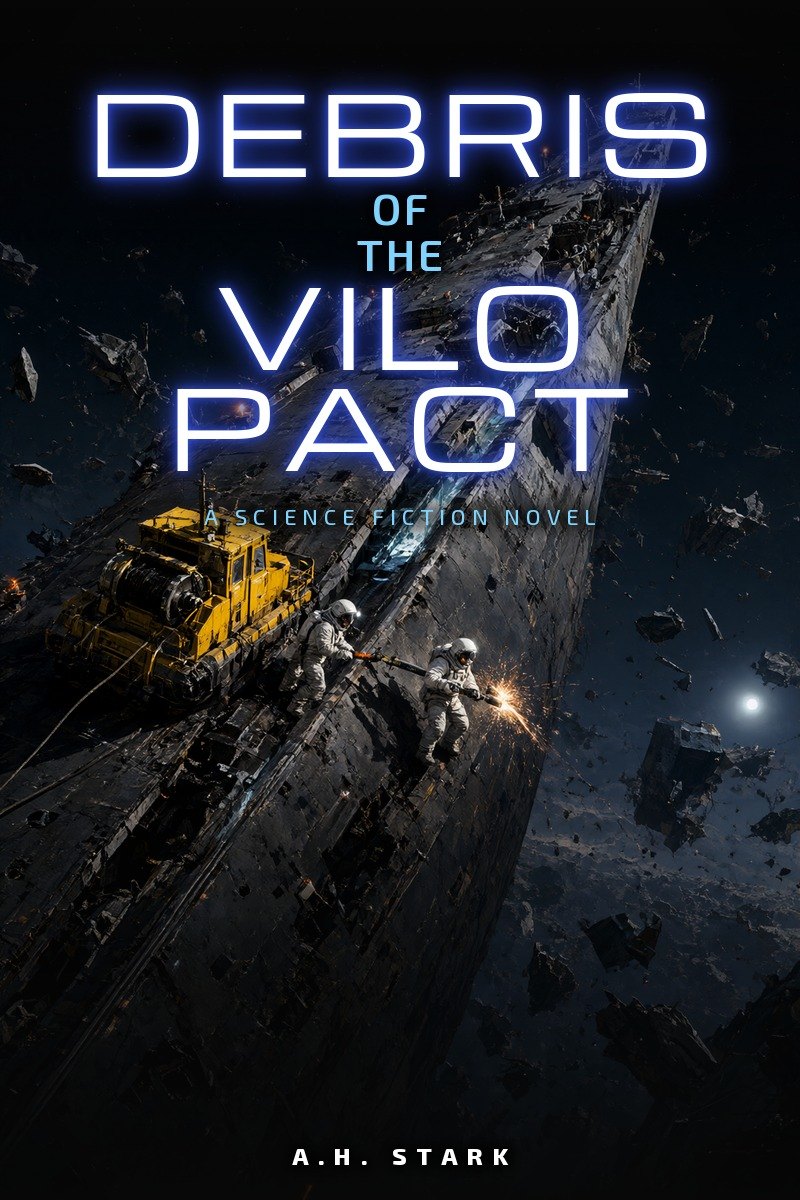
Ahead of them, dominating the black field of view, hung the dreadnought Sula. The derelict was a monstrous wedge of scorched composite armor, its eight hundred and forty-two thousand tons of unpowered deadweight drifting in perfect formation forty meters behind the Kaha’s stern. The two carbon-titanium tow lines, each as thick as a man's torso, bridged the void under staggering tension. Every micro-burst from the Kaha’s reaction control thrusters sent visible ripples through the carbon weave, traveling down the length of the cables like waves along a plucked guitar string.
Kelu unclipped his safety lanyard and stepped onto the exterior maintenance gantry. Below his boots, the tumbling iron debris of the Pelas Cluster drifted past in eerie, silent rotation. Massive iron boulders, pitted by centuries of micrometeoroid impacts, occluded the stars below, creating a temporary wall of dense mineral mass that shielded them from the automated tracking radars of Citadel Osta.
"Setting the guide anchor," Kelu said, unholstering a heavy pneumatic launcher from his right thigh bracket.
The launcher was loaded with a solid tungsten-tipped magnetic dart, coiled with five hundred meters of eight-gauge braided aramid filament. Kelu brought the optical scope to his visor, compensating for the four-degree roll bias of the Kaha’s towing attitude. The crosshairs locked onto the reinforced titanium rim of the Sula’s lower maintenance collar, situated just below the warship’s gaping primary radiator fins.
He waited for the Kaha’s gyroscopic flywheel to complete its quarterly stabilization cycle. As the floating reticle turned solid green, Kelu pulled the trigger.
The launcher kicked against his shoulder with a sharp puff of high-pressure nitrogen. The tungsten dart flashed through the darkness, trailing a gleaming white line of aramid thread. Two seconds later, the dart struck the Sula’s maintenance collar. The magnetic head engaged with a resonant clang that traveled back along the filament as a distinct mechanical tap.
"Anchor seated," Kelu reported, reading the telemetry off his wrist unit. "Tensile load holding at twelve kilonewtons. Nura, feed the carrier wire."
Nura racked a heavy steel motorized winch onto the Kaha’s reinforced stern tow bracket. She threaded the aramid line through a dual-drum capstan and slid a heavy carbon-composite trolley sleeve over the wire. "Carrier wire tensioned. Capstan motor rated for five hundred kilos at four meters per second. We can pull two adults per run without bogging down the drive."
"Let's move," Kelu said. He clipped his dual carabiners to the primary guide line, engaged his suit's nitrogen RCS pack, and stepped off the gantry into open space.
The drop across the forty-meter void was a study in controlled vertigo. Under active tow, the vacuum between the two hulls was not a static environment. The continuous forward acceleration of the Kaha pulled the universe forward, while the massive inertia of the Sula acted like an anchor dragging against the stars. Kelu kept his eyes fixed on the tungsten anchor point, his suit thrusters spitting microscopic pulses of cold gas to counter the lateral draft caused by the vibrating tow cables ten meters to his left.
He hit the Sula’s outer plating feet-first, his magnetic soles absorbing the impact before clamping securely to the pitted composite armor. He spun around, catching Nura by her utility harness as she slid down the guide wire behind him.
"Anchor is firm," Nura said, slapping the structural weld on the Sula’s collar. "Cracking the hatch."
She inserted a heavy manual ratchet into the emergency override port of the keel maintenance hatch. The titanium gears within had not turned in thirty years, their lubrication long since boiled away into vacuum. Nura braced her boots against the frame and leaned her full body weight into the lever. With a screech that vibrated through the metal into their suits, the locking dogs disengaged.
A faint cloud of frozen condensation puffed from the seal, drifting across Kelu’s faceplate like crystalline frost. Kelu pulled the heavy circular plate back, swung his legs into the darkness of the access trunk, and clicked on his helmet floodlights.
Inside the borated keel ballast tank, ten figures were huddled against the reinforced structural ribs.
The space had originally been designed to hold dense liquid slurry to shield the warship’s lower missile magazines from neutron radiation. Now, it smelled of chilled condensation, copper shavings, and the sour tang of human sweat trapped inside emergency thermal foil.
Mira was crouched near the hatch ladder, her arm wrapped tightly around young Bimo. The eight-year-old boy was trembling despite the thermal blankets, his small face pale inside an oversized emergency rebreather hood. Beside them, eleven-year-old Sela was diligently checking the oxygen valve on old Rian’s mask. The elderly rim machinist sat propped against a titanium stringer, his gnarled, grease-stained hands stiffened by the lingering effects of the rapid cryogenic thaw. The other six refugees, men and women from the outer rim settlements whose homes had been sanitized under the Vilo Pact’s pacification decree, looked up at the floodlights with hollow, exhausted eyes.
"Time is running out," Kelu said, dropping into the compartment and landing lightly in the low gravity. He lifted his outer gold visor so they could see his eyes. "We have less than fifteen minutes before Citadel Osta sweeps this sector. Everyone moves now."
"Is the other ship ready?" Mira asked, her voice crackling through the short-range acoustic patch on her rebreather. "Bimo can barely stand. His joints are locked up from the cold."
"He won't need to stand," Kelu said, unspooling two heavy nylon transit harnesses from his pack. "You’re going across on a high-speed trolley wire. It takes twelve seconds. But you must keep your limbs tucked inside the harness, keep your heads down, and do not fight the straps. If you panic and kick in the gap, the lateral wobble will bring you into contact with the main tow cables."
Nura dropped down the ladder behind him, her heavy tool kit clattering against the deck ribs. "We run the children first. Mira, you take Bimo in the front sling. Sela, you’re paired with the machinist. Double-check every buckle. If a latch pops in the vacuum, nobody is chasing you down."
Old Rian let out a dry, rattling cough behind his mask, his voice raspy with cryo-burn. "I spent forty years running gantry cranes on the Osta high docks, girl. I know how to ride a high-line. Just don't let some green tug pilot jerk the winch."
"Then keep your mouth shut and your arms tucked, old man," Nura retorted, pulling the heavy steel shoulder straps over his jacket and cinching the waist belt until the tension indicator clicked yellow. "Save the lecture for when we’re through the quarantine gate."
Kelu lifted Bimo into the front sling of the primary harness. The boy was shivering violently, his small fingers clenching into the fabric of Kelu’s insulated suit sleeve. Kelu leaned down, meeting the boy’s terrified gaze through the scratched polycarbonate of his emergency hood.
"Listen to me, Bimo," Kelu said softly. "You see that white light across the dark? That’s the Kaha’s airlock. It’s warm over there, and there’s a ration pack with real sugar paste waiting in the galley. When the winch pulls, you keep your eyes locked on that light. Don't look down at the big ship, and don't look at the cables. Just count to twelve. Can you do that?"
Bimo swallowed hard, his throat bobbing behind the clear plastic seal, and nodded once.
Mira slid into the harness behind the boy, locking her arms around his chest in a protective vise. Kelu checked the quick-release shackle, fastened the secondary safety lanyard to the cold-gas trolley sleeve, and hoisted the pair up to the hatch opening.
"Pair one on the wire," Kelu signaled over the comms. "Nura, take the guide control. I’m running the dampener remote."
Nura climbed to the outer rim of the hatch, locked the trolley onto the aramid carrier line, and engaged the pneumatic slide. "Line clear. Launching in three, two, one."
The trolley hissed out of the access housing, propelled by a sudden blast of pressurized nitrogen. Mira and Bimo shot out into the forty-meter vacuum gap, gliding along the taut aramid filament like a bead on a wire.
Kelu leaned out the hatch, tracking their trajectory with the remote control unit on his left forearm.
The crossing began smoothly. The Kaha’s illuminated airlock frame grew rapidly ahead of them. But twenty meters into the span, the Sula’s port attitude stabilizer, damaged decades ago during the rim bombardment, shifted slightly on its seized hydraulic trunnions. The sudden asymmetric drag sent a violent, low-frequency shockwave down the port carbon-titanium tow line.
The aramid guide wire, running parallel to the tow cables, caught the harmonic resonance. The trolley began to violently whip side to side, the lateral oscillations swinging Mira and Bimo directly toward the humming tow line.
"Tension spike!" Nura shouted over the comm. "The runner is oscillating at four hertz! Hit the emergency brake!"
"If I hit the brake, the dynamic snap will shear the filament!" Kelu barked back.
His fingers flew across the manual override toggles of his forearm pad. He isolated the secondary cold-gas reaction nozzle on the underside of the trolley sleeve, calculating the phase angle of the swing by eye. As the harness reached the peak of its leftward arc, two feet from the grinding carbon fibers of the tow line, Kelu pulsed the nitrogen thruster.
Pfft-pfft.
Two sharp jets of white gas blossomed in the vacuum. The reactive force punched against the oscillation, arresting the lateral momentum and shoving the harness back onto the centerline just as Bimo’s magnetic boots cleared the tow cable by less than four inches.
The trolley stabilized, shot through the remaining ten meters of wire, and slid cleanly into the Kaha’s open airlock chute.
"Pair one secured," the Kaha’s automated internal status chimed over the suit link. "Airlock atmospheric purge cycle initialized."
Kelu exhaled a breath he hadn't realized he was holding, wiping cold sweat from his eyebrows inside his helmet. "Ten minutes left on the Pelas shadow. Next pair. Sela, Rian, get to the hatch."
The eleven-year-old girl didn't hesitate. She hauled Rian up the ladder rungs with surprising strength, guiding the old machinist’s stiffened legs through the hatch collar. Her eyes were sharp, devoid of the panic that usually paralyzed passengers during emergency EVAs.
"I’ve got his oxygen line anchored to my hip ring," Sela said, looking directly at Kelu. "We’re ready."
"Good girl," Kelu said, double-locking the reinforced carabiners onto the trolley carriage. "The dampener is calibrated for the stabilizer drag now. It’s going to be a smooth run."
He engaged the pneumatic launcher. The second carriage launched into the void, its cold-gas micro-thrusters firing in rhythmic, automated pulses to cancel out the standing harmonic waves of the tow cables. Sela and Rian crossed the forty-meter void in eleven seconds flat, sliding into the Kaha’s airlock without a single shudder.
"Pair two aboard," Nura reported from the hatch lip, checking her wrist display. Her visor reflected the flashing red telemetry from their approach sensors. "We have six minutes left, Kelu. Look at the Pelas density index. It’s dropping off a cliff."
Kelu checked his suit monitor. The Pelas iron core’s gravitational wake was clearing out the surrounding dust faster than his orbital model had predicted. The protective curtain of dense particulate was thinning into wisps of faint metallic powder.
"Citadel Osta’s long-range radar will have an unobstructed optical line to our stern in four minutes," Kelu said. "We can't do single pairs. It takes forty seconds to reset the winch carriage."
"We can't put four adults on a single aramid line," Nura said. "The static sag under towing acceleration will drop the trolley right into the tow lines."
"Then we run a tandem staggered feed," Kelu said, his mind rapidly re-engineering the rigging. "We clip two trolley carriages to the wire, spaced twelve meters apart, connected by a non-elastic Spectra spacer. We launch them simultaneously with a dual pneumatic charge. Nura, you ride the second carriage to manage the tail brake. I’ll clear the ballast tank, secure the Sula’s hatch, and bring the last man across on my own harness."
Nura stared at him through her faceplate for half a second. "If the spacer breaks under dynamic tension, the rear carriage will slam into the front one at twenty kilometers an hour."
"Then keep your hand on the manual friction damper," Kelu said, already hooking five of the remaining adult refugees into the harnesses: three clustered on the forward carriage, two linked to the rear. "Move, Nura. The clock doesn't care about our tolerances."
Nura grunted, grabbed the trailing harness of the cluster, and clipped her own center ring to the rear trolley carriage. "If you get left behind on this floating scrap heap, Kelu, I’m claiming your salvage shares."
"You’d have to pay my back taxes first," Kelu shot back. "Clear the rail!"
Nura hit the dual-launch trigger.
The two carriages shot into the vacuum in tandem, linked by a taut blue Spectra line. The added mass of six adults caused the aramid guide wire to bow downward under the Kaha’s continuous sub-light acceleration, but the cold-gas dampeners fired in synchronized bursts, holding the human chain steady above the deadly hum of the main tow cables. Kelu watched them track across the void, a silent procession of spacesuits and emergency blankets glittering against the distant cold stars, until they vanished into the Kaha’s open airlock.
Kelu turned back to the dark interior of the Sula’s ballast tank.
Only one person remained: a silent, middle-aged rim mechanic whose coveralls were stained with dried reactor lubricants. The man was standing near the bottom of the ladder, his gaze fixed on the dark, cavernous bulkheads of the dreadnought’s lower deck.
"There’s nothing left to save here, friend," Kelu said gently, stepping down and clipping the man’s center harness ring directly into his own heavy-duty master carabiner. "Let's go home."
The mechanic looked at Kelu, swallowed hard, and gave a single, firm nod. "Let's go."
Kelu hauled them both up through the hatch. He reached down and yanked the Sula’s manual hatch dog until it slammed flush against the hull, sealing the empty keel compartment behind them. He clipped their dual harness to the final retrieval lanyard, armed his suit’s remaining nitrogen reserves, and triggered the high-speed winch return.
They launched into the void.
The sensation of flying across the forty-meter gap was breathtaking and terrifying. The dreadnought Sula receded behind them, an immense black monolith of dead armor and shattered history. Below them, forty meters of empty space fell away into the swirling, glittering dust lanes of the Sema field.
A sharp audio tone screamed inside Kelu’s helmet.
Warning: Sensor Occlusion Index Depleted. Direct Optical Line to Citadel Osta Established.
Active Radar Sweep Detected: Frequency 14.2 GHz.
"Kelu, burn your thrusters!" Nura’s voice screamed over the comm. "Citadel Osta’s primary search array just lit up our stern plates!"
Kelu dumped the entirety of his suit’s remaining cold nitrogen through the rear bypass valve. The sudden acceleration kicked them forward like a hammer blow. The guide wire shrieked through the trolley bearings, trailing sparks of shaved composite as they hurtled toward the Kaha.
They hit the airlock entry chute hard. Kelu absorbed the impact with his knees, his magnetic boots skidding across the ribbed deck plates before locking onto the metal.
Nura was already waiting at the threshold. She grabbed Kelu’s shoulder armor with both hands, hauled him and the refugee inside, and hit the emergency atmospheric seal with the heel of her fist.
The outer hatch slammed shut with a deafening hydraulic thud.
The airlock pumps engaged instantly, hissing as they flooded the chamber with warm, life-giving air. Nura raised her handheld plasma torch and sliced through the aramid guide line at the hull penetration port, severing the physical link to the Sula to eliminate any acoustic bridge.
"Guide wire cleared," Nura panted, lowering her visor. "Aft hull hermetically sealed. Zero pressure anomalies."
Kelu released the locking collar on his helmet, twisted it forty-five degrees, and pulled the heavy dome from his head. He took a deep, greedy breath of the Kaha’s recycled air, savoring the familiar scents of heated wire, hydraulic fluid, and ozone.
"Where are they?" Kelu asked, wiping sweat from his forehead.
"Lower deck," Nura said, stowing her torch. "Mira has them in the secondary ballast. Follow me."
They scrambled down the narrow maintenance ladder into the Kaha’s lower machinery spaces.
The secondary ballast compartment sat directly above the tug’s reinforced keel, nested between the main fuel cells and the atmospheric water reclaimers. Over the past forty-eight hours, Kelu and Nura had lined every square inch of the compartment with three inches of dense lead-borated polyethylene panels, scavenged from obsolete reactor containment bulkheads.
Inside the narrow hold, all ten refugees were seated in two tight rows on vibration-dampening foam pads. The ceiling was barely four feet high, forcing the adults to sit with their knees drawn up to their chests, but the air was warm and circulating steadily through an isolated scrubber loop.
Mira was carefully unwrapping self-heating ration blocks, handing pieces of compressed protein and warm sugar paste to Bimo and Sela. The little boy was chewing with quiet determination, his face smeared with grease, but the terror that had haunted his eyes was gone. Old Rian was resting against the lead-lined bulkhead, his breathing deep and rhythmic.
"Ten accounted for," Mira said, looking up as Kelu appeared in the hatchway. A faint, exhausted smile touched her lips. "No lost gear, no broken lines. The children are safe."
"They're safe from the vacuum," Nura muttered, though she pulled two additional emergency thermal blankets from a storage bin and tossed them over Rian’s stiff shoulders. "Now you sit tight and keep your heads down. We’re entering Citadel Osta’s inner quarantine perimeter. That means total acoustic silence. No moving around, no talking above a whisper, and absolutely no tapping on the hull frames. Their acoustic sensor nets can pick up a dropped bolt through three layers of armor."
"We worked the deep rim," Rian said softly, his voice muffled by the blanket. "We know how to keep quiet when the wolves are scanning."
Kelu reached for the heavy lead-shielded hatch cover. "The air scrubbers are running on dedicated internal batteries. You have three hours of clean oxygen in this hold. We’ll come get you the second our salvage voucher is stamped and we clear the citadel docks."
"Thank you, Captain," Mira whispered.
Kelu nodded, pulled the heavy rectangular door into its frame, and turned the center locking wheel until the mechanical deadbolts slammed into place with three distinct metallic thumps.
With the hatch secured, the biological mass of ten living humans was entirely insulated beneath three inches of neutron-absorbing polymer. To any long-range sensor sweep from Citadel Osta, the Kaha’s lower keel would register as nothing more than a solid block of dense mineral ballast used to trim the tug’s center of gravity during heavy structural towing.
"That's done," Kelu said, letting out a long sigh as he leaned back against the corridor bulkhead. "The Sula is clean."
"The Sula is cold iron," Nura said, wiping a streak of black machine grease from her nose. "Let's go face the auditor."
They climbed back to the flight deck and dropped into their respective control seats.
Through the main forward viewport, the terrifying architectural scale of Citadel Osta filled the upper half of the sky.
The Citadel was an enormous, rotating titanium ring over four kilometers in diameter, anchored permanently at the primary navigation confluence of the Sema debris field. Its outer superstructure bristled with automated kinetic railgun batteries, high-energy bio-scanning arrays, and cavernous salvage processing bays designed to dismantle capital warships. Long lanes of pulsating amber approach buoys stretched through the drifting scrap, forming a sterile, strictly monitored corridor that guided incoming salvage tugs toward the quarantine inspection berths.
On the central communications console, a high-priority data stream chimed with an automated chime.
Citadel Osta Automated Flight Director: Transponder Handshake Verified.
Vessel: Salvage Tug Kaha (Registry #77-Sema).
Towed Scrap: Derelict Dreadnought Sula (Unregistered Battlefield Asset).
Instruction: Maintain Approach Vector 04-Delta. Prepare for Automated Quarantine Ingestion.
Kelu tapped the control array to synchronize their navigational thrusters with the citadel’s tractor beacon. "Inspector Ruji’s automated audit handshake is locked on our forward antenna."
"Kelu, look at the telemetry bridge," Nura said suddenly, her voice tightening as she leaned over the starboard sensor console. "The dreadnought's internal systems just received an encrypted carrier pulse from Osta's primary perimeter relay."
Kelu shifted his display to monitor the Sula’s dormant diagnostic feeds.
Behind them, forty meters down the carbon-titanium tow lines, the dark, monolithic hull of the dreadnought began to undergo a terrifying transformation.
Across the vast expanse of the warship’s armor, rows of auxiliary emergency circuits flickered to life. Long-dead coolant pumps groaned in the deep compartments, drawing emergency reserve power directly from the citadel’s remote inductive charging beam.
Alert: Automated Protocol 01-A Engaged: Pre-Docking Biological Sanitation.
Kelu watched in silence as the Sula’s primary thermal purge grid went from zero to full output in five seconds.
Citadel Osta had never intended to send an inspection crew aboard to verify the ship's manifest. The Vilo Pact quarantine code was entirely automated: every unregistered battlefield asset towed within range of the citadel was subjected to an autonomous thermal sweep, flash-incinerating the interior compartments with superheated plasma before the hull was even allowed into the mechanical processing bays.
If the refugees had remained in Compartment 4-C, or inside the Sula’s borated keel tanks, they would have been reduced to carbonized ash before the Kaha crossed the outer perimeter line.
Kelu eased the throttle forward, locking the Kaha into the glowing amber approach corridor. Behind them, the dreadnought burned clean against the cold stars, its empty corridors scouring themselves with silent fire while the ballast hold below his boots hummed steady, shielded, and dark.

Comments
Loading comments…