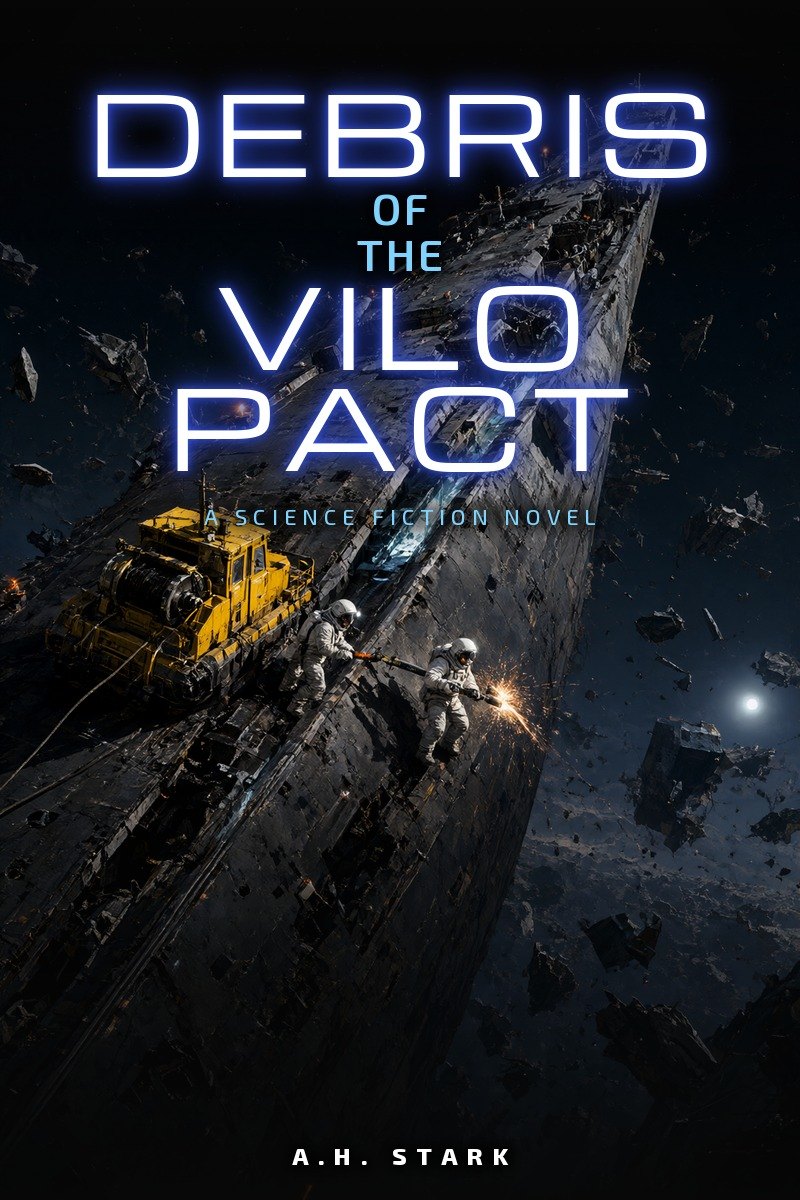
Chapter 6
How much kinetic shear could an eighty-meter salvage tug absorb before its structural spine sheared clean across the engine mountings? Kelu needed the answer to four decimal places, and he needed it before the Kaha’s primary thrusters dragged eight hundred and forty-two thousand tons of dead dreadnought into the iron-dense gravitational reef of the Pelas Cluster. He leaned over the flight console, both thumbs resting on the manual vector toggles, calculating an orbital slingshot that would drop them directly behind the cluster’s radio-opaque scrap curtain without snapping their carbon-titanium tow lines.
On the overhead status board, the tactical telemetry link with Inspector Ruji’s orbital relay array blinked in steady amber: Transit Beacon Active. Telemetry Ping: 1.40 Seconds. Course Variance Tolerance: 0.08 Degrees. Time to Citadel Osta Intercept: 11 Hours, 48 Minutes.
"If we hold Ruji’s designated approach lane, his buoys paint our dorsal plates every eighty seconds," Kelu said, his voice flat in the quiet cockpit. "When we reach Citadel Osta’s outer perimeter, their stationary neutron arrays will slice the Sula from prow to stern. The ten people in the keel tank won't last forty seconds under a military-grade bio-scan."
Nura sat in the co-pilot’s rig to his right, her magnetic boots locked into the deck stirrups, checking the tension readouts from the stern winches. Her flight suit still smelled of scorched insulation and cutting flux from her run through the dreadnought’s crawlways. "And if you pull twenty degrees port into the Pelas reef, the automated flight director at Osta flags an illegal course deviation and their automated picket launches an interceptor flight."
"Not if the deviation looks like orbital drag from an un-stabilized wreck," Kelu replied. He tapped a sequence into the thrust compensator, slaving the Kaha’s four gimbaled chemical-ion engines to an asymmetric burn profile. "Pelas is ninety thousand kilometers of pulverized armor plates, spent booster stages, and nickel-iron slag left over from the first siege. The core has enough magnetic interference to swallow high-frequency radar whole. If we whip the Sula through the inner fringe, the gravity well forces a clean communications blackout. That gives us our blind spot."
"A blind spot," Nura said dryly, squinting at the structural load curves on her monitor. "Assuming the tow cables don't pull our engines out through our teeth. Those braided carbon-titanium lines are certified for four hundred thousand tons under steady acceleration. You’re asking them to pull double their rated yield around a gravitational eddy."
"The manufacturer builds a thirty-percent safety margin into the molecular lattice," Kelu said.
"Which was written by a desk engineer sitting in an office on an orbital station, Kelu, not a cutter hanging off an engine block in a debris field."
"That’s why we don't invite the engineer." Kelu gripped the dual throttle levers, resting his palms against the worn polyurethane grips. "Clear the stern bay. Disengage the automatic winch locks. If the load spikes past ninety-five percent of tensile yield, I need the magnetic dampeners floating on manual hydraulic control."
Nura threw a heavy three-position toggle on the secondary console. A harsh mechanical clunk reverberated through the Kaha’s deck plates as the magnetic winches decoupled from the rigid hull anchors, switching over to the secondary hydraulic shock-absorption rails. "Dampeners on manual. Buffer fluid pressure is steady at sixty bar. You have thirty seconds before the primary burn window opens."
Kelu checked the forward viewport. Ahead of them, the Sema graveyard sprawled across the starfield, a vast expanse of shattered hulls and frozen particulate reflecting the pale, distant glare of the system’s primary star. Further along their flight path, the Pelas Cluster hung like a bruised knot against the void, a dense tangle of jagged wreckage orbiting a crushed super-dreadnought core that had collapsed under its own mass forty years ago.
Behind the Kaha, tethered by two three-hundred-meter lines of braided carbon-titanium fiber, the Sula loomed like a jagged black mountain. The derelict dreadnought had no active running lights, no internal power, and no reaction control thrusters to stabilize its yaw. It was eight hundred and forty-two thousand tons of cold, unyielding armor, waiting to obey the unforgiving laws of conservation of momentum.
Before committing to the burn, Kelu switched the secondary comm channel to the low-bandwidth hardline running down the port tow cable. "Mira, can you hear me?"
A burst of static crackled through his headset, followed by Mira's strained voice from deep within the Sula’s borated keel ballast tank. "We hear you, Captain. We’re lashed to the internal ribs with cargo webbing. Rian checked the seals on everyone's rebreather hoods. The children are secure."
"Keep your heads down and brace for heavy lateral g-forces," Kelu told her. "We're going into an orbital slingshot. The dreadnought is going to roll and grope against the gravity gradient. You’ll hear metal twisting outside your compartment, but the borated tank walls are sixty millimeters of solid alloy. Hold on to the webbing and don't unclip until Nura comes for you."
"Understood," Mira replied. "We trust you."
Kelu closed the channel. He took a steady breath, centering his focus on the vector needles dancing across his heads-up display.
"Initiating primary burn in five," Kelu announced. "Four. Three. Two. One. Ignition."
He eased the dual throttle levers forward.
The Kaha’s chemical-ion thrusters fired with a deep, bone-rattling rumble that bypassed the cockpit’s acoustic dampeners entirely, vibrating up through the pilot seat into Kelu’s spine. Twin streams of blue-white exhaust lanced into the vacuum, pushing against the void.
For three tense seconds, the tug accelerated forward while the tow cables unspooled from the stern winches with a high-pitched mechanical whine. Then the lines reached their maximum payout.
The kinetic shock hit the ship like a physical hammer.
The Kaha’s forward velocity violently jerked to a crawl as the slack vanished. The internal inertial compensators shrieked in protest, their magnetic coils struggling to bleed off the sudden negative acceleration. Kelu was thrown forward against his four-point harness, the nylon straps biting hard into his collarbones. Consoles rattled in their shock mounts, and loose tools in the aft locker clattered against the bulkheads.
On the central load display, the tension vector bar jumped from cool green into bright, angry crimson: Load: 780,000 kN. Yield Threshold: 82%.
"Cables holding," Nura called out over the roar of the thrusters, her fingers moving across the winch pressure regulators. "Winch reels are slipping five centimeters per second to bleed the initial snatch load. Starboard line tension is three percent higher than port. The Sula is listing two degrees to the right."
"Correcting with port attitude thrusters," Kelu said, his jaw set as he worked the rotational hand controller. He pulsed the cold-gas thrusters along the Kaha’s port bow, fighting the massive rotational inertia of the dead warship trailing behind them. "Come on, old girl. Wake up and roll."
Slowly, almost imperceptibly, the immense bulk of the Sula began to follow. The numbers on the navigation HUD shifted. Velocity crept upward: fifty meters per second, seventy-five, one hundred. But every meter of speed had to be bought with continuous, groaning thrust against the dreadnought’s dead weight.
"Telemetry ping from Ruji’s buoy," Nura reported, keeping her eyes fixed on the tactical terminal. "They registered the burn. Beacon indicates our vector is four degrees off their primary lane. Automated query incoming."
"Feed them the pre-programmed drift packet," Kelu said, not taking his eyes off the vector plots. "Tell them the Sula’s seized starboard stabilizer fin is creating an uncompensated torque bias, forcing an orbital trim correction toward Pelas."
Nura tapped out the cryptographic acknowledgment, routing the forged engine diagnostic logs through the Kaha’s communications array. A few seconds later, the incoming warning tone dropped in pitch.
"Ruji’s system bought it," she said, releasing a breath. "They logged the drift as an anomalous drag event. But the buoy’s update frequency just increased to once every forty seconds. He's keeping a tighter leash on us."
"Forty seconds is plenty," Kelu said. "Once we round the Pelas rim, the iron clutter will fragment their radar pulse into white noise."
The tug and its gargantuan tow accelerated into the outer perimeter of the Pelas Cluster.
Here, the debris field thickened dramatically. Long ribbons of shredded armor plate, twisted structural trusses, and dense clouds of millimeter-scale metallic dust drifted through the crossing orbits. The Kaha’s forward deflector grids hummed, glowing with faint static discharges as they vaporized incoming micrometeorites.
"Entering the first debris belt," Nura said, tracking the proximity radar sweep. "We’ve got a three-kilometer wide cluster of titanium hull fragments at two o’clock, relative velocity twelve meters per second. If we stay on this curve, the Sula’s port flank is going to scrape the edge of it."
"She took heavy railgun fire forty years ago; a few tons of sheet metal won't break her skin," Kelu muttered. "Watch the cable load. We’re hitting the gravitational gradient of the core remnant in sixty seconds."
The core remnant of Pelas was the crushed wreckage of three super-dreadnoughts that had collided and fused during the final battle of the Sema campaign, forming an irregular, high-density mass nearly four kilometers across. Its localized gravity well was weak compared to a planet, but in orbital mechanics, even a fraction of a milligee was enough to violently twist an unpowered tow.
As the Kaha crossed the orbital threshold, the invisible hand of the gravity gradient took hold.
The tug, being light and nimble, curved smoothly along the calculated entry vector. But the Sula, lagging three hundred meters behind with its vast mass, entered the gradient at a flatter angle. The difference in orbital velocity created an immediate, lethal shear.
The Sula began to swing outward, pulling wide of the Kaha’s flight path like a massive iron weight on the end of a sling.
"Tensile load spiking!" Nura warned, her voice sharp and rapid. "Eighty-five percent... eighty-nine... starboard winch dampener is bottoming out against the travel stops!"
A low, metallic groan reverberated through the Kaha’s hull frame, a sound of heavy structural beams being twisted past their elastic limits.
"The dreadnought is trying to drag us into a tumble," Kelu said, his hands moving with precise, deliberate speed across the thruster matrix. "The flight computer wants to throttle down to match her speed, but if we drop thrust, the cable will go slack and whip back when she catches up. The snap will rip our stern right off."
"Then what are you doing?" Nura demanded, watching the crimson line on the yield gauge push past ninety-one percent.
"We don't match her speed," Kelu said calmly. "We pull harder."
He slammed the chemical-ion throttles forward to one hundred and ten percent of rated emergency output.
The engine bay temperature alarms immediately began to chime, a steady, urgent pulse of amber light strobing across the cockpit ceiling. The Kaha surged forward, fighting the colossal centrifugal force of the swinging dreadnought.
"Tensile strain ninety-four percent!" Nura called out, her knuckles whitening as she gripped the emergency cable-severing switch. "Kelu! If that line snaps, the recoil will cut this cockpit in half!"
"Don't touch that release!" Kelu snapped. "Watch the harmonic frequency on the starboard line. What’s the oscillation rate?"
Nura glanced at the secondary acoustic sensor display. "Seven point two Hertz! It's building an amplitude wave. It's going to hit resonance in four cycles!"
When a carbon-titanium tow line enters harmonic resonance under maximum load, the standing wave creates localized points of infinite kinetic tension. The cable doesn't just stretch; it shatters into molecular dust.
Kelu didn't look at the warning lights. He visualized the vector geometry: the Kaha at the apex, the two cables forming a dynamic triangle with the Sula’s forward mooring bitts, and the iron core of Pelas pulling them into a tight orbital arc.
Instead of fighting the harmonic wave with steady thruster power, Kelu began to manually pulse the Kaha’s reaction control thrusters in counter-rhythm.
He fired the port bow thruster for a fraction of a second, waited point-four seconds, then fired the dorsal stern thruster, deliberately inducing a calculated pitch and yaw into the tug’s motion.
He was using the eighty-ton mass of the Kaha itself as a dynamic harmonic damper, pitching and yawing the tug by fractions of a degree to disrupt the standing wave before it could reach peak amplitude.
On the third cycle, the violent vibration shaking the cockpit suddenly smoothed out. The acoustic frequency on Nura's monitor dropped from seven point two Hertz down to an erratic, harmless flutter of one point five.
"Harmonic broken," Nura breathed, her eyes wide as she looked from her screen to Kelu. "Load dropping to eighty-two percent. The Sula is coming around into the gravity pocket."
Behind them, the massive silhouette of the dreadnought cleaved through the outer edge of the debris field. A cloud of jagged metal fragments struck its thick bow plating, sparking silently in the vacuum, but the ship’s momentum held true. The gravitational pull of the Pelas remnant caught the Sula’s bulk, curving its trajectory into a slingshot arc that matched the Kaha’s heading.
Together, tug and derelict swept around the dark side of the crushed core remnant.
The starfield vanished behind a towering wall of mangled armor plate, pulverized slag, and ancient docking gantries. The harsh cockpit lighting reflected off the swirling storm of iron dust outside the viewport.
On the tactical board, the amber telemetry indicator flickered once, twice, and then went completely dark.
Telemetry Signal Lost: Carrier Wave Blocked by High-Density Ferrous Obstruction.
Radar Cross-Section: Fragmented.
External Buoy Status: Out of Sight-Line.
Silence settled over the cockpit, broken only by the steady, low hum of the cooling pumps circulating liquid freon through the overheated engine blocks.
Nura leaned back into her seat, letting out a long, ragged exhale. She reached up and unclipped her helmet seal, running a gloved hand across her forehead. "I swear, one of these days you’re going to calculate a safety margin that doesn't leave five millimeters between us and a kinetic vapor cloud."
Kelu pulled back on the throttle levers, reducing engine power to a quiet, sustainable cruising drift. He unlatched his harness, rolling his shoulders to ease the ache where the straps had dug in during the turn.
"Five millimeters is five millimeters," he said, reaching down to tap the navigation timer. "We’re in the blind zone. The iron core will mask our radar and thermal emissions for exactly eighteen minutes before our orbital arc carries us out the other side of Pelas and back into Osta’s sensor grid."
"Eighteen minutes," Nura repeated, turning to face him. Her expression had hardened back into her usual practical focus. "That's our only window to get those ten people out of the Sula’s keel tank and into our shielded ballast bay before Ruji’s citadel patrol locks onto us."
Kelu brought up the internal schematics of the Kaha, highlighting the narrow maintenance conduit that connected their secondary airlock to the lower ballast storage. "The radiation liners in our ballast will hide their biological signatures from Citadel Osta’s long-range neutron arrays. But moving ten malnourished refugees across an open zero-g gap while tethered at cruising speed isn't going to be clean."
"None of this has been clean since we cracked that airlock," Nura said. She reached down, picked up her heavy cutting helmet from the deck, and racked the visor down with a decisive click. "Get your mag-boots on, Captain. The clock is running."
Kelu looked at the countdown timer ticking steadily downward on the flight console: 17 Minutes, 42 Seconds of Sensor Obscuration Remaining.
He reached for his suit gloves on the console rack and locked the wrist rings with a sharp snap. "Let's go get them."

Comments
Loading comments…