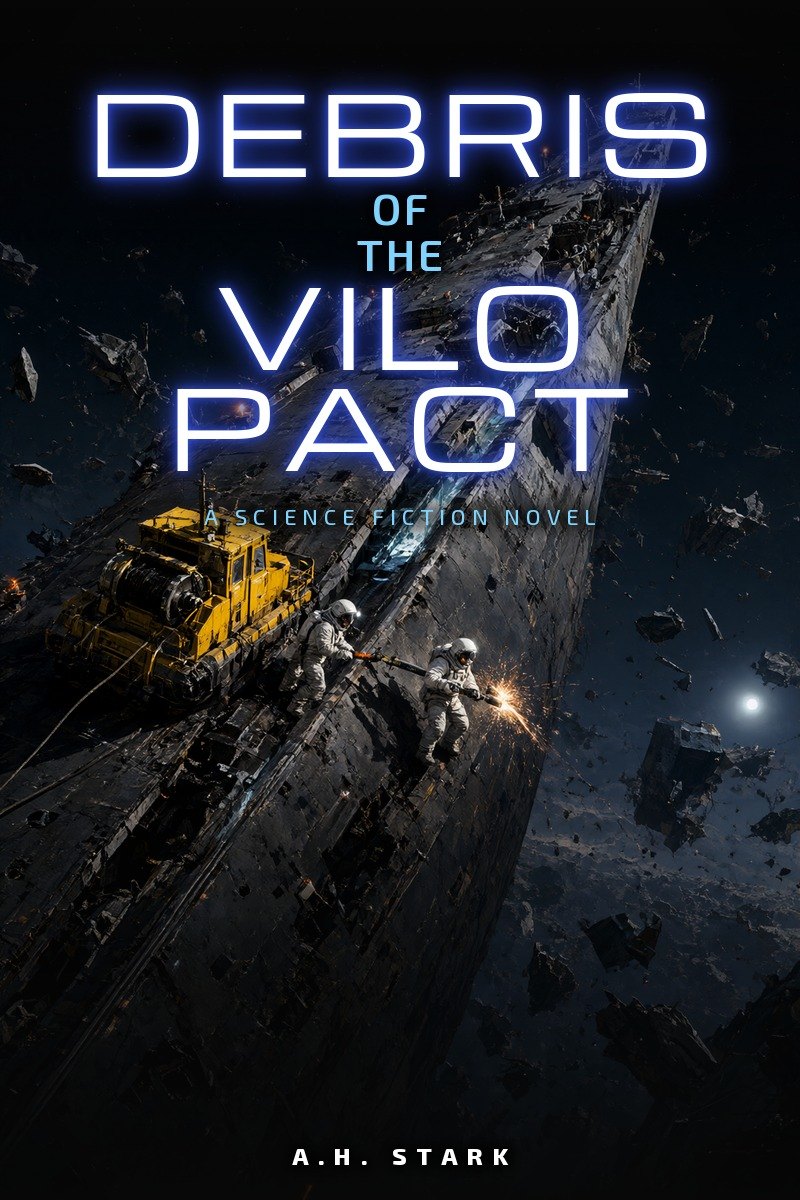
Chapter 3
The incoming telemetry ping did not wait for them to take off their helmets. It hit the Kaha’s communications array with the sharp, rhythmic snap of a high-gain military handshake, vibrating through the cockpit floorplates before Nura had even latched her boots to the deck rail.
She reached up with gloved fingers, unsealed the neck ring of her vacuum rig with a pneumatic hiss, and hauled the helmet free. The cabin smelled of burnt ozone, stale recirculated sweat, and the bitter trace of vaporized copper from Kelu’s acoustic cutter. Across the central console, the tactical monitor pulsed an amber warning square stamped with the Vilo Pact audit crest: three interlocking gear teeth enclosed in a quarantine diamond.
"They're on the sublight carrier," Nura said, dropping her helmet into the retaining net behind the pilot’s couch. Her short black hair clung to her forehead in damp spikes. "Pact Patrol Cutter Sena-7. Carrier frequency is locked to our transponder. They aren't asking if we’re here, Kelu. They know our reactor signature down to the third decimal."
Kelu drifted past her toward the secondary engineering console, unlocking his helmet and setting it on the bench, his magnetic soles clicking against the deck grating with a deliberate, maddening calm. He was still wearing his suit gloves, the heavy thermal cuffs smudged with black soot from the dreadnought’s exhaust stack.
"Ruji’s cutter was stationed at the outer beacon two hours ago," Kelu said, his eyes scanning the fast-scrolling packet headers on the display. "He picked up the Sula’s distress beacon the second my valve bypass dumped the manifold pressure. How much time on the handshake timeout?"
"Fifty-four seconds," Nura replied, her fingers already dancing over the ceramic interface keys. "If the Kaha doesn't return an automated telemetry log before the buffer empties, the system assumes our crew has suffered total biological contamination or catastrophic sabotage. Then Ruji’s automated gunnery suite queues a kinetic penetrator into the Sula’s core to sterilize the wreck."
"Fifty seconds is plenty," Kelu muttered.
"Not if you want to explain why a dead dreadnought suddenly burped four hundred bar of liquid ammonia into open space without a meteor impact," she snapped, shoving him toward the secondary bank. "Get out of my seat. You do the plumbing. I do the paperwork that keeps us out of an orbital furnace."
Nura dropped into the pilot's harness and locked the magnetic thigh braces. Her mind shifted gears, locking out the panic and dropping straight into the cold, calculated calculus of Vilo salvage regulations. She had spent five years working municipal inspection slips on the inner orbital ring before partnering with Kelu; she knew how the Pact’s audit daemons thought. They were not intelligent in the human sense. They were mathematical predators designed to flag variances in physical data.
To save the ten people sleeping in Compartment 4-C, she had to fabricate a catastrophic decompression log that looked completely accidental, mechanically plausible, and mathematically identical to a micro-meteoroid strike.
"Pulling the Sula’s raw manifold log," Kelu said from the auxiliary terminal, his voice dropping into the quiet cadence he used when things were about to blow up. "Ammonia pressure dropped from four hundred twenty bar to ambient zero in eight-point-six seconds. The thermal spike hit seventy-four degrees before the relief valve opened."
"That’s too clean," Nura said, her fingers flashing across the data-forge subroutine on her board. "A manual valve opening produces a linear pressure drop with a smooth parabolic tail. A rock strike produces an explosive fracture: a violent initial spike, acoustic shudder across the adjacent bulkheads, and an exponential pressure decay as the hole widens under shear stress. If I send Ruji the raw manifold curve, his audit filter will see a wrench turning a nut, not a hull breach."
"Can you synthesize the acoustic ringing?" Kelu asked.
"I’m doing it now," Nura said through her teeth. "Give me the vibration telemetry from your plasma lance when we punched through the exhaust riser."
She pulled the lance’s high-frequency arc log from the suit dock, routing the raw acoustic waveform into the Sula’s pressure record. On her left display, two line graphs hovered in bright green wireframe. The top line was the true event: Kelu using an acoustic resonance transducer to gently shear cold-welded copper washers off a bypass valve. The bottom line was the fiction she was carving from whole cloth: an eight-gram nickel-iron fragment striking the Sula’s dorsal hull at twenty-two kilometers per second.
She spliced the lance’s initial ignition pop into the start of the pressure drop, scaling the amplitude to match a kinetic hull puncture. Then she applied the standard dampening coefficient for the Sula’s twelve-centimeter armored bulkhead plates. The synthetic graph buckled, creating a jagged, chaotic cluster of high-frequency ripples that slowly faded into the smooth decay of venting ammonia.
"Thirty seconds on the handshake," Kelu warned. "The carrier beam is narrowing. Sena-7 is switching from broad sweep to directed interrogation."
"I need the debris trajectory," Nura said, sweat stinging the corner of her left eye. She ignored it. "If the breach was caused by an impact, the vector has to match the Sema field's orbital drift. If the angle is off by two degrees, Ruji's navigational computer will calculate that the rock came from inside our own engine plume."
"Field vector is three-one-four relative to the local ecliptic," Kelu supplied instantly, calling up the orbital tracker. "Average debris velocity is eighteen point two kilometers per second. Dense cluster passing three kilometers sunward of our starboard quarter."
"Done," Nura whispered. She locked the vector into the packet header, stamped the forged acoustic ringing onto the dreadnought’s primary telemetry block, and appended the Kaha’s standard salvage transponder token.
Her finger hovered over the transmit key for half a second.
This was where ordinary smugglers died. They treated audit logs like spoken lies, hoping the officer on the other end was lazy or corrupt. But Inspector Ruji was neither. Ruji was an auditor who believed the quarantine grid was the only thing preventing the entire sector from dissolving into necrotic plague. He didn't read reports; his automated algorithms tore them apart at the byte level.
"Sending packet," Nura said, and slammed the key.
The tactical display flashed blue as the compressed telemetry burst fired along the tight-beam link, streaking across forty thousand kilometers of empty space toward the incoming patrol cutter.
For ten agonizing seconds, the cockpit was silent except for the dull hum of the Kaha’s life support scrubbers. The timer on the central screen froze at zero-four seconds.
Then the amber quarantine diamond blinked twice and cleared to a steady, pale green.
TIER-1 AUDIT HANDSHAKE ACCEPTED.
ANOMALY CLASSIFICATION: UNINTENTIONAL STRUCTURAL FAILURE (IMPACT DECOMPRESSION).
KINETIC STERILIZATION INTERVENTION: STANDBY.
Nura let her breath out in a long, quiet hiss, her shoulders sinking back into the harness padding. "The daemon bought the acoustic decay. It logged the pressure drop as a micrometeoroid strike on the auxiliary coolant loop."
"I never doubted you for a second," Kelu said, reaching over to tap the side of her console.
"Shut up, Kelu," Nura said, her voice dry as slag. "You turned a routine core-stripping run into a capital felony, tripped an automated sector alarm, and nearly got us atomized by an orbital battery, all before lunch. If we survive this, you're giving me seventy percent of the salvage split on that Hala core."
"Sixty-five," Kelu offered with a faint grin. "I provided the moral backbone."
"Moral backbone doesn't pay for fresh reaction mass," she said.
Before Kelu could reply, the main audio channel opened with a crackle of carrier static. The green handshake icon shifted into an active audio link. A voice came through the cockpit speakers: precise, unhurried, and perfectly modulated, carrying the distinct clipped cadence of the Vilo Pact Central Directorate.
"Salvage Tug Kaha, registry Seven-Seven-Delta," the voice said. "This is Inspector Ruji, Vilo Sanitation Authority, commanding Patrol Cutter Sena-7. We have received your automated telemetry packet regarding the catastrophic decompression aboard the derelict vessel Sula."
Nura leaned forward, toggling her throat mic to transmit on the return carrier. She smoothed her voice into the flat, exhausted drawl of an underpaid contractor who had just spent six hours wrestling rusty pipe in hard vacuum.
"Copy that, Sena-7," Nura said. "This is Chief Specialist Nura, Kaha. Good to hear a friendly carrier wave out here. We were ten meters off the Sula’s dorsal hull prepping an exterior clamp when some rogue iron pebble punched through her secondary manifold. The whole cooling loop dumped in our faces. Ruined two of my optical sensors and nearly tore our umbilical."
There was a three-second transmission delay while the signal crossed the vacuum between the two ships. When Ruji spoke again, his tone had not changed in the slightest.
"A regrettable complication, Specialist Nura," Ruji said. "The Sema field has exhibited elevated kinetic drift in quadrant four over the past thirty-six hours. However, Directive Twelve of the Sanitation Protocol requires an immediate verification of any containment breach involving vessels of capital tonnage."
Nura’s fingers tightened on the edge of the control yoke. "Inspector, the breach was purely mechanical. The primary coolant line suffered structural rupture. There was no atmospheric loss from the pressurized living quarters."
"The automated sensor grid on the Sula was designed fifty years ago," Ruji replied calmly. "Its logic pathways are optical and unmodifiable, but its physical sensors degrade under prolonged cosmic radiation. A sudden pressure collapse in the primary thermal loop can mask a secondary atmospheric vent from adjacent compartments. If any biological residue from the pacification era has been exposed to vacuum or thermal agitation, the local debris stream must be declared a Class-4 biohazard zone."
Kelu stepped close to Nura’s shoulder, keeping his eyes glued to the long-range sensor sweep. On the edge of the system map, forty thousand kilometers out, the glowing blue icon of the Sena-7 was altering its vector, decelerating along a standard intercept trajectory.
"Inspector," Nura said, keeping her tone strictly procedural, "our salvage permit for the Sula expires in eighteen hours. We’ve already spent four tons of propellant anchoring our tug to the dorsal spine. If you declare a biohazard perimeter, our claim gets impounded and we take a total loss on the expedition."
"The economic viability of your salvage run is not within my operational mandate, Specialist Nura," Ruji said. His voice was entirely devoid of malice, which only made it more terrifying. "Systemic biosecurity is. If an unregistered organic vector is present aboard that dreadnought, it cannot be permitted to drift into the commercial shipping lanes."
"There are no organics aboard," Nura said firmly. "The ship is a block of frozen iron."
"That is what your forged log suggests," Ruji said.
Nura's pulse jumped into her throat. She kept her hand rock-steady on the panel, refusing to let the sudden spike of adrenaline shake her grip. Beside her, Kelu's jaw set, his gaze hardening as he reached toward the manual throttle release.
"Forged, Inspector?" Nura asked, letting a sharp edge of indignation bleed into her words. "That data packet came directly off our transponder link. If you're accusing my crew of falsifying flight records, cite the specific treaty clause or let us clear our salvage lines."
"I make no formal accusation, Specialist," Ruji replied smoothly after the brief delay. "Your acoustic resonance model is remarkably elegant. The dampening curve matches an eight-gram nickel-iron fragment to within point zero four percent of theoretical standard. In fact, it matches the textbook simulation from the Naval Engineering Manual so precisely that my secondary analysis subroutines flagged it for mathematical symmetry. Real debris impacts in the Sema field rarely exhibit such pristine adherence to theory."
Nura stared at the waveform on her screen. She had cleaned the noise too well. In her effort to ensure the automated audit daemon wouldn't find a single anomaly, she had made the data look like a laboratory demonstration.
"The Sema field is full of anomalies, Inspector," Nura countered, her mind racing through the treaty bylaws. "Under Article Fourteen-B of the Debris Accord, an operator's telemetry log is considered legally binding until physical counter-evidence is established. You cannot issue a kinetic purge without on-site confirmation."
"You are entirely correct, Specialist Nura," Ruji said. "I have no intention of firing a kinetic penetrator at a registered salvage vessel without empirical verification. The Vilo Pact values procedural integrity above all things."
A faint chime sounded on the Kaha’s tactical board.
"I have just deployed a Class-Three autonomous reconnaissance probe from our forward launch tube," Ruji continued. "It is equipped with wide-spectrum optical sensors, neutron scanners, and an active atmospheric sniffer. The probe will arrive at your coordinates in forty-two minutes."
Nura looked at the intercept vector spreading across her navigational map. A small, high-acceleration beacon had detached from the Sena-7, burning hard on a direct path toward the Sula.
"The probe will execute a thorough exterior scan of the breach," Ruji said. "It will insert its optical snake into the ruptured manifold to visually verify the shear pattern of the torn metal, and it will run a neutron sweep across the adjacent bulkheads to confirm zero biological signatures within a fifty-meter radius of the incident. If the physical damage matches your telemetry, I will personally validate your salvage claim and withdraw my cutter."
"And if it doesn't?" Nura asked.
"If the probe detects manual tool markings on the bypass valve, or if its neutron scan discovers living tissue hiding behind the thermal bulkheads," Ruji said, his tone as pleasant and neutral as a weather broadcast, "the probe will automatically paint the Sula with an active targeting laser. At that moment, Sena-7 will deploy three high-yield kinetic warheads to sterilize the derelict and all vessels docked within its exclusion zone."
The comms channel clicked. The carrier wave dropped back to passive standby, leaving only the steady, low hum of the Kaha’s cooling fans.
Nura sat back in the chair, her knuckles aching where she had gripped the edge of the console.
"Forty-two minutes," she said, looking up at Kelu.
"Forty-two minutes," Kelu repeated, looking down at the red trajectory line extending from the launched probe directly toward their position.
"A Class-Three probe has active neutron sensors," Nura said, her cynical veneer dropping away to reveal the sharp, focused technician beneath. "A neutron sweep cuts right through standard dreadnought hull plating. Compartment 4-C is less than thirty meters from the dorsal manifold. The moment that probe pulls up alongside the radiator fins, it will see the metabolic signatures of ten living human bodies inside those stasis pods like lanterns in a coal cellar."
"Then we have forty-two minutes to make those lanterns invisible," Kelu said, reaching for his helmet.
"And you have to make that sheared valve look like it got hit by an eight-gram meteor," Nura added, unbuckling her harness and grabbing her plasma lance from the rack. "Because if that optical snake sees your clean resonance cut on the copper washers, we won't even live long enough to argue the fine points of Article Fourteen."
She shoved her boots back into the magnetic boots and sealed her helmet collar. The pneumatic lock snapped shut with a hard, final click.
They had beaten the automated audit. They had stopped the orbital guns from firing blindly into the dark. But the real test was forty thousand kilometers out, burning toward them at nearly sixteen kilometers a second, carrying cold lenses, neutron beams, and the absolute authority of the law.
Nura stepped into the airlock, checked the charge on her cutting rig, and looked back at Kelu.
"Let's go wreck a dreadnought," she said.

Comments
Loading comments…